





























In the garden, hazels offer their innumerable pendulous aments, before the willows enter the dance with their silky inflorescences... The season of aments is upon us! Yellow, purple, silver... they are very decorative and spectacular in the setting sun. I invite you to discover some of these catkin-bearing shrubs, some very well known, others much less so.
1. Hazels
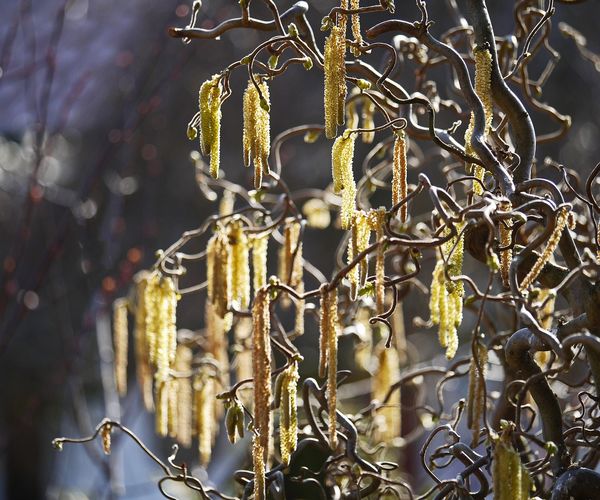
The hazel aments are highlighted by the sunlight. Here: Corylus avellana 'Contorta'.
At the moment, hazels are dressed in their finest green-yellow or reddish aments depending on the species.
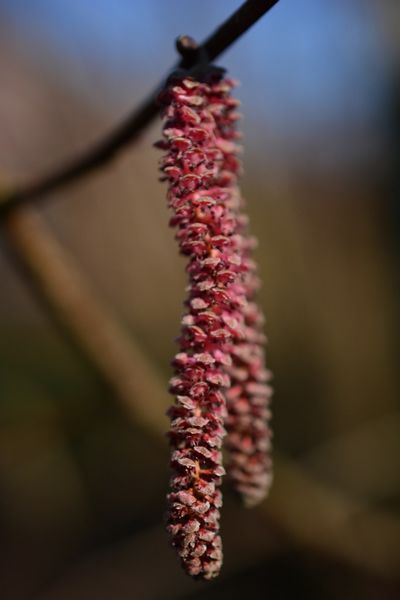
The purple aments of Corylus maxima 'Red Majestic'.
This hazel with sinuous branches has the remarkable feature of spring foliage that is vividly purple and reddish aments of the finest effect! It can perfectly be included in an informal hedge. Its only fault (if there is one) is that it does not stay purple all season, but you should know that it makes up for it with its autumn colours.
2. Willows
They are undoubtedly my favourites when it comes to aments! To begin with, their early flowering provides pollen and nectar in abundance as winter ends. Bees buzz with happiness! Next, their silky aments are really beautiful and photogenic. Finally, willows thrive in my damp soil, which is a considerable advantage. I always advise my customers to favour plants suited to their garden! It saves many disappointments...
- Salix caprea
How can one talk about aments without mentioning the famous goat willow? It is the very first to flower!
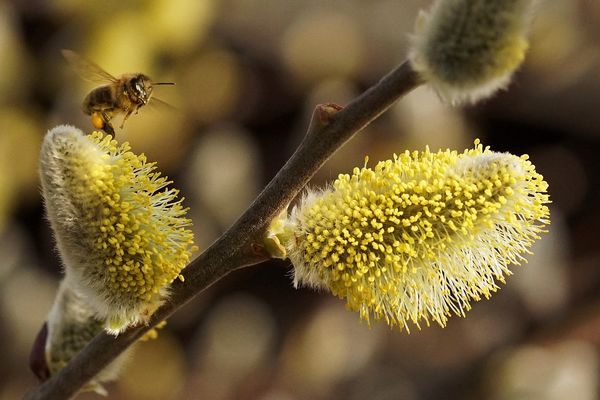
Bees delight in foraging the willows' aments (Salix caprea).
The variety 'Kilmarnock' with trailing branches becomes adorned with large silver aments in February–March.
It is also known as the willow "Wolf's Claw" and is really easy to grow. My specimen, derived from a cutting a gardening friend gave me, is now several years old. It is a handsome shrub about 3 m tall which I prune to keep a transparent habit so that a few sunbeams reach the plants at its base. Each year, in March, I photograph its incredible black aments with reddish anthers heavily visited by foragers.
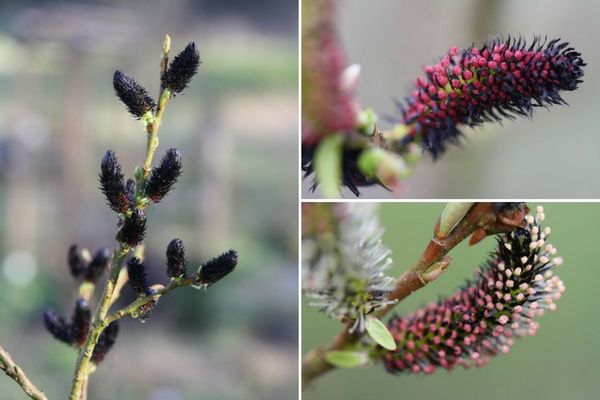
The distinctive black aments of Salix gracilistyla (Melanostachys).
- Salix chaenomeloides 'Mount Aso'
It flowers a little later than the other willows since its catkins appear in March–April. This willow offers fabulous dark pink aments that are the talk of bouquets. It has a rightful place in a hedge, but I find its beauty is better showcased when planted as a standalone specimen, positioned so that the sun’s rays rising or setting illuminate the catkins.
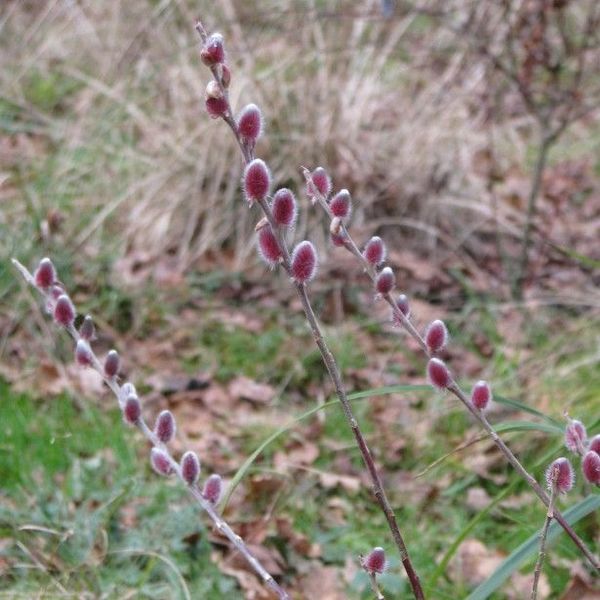
The softness of the pink aments of Salix chaenomeloides 'Mount Aso'.
3. Garrya elliptica
Little known, the Garrya elliptica features long grey-silvery aments shaded with pink that stand out well from its evergreen foliage, in February–March.
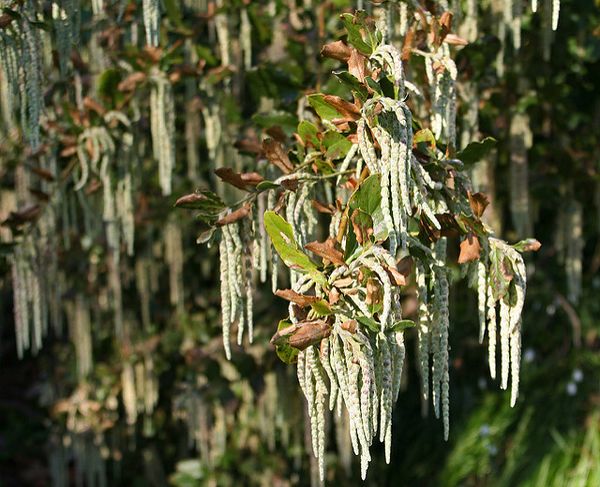
Garry Elliptica (Photo Andy Andrew Fogg on Flickr)
Michael once dedicated a post to it: "The Garrya elliptica, a flowering shrub in winter." Ten years ago, I would probably have said that my climate wouldn’t suit it given its somewhat borderline hardiness (-12°C) for the Ardennes. Today, given that we hardly have proper winters any more, I could probably give it a go. But first, I’d need to find it a well-drained spot, which isn’t easy! In short, I’d be tempted to train it against a wall... Now to find a wall still available!
4. Stachyurus praecox
Even more obscure, Stachyurus praecox also releases long strings of pale yellow beads in March–April. I still remember the first time I discovered this wonder. It was in the exquisite book by Princess Sturdza, "A Garden for All Seasons".
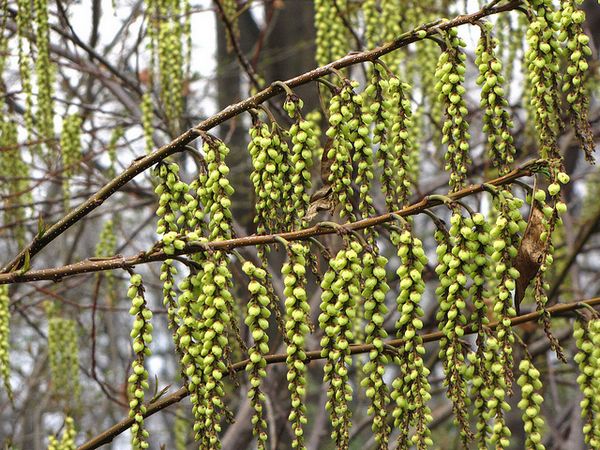
Stachyurus praecox (photo Katja Schulz on Flickr)
The variety 'Celina' offers charming cream-white bells in March.
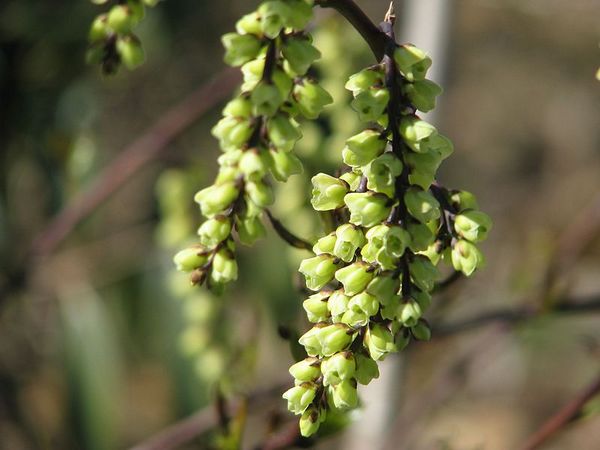
Inflorescences of Stachyurus chinensis 'Celina' (photo Peganum on Flickr).
The housing crisis is looming! I’ll have to push the garden's boundaries to plant all my desires... But I imagine that’s the concern of all garden enthusiasts!

Comments