





























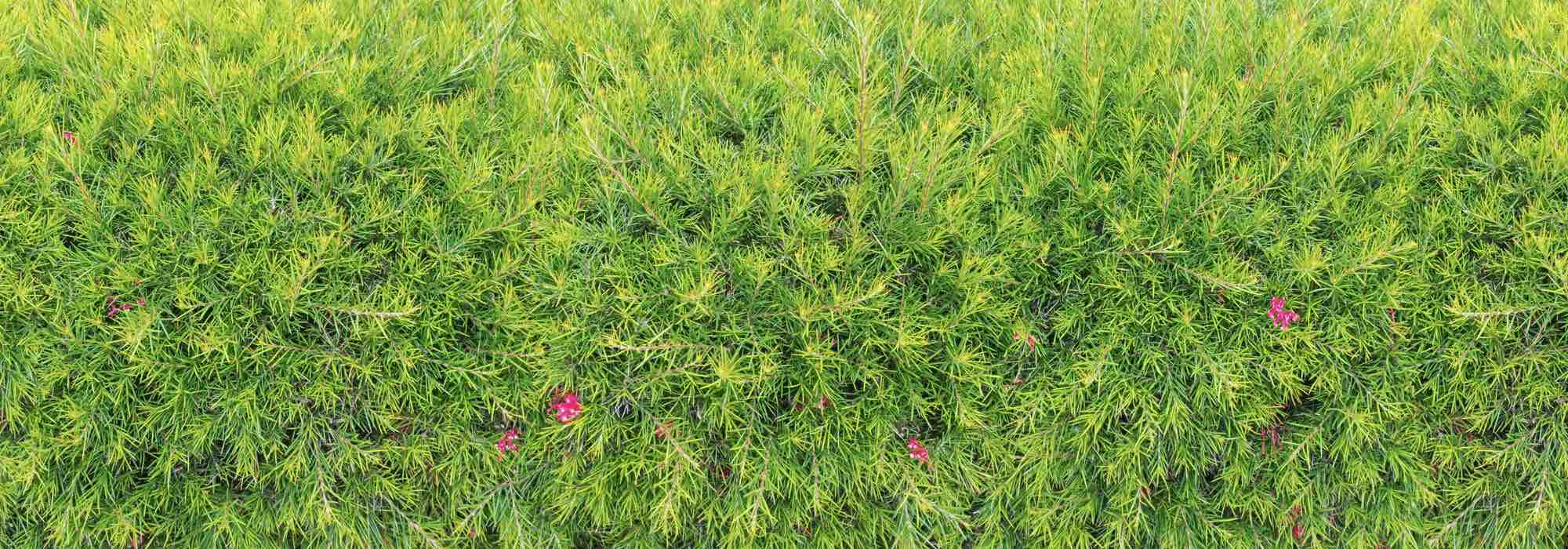
5 Grevilleas for a Hedge
Ideal varieties for defining a space, creating a screen or a windbreak in the garden
Contents
We particularly love Grevillea for their decorative evergreen foliage in all seasons, but also for their often somewhat unruly flowering, which has a hint of the exotic. The species exhibit a great diversity of sizes, shapes, flowering periods, and foliage forms.
Native to Australia, these bushes or small trees thrive in a mild, sunny climate protected from severe frosts, due to their medium hardiness.
Grevillea can be grown in pots, in borders, or in rockeries. They are also excellent candidates for hedge design, whether to shield from prying eyes, to structure an area, or to protect from the wind. Here are our 5 favourite species for creating a beautiful, sustainable green screen.

Grevillea rosmarinifolia: for a hardy hedge with spring flowering
The Grevillea rosmarinifolia is the hardiest of the genus, capable of withstanding occasional frosts down to -15°C, provided it is grown in perfectly drained soil (which does not become waterlogged in winter). This tolerance allows it to be cultivated to form a hedge in many of our regions.
This bush quickly reaches about 2 metres in height and the same in spread, making it suitable for creating a fairly tall hedge. Its bushy, bristly silhouette provides a dense and obscuring effect.
More modest and less hardy (withstanding down to -10°C), the cultivar ‘Clearview David’ adapts well to smaller spaces, with its balanced silhouette reaching 1.5 metres in all directions. In a sheltered position on a balcony or terrace, it can easily be grown in a pot to create a green barrier.
The Grevillea rosmarinifolia gets its name from the needle-like shape of its leaves, reminiscent of those of rosemary. It is one of the first shrubs to bloom at the end of winter: from February onwards, continuously, sometimes until mid-spring, it reveals its explosive flowering. The 5 cm flowers, which lack petals, consist of long, curved stamens, giving them a spider-like appearance. They display a vibrant raspberry red that does not go unnoticed in the garden.
Resistant to drought and diseases, it is an easy-going shrub. Provide it with a sunny location in light, even poor, soil. The substrate should be rather acidic or neutral, but must be free of lime.
For example, plant it alongside a Callistemon, which shares the same origins as our Grevillea and enjoys the same growing conditions. Its stunning bottlebrush flowers will take over in summer, providing a flowering hedge for many months. In mild but wetter climates, also consider Camellia sasanqua (‘Kanjiro’, ‘Choji Guruma’), which also prefer rather acidic soils and will precede the flowering of the Grevillea. Add the dense and vibrant foliage of a Griselinia littoralis.
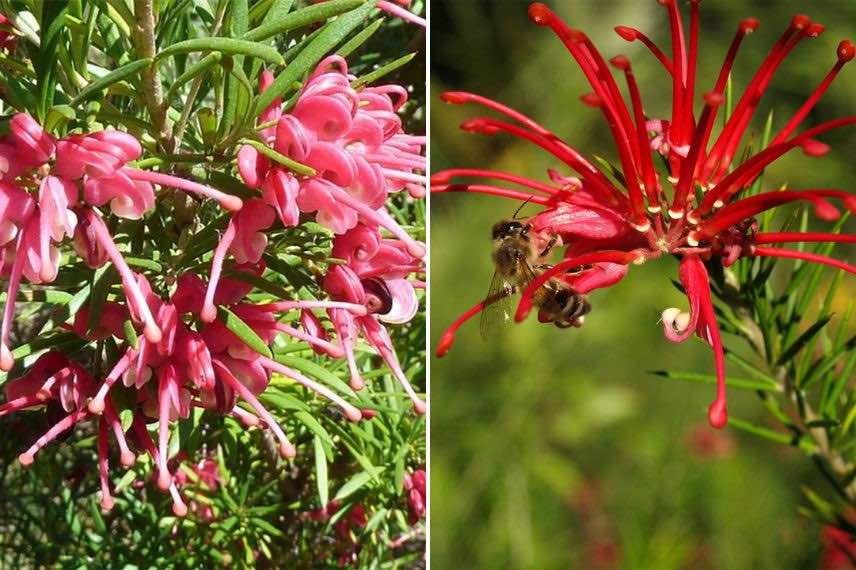
Grevillea rosmarinifolia and the cultivar ‘Clearview David’
Read also
Grevillea: planting, pruning and careGrevillea johnsonii: for a free and wild hedge in coastal climate
The Grevillea johnsonii offers the same qualities as its relatives. It features a decorative evergreen foliage all year round, consisting of fine green needles reminiscent of those of pines.
Its generous flowering begins at the end of winter and can last until early summer, renewing itself almost without interruption. It comprises astonishing light red or bright pink flowers that curl in on themselves like snail shells. These are accompanied by long, colourful pistils. Nectariferous, this flowering inevitably attracts valuable pollinating insects to the garden.
In just 3 to 4 years, it reaches a height of about 3 metres with a spread of 2 metres, allowing for the rapid formation of a tall hedge that can grow freely without requiring careful pruning. Its bushy silhouette thus provides a perfect green screen.
Its hardiness, limited to around -10°C, makes it more suitable for the mild coastal regions by the sea or ocean, especially as it withstands sea spray well. To flower well, Grevillea johnsonii needs full sun in an open position. It is quite capable of enduring summer drought, making it a good candidate for Mediterranean gardens.
Pair it with a evergreen ceanothus, preferably in white or pink tones (Ceanothus thyrsiflorus ‘Millerton Point’, for example), to create a lovely harmony with the flowering of our Grevillea. Also consider the Pittosporum tobira, an iconic evergreen bush for coastal or Mediterranean hedges. For a defensive hedge, think instead of the firethorn Pyracantha ‘Teton’, with its pure white flowers in late spring and attractive decorative fruits.
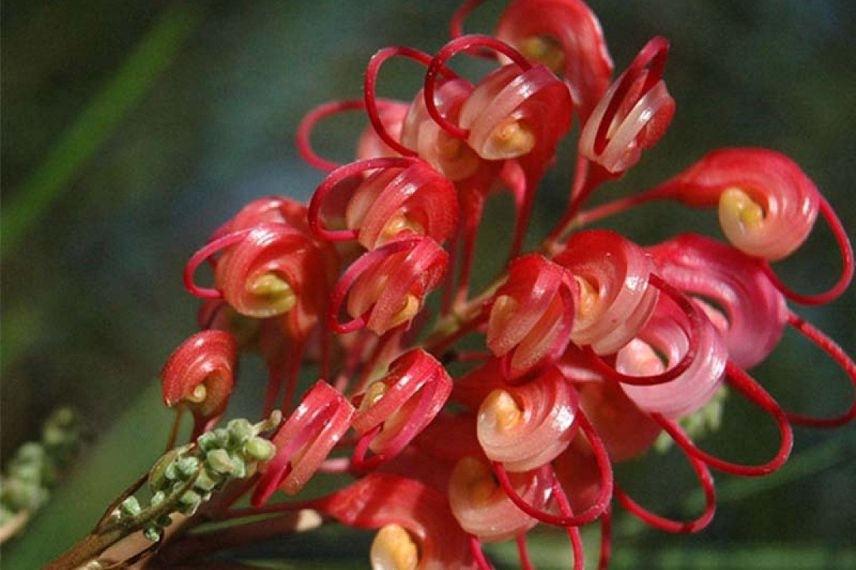
Grevillea johnsonii
Grevillea juniperina: a reliable choice that flowers from winter onwards
The Grevillea juniperina or Juniper-leaved Grevillea is certainly one of the most popular species in the genus, alongside the large Grevillea robusta. It is recognisable by its bright green foliage, consisting of fine, needle-like leaves, similar to those of juniper. This evergreen bush forms a generous, bushy habit of 2 metres in all directions.
Its early flowering occurs as soon as winter in mild climates, but rather in spring in cooler regions. It can then continue for many months until summer. The flowers, a dazzling bright red, are gathered in clusters. Lacking petals, they consist of petaloid styles that curl in on themselves, revealing long, upright stamens. Their shape can resemble that of a spider, giving them an uncommon charm.
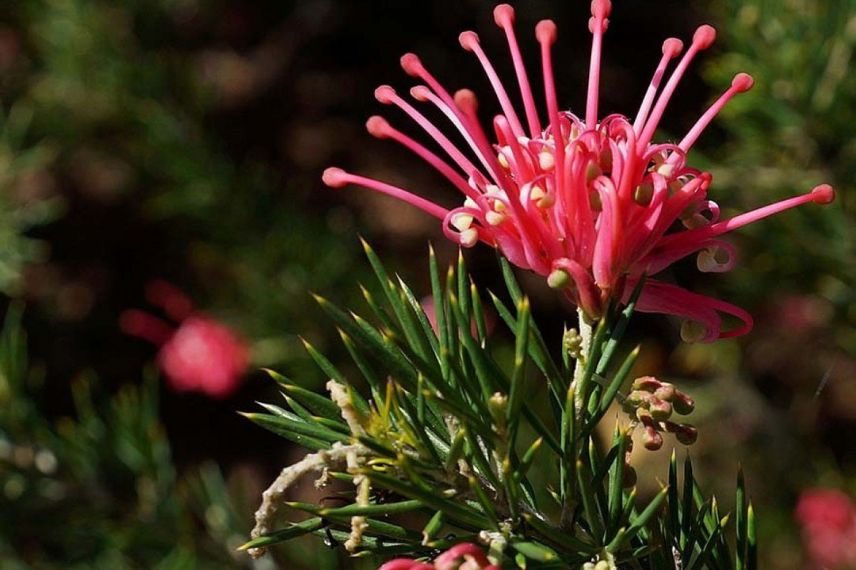
Grevillea juniperina
Like all Grevilleas, this species is easy to cultivate. It requires only a sunny position and light, well-draining soil to prevent water from stagnating. Due to its average hardiness (-10 to -12°C maximum), it can be grown in a pot and used as a temporary hedge during the warmer months, allowing light to filter through in winter.
Our bush is resistant to both diseases and drought. In a dry garden where it will undoubtedly find its place, accompany it with brooms in shades of pink or red (Cytisus scoparius ‘Burkwoodii’, ‘Roter Favorit’ or ‘Boskoop Ruby’), with a common myrtle that will take over the flowering in summer or with an Elaeagnus ebbingei with very ornamental foliage. Also consider Pistacia lentiscus, a beautiful bush that can even withstand scorching sun. While its spring flowering is rather insignificant, the female plants that are pollinated become covered in very decorative red fruits, which remain in place until winter.
Grevillea rhyolitica: a large-leaved species that is more frost-sensitive but generous
The Grevillea rhyolitica is also known as Grevillea deua. It has the unique feature of displaying lanceolate leaves, which are less common in the genus. Its large, broad, ovate leaves are pointed at the tips and have a matte appearance. They remain in place throughout the year.
Incredibly floriferous, this bush flowers from February to September, or even all year round if the climate is mild enough. Not very hardy, it will not withstand frosts above -5°C, which limits its cultivation in open ground to a few privileged regions. Its tubular flowers showcase a bright coral red, further enhancing the exotic appearance of the plant. Melliferous, they delight pollinating insects.
In terms of shape, our Grevillea will quickly reach 2 metres in all directions and will be quite compact. This will allow it to be easily grown in pots in less clement regions.
Like its relatives, it will require a sunny exposure, in light, well-draining soil, even if poor. To create an exotic-looking hedge, pair it with a oleander, whose flowering colours of pink, red, salmon, or even white will beautifully complement its own. Add a Euphorbia mellifera, a perennial evergreen resembling a bush, as well as a very architectural Melianthus major. For a touch of originality, place a Protea with its incredible colourful flowering nearby.
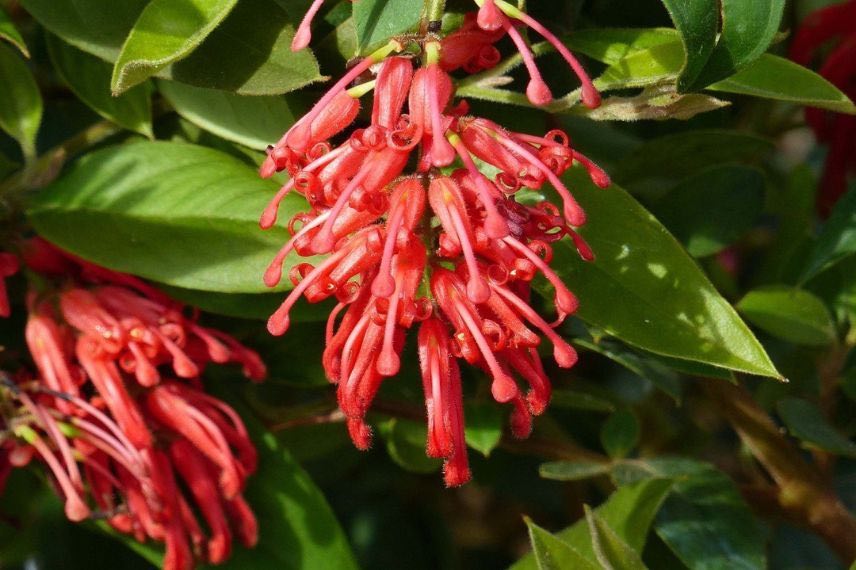
Grevillea rhyolitica
Grevillea gracilis ‘Clearview David’: for a modest yet effective hedge
The Grevillea gracilis ‘Clearview David’ reaches 1.5 metres in all directions, making it suitable for creating low hedges that are sufficient to define a space. This bushy shrub features again needle-like leaves, reminiscent of those of rosemary. They are a lovely dark green and remain decorative all year round.
Our shrub will reach its final size quite quickly, within 3 to 4 years. It will then form a beautiful dense and bushy mass.
Generous in flowers, it will adorn the garden for many months, from late winter to early summer. Its scarlet red flowers easily bring dynamism and exoticism.
Almost maintenance-free and always easy-going, this Grevillea will only fear heavy soils (clay, wet), limestone, and severe frosts. Its hardiness is limited to -8°C to -10°C at most, provided it is grown in perfectly drained soil. In a heather soil hedge, you can accompany it with Erica canaliculata, whose pink flowers brighten the short winter days, or with Erica mediterranea.
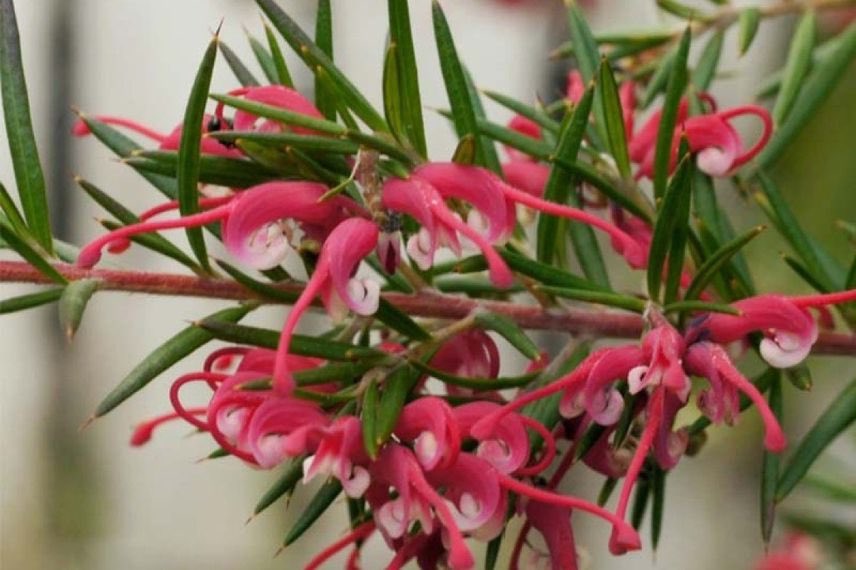
Grevillea gracilis ‘Clearview David’
- Subscribe!
- Contents
Comments