





























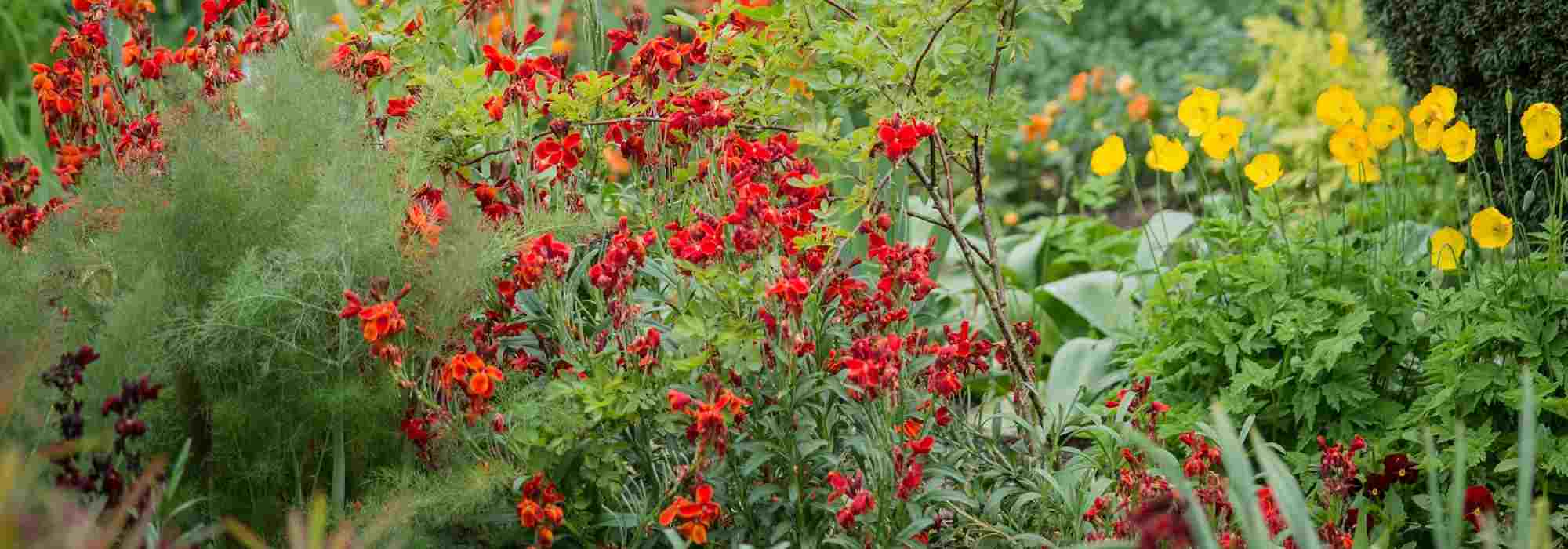
6 ideas for red/purple garden borders
Which flowers to create a blaze in the garden?
Contents
The vibrant red garden is adorned with flowers and foliage in scarlet hues: raspberry red to coral red, carmine, garnet, or burgundy. These strong colours create characterful scenes and deserve carefully selected plantings that will reveal the sought-after exoticism or classicism. They can be paired with equally stimulating colours like orange tones to create summer beds, or temper the fervour of red with white and plenty of green!
In this article, we offer you some ideas to ignite your garden from spring to autumn, in various garden styles.

An exotic jungle bed
In an exotic atmosphere, red truly shines in the garden! Numerous red flowers indeed provide a nearly tropical sensation. Nestled among broad, strikingly different foliage, they look stunning when paired with hints of Indian pink or orange. Red will also be highlighted by some of the most beautiful purple foliage.
For a border suitable for a wide range of regions (taking care to lift your more tender bulbs), here’s a display featuring plants with grand and audacious red attire: plant in masses of structural Cannas, ‘Black Prince’ daylilies or ‘Sammy Russel’ with golden hearts, and a few ‘Nancy’s Red’ kniphofia for their scarlet spires. Now for the beautiful foliage, essential: a dwarf banana Musa basjoo and a Trachycarpus fortunei will be chosen for their lovely hardiness, a slender Phormium, a Broussonetia papyrifera for the uniqueness of its lobed and velvety leaves, and a Schefflera taiwaniana. A Tetrapanax can also join this exceptional foliage ensemble. The orange note will be provided by another variety of day lily or a few purple-leaved dahlias like Dahlia ‘Sunshine’ and Libertia ixioides with coppery tones. As groundcover, a few purple and aniseed Coleus will be welcome, and in a mild coastal region, a Geranium maderense can replace them in the border with its beautifully cut foliage and magenta pink flowering. Finally, several Eucomis like ‘Sparkling Rosy’ will add another splash of colour at the end of summer.
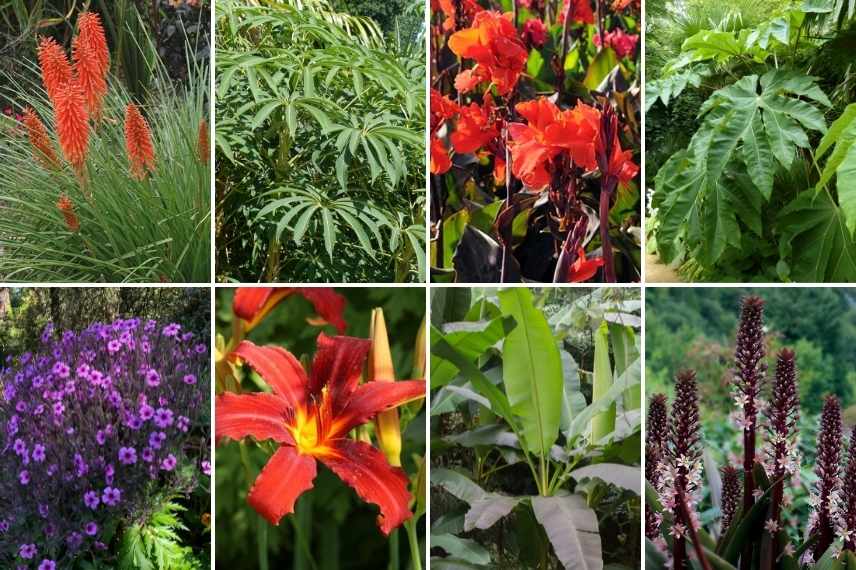
Kniphofia ‘Nancy’s Red’, Schefflera taiwaniana, red Cannas, Tetrapanax, Geranium maderense, Hemerocallis ‘Sammy Russel’, Musa basjoo and Eucomis ‘Sparkling Rosy’
Read also
Pairing red or purple flowersA red flower bed for a Mediterranean garden
Further south, regions that experience little to no frost can create a stunning red display with unique, subtropical plants. It is in the Mediterranean that this type of large flowerbed will thrive best, but it can also be attempted in gardens in Brittany or the southern Atlantic coast. This is a rarer garden, radiating greenery and purplish red, illuminated by more tangy notes.
Exceptional inflorescences will take centre stage here, featuring Hibiscus moscheutos and the impressive stature of Cannas edulis, bright red, surrounded by foliage resembling banana leaves. The Leucospermum are also invited, enchanting with their spectacular flowering, as well as Echium wildpretii, or Tenerife viper’s bugloss, true red candelabras. Plan for a beautiful tree like the fire tree (Embothrium coccineum) to ignite the garden in spring. Let the light green and purplish foliage take centre stage: clumps of Alpinia zerumbet ‘Variegata’ and Colocasias will enhance the tropical impression. An orange touch will brighten this flowerbed even more in summer with Strelitzia or Hedychiums, both also featuring tropical leaves.
To perfect the uniqueness of such a flowerbed, nothing beats a red palm (Cyrtostachys renda) or a dwarf date palm (Phoenix roebelinii).
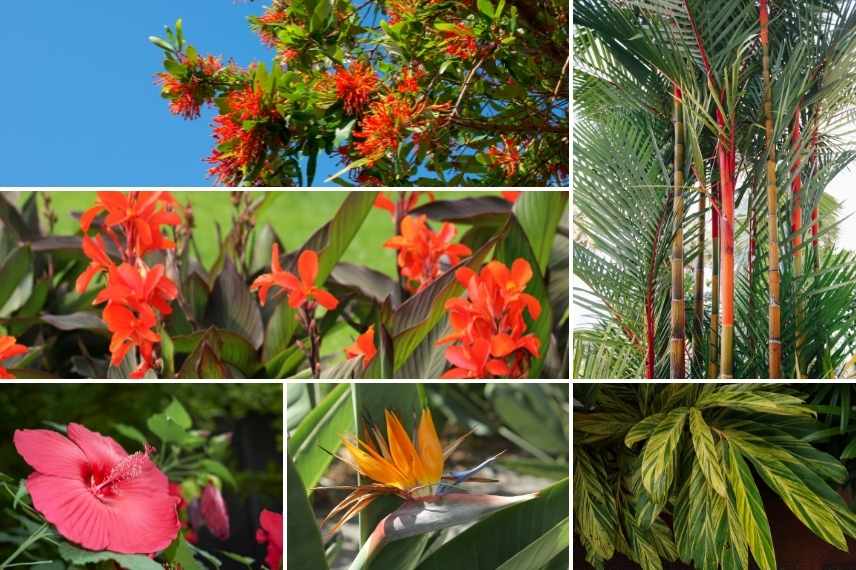
The fire tree, red palm, orange-red Cannas, pink Hibiscus moscheutos, a mass of bird of paradise, and the bright foliage of Alpinia zerumbet ‘Variegata’ create a stunning red garden in a mild climate.
A summer-coloured border
A desire for vibrant colours is urging you to liven up a flower bed or a too tame mixed border in your red garden? Summer is the season that particularly highlights red flowering plants. It’s the perfect opportunity to create a summer scene ablaze with colour, in a hot border style, featuring light perennials, generous red inflorescences, and a few more delicate ones to play with shapes. They will be enhanced with touches ranging from pink to orange!
Combine plants that put on a show with their large inflorescences, such as ‘Bimbo’ gladioli, copper-tinged purples, or red cannas. Complete with a beautiful mass of orange-red echinaceas like Echinacea ‘Hot Summer’, day lilies, and a few ‘Downham Royal’ pom-pom dahlias in a wine-red hue, which have a slightly sophisticated look with their pom-pom shape. These plants will be complemented by lighter flowers, from dark red to pale pink, even mauve: Dianthus barbatus, Verbena hastata, or bushy sage. The orange touch will be provided by Kniphofia or, in milder regions, by Aloe arborescens.
A bronze fennel, an Andropogon hallii ‘Purple Konza’, a beautiful grass with feathery spikelets turning red at the end of summer and bluish-green foliage, and a Pennisetum setaceum ‘Rubrum’ will complete this summer tableau in an airy and fluffy manner.
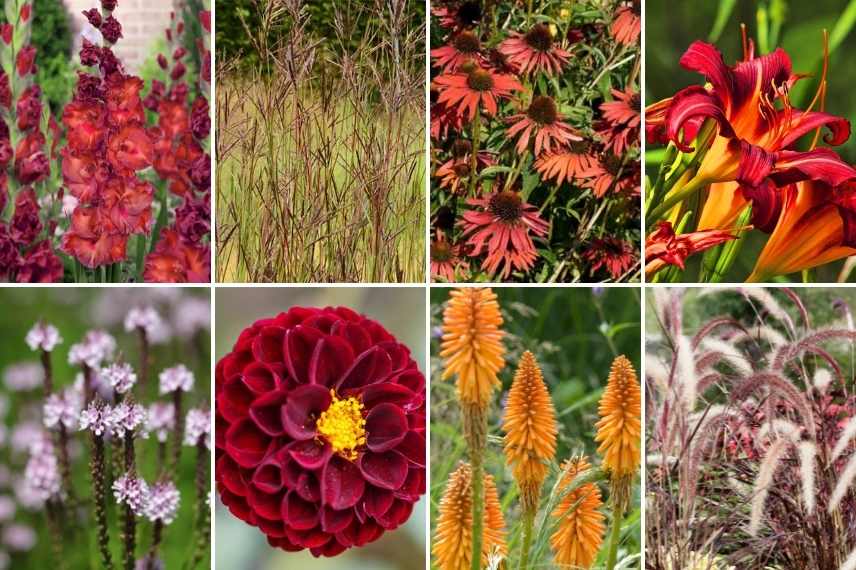
Gladiolus ‘Bimbo’, Andropogon hallii ‘Purple Konza’, Echinacea ‘Hot Summer’, Hemerocallis, Verbena hastata, Dahlia ‘Downham Royal’, Kniphofia ‘Fiery Fred’, and Pennisetum setaceum ‘Rubrum’
Read also
8 landscaping tips for red gardensA baroque scene in red and black
The Red and the Black is not just a major literary work: it is a baroque and bold arrangement in a precious garden. The theatrical effect achieved will be interesting in a small area, or in a border, for example.
Bright, highly saturated reds are preferred, which are paired with purple foliage of varying darkness. To prevent the bed from appearing too gloomy, make sure to insert some contrasting bright green foliage.
Build your base with the vibrant red of the decorative Dahlia ‘Lovelife’ and the bright red of Lychnis chalcedonica. They provide enough dynamism to a small bed. Soften this strong visual with bright, even anise-scented foliage: Imperata cylindrica ‘Red Baron’ at the edge, a Swiss chard ‘Charlotte’ with reddened ribs escaping from the vegetable garden, and a Helianthus salicifolius in the background. Finally, add some touches of purple foliage leaning towards black: Phormium ‘Black Adder’ in a large bed, a Heuchera ‘Black Pearl’, a few Sedums ‘Matrona’ to accompany the bed at the end of summer, and a carpet of Iresine herbstii, a lovely perennial to use as an annual. A purple-leaved Dahlia is also welcome in this composition, as well as a grass, light and airy (Stipa gigantea, Chinese fountain grass…).
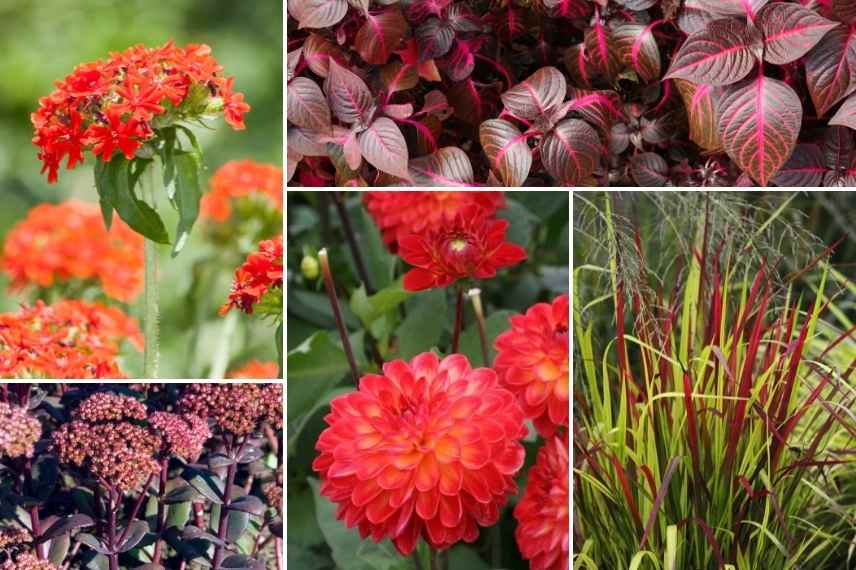
Lychnis chalcedonica, Iresine herbstii, Sedum matrona, Dahlia and Imperata cylindrica ‘Red Baron’
A large shrub bed with autumn colours
It’s not just the flowers that bring a glow to the garden. Trees and bushes changing colour in autumn provide an additional reason to create a beautiful sunny space that will ignite the garden in October.
To achieve a lovely blend, plant a small grove of some of the reddest-leaved bushes: a Cotinus coggygria ‘Winecraft Black’, compact and with a beautiful dark purple, turning orange-red in autumn, a winged euonymus, or a Euonymus europaeus ‘Red Cascade’ or ‘Red Wine’ will also take on splendid reddish hues and provide colourful fruiting. A Viburnus opulus, known as snowball viburnum, bursting with white in spring, will remain green until its flamboyant autumn colouration. A maple like the Acer palmatum ‘Villa Taranto’ will be the essential orange-red complement. Finally, if the space is large enough, plant a tree to enjoy an additional stratum and crimson hues, with a Parrotia persica, a majestic Liquidambar, or a Gleditsia triacanthos ‘Elegantissima’, which will turn yellow!
Contrast with brighter green or golden foliage, the effect will be even more striking: two or three Berberis thunbergii, green and purple, or bicoloured like ‘Limoncello’, a Kochia scoparia tricophylla, resembling a small low conifer with soft foliage, and a Cornus alba ‘Elegantissima’ with variegated leaves.
It is interesting to mix in lower perennial plants that will add colour to the mass from the end of summer with orange-red or scarlet hues: Schizostylis coccinea with its beautiful bright red or Chrysanthemums rubellum ‘Duchess of Edinburgh’, pink-red, quickly followed by a carpet of Erica x darleyensis ‘Karmer’s Rote’ and ‘Eva Gold’, which will bloom for a long time in winter.
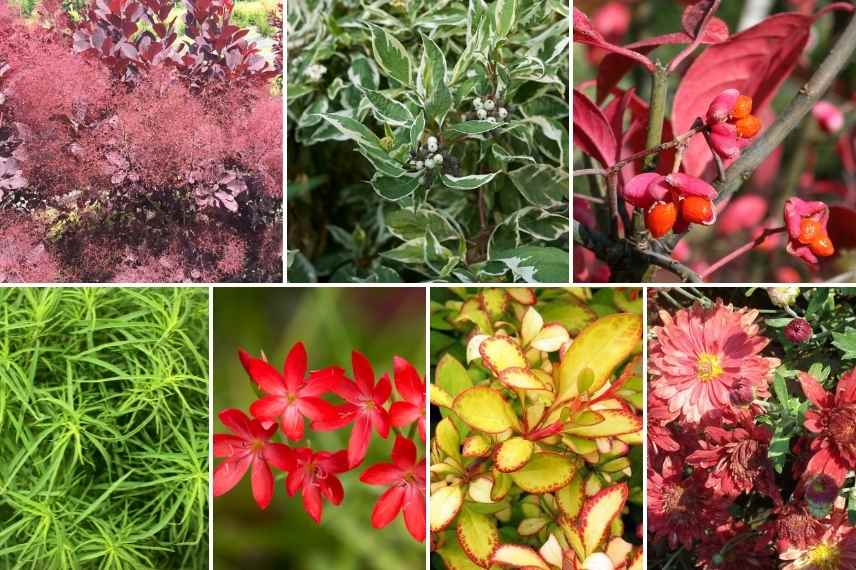
Cotinus coggygria ‘Wine’, Cornus alba ‘Elegantissima’, Euonymus, Kochia scoparia, Schizostylis coccinea, Berberis ‘Limoncello’ and Chrysanthemum ‘Duchess of Edinburgh’
A red bed for a Japanese garden
The Japanese garden is particularly suited to the red garden when choosing the most vibrant blooms from azaleas and rhododendrons, which will be the standout subjects in spring.
You can accompany them with Pieris that unfurl red early in spring such as the classic Pieris ‘Forest Flame’, Pieris ‘Sarabande’, or Pieris ‘Little Heath’, all showcasing beautiful white bell-shaped flowers. The Kalmia latifolia ‘Tad’, with its graceful white and dark purple flowers, will be the little gem of May. An Enkianthus campanulatus, another attractive heather soil shrub, will extend the flowering until June with its white and pink bell-shaped flowers, and will turn red as autumn approaches. Plant it at the back of the border. This setting will be a ode to heather soil shrubs as well as ferns, Brunneras, Ophiopogon, and other Hakonechloa providing contrasting foliage in a semi-shaded area. A small pine will enhance the whole with its brilliance and habit, whether rounded or twisted, such as the Pinus mugo ‘Mops Gold’ or Pinus thunbergii.
This garden will be primarily ornamental in spring, but also consider autumn by selecting one or two Japanese maples like Acer palmatum ‘Villa Taranto’ with its red-orange leaves that will finish in a beautiful golden yellow in October, illuminating the whole, or Acer palmatum ‘Skeeter’s Broom’, transitioning from spring to summer through all shades of red to purple.
Complete the scene with some mossy rocks where helxine or Zoysia tenuifolia will spill over, a border made of bamboo canes, or play again with red by installing a small lacquered railing.
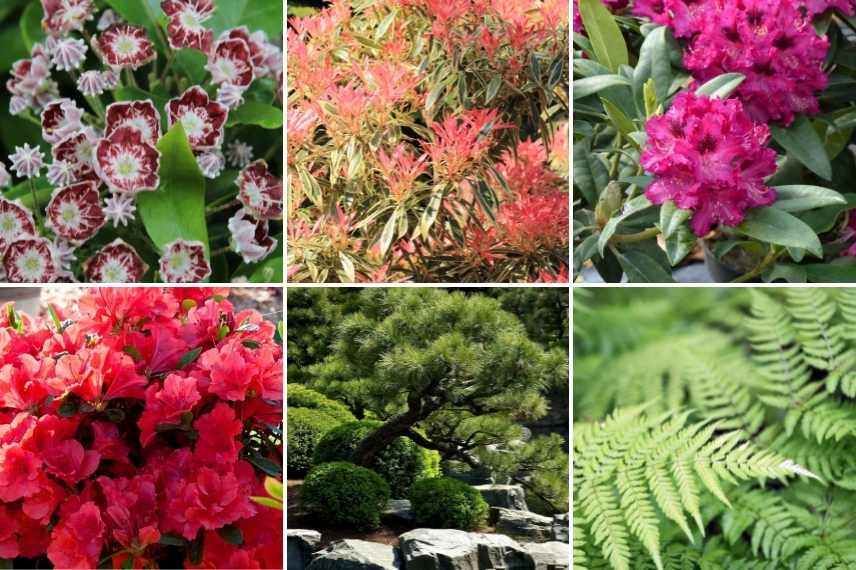
Kalmia latifolia ‘Tad’, Pieris ‘Forest Flame’, Rhododendron ‘Nova Zembla’, Azalea Encore ‘Ruby’, Pinus thunbergii, and Dryopteris filix-mas
- Subscribe!
- Contents
![[plant_catalog category="jardin" color="red-purple"]Suggestions and Ideas for a Red-Purple Garden[/plant_catalog]](https://en.promessedefleurs.eu/blogwp/wp-content/uploads/2022/09/jardin-rouge-pourpre-conseils-et-idees.jpg "[plant_catalog category=\"jardin\" color=\"rouge pourpre\"]Conseils et idées")
Comments