





























6 Mahonias with Winter Flowering
Our selection for a bright winter
Contents
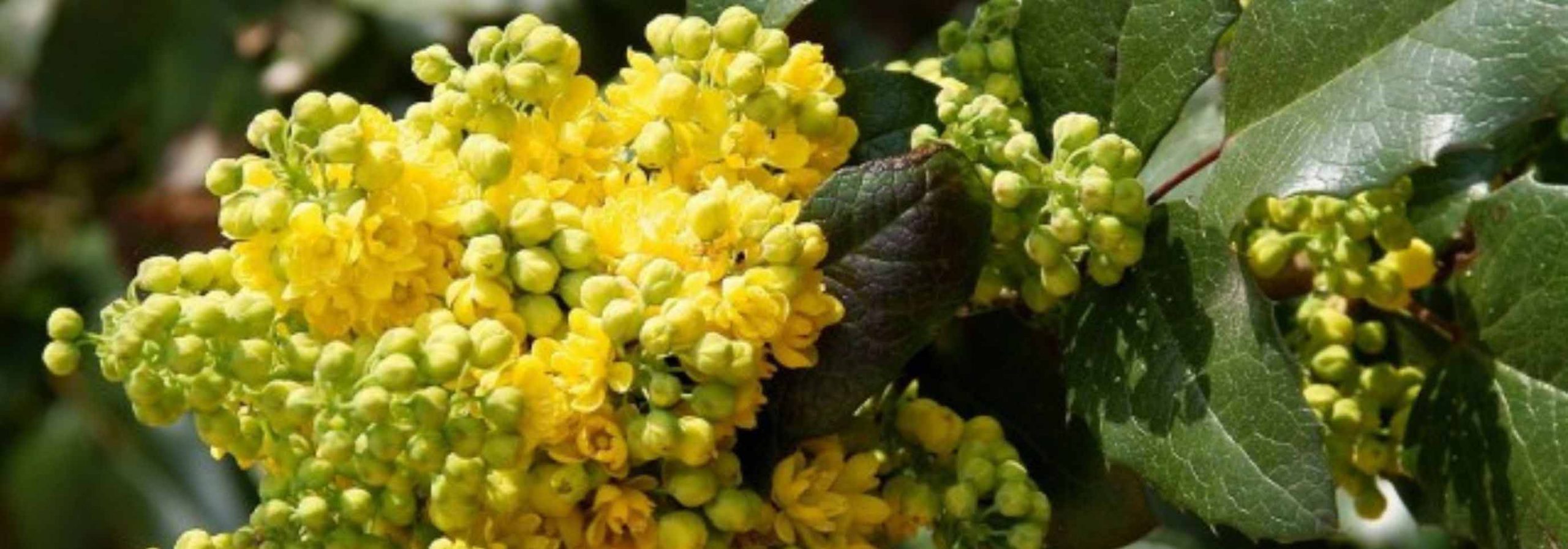
Hardy bush that generally thrives in shade or partial shade, the Mahonia or false holly is interesting in garden designs due to its evergreen and decorative foliage giving it an undeniable exotic touch, as well as its bright flowering becoming the focal point in the garden when other plants are dormant. Some varieties are covered in numerous clusters of yellow flowers in the middle of winter, followed by blue berries replacing the faded flowers. The sweet fragrance of their flowers complements their vibrant flowering. To add a touch of golden colour to your garden, discover our selection of 6 winter-flowering Mahonias.

Mahonia (x) media 'Charity'
Very robust, with leathery and thorny foliage, the Mahonia (x) media ‘Charity’ is an evergreen bush with an impressive habit, eventually forming a beautiful bush of 3-4 m in all directions due to a relatively slow growth during the first years, which then accelerates. In the heart of winter, it displays between December and March its long, compact, bright yellow clusters, pleasantly fragrant. They are nectariferous, visited by bees and bumblebees, and later produce small berries that turn midnight blue, appreciated by birds.
Mahonia ‘Charity’ thrives in partial shade or shade, in any garden soil without excessive lime, even if it becomes quite dry in summer. Showcase it in a “winter garden” with a Berberis darwinii, a Cornus sanguinea ‘Winter Beauty’ and a Siberian dwarf pine Pinus pumila ‘Glauca’.
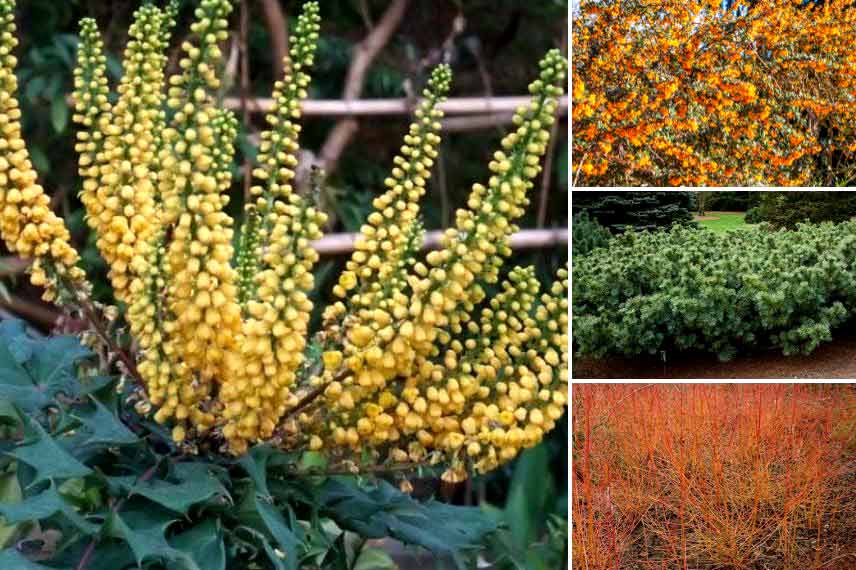
Mahonia (x) media ‘Charity’, Berberis darwinii, Pinus pumila ‘Glauca’ and Cornus sanguinea ‘Winter Beauty’
Read also
Mahonia: 7 companion planting ideasMahonia (x) wagneri 'Fireflame'
In February-March, Mahonia (x) wagneri ‘Fireflame’ boasts a slightly fragrant yellow flowering that is absolutely stunning against its colourful foliage, which takes on shades of orange, red, and purplish-blue due to the cold in autumn and winter. Its flowers are followed by quite decorative black berries that some birds are fond of. ‘Fireflame’ is an evergreen bush with a bushy yet upright habit, reaching up to 2 m in height and 1.75 m in spread at maturity. Its spiky leaves resemble those of holly.
Hardy and easy to grow in ordinary soil, Mahonia ‘Fireflame’ adapts to all exposures. Plant it in an original winter bed alongside Garrya elliptica ‘James Roof’, which is also evergreen and flowers in winter with long, spectacular pendulous aments of white-pink-silver. Add to them Sarcococca hookeriana ‘Digyna’ for its fragrant winter flowering.
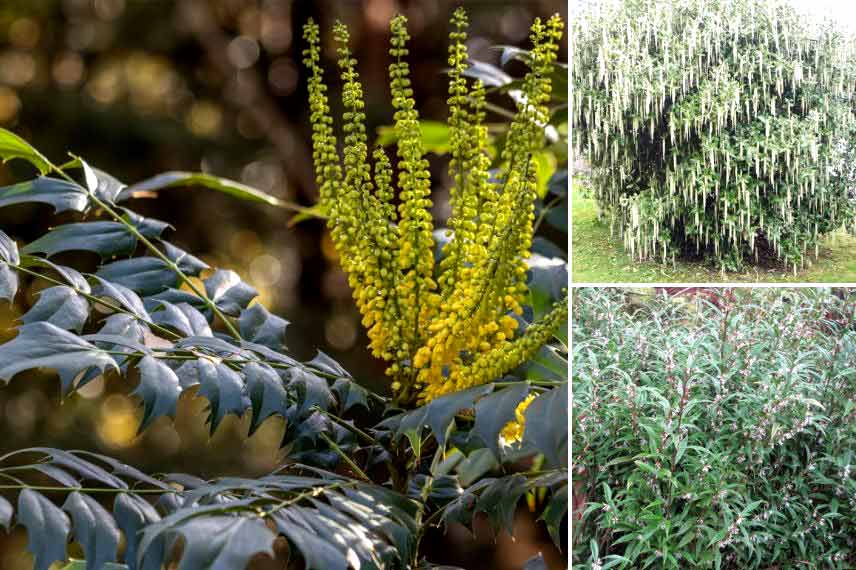
Mahonia (x) wagneri ‘Fireflame’, Garrya elliptica ‘James Roof’ and Sarcococca hookeriana ‘Digyna’
Discover other Winter-flowering shrubs
View all →
Available in 1 sizes
Available in 2 sizes
Available in 1 sizes
Available in 1 sizes
Available in 1 sizes
Available in 1 sizes
Available in 2 sizes
Available in 1 sizes
Available in 1 sizes
Available in 1 sizes
Mahonia aquifolium
Small bushy shrub of about 1 m in all directions, the Mahonia aquifolium features evergreen foliage similar to that of holly, glossy green that turns purple in winter. Its flowering, early, light and fragrant, begins in February, with small golden-yellow flowers clustered in pyramidal spikes 10 cm long. They are followed by bluish-black berries. Very cold-resistant, Mahonia aquifolium thrives in cool, neutral or calcareous soil. Highly tolerant, it prefers light soil and withstands wind and pollution. Fast-growing, it tolerates both sun and dense shade.
For beautiful scenes in borders or containers during the winter period, fill the base of the Mahonia aquifolium with ‘Early Sensation’ Daffodils, one of the earliest, which has lovely trumpet-shaped, solitary and fragrant, bright yellow flowers and Snowdrops or Galanthus woronowii. Their bell-shaped, drooping white flowers will surprise you at the end of January!
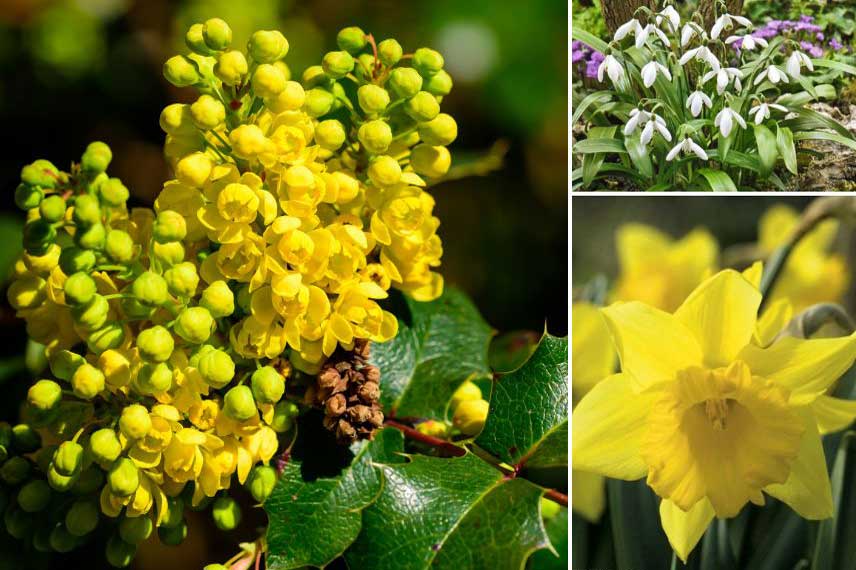
Mahonia aquifolium, Galanthus woronowii and ‘Early Sensation’ Daffodils
Read also
7 Mahonias flowering in autumnMahonia bealei
Another beautiful winter flowering, cheerful and colourful! The Mahonia bealei forms in the garden a bush prized for its architectural habit with several upright trunks, reaching 3 m high and 2 m wide. Its very bright flowering lights up winter scenes from December to February, thanks to its short, upright clusters of lemon-yellow flowers. They are fragrant and followed by purple-blue fruits that delight the birds. The evergreen foliage of Mahonia bealei consists of large, bluish, leathery leaves divided into spiny leaflets, very similar to holly leaves.
Very accommodating, it is a bush that adapts to all soils that are not too dry and prefers shaded locations. It is a perfect plant for defensive hedges alongside Berberis thunbergii ‘Orange Rocket’, of Blackthorn and Holly ‘JC Van Tol’.
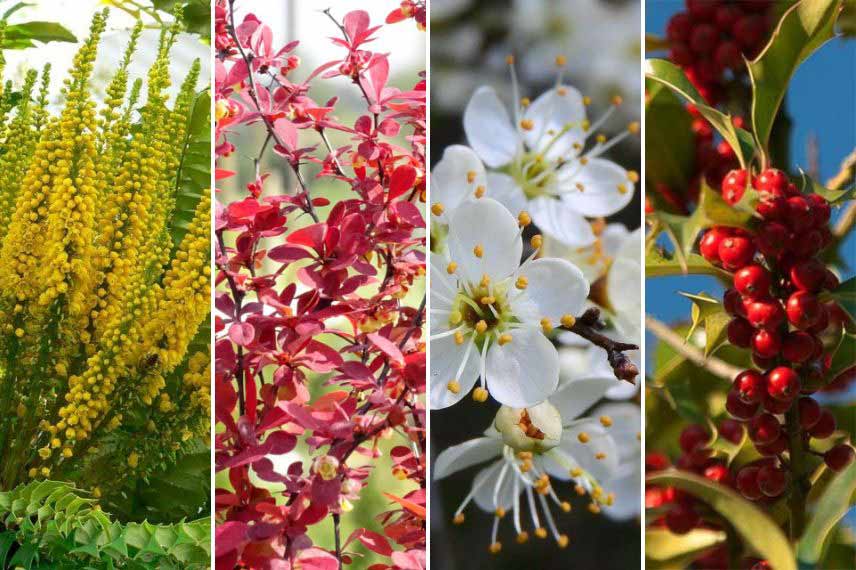
Mahonia bealei, Berberis thunbergii ‘Orange Rocket’, Blackthorn and Holly ‘JC Van Tol’
Mahonia (x) media 'Winter Sun'
The Mahonia (x) media ‘Winter Sun’ certainly lives up to its name! Like a sun in the heart of winter, from December to February it brightens the surroundings of the house with its particularly long panicles of pale yellow flowers. Eventually forming a beautiful bush of 3 m in all directions, it has a very distinctive, upright and slightly spreading habit, supported by sparsely branched branches that give it an exotic appearance throughout the year. Its long, evergreen, glossy leaves, divided into spiky leaflets, take on lovely purplish hues in the cold, to which it withstands perfectly.
Structuring and graphic, the Mahonia ‘Winter Sun’ will bring a welcome verticality to a shady border in deep, cool soil, with at its feet masses of evergreen ferns Polystichum aculeatum and Hepaticas Hepatica nobilis that will form a lovely counterpoint with their round, bright royal blue flowers and white stamen centres.
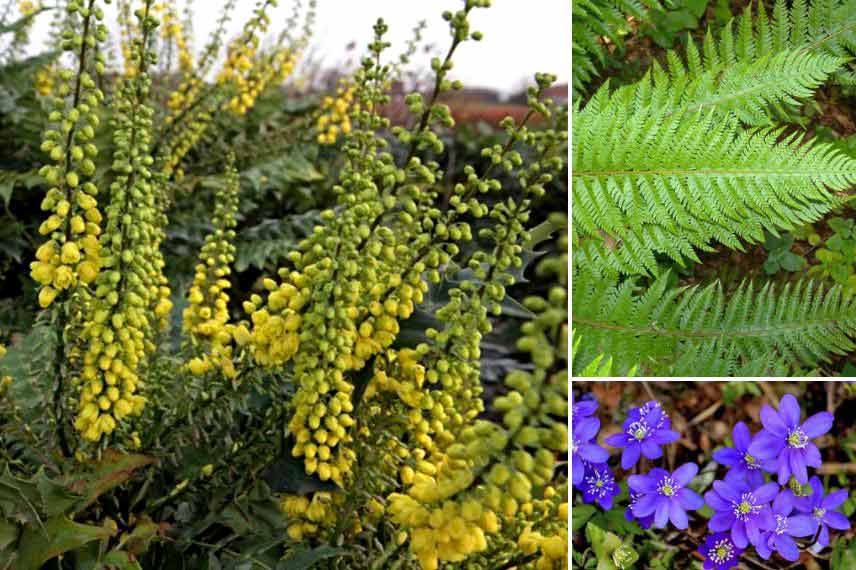
Mahonia (x) media ‘Winter Sun’, Polystichum aculeatum and Hepatica nobilis
Mahonia (x) wagneri 'Pinnacle'
For a particularly abundant and fragrant vibrant flowering, choose the Mahonia (x) wagneri ‘Pinnacle’ : this very attractive mahonia produces bright yellow flowers in February-March, gathered in generous pyramid-shaped clusters measuring 10 to 15 cm. Highly visited by bees, these nectariferous flowers give way to lovely clusters of bluish-black berries that are quite ornamental and appreciated by certain bird species. The young leaves of ‘Pinnacle’, tough and spiny, are bronze-coloured in spring, then turn bright green in summer. This dense bush with a wide habit of 1.50 m to 1.75 m in all directions is hardy, easy to grow in ordinary soil and adapts to almost any exposure.
In a fragrant winter border, pair the Mahonia ‘Pinnacle’ with the Botanical Camellia transnokoensis. The latter is a small marvel of simplicity and generosity in the heart of winter, with its small delicately fragrant white flowers. Add the Sarcococca confusa, a shade shrub with evergreen foliage and pure white fragrant flowers, which are also decorative in winter.
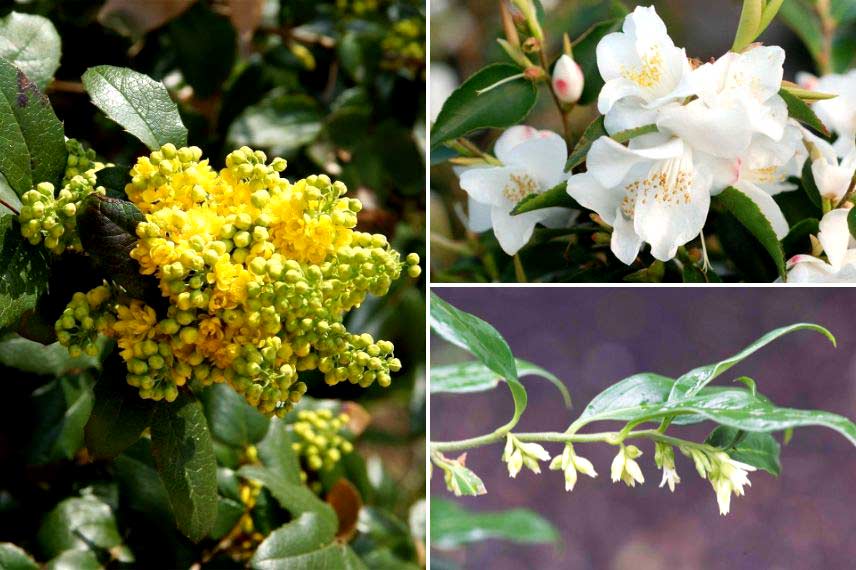
Mahonia (x) wagneri ‘Pinnacle’, Camellia transnokoensis and Sarcococca confusa (Chiara Coetzee – Flickr)
For further reading
→ Find all our Mahonias varieties
→ To learn everything, check out our complete guide on Mahonia: planting, pruning, and maintaining

- Subscribe!
- Contents
Comments