





























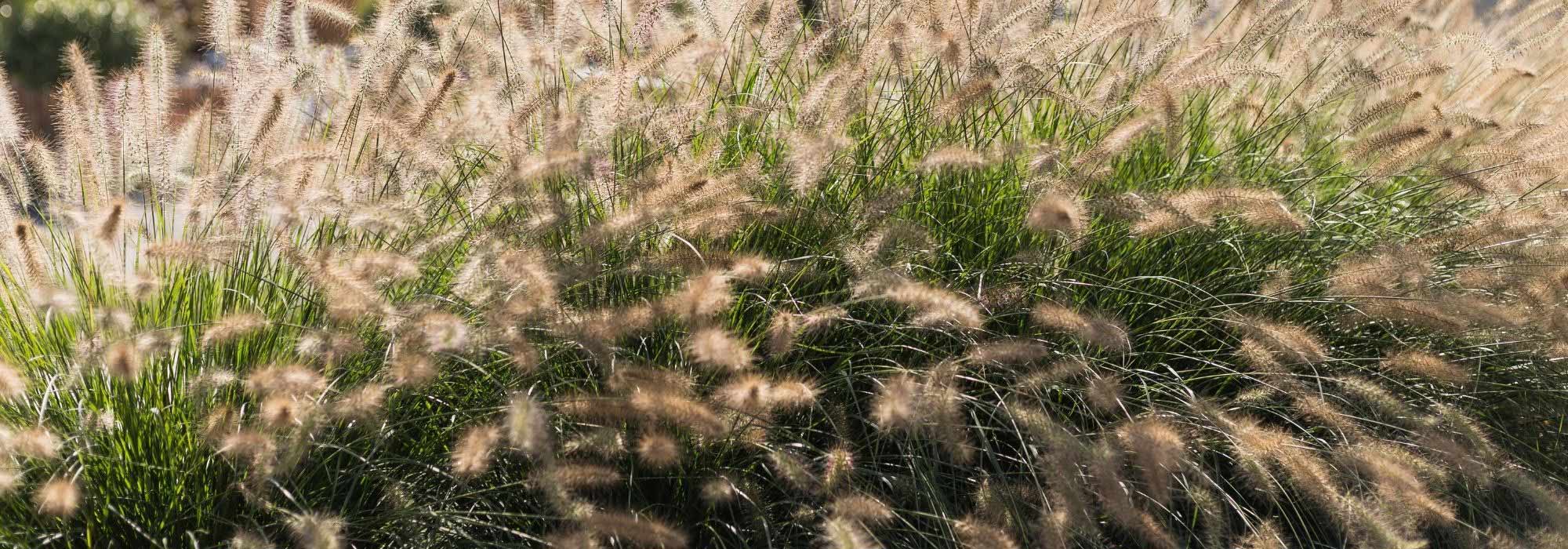
7 grasses for allergy sufferers
Ornamental grasses in the garden when you're allergic? It is possible!
Contents
Among the plants responsible for pollen allergies, grasses are often blamed, and many gardeners shy away from them, fearing the discomfort they cause. However, many of them are not among those used for their decorative value, and when we look at the scientific studies conducted on the subject, we happily and reassuringly find that many ornamental grasses are safe, as they produce little pollen, or that the pollen they do produce is not allergenic.
In this article, I propose to clarify the issue of grass pollen allergies, to discover which ones you should avoid if you are allergic, but also to meet 7 very beautiful ornamental “herbs” that you can welcome into your garden with complete peace of mind.

Grass allergies: symptoms, periods, how to manage them?
Grasses belong to the Poaceae family, which represents about 1/4 of the Earth’s vegetation cover, making it clear that it is nearly impossible to avoid exposure in one way or another. Among allergic individuals, 20% are sensitive to grass pollen, which understandably makes them wary of it.
Symptoms
Commonly known as ‘hay fever’, these pollen allergies cause fairly characteristic symptoms, such as:
- itching in the nose, eyes, mouth, or throat
- allergic rhinitis (blocked or runny nose, with or without sneezing)
- headaches
- breathing difficulties, asthma
- red eyes, with a gritty sensation
These discomforts, varying in severity, appear during the flowering period of grasses, known as flowering spike.
Pollen peaks
From April-May until autumn depending on the grasses, the spikes reach maturity and release microscopic pollen that causes allergies. Anemophilous, these ‘herbs’ rely on the wind to disperse their male gametes, thus fertilising the female gametes of other individuals, ensuring their offspring. This mode of dispersion makes their propagation in the air even more difficult to control, and when humidity comes into play and leads to mould, the risk of allergies is further increased.
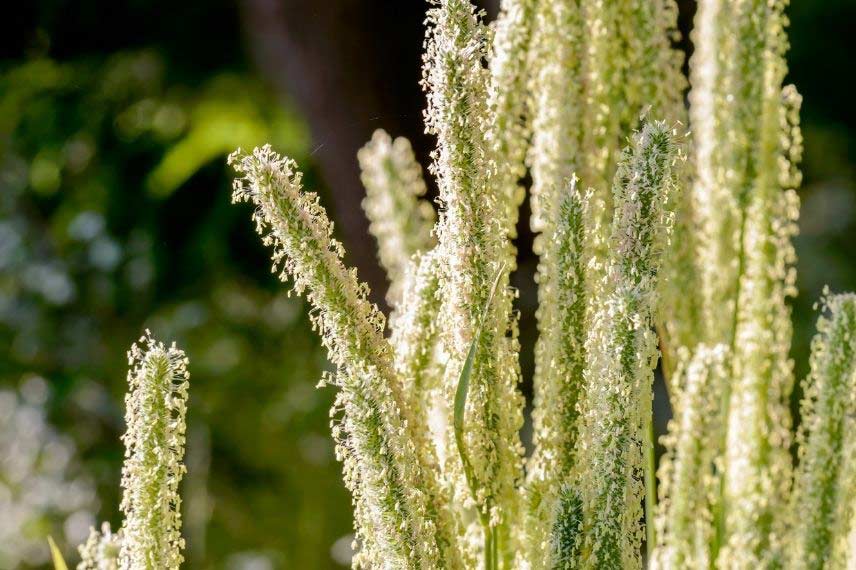
When the spikes are mature, they release their allergenic pollen (Phleum pratense)
How to manage your allergies?
To limit the risk of allergic reactions to grass pollen, a few simple rules should be followed:
- avoid going out with wet hair, but wash it when you return and before going to bed
- change clothes when you get home
- dry your laundry indoors rather than outside
- keep car windows closed, and ventilate your interiors early in the morning or late in the evening, when the ambient humidity weighs down the pollen and limits its dispersion.
- If you experience severe reactions, do not hesitate to consult a healthcare professional.
→ To stay informed about pollen peaks according to the seasons and regions, visit the National Aerobiological Surveillance Network, which also offers tools to monitor and manage your allergies, in the form of smartphone applications.
At this point in your reading, you may very well be thinking that there is no way you would adopt grasses in your garden, as it would be like handing a stick to beat yourself with? Think again! While some grasses are indeed highly allergenic, others, including many ornamental grasses, pose no risk, and can thus bring beauty and lightness to your flower beds, without the drawbacks of their cousins! It would be a shame to deprive yourself of them!
Read also
Pollen allergy: how to protect yourself?Grasses responsible for allergies
Not all grass pollens have the same potential to cause allergies.
The most problematic ones can be classified into three categories based on their use.
Forage grasses
- Timothy (Phleum)
- Meadow Fescue (Dactylis)
- Agrostis (Agrostis)
- Brome (Bromus)
- Common Fescue (Festuca, but ornamental varieties with blue foliage, Festuca glauca, are not allergenic)
- Sweet Vernal Grass (Anthoxanthum)
- Yorkshire Fog (Holcus)
- Italian Ryegrass (Lolium multiflorum or Italian ryegrass, Lolium perenne or English ryegrass)
- Meadow Grass (Poa)
- Quackgrass (Elytrigia or Agropyron repens, Elymus repens)
- Meadow Foxtail (Alopecurus)
Most of these grasses are found in fields, along roadsides, or in ditches. Some are used in lawn creation. To minimise risks, mow regularly to prevent your lawn from flowering.
Cereal grasses
- Wheat (Triticum)
- Oats (Avena)
- Rye (Secale)
- Barley (Hordeum)
Ornamental grasses
These are the ones that interest us most as gardeners. Knowing their allergenic potential allows us to choose those suitable for our sensitivity.
High-risk ornamental grasses
These are the main decorative grasses to avoid if you are allergic to grasses.
- Arrhenatherum bulbosum, in its variegated or non-variegated form
- Tufted Hairgrass (Deschampsia cespitosa and its various cultivars)
- Fescues (except for Festuca glauca and its various cultivars, which present little risk)
- Reed Canary Grass (Phalaris arundinacea)
Medium-risk grasses
You can use them, but avoid planting them in large numbers.
- Calamagrostis (Calamagrostis acutiflora)
- Hare’s Tail (Lagurus ovatus)
- Blue Wheat or Sand Elymus (Leymus arenarius)
- Giant Stipa (Stipa gigantea)
Fortunately, Nature is rich and well-made, and many grasses can be used in borders without risk.
Discover other Ornamental grasses
View all →
Available in 0 sizes
Available in 0 sizes
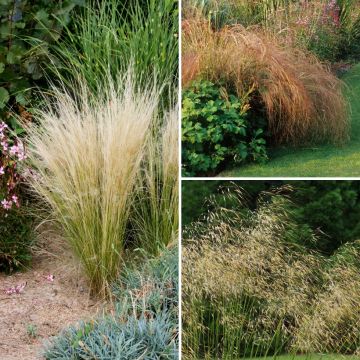
Available in 0 sizes
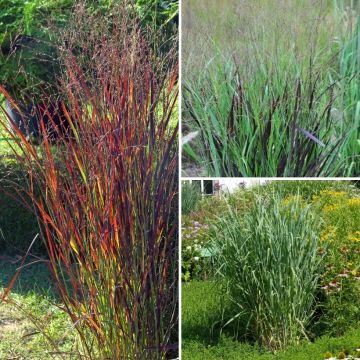
Available in 0 sizes
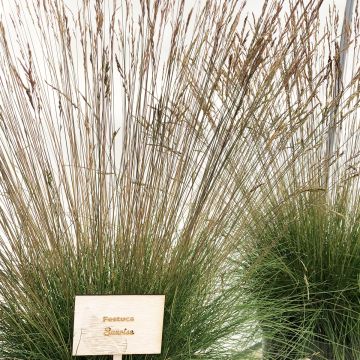
Available in 1 sizes
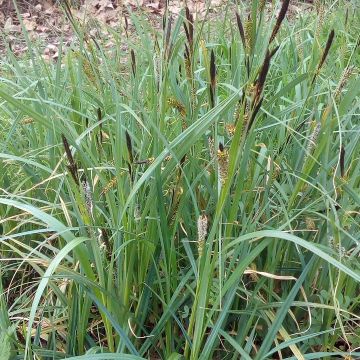
Available in 1 sizes
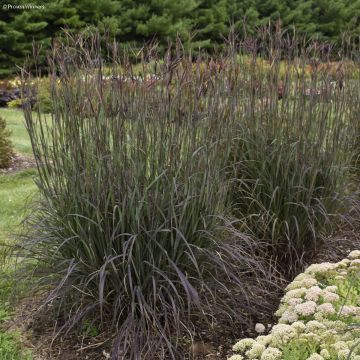
Available in 2 sizes
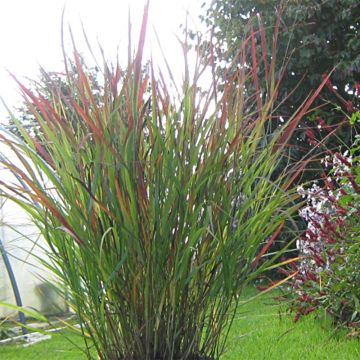
Available in 1 sizes
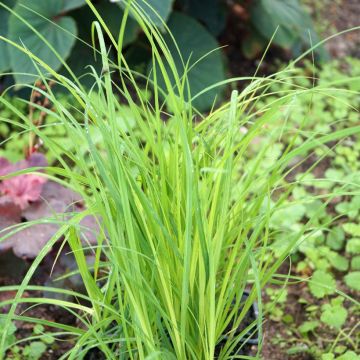
Available in 1 sizes
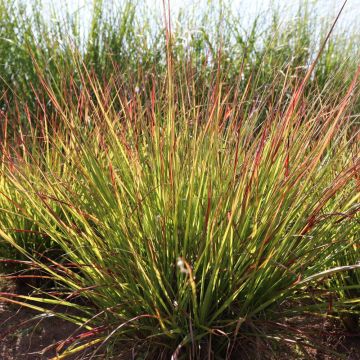
Available in 1 sizes
Which grasses are suitable for allergy sufferers?
Even if you are allergic, here is a list of grasses that you can safely install in your ornamental garden as they are non-allergenic.
Festuca glauca
The Blue Fescue is a small grass that forms a cushion of dense, stiff leaves, with intense glaucous to bluish tones. Among the most colourful varieties, ‘Intense Blue’ and ‘Elijah Blue’ always make an impression, even in the heart of winter as they are evergreen grasses. A light, silvery flowering tops the clump from June. Hardy, drought-resistant, and easy to grow, it finds its place along a path, in a rockery, on a slope, or even in a pot on a sunny terrace.
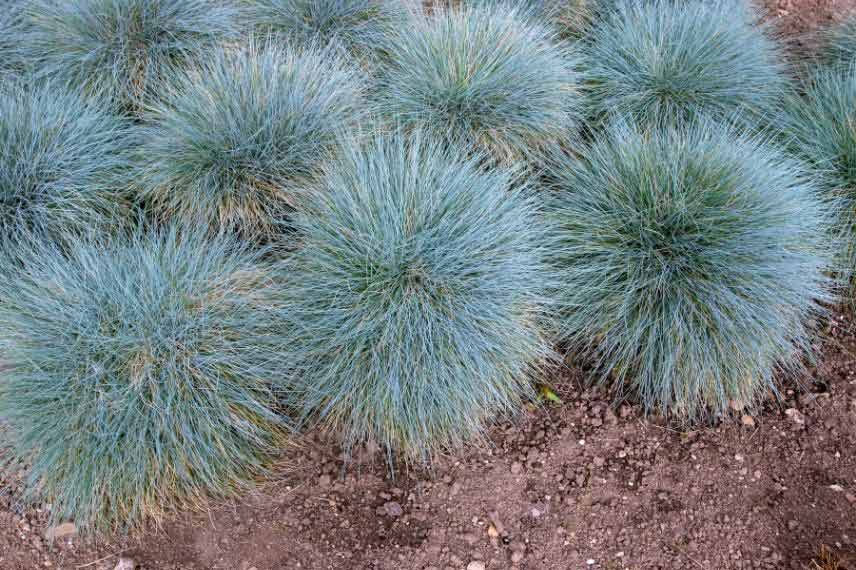 Festuca glauca
Imperata cylindrica ‘Red Baron’
The Imperata is another small grass, whose deciduous foliage rises vertically at the start of the season, in olive-green tones, before gradually turning red, becoming more intense throughout the summer. Preferring cool soils, it must not lack water to express its full beauty, and it spreads slowly but surely to form beautiful colourful patches. Quite hardy, it should be placed in a bright location to enhance its colours, or possibly in light shade. It can also be easily grown in pots.
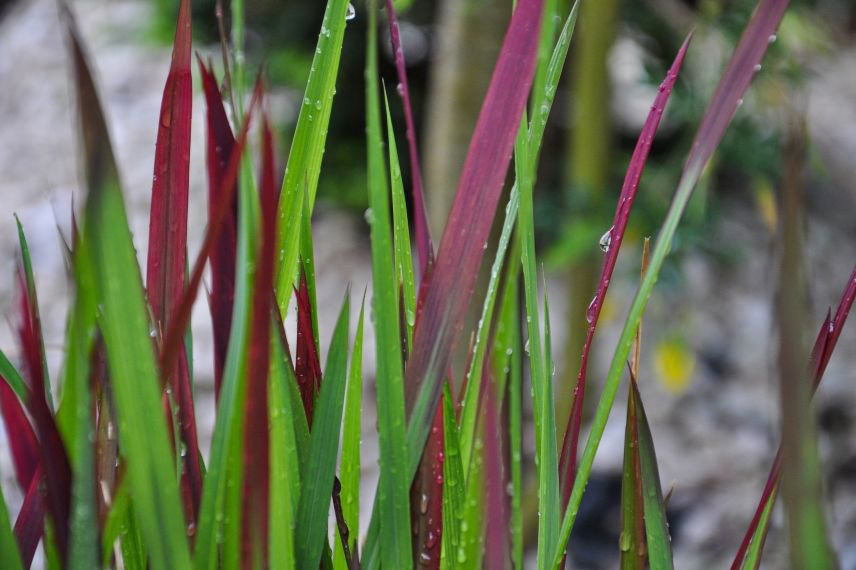 Imperata cylindrica ‘Red Baron’
Miscanthus sinensis and Miscanthus giganteus
The Chinese Reed comes in a very large number of varieties, some reaching barely 1 m in height, while others can peak at around 2 m. Renowned for their flowering spikes of varied hues, many are spectacular in full bloom (‘Silberfeder’, ‘Nepalensis’, ‘Ferner Osten’…). The foliage, varying in width, often adopts a graceful fountain-like habit, and is not just green. Some are beautifully variegated with white or cream along their length (‘Variegatus’, ‘Cosmopolitan’, ‘Cabaret’) or in horizontal bands (‘Strictus’, ‘Little Zebra’). Others, like ‘Little Miss’ mix early in the season purplish to violet hues, and many take on incredible shades in autumn (‘Malepartus’, ‘Ghana’, ‘Purpurascens’). Generally quite hardy, they also withstand drought well but appreciate some moisture at their base. They thrive in both calcareous and acidic soils, and enjoy full sun, with some even being suitable for pot cultivation. Their foliage dries out in late autumn, but remains decorative until late winter.
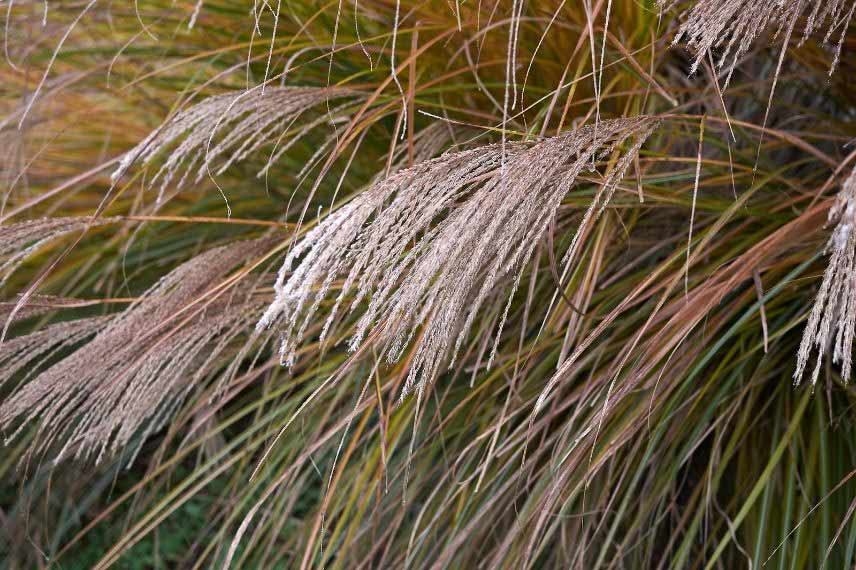 Miscanthus sinensis
Miscanthus giganteus lives up to its name, as it is a true giant! In full bloom, it can reach over 3 metres, making it a striking feature, with strong graphic lines visible from afar. Like its relatives, it is perfect for creating dense hedges for a good part of the year. Its foliage and stems take on beautiful hues in autumn, further enhancing its already notable presence.
Molinia caerulea
The Blue Molinia is a grass with both an upright and flexible habit, ranging from 40 cm to 3 metres depending on the variety. From summer to autumn, its long and generous flowering forms a beautiful, airy cloud. The foliage, with bluish reflections, features variegation in varieties like Molinia ‘Variegata’, and autumn colours these grasses in yellow or orange, making them essential in late-season displays. Their silhouette and straw-like colour continue to enliven borders throughout winter. Quite hardy, it is a grass perfectly suited to heavy, even wet soils, preferably acidic, but it adapts to very diverse situations. Sometimes a bit slow to establish, it enjoys both sun and partial shade.
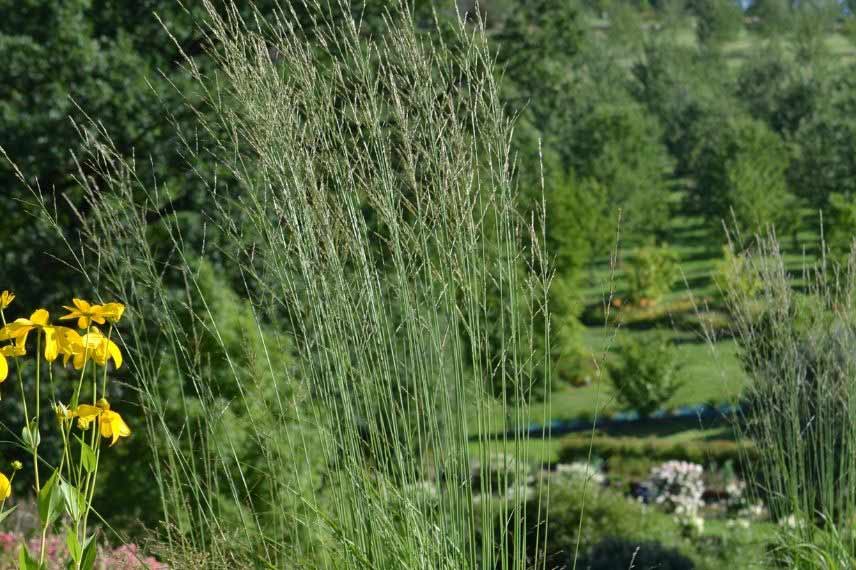 Molinia caerulea
Stipa tenuifolia (syn. Nassela tenuissima)
Angel Hairs are perhaps the lightest grasses, their airy culms swaying at the slightest breeze. Initially green, they turn golden and then straw-like, requiring only a little tidying up at the end of winter. About 50 to 70 cm tall, Stipa can be used in gardens of all sizes, from the most romantic to the most contemporary. Undemanding and hardy, it thrives in poor soils and is also very drought-resistant.
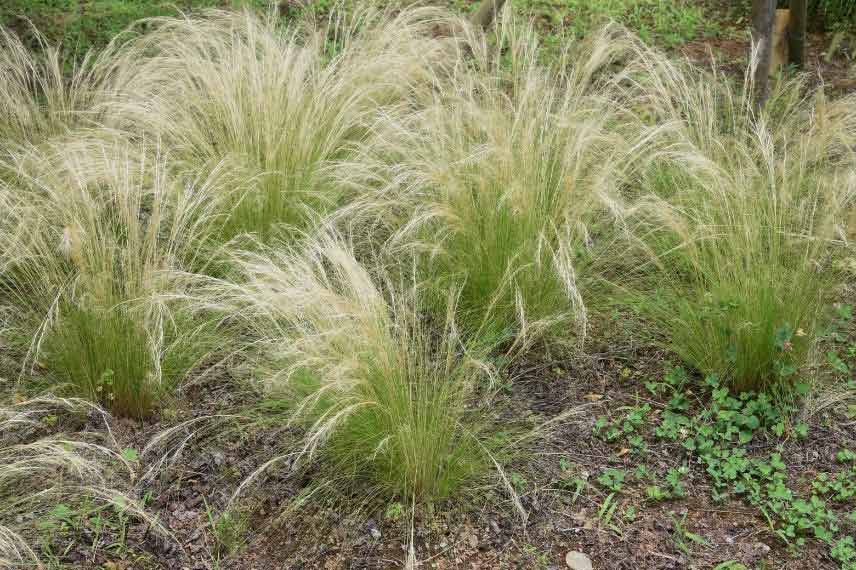 Stipa tenuifolia
Panicum virgatum
The Upright Panic is a grass that comes in varieties of small, medium, or larger sizes. It is primarily appreciated for its upright, architectural habit, and the colour of its foliage. Green, blue, orange, or deep purple, it features a fluffy flowering from summer and remains decorative for part of the winter. Very hardy and easy to grow, Panic adapts to all types of soil, in full sun or partial shade.
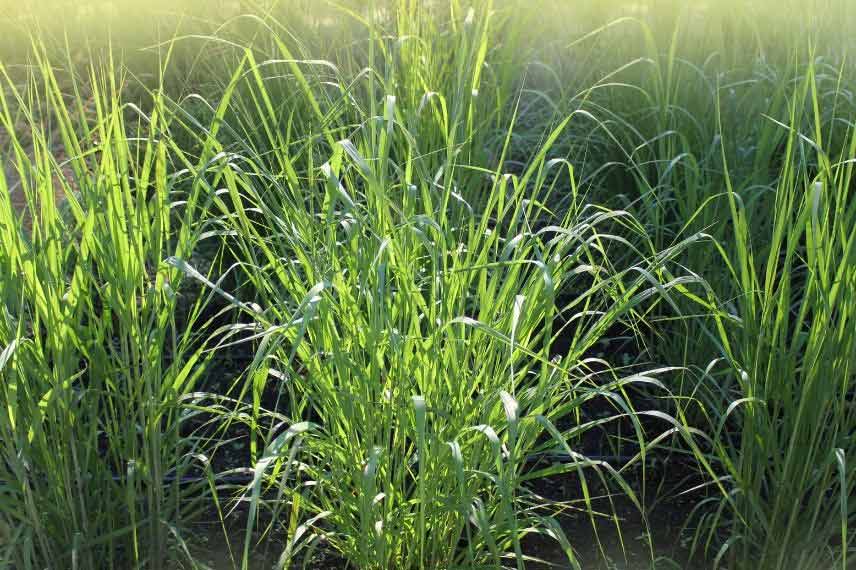 Panicum virgatum
Pennisetum (P. alopecuroides, P. orientale, P. macrourum)
The Fountain Grass is a classic in grass gardens, where its flared fountain-like silhouette is enhanced by particularly decorative fluffy spikes. Depending on the species and varieties, heights range from about 30 cm to nearly 2 m. Green or distinctly golden, the foliage also offers warm hues in autumn. This is a hardy grass (P. macrourum is a bit less so), ideal in full sun, in any soil, even dry, and it is particularly suited for seaside gardens, as it withstands both wind and salt spray.
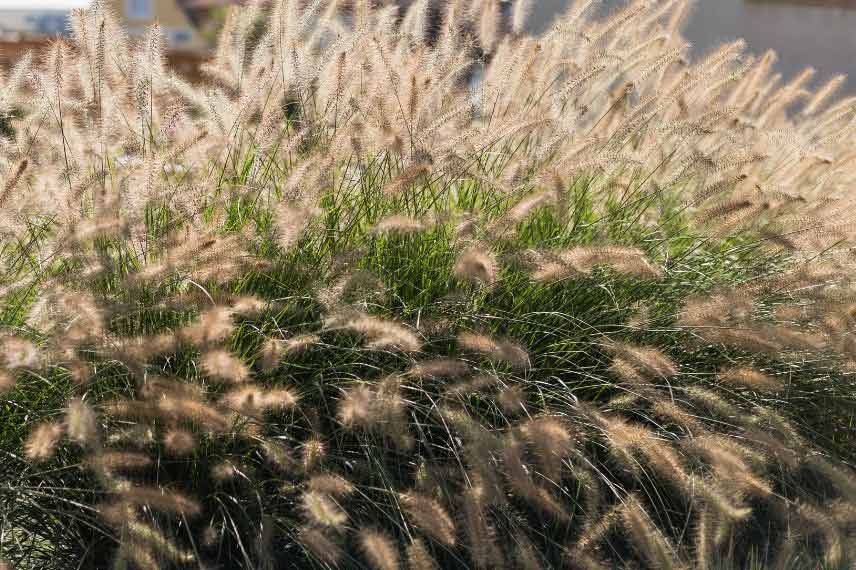 Pennisetum alopecuroides
Other plants and alternatives
Bamboos are also non-allergenic grasses (there are non-invasive varieties that do not spread throughout the garden), and many plants have grass-like foliage without belonging to this family, which also eliminates any drawbacks. This is the case for Carex, Rush, Luzula, or Ophiopogon.
- Subscribe!
- Contents
Comments