





























7 pairing ideas with Fatsia
A shrub that's easy to adopt for an exotic look
Contents
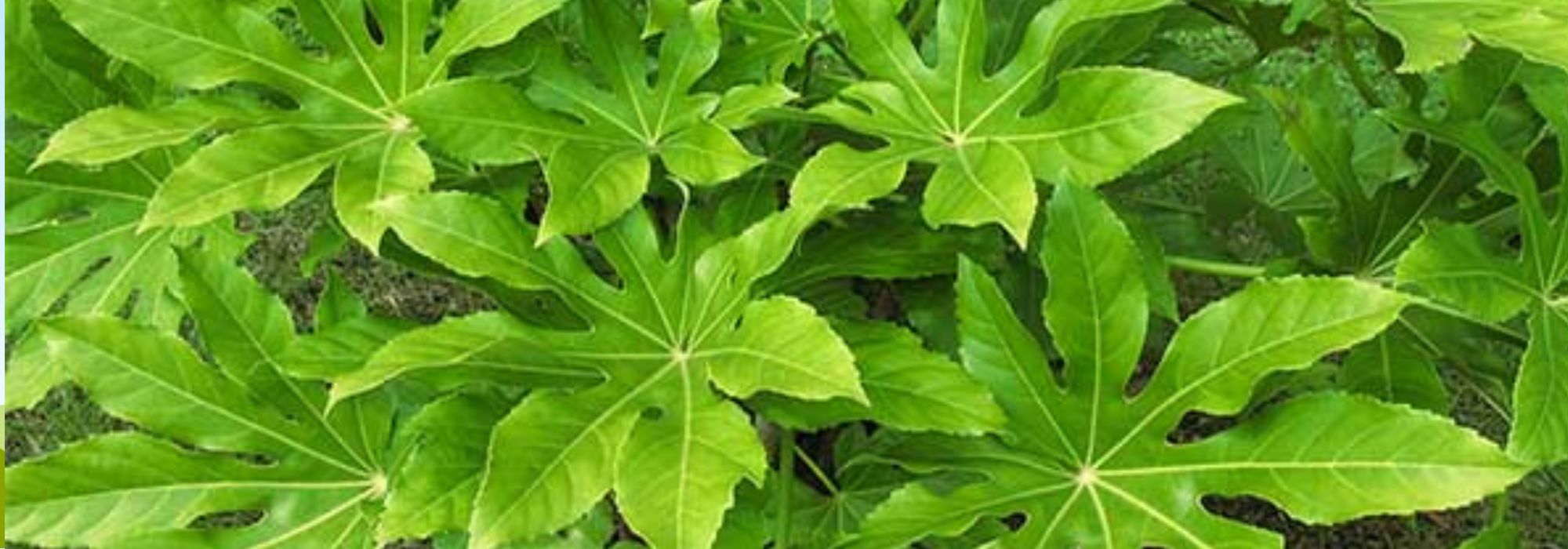
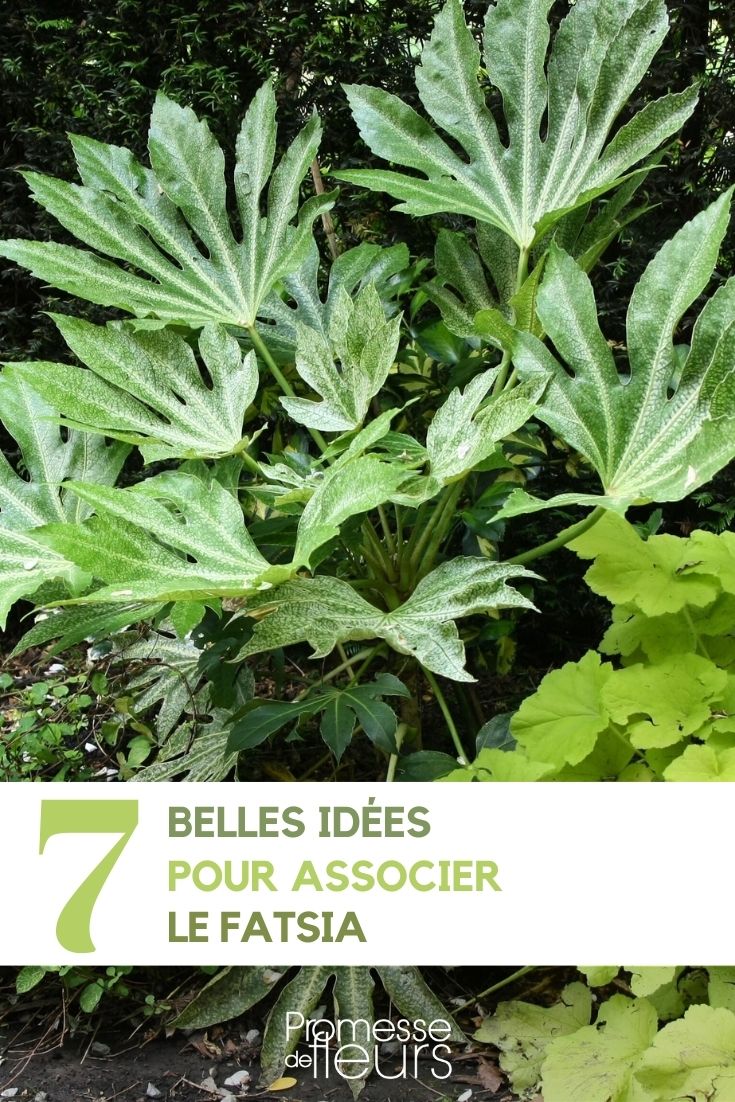
Fatsia or False-Aralia is an exotic shrub with lush, evergreen foliage, native to Japan, Korea, and Taiwan. Its large, deeply lobed leaves can exceed 30 cm in diameter and are borne on long petioles. There are few species of Fatsia, the most well-known being Fatsia japonica, commonly called Japanese Fatsia, which is also available in two beautiful variegated forms. Also discover the Fatsia polycarpa ‘Green Fingers’, a stunning specimen with narrow, finely lobed leaves that are very decorative.
Fatsia thrives in partial shade or light shade. Quite hardy for an exotic plant, tolerating temperatures down to about -12° C, it is well-suited to sheltered spots in city gardens, where its graphic appearance adds a lovely presence with minimal maintenance. Discover 7 pairing ideas to incorporate a Fatsia into your garden, courtyard, balcony, or terrace, and even indoors.

In an exotic atmosphere
Exotic-looking plant par excellence, Fatsia develops large palmate leaves, divided into 7 to 9 lobes, with a glossy appearance. They measure up to 30 cm in diameter and are supported by a long petiole. All these characteristics contribute to the tropical look of this bush. Often, lush, exotic gardens highlight foliage, playing with their shapes, sizes, textures, and possibly their colours, although the other criteria are sufficient to create contrast and variety.
In light shade, in well-drained soil, plant for example under the Fatsia japonica, a Farfugium japonicum, with very round leaves, reaching 60 cm in height, which benefits from the shade provided by the Fatsia. A Colocasia with lanceolate leaves, chosen in green or almost black-purple, accompanies them. However, these two plants are slightly less hardy than Fatsia, and depending on the species, they withstand temperatures of -5 to -10° C. Fatsia, on the other hand, tolerates frost down to -12° C. If you want to choose plants that are at least as hardy as Fatsia, consider Acanthes, which also have exotic potential in foliage and flowers. Palms like the well-known Trachycarpus fortunei or Chinese Windmill Palm, also very hardy, offer their fan-shaped foliage. Just like Musa Basjo or Japanese Banana. All these plants require fresh, rich soil. Farfugium offers a flowering of yellow daisies, and the Acanthus sennii adorns itself with bright red flowers at the end of summer.
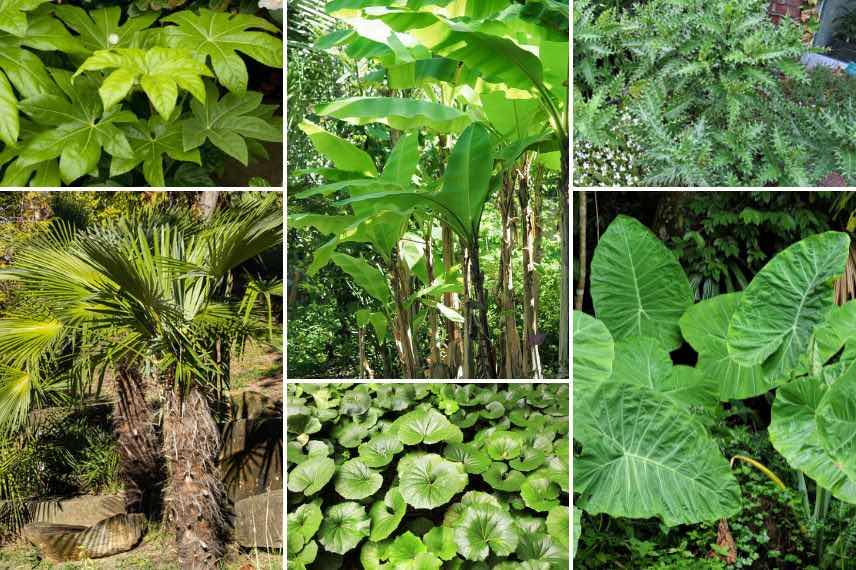
Clockwise: Fatsia japonica, Musa basjo, Acanthus sennii, Colocasia, Farfugium japonicum, Trachycarpus fortunei
In a shade garden
Fatsia dislikes direct sunlight; it thrives in partial shade, enjoying dappled sunlight or shade during the hottest hours, as well as light shade that is not too dense. A woodland or understorey environment, beneath the canopy of a tree, suits it perfectly.
Pair it with typical woodland plants that have attractive foliage and picturesque flowering. Here, a Fatsia japonica ‘Variegata’, variegated with white to bring in some light, is accompanied by Rodgersia aesculifolia, with horse chestnut-like leaves. Both plants reach heights of 1 to 2 m, forming a small backdrop. In front, add some perennials that enjoy similar conditions, such as Dicentra ‘Ivory Hearts’ or bleeding heart with white flowers, echoing the white variegation of the Fatsia. Also, plant some ferns, such as Dryopteris wallichiana and lovely Epimediums or fairy flowers, which bloom above the foliage.
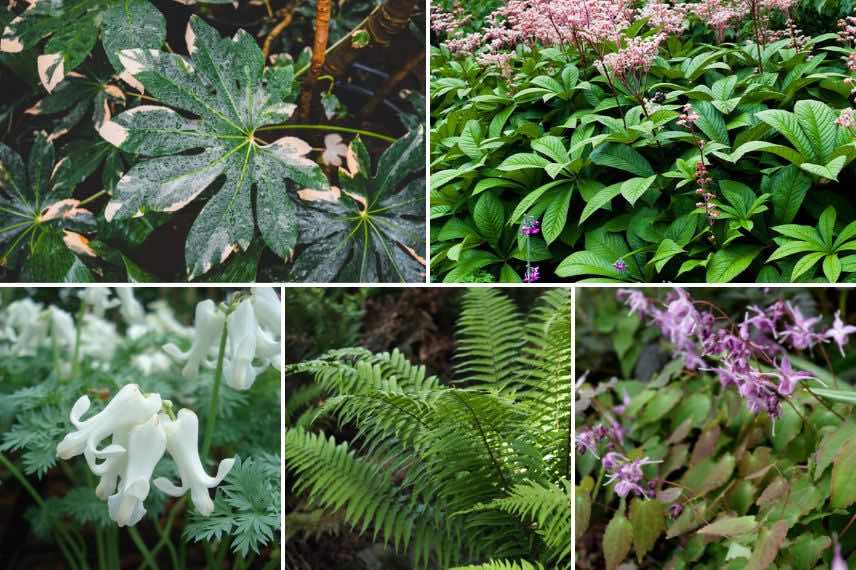
Fatsia japonica ‘Variegata’, Rodgersia aesculifolia, Epimediums, Dryopteris wallichiana, Dicentra ‘Ivory Hearts’
In a graphic city garden
Ultimately quite hardy for an exotic plant, Fatsia is even more so in a city garden, surrounded by walls that shelter it from cold winds. A small walled city garden is necessarily quite shaded, which is not a problem for Fatsia. Reaching 2 m in height at ripeness, its stature and ample foliage can also conceal unsightly vertical surfaces, especially since it is evergreen.
In this protected and shaded situation, plant a Fatsia japonica ‘Spider’s Web’, the brightest variety, splashed with white. It looks very attractive against a dark wall, a red brick wall, and is spectacular and graphic in front of a black-painted wall. Other evergreen shrubs like Aucuba, Holly, or certain Viburnums can accompany it. Also plant perennials like hostas or Heucheras at the front, which thrive in shaded conditions. Here, a Ilex crenata (box-leaved holly) trimmed into a ball shape is a great substitute for boxwood, which is too susceptible to diseases. The Euphorbia amygdaloides var. robbiae, with its rosette foliage and acid green flowering, is a very ornamental, also evergreen plant. A Caucasian forget-me-not, the Brunnera macrophylla ‘Jack Frost’, echoes the Fatsia with its variegated foliage. A stunning graphic fern, the Dryopteris wallichiana, and a groundcover carpet of Soleirolia soleirolii or Helxine complete the ensemble.
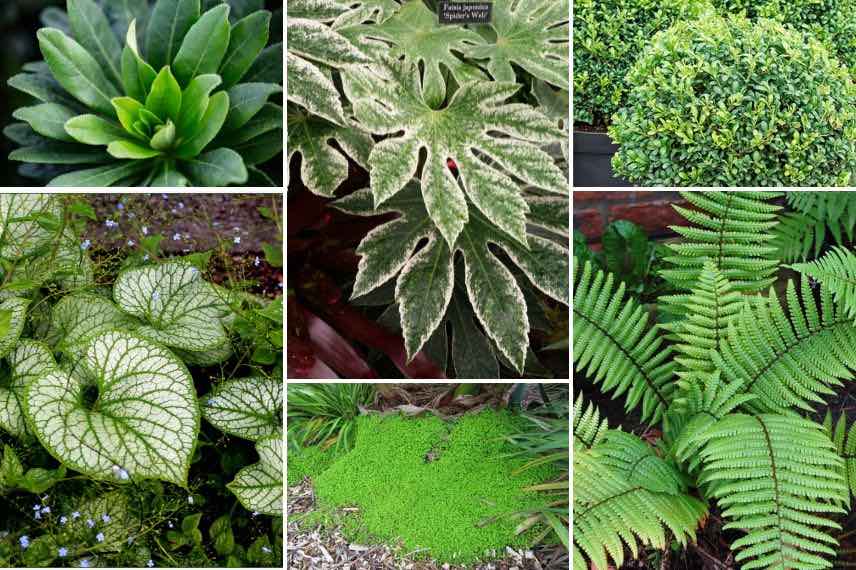
The rosette foliage of Euphorbia amygdaloides, Fatsia japonica ‘Spider’s Web’, Ilex crenata in a ball shape, Dryopteris wallichiana, Soleirolia soleirolii, Brunnera ‘Jack Frost’
In a Japanese-inspired atmosphere
Native to Japan, Korea, and Taiwan, Fatsia naturally pairs with Japanese garden plants that have similar cultivation needs. The Japanese garden emphasises foliage and simplicity, and the plants within it thrive in cool, woodland-like environments.
Plant a Fatsia japonica against a backdrop of Bamboos with naked culms. A tree fern, Dicksonia antarctica, adds its majesty and graphic fronds. A Japanese Maple brings a touch of whimsy with its foliage warmed by orange hues. A Hakonechloa, or Japanese grass, forms a rounded clump of luminous gramineous foliage. Also consider Hostas with green or variegated leaves.
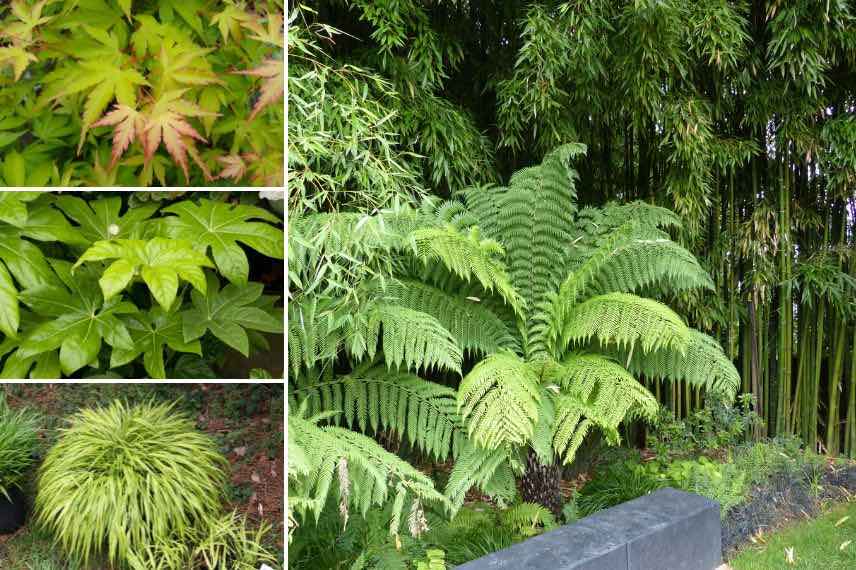
Japanese Maple, Dicksonia antarctica, Bamboos, Hakonechloa, Fatsia japonica
A tropical indoor scene
Fatsia can be grown as an indoor plant where it is important to provide a cool atmosphere (not heated), regular misting, and frequent watering in summer. It should be placed in a bright location, but out of direct sunlight. The beautiful Fatsia polycarpa ‘Green Fingers’ makes a refined specimen in a pot with its fine foliage and upright habit. It can be taken outside to a balcony or terrace during fine weather, while protecting it from the sun. However, it can remain indoors all year round.
A group of pots can be arranged to create a scene of exotic indoor foliage, accompanying this Fatsia with Schefflera and Aspidistra elatior, which has a dense bouquet of lanceolate leaves. You can also plant a Coniogramme emeiensis in a pot, a fern known as Bamboo Fern, which can also be grown as an indoor plant.
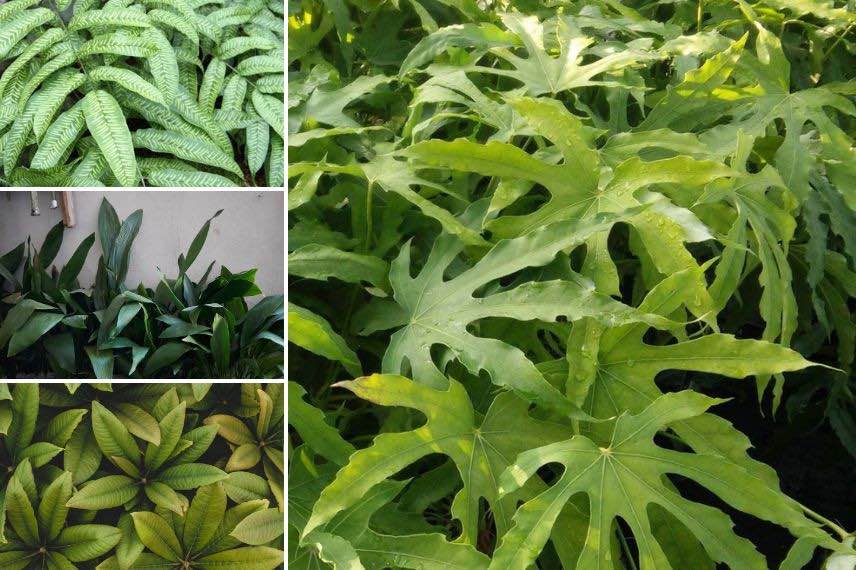
Coniogramme emeiensis, Fatsia polycarpa ‘Green Fingers’, Schefflera, Aspidistra elatior
In a pot garden on a terrace
The Fatsia japonica ‘Spider’s Web’ thrives in partial shade, in very cool, light, and rather neutral to acidic soil. If you have a terrace or balcony that receives morning sun, facing east or sufficiently sheltered by shade during the day, you can enhance the space with a beautifully sized plant like the Fatsia. Comfortable in a pot, this also allows you to create a custom substrate for it.
Create a lovely scene by adding to the large pot of a Fatsia ‘Spider’s Web’, variegated with dark green and white, smaller pots containing a plant with exceptionally long flowering, the Geranium Rozanne, with blue flowers. An Ajuga incisa ‘Frosted Jade’ offers very ornamental variegated foliage and flowers of a deep blue. Ophiopogon planiscapus nigrescens with black gramineous foliage, very graphic, perfectly fills small rounded pots, looking lovely alongside the blue flowers.
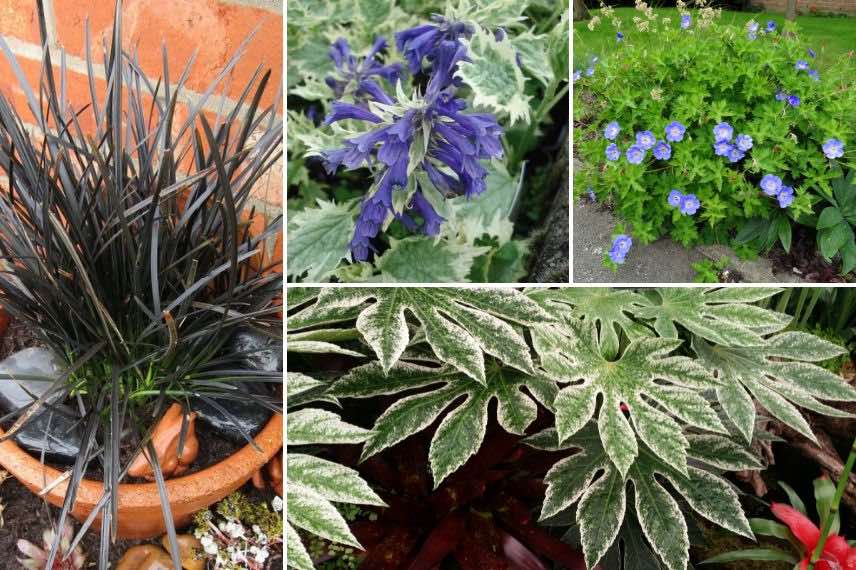
Ophiopogon planiscapus nigrescens, Ajuga incisa ‘Frosted Jade’, Geranium Rozanne, Fatsia Spider’s Web
With flowering plants in acidic soil
The fatsia prefers acidic or neutral soils, but not calcareous ones. It thrives in light, fairly rich soil. While it enjoys the coolness of the soil in summer, it requires well-drained soil to tolerate winter moisture. If you want to pair it with flowering plants, find companions with similar conditions, such as ericaceous shrubs and perennials, which generally prefer dappled light, partial shade, or light shade, along with light, cool, and well-drained soils. Don’t hesitate to add leaf mould and well-decomposed compost, which all of them appreciate.
In a small bed in partial shade, with morning sun, an Acer negundo ‘Flamingo’ forms a small tree that overlooks a Fatsia japonica ‘Variegata’ and a Rhododendron ‘Blue Tit’ with mauve flowers. They are accompanied by the lovely white flowers of the Azalea ‘Palestrina’, echoing the white touches of the Fatsia and a Camellia transnokoensis ‘Sweet Jane’ with pink flowers. The flowering period extends from February to May.
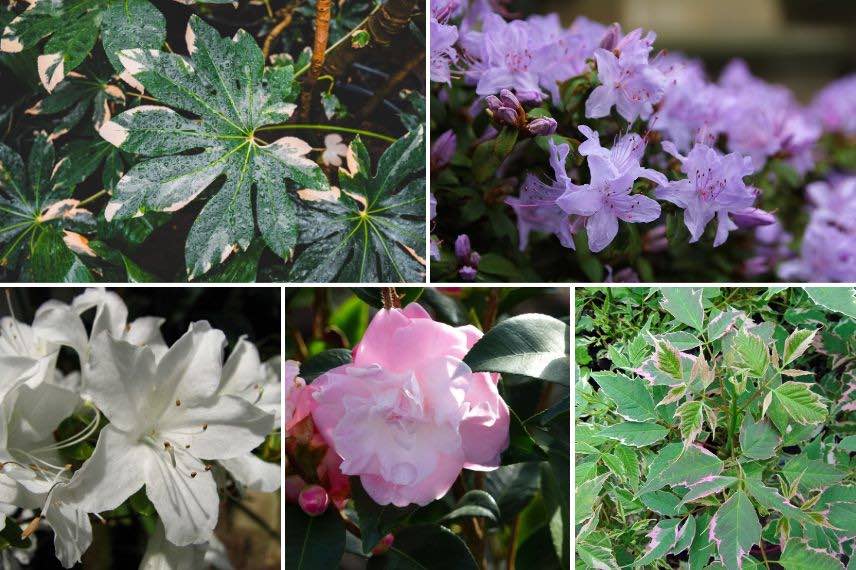
Fatsia japonica ‘Variegata’, Rhododendron ‘Blue Tit’, Acer negundo ‘Flamingo’, Camellia transnokoensis ‘Sweet Jane’, Azalea ‘Palestrina’
- Subscribe!
- Contents
Comments