


8 decorative fruiting viburnums
Discover the most beautiful Viburnums with colourful berries.
Contents
Viburnums or Viburnum are bushes valued for their lovely flowering typically in spring, white, sometimes pink, their decorative foliage, as well as their colourful berries. Indeed, depending on the species and varieties, they produce fruits yellow, orange, red, blue, black, and even pink… which are a delight for birds. The foliage of Viburnums can be deciduous, displaying beautiful red or orange hues in autumn, or evergreen, remaining decorative even in winter. Viburnums are easy to grow, requiring little maintenance, and are generally very hardy. They thrive in full sun or partial shade, in cool but well-drained soil. Depending on the species, they can be planted in hedges, as solitary specimens, or in shrub borders. Discover our selection of the most beautiful varieties of decorative fruit Viburnums!
And for everything you need to know about their cultivation, feel free to check our complete guide “Viburnum: planting, pruning, and cultivating”

Viburnum opulus
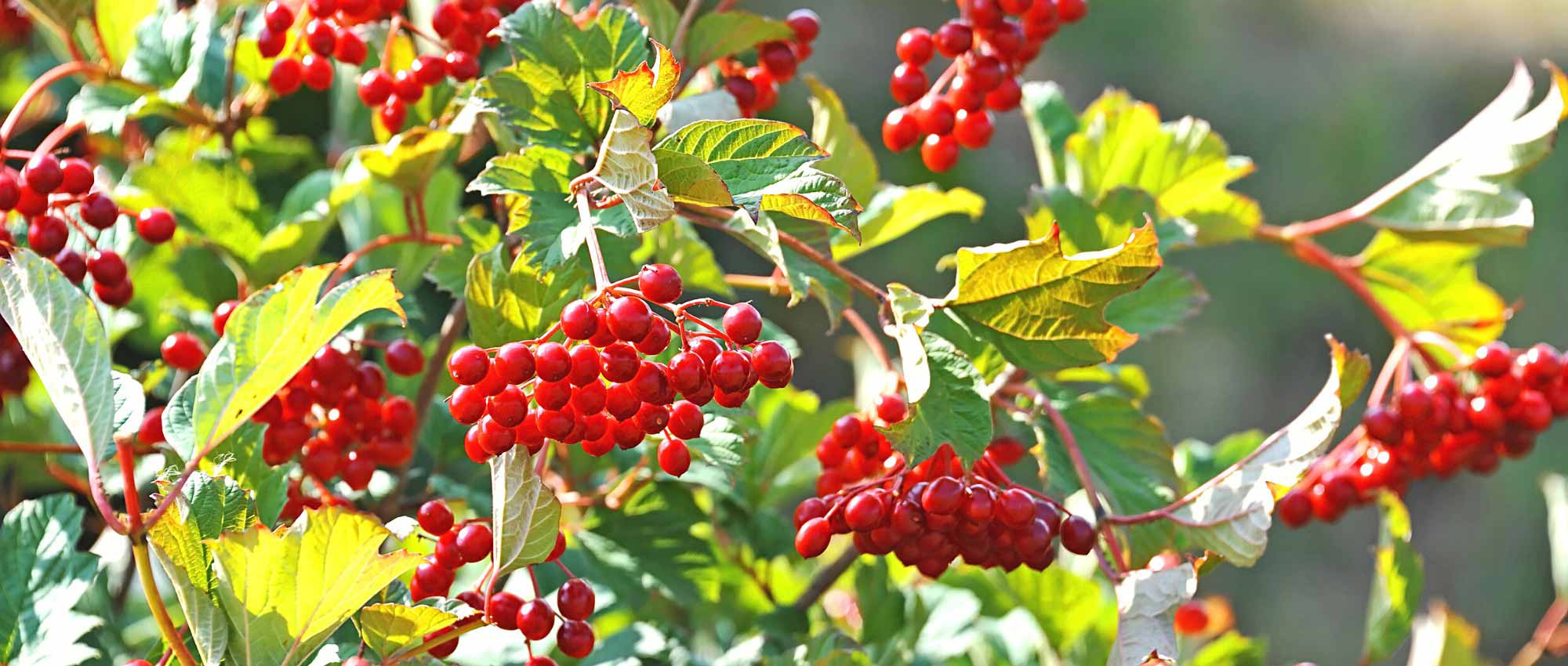
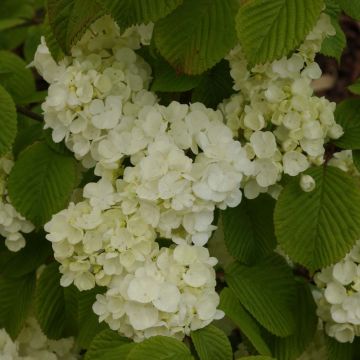
The most well-known viburnum for its colourful fruits is the Guelder rose, Viburnum opulus. This is a bush with a rounded habit, reaching about 3.50 m in height and 3 m in spread at maturity. It bears palmate leaves, divided into 3 to 5 lobes, which take on a beautiful purple hue in autumn before falling. In May-June, it produces white flowers arranged in large, flat umbels. The inflorescences consist of a cluster of small fertile flowers in the centre, surrounded by larger, sterile flowers with five petals. Melliferous, they are favoured by pollinating insects. These are followed by bright red, round berries, about 1 cm in diameter, clustered in pendulous clusters. These berries are enjoyed by birds.
The Guelder rose will beautifully accompany shrubs that display lovely autumn colours, such as spindle trees, maples, and dogwoods.
Viburnum opulus 'Xanthocarpum'
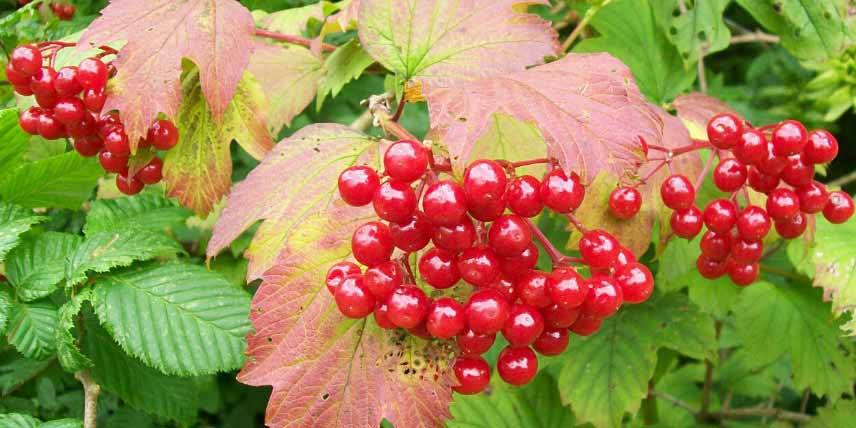
The Viburnum opulus ‘Xanthocarpum’ is a Guelder rose distinguished by its yellow fruits! In spring, around May-June, it produces white flowers grouped in flat corymbs. These are followed by the appearance of orange-yellow berries, unlike the classic Viburnum opulus, which bears red berries. We appreciate their bright hue! It also features beautiful lobed leaves that turn purple in autumn with the arrival of cold weather. It forms a rounded, bushy shrub, reaching about 2 m in all directions.
Pair it with shrubs that offer berries in shades of red, orange, or yellow, such as pyracantha, cotoneaster, and ornamental crab apples.
Discover other Viburnum
View all →
Available in 3 sizes
Available in 2 sizes
Available in 3 sizes
Available in 3 sizes
Available in 2 sizes
Available in 1 sizes
Available in 3 sizes
Available in 1 sizes
Available in 2 sizes
Available in 2 sizes
Viburnum dilatatum
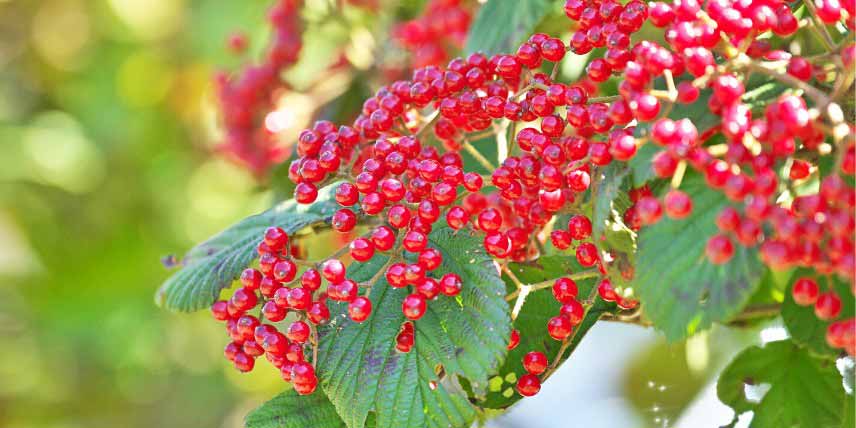
When it comes to decorative fruits, Viburnum dilatatum is just as impressive as the Guelder rose (Viburnum opulus)! It blooms abundantly in May-June, producing large umbels (over 10 cm in diameter) made up of numerous small white flowers with long stamens, giving them a fluffy appearance. They are followed by the appearance of countless bright red berries, which are favoured by birds. Its leaves, deciduous, resemble those of the lime tree. They are deeply veined and delicately dentate along the edge of the lamina. The leaves turn a beautiful dark red in autumn before falling. It grows quickly and forms a bushy, well-branched shrub, reaching 1.5 m to 2 m in all directions.
There are many varieties of Viburnum dilatatum with decorative fruit: ‘Sealing Wax’, which bears lovely bright red, shiny berries, ‘Michael Dodge’, with yellow berries, ‘Tandoori Orange’, with orange berries… In the garden, you can combine these different varieties, as their warm colours blend very well together. They will also look perfect alongside the red berries of a rowan (Sorbus aucuparia) and the unique fruits of a European spindle.
Read also
Viburnum: 8 successful pairing ideasViburnum davidii
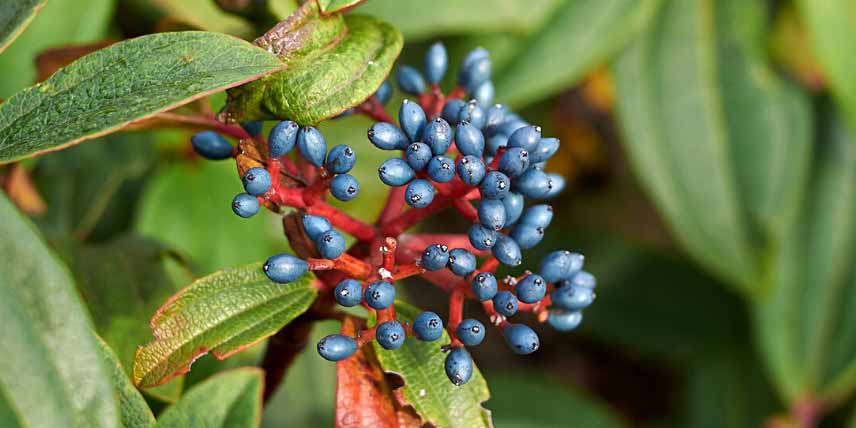
The David viburnum or Viburnum davidii is a small bush with a compact, bushy habit, reaching a height and width of between 1 m and 1.5 m at maturity. It features beautiful evergreen foliage, dark green and glossy, marked with parallel veins. The leaves are ovate, measuring 10 to 15 cm long, and are nicely highlighted by the red petioles that support them. It flowers in June, producing flattened corymbs, 5 to 7 cm in diameter, bearing small white flowers. These are followed by stunning dark blue glossy fruits, with an almost metallic hue and an oblong shape. Note that Viburnum davidii is dioecious: several plants are needed to produce berries.
The berries of the David viburnum will be ideal to accompany the small turquoise blue fruits of the Ophiopogon japonicus. They will also pair well with the white berries of the Actaea pachypoda ‘Misty Blue’.
Viburnum dentatum 'Blue Muffin'
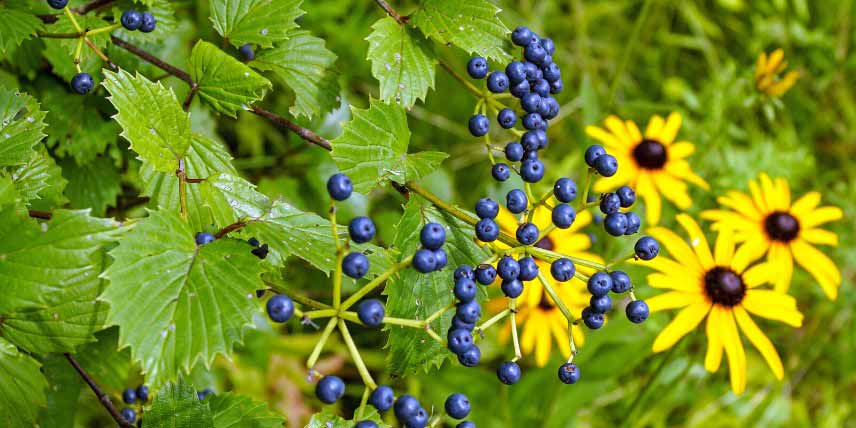
We remain in a beautiful metallic blue hue with the stunning fruiting of the Viburnum dentatum ‘Blue Muffin’! This is a deciduous bush with a well-branched and bushy habit, reaching about 2 m in height and 1.5 m in spread. In May-June, it produces white flowers gathered in flat corymbs, with a light and airy appearance. These are followed by a multitude of small, intensely blue berries that are highly decorative. They remain on the bush for a good part of winter, unless devoured by birds! Its fruiting is particularly abundant! It also bears beautiful, glossy dark green leaves, with well-defined veins and a dentate edge (which gives it its name, Viburnum dentatum: the dentate viburnum). In autumn, its foliage turns golden yellow, then orange, finally becoming dark red, with copper and mahogany highlights.
Dare to create contrasts by pairing the blue berries of ‘Blue Muffin’ viburnum with yellow flowers such as those of Rudbeckias and Dahlia ‘Golden Emblem’.
Viburnum odoratissimum
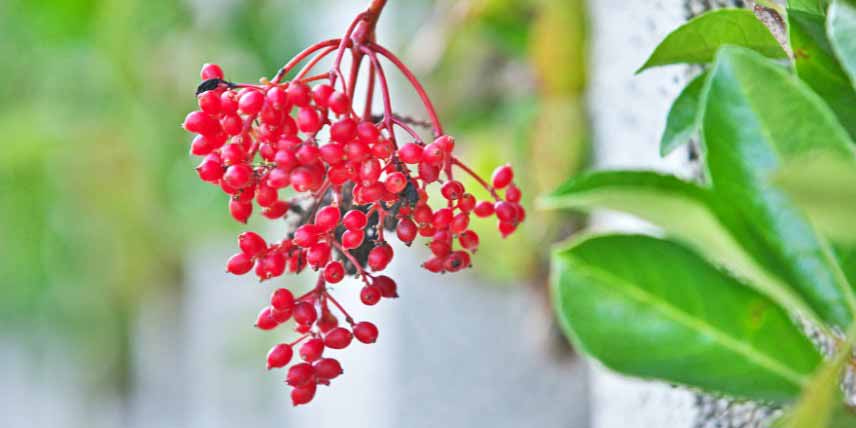
Fragrant viburnum, or Viburnum odoratissimum, is a beautiful bush with evergreen foliage. It reaches about 2 m in all directions. Its leaves are elongated, dark green, and glossy. In spring, from May to June, it produces panicles of fragrant white flowers that attract pollinating insects. These are followed by pyramidal clusters of red-orange berries. In autumn, some of its leaves take on a red hue, which is rare for an evergreen bush!
The red fruits of fragrant viburnum will be perfect for complementing decorative wood shrubs, such as Cornus alba ‘Baton Rouge’, Cornus sanguinea, or Prunus serrula ‘Amber Scot’. You can also pair them with the red berries of Viburnum dilatatum ‘Sealing Wax’ and the yellow berries of Viburnum opulus ‘Xanthocarpum’.
Viburnum nudum 'Pink Beauty'
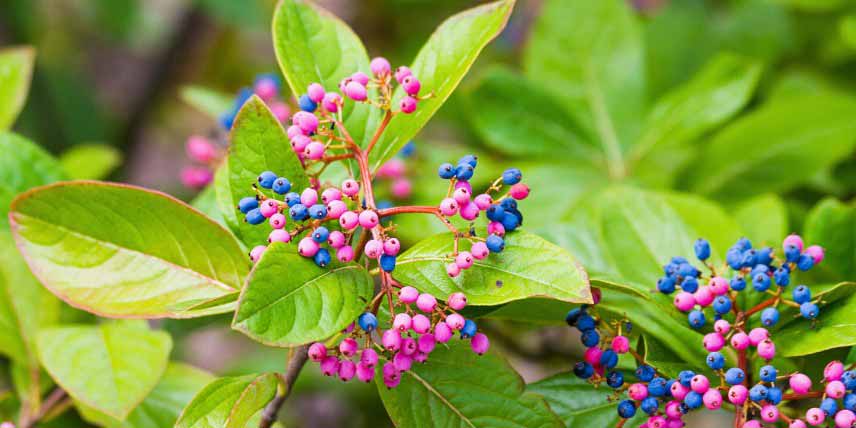
Viburnum nudum ‘Pink Beauty’ (not to be confused with Viburnum plicatum ‘Pink Beauty’) is distinguished by its candy-pink berries! This is a deciduous bush with a nival zone habit, reaching about 2 m in height and 1.5 m in spread. It bears long, slender, glossy dark green leaves that take on beautiful autumn colours in shades of red, purple, and burgundy. In early summer, it produces corymbs measuring 10 to 15 cm in diameter, made up of small white flowers that are highly melliferous. These are followed by bright pink berries, which turn blue-violet at ripeness.
It will be perfect alongside other shrubs that offer decorative berries in soft shades of white, pink, mauve, or purple, such as callicarpa and symphorine.
Viburnum lantana
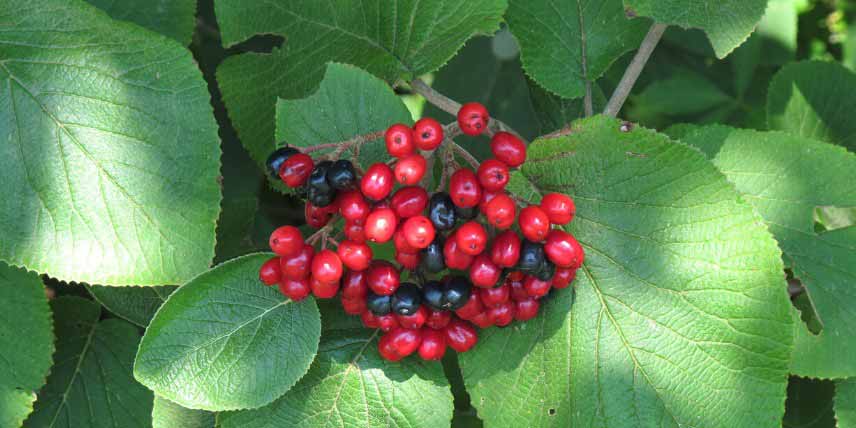
Wayfaring tree, Viburnum lantana is a bush that grows spontaneously in France, mainly in clear woods and scrubland, on calcareous soil. It forms a bushy habit, about 3 m in height and 2 to 3 m in spread. It bears deciduous grey-green leaves, which later turn dark green. From April to June, it produces fragrant white flowers, gathered in clusters 4 to 10 cm in diameter. These are followed in autumn by spherical fruit clusters, first red then black at ripeness, often with both colours present simultaneously.
Plant the wayfaring tree in a free-standing hedge alongside other bushes with a rustic charm, commonly found in our countryside: European spindle, hazel, blackthorn, rowan… for a very natural style garden!
- Subscribe!
- Contents
Comments