



























Apple trees: why choosing heritage and local varieties?
For their natural resistance, for biodiversity and for the preservation of heritage
Contents
Among nearly 6,000 apple varieties that exist, only a small handful end up in our supermarkets. The old varieties, which nevertheless have many qualities, are all too often neglected in favour of modern varieties, regarded as more productive and more disease-resistant.
However, the preservation of apple varieties is a real cultural and environmental issue. So, since apple trees are very popular fruit trees in gardens and remain the most cultivated in Europe, why not prioritising these varieties? Let us rediscover together their many benefits and the main varieties involved.
In addition, to learn everything about growing apple trees, discover our comprehensive guide: Apple tree: planting, pruning and care.

The origins of apple trees
Apple trees (Malus domestica) are fruit trees in the Rosaceae family (pears, plums, cherries, but also roses, spireas…). They are native to temperate regions of the northern hemisphere.
They are plants that have been cultivated for centuries. About 60 Malus species, whether ornamental or fruiting, exist in the wild.
In France, from the 1930s onwards, heritage apple trees suffered the consequences of technical progress, and the campaigns to uproot cider apple trees, officially to combat alcoholism in rural areas. Rural exodus also contributed to the abandonment of some orchards. Local varieties then began to disappear.
Over time, many selections and cross-breeding have been carried out to obtain cultivars with fruits that are more homogeneous and well-calibrated, without ‘imperfections’. In parallel, they offer higher and more regular yields, as well as a long shelf life, which helps meet the pace of modern production and consumption. Some recent varieties have also been developed to better resist diseases, notably apple scab, which makes them easier to grow. That is why in mainstream stores there are only a few varieties of apples, despite the wide diversity, such as the ‘Golden Delicious’, the ‘Gala’, the Pink Lady or the ‘Granny Smith’. Their flavour also better matches contemporary expectations: their fruits are less acidic, sweeter, pleasing to the majority of palates.
Today, even though the apple is often linked to the Normandy region in the minds of consumers, it is mainly produced in Occitanie, in Pays de la Loire, in PACA and in Nouvelle-Aquitaine (source: French Chambers of Agriculture 2022).
Heritage and local apples: varieties suited to our climates.
This is the first argument in favour of heritage and locally grown apple trees. Like all native plants, that is, native to the territory where they grow, they are naturally varieties that are adapted to all medium conditions. This includes:
- the type of soil;
- the weather conditions;
- the pests and parasites.
As a result, they will display greater resistance to these factors and only varieties able to withstand them could survive, by natural selection. For example, in a region where late frosts can occur, the apple tree’s flowering may naturally be delayed to avoid damage. In a very damp region, the fruit tree may prove more resistant to cryptogamic diseases.
Thus, these apple trees naturally require less care than some of their modern counterparts: protection against cold, sanitary treatments (fungicides, antiparasitics…), watering, pruning, etc. Their cultivation therefore saves time and money, while limiting the use of substances that may prove harmful to the environment.
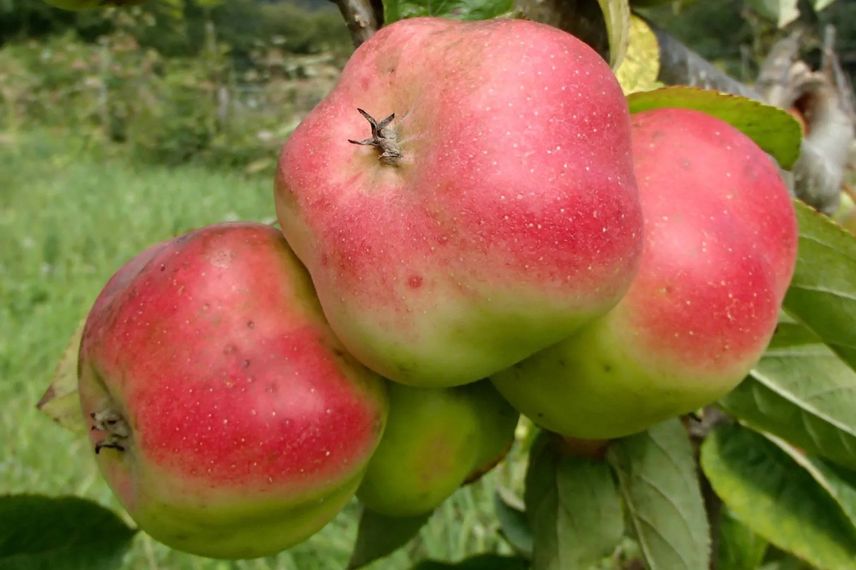
Pommier ‘Api Étoilé’
Apple trees adapted to local biodiversity
When they are native to a given area, fruit trees blend seamlessly into the landscape at all levels. If we have just seen that they can tolerate growing conditions, they will also contribute to the balance of the medium. Thus, they will be fully adapted to local biodiversity: other plants, insects, birds, small mammals, etc.
Old varieties are often excellent pollinators, enabling the flowering of other apple trees, but also of plants growing nearby.
Read also
What are the best apple varieties?The importance of safeguarding food heritage.
Heritage apple trees remind us how nature rewards us with a wide palette of flavours. Choosing to not let old varieties disappear is not just nostalgia. It is a means of safeguarding the genetic heritage of these plants that form part of our culture and history. This helps avoid homogenisation of flavours, shapes and textures, and enhances a terroir.
But preserving a rich genetic heritage also helps reduce the risk of epidemics. The presence of these old, locally grown apple trees is just as important for the future: they can be studied to address our current climate challenges in terms of adaptation to a medium. They are also essential to continually developing new cultivars.
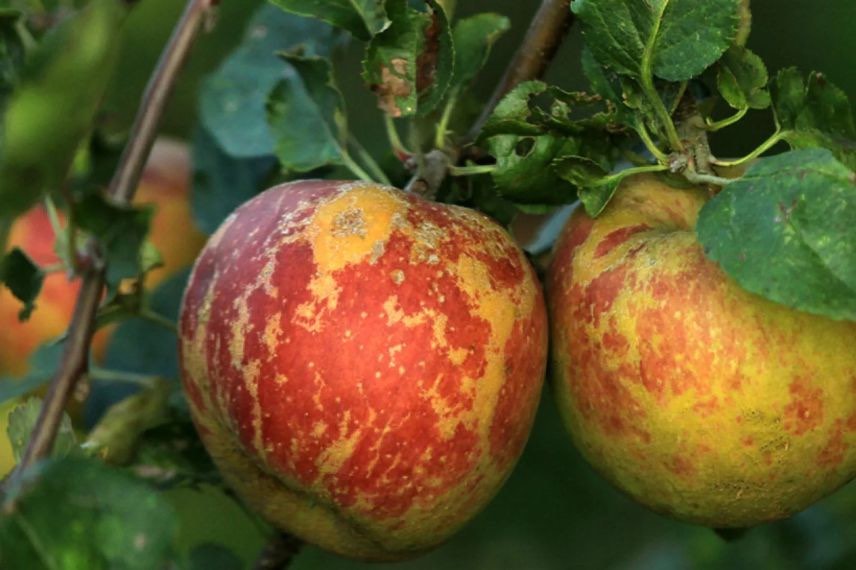
Apple tree ‘Chailleux’
What are the old and local apple varieties?
You can find heritage apple trees:
- online, notably on our site 🙂 ;
- in nurseries;
- directly from local producers;
- at some markets.
There are also conservation plots or local preservation associations dedicated to safeguarding them.
There are dozens of heritage apple varieties.
- The apple tree ‘Châtaignier’. This is a variety particularly cultivated in Normandy for cider or apple juice. It produces yellow-green fruits, mottled with red, which keep for many weeks after harvest. They offer a fairly sweet flavour, with tender flesh and a thin skin. It is an apple tree resistant to apple scab.
- The apple tree ‘Calville Rouge d’Hiver’. It yields blood-red apples with rosy flesh, which gives them their name of ‘Sanguinole’. Their taste is tart and sweet, the flesh melting and juicy. It is an apple ideal for eating raw, which stores well. Best grown in regions not too hot in summer.
- The apple tree ‘Astrakan rouge’. An early variety whose fruits can be eaten from mid-July. Its flesh is juicy and fragrant. This fruit lends itself equally to eating raw or cooked. Its flowering, which occurs only in May, is ideal for regions prone to late frosts. It is a variety perfectly suited to high-altitude areas, thanks to its cold resistance.
- The apple tree ‘Api étoilé’, whose fruits have a distinctive star shape. Their skin is green, tinged with pink on the sun-exposed side. It is a scented apple, but not very juicy. Harvesting takes place at the end of the year, for long keeping until May. To be eaten raw or cooked.
- The apple tree ‘Chailleux’. A variety widely cultivated in Brittany, well productive. Its colourful apples offer crisp, juicy and sweet flesh. They are prized for making cider, but store very well as well. It is a disease-resistant fruit tree.
- The apple tree ‘Reinette Clochard’, which yields very good eating apples. Of a yellow skin flecked with brown, they offer fragrant, sweet and tangy flesh. It is also a variety that stores until spring.
- The apple tree ‘Belle Fille de Salins’, a rare variety originating from the Jura. Its fruits can be eaten straight from the tree. They are nicely coloured, crisp and sweet. This apple tree is very resistant to cold and to diseases.
- The apple tree ‘Bon Père’. Very old, this generous variety yields large yellow-green apples. The fruits are crunchy, sweet and tart. They can be enjoyed as is or transformed for savoury or sweet recipes.
- The apple tree ‘Calville Alexandre’. It rewards us with large-calibre fruits, with firm, crisp and fruity flesh. Some palates detect notes of banana. It stores well through winter.
- The apple tree ‘Douce Coët Ligné’. This is an old cider apple variety. Vigorous and hardy, it yields well. Its fruits display an ochre colouring and reward us with a sweet-and-tart flavour. It is also a good apple for vinegar or juice.
- The apple tree ‘Jacques Lebel’, a large-growing variety. It yields yellow apples striped with pink. They are well suited to making sweet dishes (tarts, compotes, fritters, etc.).
- The apple tree ‘Pigeonnet de Jerusalem’. Its apples are yellow striped with carmine. They have a sweet and tart flavour, very balanced on the palate. They are perfect dessert apples, but also good for recipes or juice making.
- The apple tree ‘Bénédictin’ or ‘Reinette Normande’. As its name suggests, it is a very common variety in Normandy. It yields large yellow-orange fruits, well flavoured. It can be eaten raw or incorporated into pastries, compotes and juices.
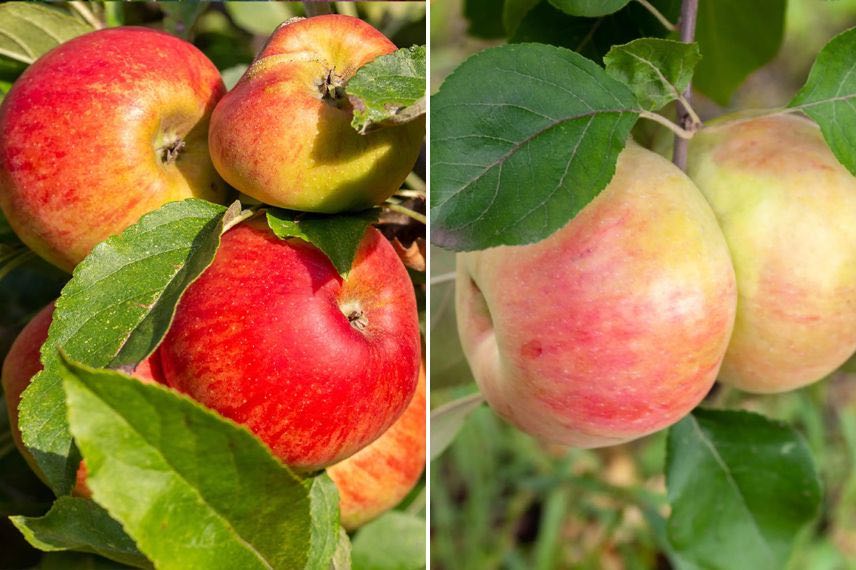
Apple tree ‘Châtaignier’ and ‘Bénédictin’
- Subscribe!
- Contents
Comments