





























Pairing ideas with Echium or viper's bugloss
Invite viper's bugloss into your sunny garden.
Contents
The Echium or Viper’s Bugloss is a herbaceous or bushy plant that takes on different forms depending on the species. Common features of all Echiums include their flowering spikes, short lifespan, and ability to self-seed in poor soil and mild climates. The Echium pininana or Canary Island Viper’s Bugloss is a spectacular exotic bush with long, large blue candles. The Echium candicans, also known as Echium fastuosum or Madeira Viper’s Bugloss, forms a large silver bush with medium-sized candles. These two species are remarkable for their architecture and the intense blue of their spikes.
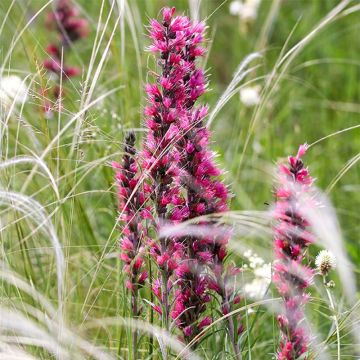
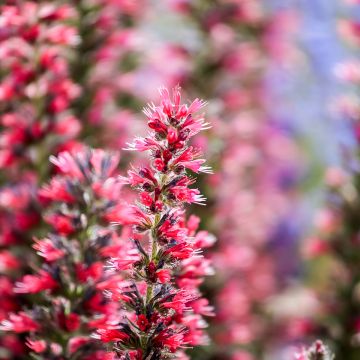
Two other species are cultivated: Echium russicum and Echium vulgare, perennials reaching 90 cm in height with light spikes, pink-red and blue-violet.
In well-drained, dry soils, in full sun and sheltered from the wind, try cultivating Echiums by planting or sowing, enjoying the sight of them wandering elsewhere in the garden. Discover possible associations with these beautiful wildflowers.

In a sunny border
Viper’s Bugloss thrives in sunlight and warmth, in very well-drained soil all year round. Its frost resistance varies depending on the species. The large shrubby Viper’s Bugloss, Echium pininana and Echium candicans (syn. fastuosum), suffer from temperatures below 0° C and are reported to withstand brief frosts of around -5° C in well-drained, dry soil during winter. They should be grown in USDA zones 10a to 9a.
The Echium fastuosum is more floriferous in cool, rich soil, but this shortens its lifespan, which is around 5 to 7 years. It forms a bush approximately 1.5 m tall and 3 m wide. Also known as Madeira Viper’s Bugloss, its silver rosette foliage is accompanied by long, dense spikes of intense blue flowers, measuring 25 cm. It is a very beautiful, graphic, and spectacular species, as well as a wild plant that wanders and self-seeds if conditions allow.
Plant it in a dry border, alongside companions such as Salvia guaranitica ‘Black and Blue’ and Salvia jamensis ‘Reve Rouge’, along with a Fuchsia magellanica var. gracilis. Sowing the annual Nigella papillosa ‘Midnight Blue’ adds touches of dark blue throughout.
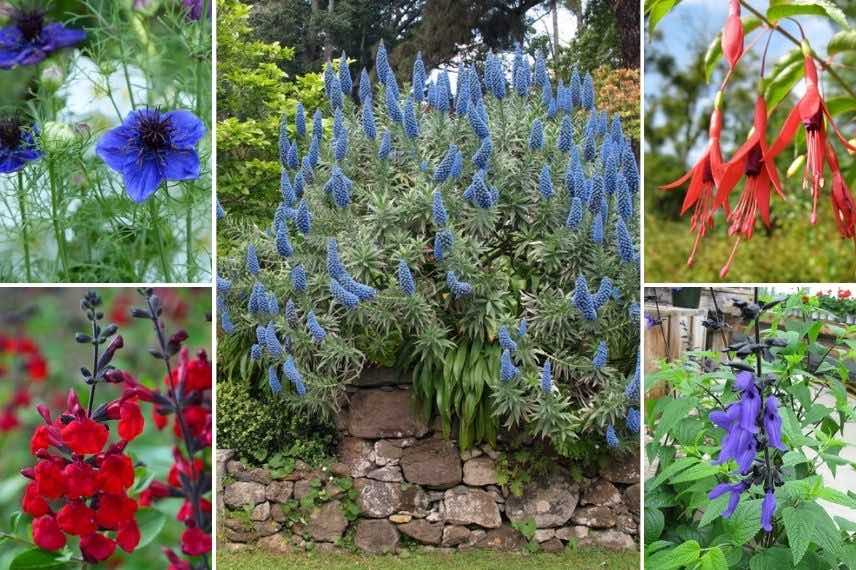
Nigella papillosa ‘Midnight Blue’, Echium fastuosum, Fuchsia magellanica var. gracilis, Salvia guaranitica ‘Black and Blue’, Salvia jamensis ‘Reve Rouge’
Isolated
Beautiful and large specimens like the Macaronesian viper’s bugloss, Echium pininana and Echium fastuosum, are certainly showcased when planted as solitary plants. The Echium fastuosum, mentioned in the previous paragraph, makes a stunning focal point, drawing all eyes.
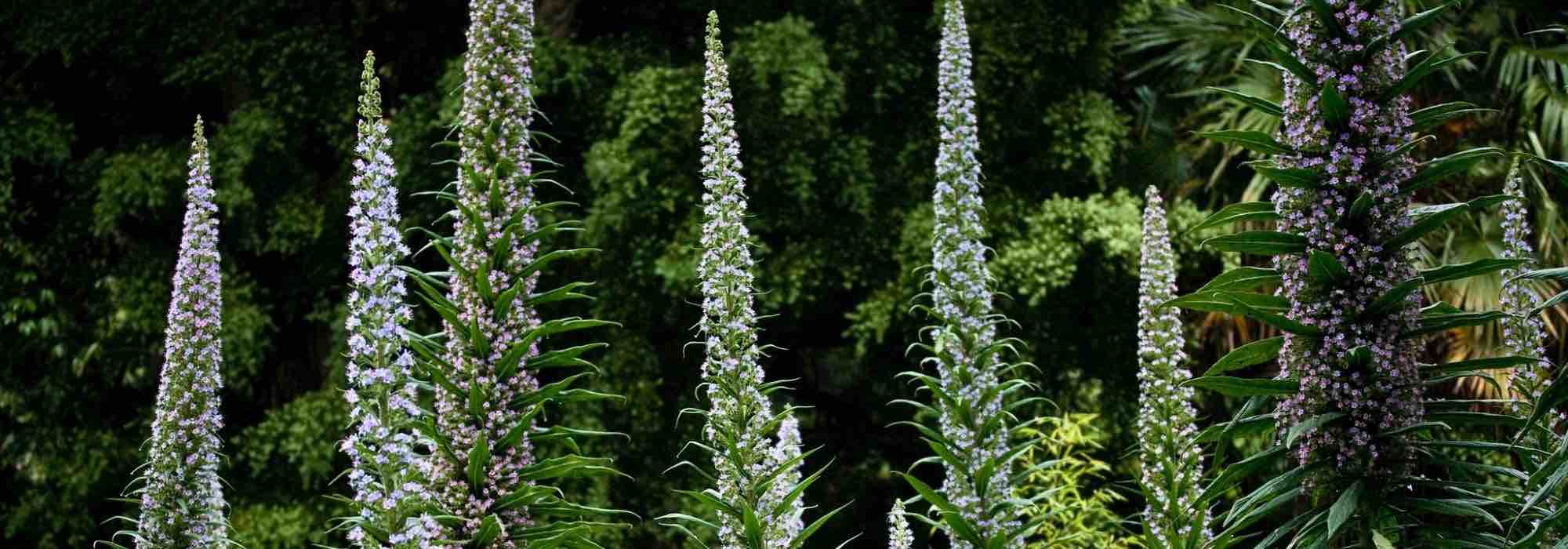
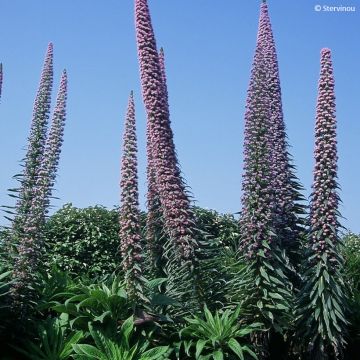
Let’s focus here on the Echium pininana, giant viper’s bugloss, particularly impressive with its immense spikes that can reach heights of 3 to 4 m! It produces a lovely basal rosette, relatively modest compared to the subsequent growth of the flower of this viper’s bugloss. It is a biennial, flowering 1 to 2 years after the appearance of its foliage and then disappearing, having not forgotten to self-seed. If you have several plants, you will achieve, for a short time, a truly impressive display. In a well-exposed and sunny position, its spikes grow upright and reach towards the tall bushes and palms.

Echium pininana
Discover other Echium - Viper's-buglosses
View all →
Available in 2 sizes
Available in 1 sizes
Available in 1 sizes
Available in 1 sizes
Available in 1 sizes
Il semble que votre message soit incomplet. Pourriez-vous fournir le texte que vous souhaitez traduire ?
In a container or large pot, you can grow all Viper’s-bugsbane. The Canary Viper’s-bugsbane, Echium Pininana, produces one stem per rosette, so you can also plant it in a pot. This is an interesting solution for anyone who does not have soil suitable for growing these captivating plants. It is also a good option for those with harsher winters, provided you can keep it during winter in very bright, frost-free conditions, such as in a conservatory or greenhouse.
The Echium candicans or Madeira Viper’s-bugsbane requires a very large container. The smaller Viper’s-bugsbane, which we will explore next, can be easily planted in pots mixed with perennials or annuals for dry soil.
Read also
Climate zones and USDA zones in FranceExotic atmosphere
It will not have escaped your notice that the two giants we discussed in the previous chapters have a distinctly exotic appearance. The conditions they favour naturally make them companions for many plants from mild climates, as well as many plants from far-flung regions. Plant it alongside Cordylines, Agapanthus, Melianthus major, or Geranium maderense.
Let’s create an exotic scene for our charming Madeira Viper’s Bugloss. Here, Echium fastuosum is accompanied by Aloe arborescens, Euryops chrysanthemoides, or African Bush Daisy, reaching 90 cm in height, and a large Euphorbia with a honey scent, Euphorbia mellifera.
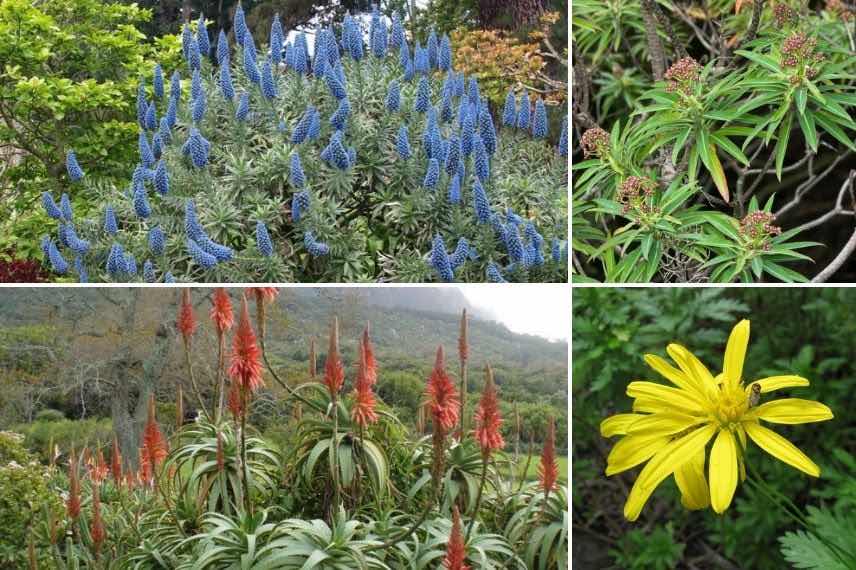
Echium fastuosum, Euphorbia mellifera, Euryops chrysanthemoides, Aloe arborescens
In a Mediterranean garden
More specifically than the sunny border, the Mediterranean garden brings together all the necessary conditions for growing Viper’s Bugloss: dry, poor, stony soil, very well-drained to filter winter rains, with no risk of stagnant moisture. It is conducive to the cultivation of wanderers, these short-lived plants that self-seed spontaneously in light soil.
Accompany Viper’s Bugloss with typical plants of Mediterranean gardens: Cistus, Lavender, Euphorbia…
For example, plant the Echium pininana in a walled garden, well sheltered from the wind that may break its stem, in a green garden, in an herb garden. Here with a Pittosporum tobira ‘Nana’ that contrasts in roundness, long stems of Fennel, Foeniculum vulgare, and a Phillyrea angustifolia, with narrow leaves similar to those of the olive tree.
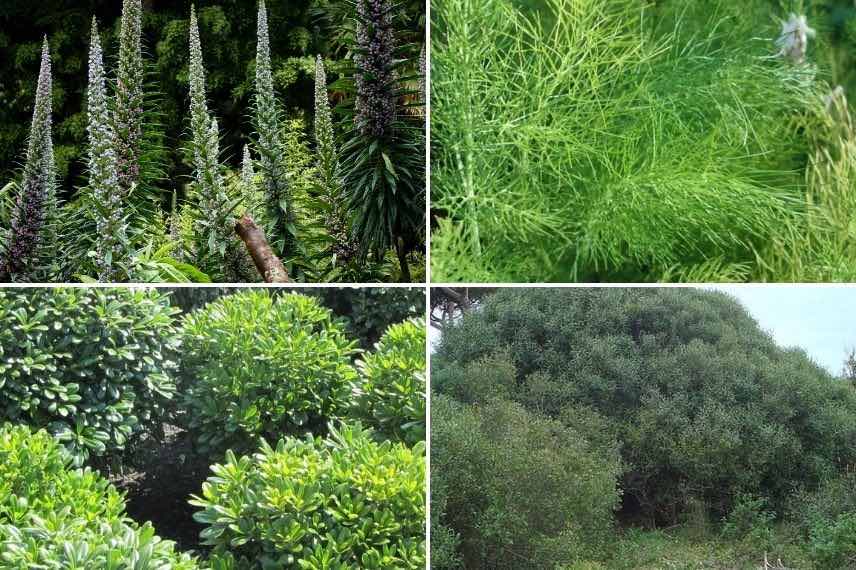
Echium pininana, Foeniculum vulgare, Phyllirea angustifolia, Pittosporum tobira ‘Nana’
By the seaside
Coastal gardens along the Atlantic can certainly embrace the large Madeira and Canary Vipers, as they adapt perfectly to sea spray. However, be sure to protect them from the wind.
Imagine an Echium fastuosum with a Tetrapanax papyrifera ‘Rex’, a Hedychium gardnerianum, and a Brugmansia arborea along with a Provence Reed, Arundo donax.
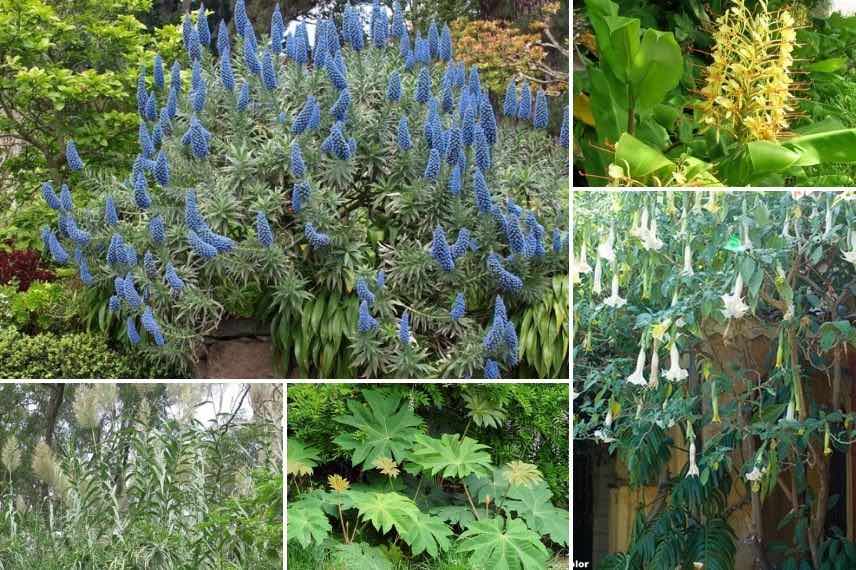
Echium fastuosum, Hedychium gardnerianum, Brugmansia arborea, Tetrapanax papyrifer ‘Rex’, Arundo donax
On the edge
Let’s now turn to the more modest species of Viper’s Bugloss: Echium russicum, Echium vulgare, and the variety Echium vulgare ‘Blue Bedder’. All three are distinct and lack the monumental character of the shrubby species. However, this does not detract from their appeal.
Let’s highlight the Echium vulgare ‘Blue Bedder’, a dwarf variety of Echium vulgare, which reaches a height of 30 cm. Annual or biennial, it is used in borders, rockeries, slopes, and as a foreground plant in beds. It offers a remarkable and prolonged flowering with spikes adorned with a multitude of tiny, intense blue flowers, capturing attention. It opens in pink buds and fades to purple, all with elegance. It self-seeds abundantly in light, rather dry soil and delights pollinators.
For enjoyment, a completely blue combination with several annuals: Phacelia, the cornflower Centaurea cyanus, the Nigella papillosa ‘Midnight Blue’, around the Echium vulgare ‘Blue Bedder’, and a perennial: Linum perenne, the Perennial Flax.
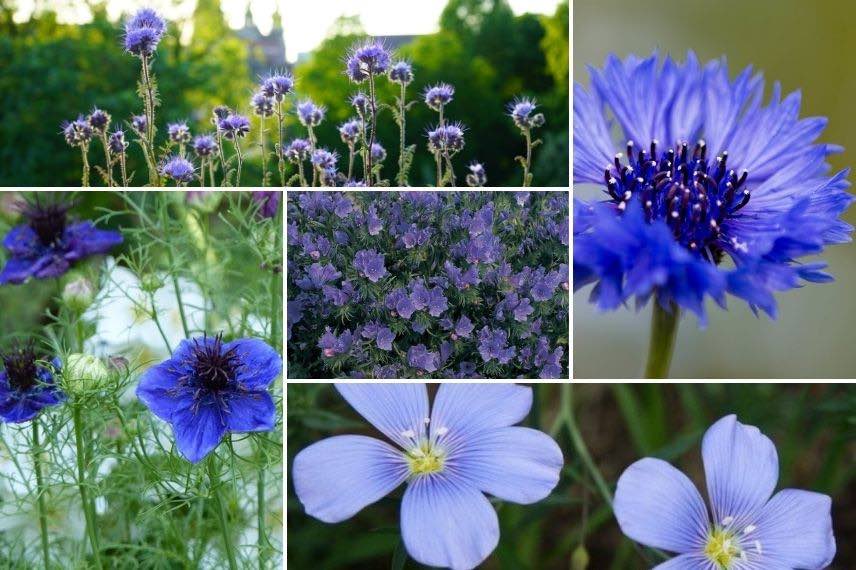
Phacelia, Centaurea cyanus, Perennial Flax, Nigella papillosa ‘Midnight Blue’, around the Echium vulgare ‘Blue Bedder’
On a slope or in a rockery
On a slope or a large rockery, plant the beautiful Echium russicum, with long dark red spikes and small old rose and wine-coloured flowers. Grown as a biennial or perennial in well-drained soil with mild winters, it is hardy down to -10° C. Like the Madeira viper’s bugloss, it thrives in fresh, rich soil, although its longevity may suffer.
Standing at 90 cm, plant it in very natural scenes, alongside blonde grasses that complement it beautifully, with summer and late summer flowering perennials.
Here, the Kniphofia ‘Nancy’s Red’, with coral red spikes, and the Echinacea ‘Tangerine Dream’, vibrant in mandarin orange, pairs beautifully with Echium russicum, alongside Pennisetum orientale ‘Karley Rose’, a lovely blue globe thistle, Echinops bannaticus ‘Taplow Blue’, and a Stipa tenuifolia.
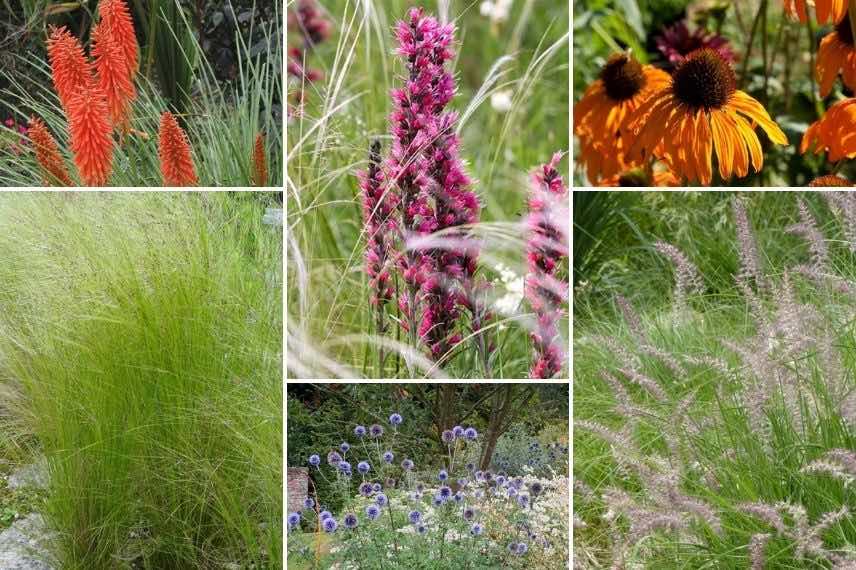
Kniphofia ‘Nancy’s Red’, Echium russicum, Echinacea ‘Tangerine Dream’, Pennisetum orientale ‘Karley Rose’, Echinops bannaticus ‘Taplow Blue’, Stipa tenuifolia
In a natural meadow alongside bees and butterflies
Let’s end with the pleasure of a plant and butterfly association! The Common Viper’s Bugloss, Echium vulgare, is a magnet for bees and butterflies, and it is remarkably melliferous. Biennial and bushy, it boasts spikes of 15 to 30 cm with bell-shaped flowers, purple in bud and then blue-violet.
A meadow plant like the two previous ones, it settles well in rockeries, borders, flower beds, and wildflower meadows. It tolerates dry soils very well.
Here in a wildflower meadow of annual and wandering flowers, with Briza media, Echium vulgare, Centaurea cyanus, Matricaria recutita, Chrysanthemum segetum, Papaver rhoeas.
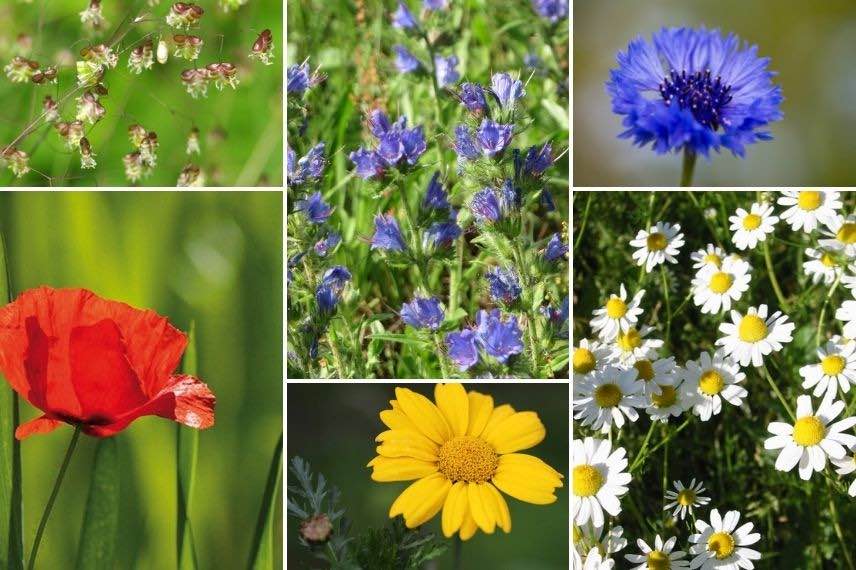
Briza media, Echium vulgare, Centaurea cyanus, Matricaria recutita, Chrysanthemum segetum, Papaver rhoeas
- Subscribe!
- Contents
Comments