





























Pairing ideas with Chrysogonum
5 Ideas for Pairing Chrysogonum in the Garden
Contents
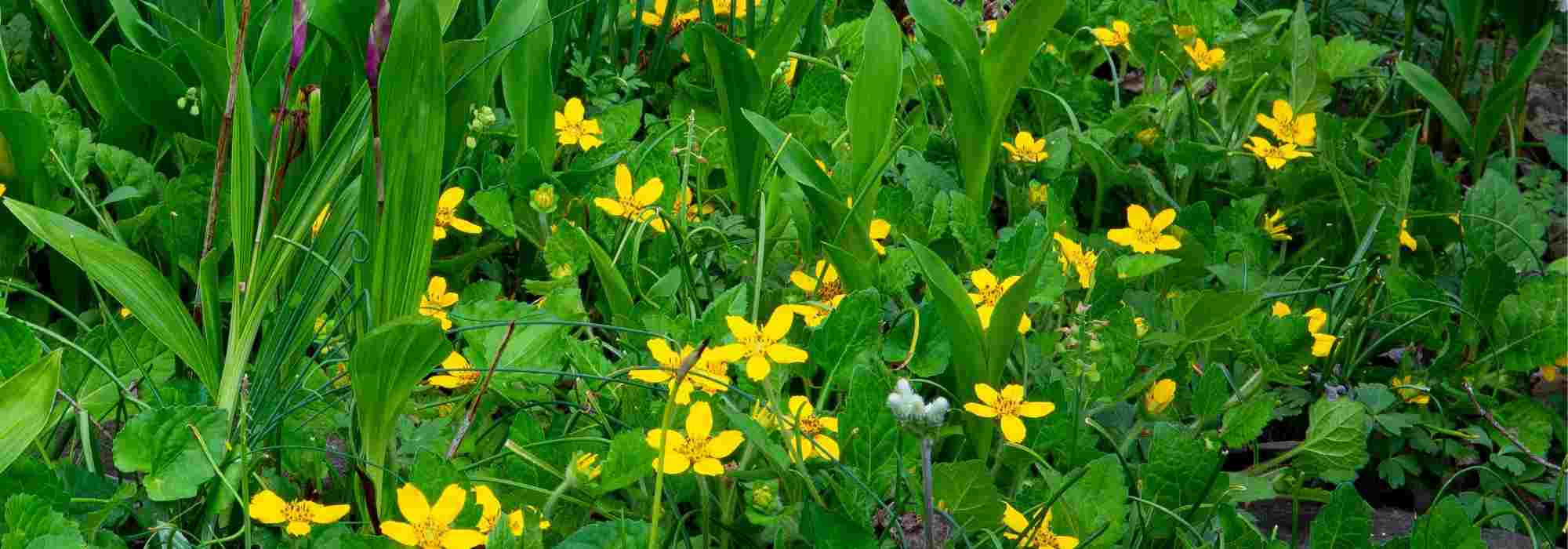
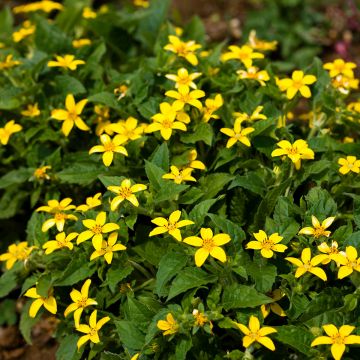
The Chrysogonum is a floriferous groundcover perennial that forms delightful little bright cushions. Its flowering, made up of a multitude of small sun-yellow flowers, brightens up any shaded and cool garden setting from late spring to autumn.
Easy to grow, hardy, low-maintenance, and non-invasive, it thrives in any good garden soil that remains well-drained and cool in summer.
This spreading perennial is very floriferous and easily pairs with other plants in cool soils, in cool rockeries, shaded slopes, around water features, in perennial borders, or in light woodlands.
Here are our ideas for successful combinations!
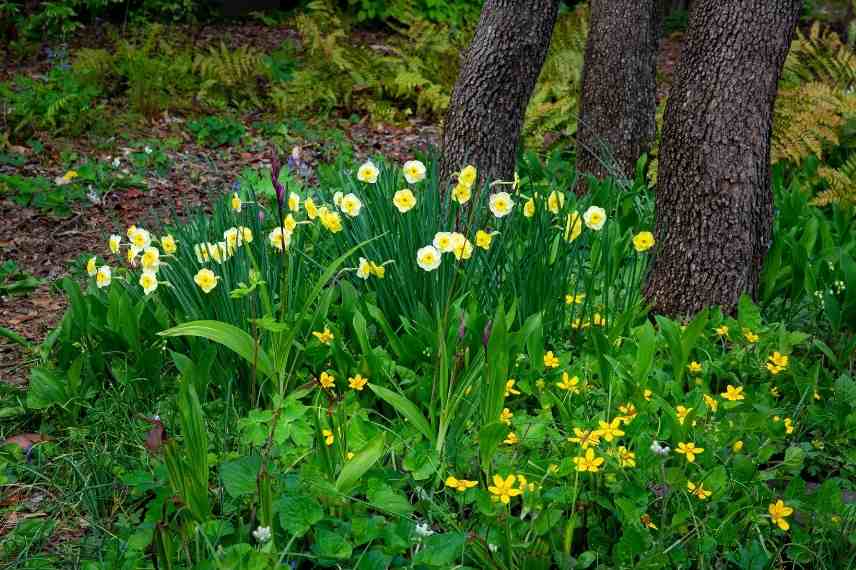 A fresh scene at the foot of trees composed of Chrysogonum and daffodils

In a fresh and flowering bed
Le Chrysogonum can accompany summer flowers in non-burning sunlight, provided the soil remains cool. With its spreading nature, it can be used to fill gaps in a perennial bed. To complement it, consider groundcover alchemillas, such as Alchemilla epipsila or Alchemilla erythropoda that adapt to many situations, with their small yellow-green flowers being light and very bright, echoing those of the Chrysogonum.
It will pair beautifully with small, sturdy plants, such as fast-growing hardy geraniums: the hardy geranium pratense ‘Cluden Sapphire’ with royal blue corollas or the hardy geranium himalayense ‘Gravetye’ will provide a lovely colour contrast.
To create complementary harmonies, also consider blue phlox such as Phlox divaricata ‘Chattahoochee’ and a Virginia spiderwort ‘Sweet Kate’ with its stunning golden-yellow foliage and abundant deep blue flowering. The lovely heuchera ‘Blondie in Lime’ will also be a great partner to bring dynamism to the display while maintaining a harmonious colour scheme.
It will prove to be a faithful companion for tall yellow foxgloves (‘Lutea’), leucanthemums or other large daisies, tall lupins, and ligularias. A beautiful grass for cool soil like molinia and a Thalictrum delavayi ‘Splendide Album’ will add height and lightness to the background of the bed.
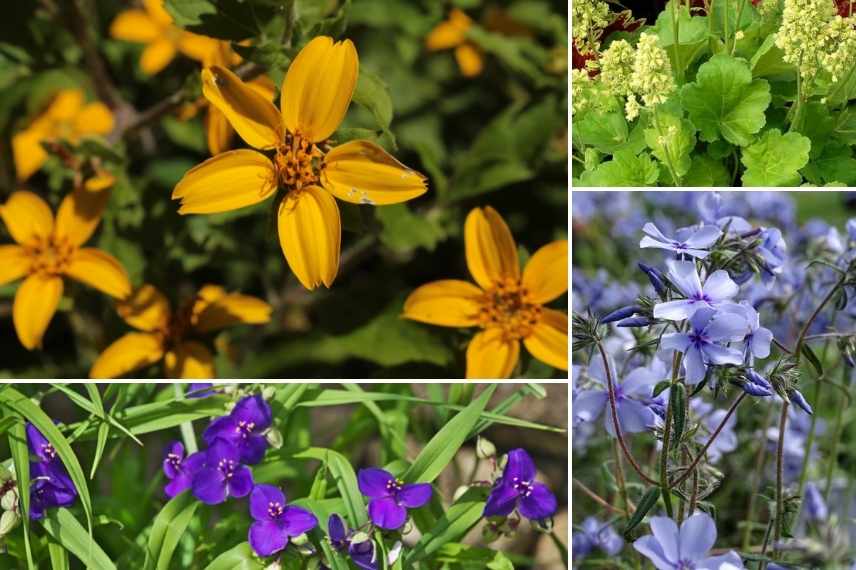
The Chrysogonum is placed here among blooms of complementary colours: the acid green of Heuchera ‘Blondie in Lime’, violet-blue Tradescantia, and the very soft blue of Phlox divaricatica ‘Chattahoochee’
By the edge of a body of water
The Chrysogonum will thrive particularly well at the edges of a water feature, as it enjoys cool but not waterlogged soil, alongside plants that appreciate freshness. Position it at the base of the lush Ligularia dentata ‘Dark Beauty’ with its orange-yellow flowering and Filipendula ulmaria ‘Variegata’. Pair it with a Carex elata ‘Aurea’ and a Hakonechloa macra ‘Aureola’ for a beautiful, bright colour harmony.
Complete this display with some lovely hostas such as Hosta ‘June’ with its flame-like cream and golden yellow foliage or Hosta sieboldiana ‘Frances Williams’. Opt for wetland perennials to form the backdrop, such as Arundo donax, Goat’s Beard, and the German fern with its architectural silhouette and ostrich plume fronds.
Japanese irises and large Chinese lysimachias like the variegated Lysimachia punctata ‘Alexander’ will add a colourful and elegant touch with their abundant blooms.
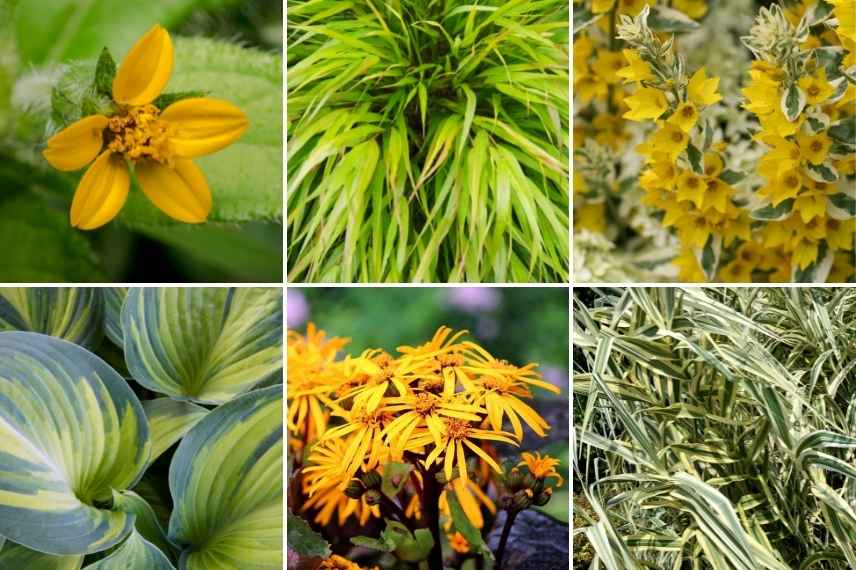
Chrysogonum virginianum, Hakonechloa macra ‘Aureola’, Lysimachia punctata ‘Alexander’, Hosta ‘June’, Ligularia dentata ‘Dark Beauty’ and Arundo donax ‘Variegatum’
Discover other Chrysogonum
View all →
Available in 1 sizes
Available in 1 sizes
As groundcover
A bit slow to establish, the Chrysogonum eventually forms small, very floriferous clumps over time. The cultivar ‘André Viette’ is ideal for greening shady areas of the garden, pleasantly highlighting paths and borders of cool beds. It will serve as a backdrop for spring and then summer flowers. However, as it dislikes root competition, avoid planting it at the base of trees. Choose to accompany it with other groundcover perennials such as dwarf varieties of hostas, creeping bugles, tiarellas and heucherellas, such as the very bright Heucherella ‘Citrus Shock’, or ’Asarum, which forms a carpet of heart-shaped evergreen leaves. It will also pair well in partial shade with helxine.
Also consider corydalis, ‘Porcelain Blue’, for example, which has the nice feature of flowering in summer in a celestial blue.
In this environment of colourful foliage, it will naturally find its place alongside flowering perennials such as Pulmonaria ‘Blue Ensign’ with its navy blue flowers, Epimediums (such as Epimedium stellulatum ‘Wudang Star’), and hardy geraniums. A Solomon’s Seal will enhance this fresh scene with its graceful flowering in May-June.
Some ‘White Gold’ bleeding hearts will precede its flowering, while Japanese Anemones will take over until autumn.
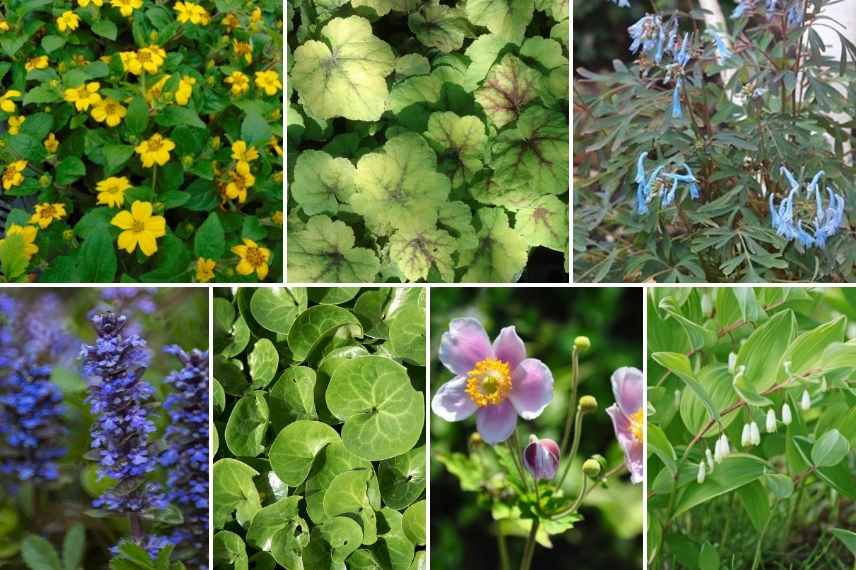
Chrysogonum ‘André Viette’, Heucherella ‘Citrus Shock’, Corydalis ‘Porcelain Blue’, Ajuga reptans, Asarum europeum, Anemone hupensins and Polygonatum
In a cool rockery
With its more or less compact habit, the Chrysogonum can be planted in a partially sunny rockery, provided the soil remains sufficiently cool during the summer months. This type of rockery will blend in quite naturally near a water feature. It will form small, colourful flowering cushions alongside Corydalis lutea, which blooms from May to October, and Epimedium perralchicum ‘Frohnleiten’, flowering in April-May with delicate yellow flowers. Accent this scene with small variegated hostas such as ‘Mighty Mouse’, a miniature variety, and Leptinella dioica ‘Minima’, a ground-covering perennial with fern-like foliage. A few clumps of graceful grasses like Carex oshimensis ‘Everillo’, with its lemon-green striped foliage, will add volume, elegance, and plenty of brightness to the overall display.

Chrisogonum virginianum, Leptinella dioica ‘Minima’, Corydalis lutea, Epimedium perralchicum ‘Frohnleiten’, Hosta ‘Mighty Mouse’, and Carex oshimensis ‘Everillo’
At the edge of the path
This perennial, which spreads slowly laterally but is never invasive, will bloom for many months and will also look good lining a path in non-scorching situations. In good company, the Chrysogonum adds colour to the edge of a path from spring to autumn. In this shaded border, interspace delicate perennials like Bleeding Hearts and Astrantias among small Hostas like ‘Little Devil’, which boasts very elegant variegated foliage.
To add vibrant relief to this fresh decor, place the Thalictrum flavum glaucum, a variety of yellow Meadow Rue, in the background, perfect for providing height and lightness. Dark-foliaged Heucheras, such as Heuchera ‘Blackout’, will beautifully highlight these colour nuances.
→ Check out our ideas for Dressing a Path
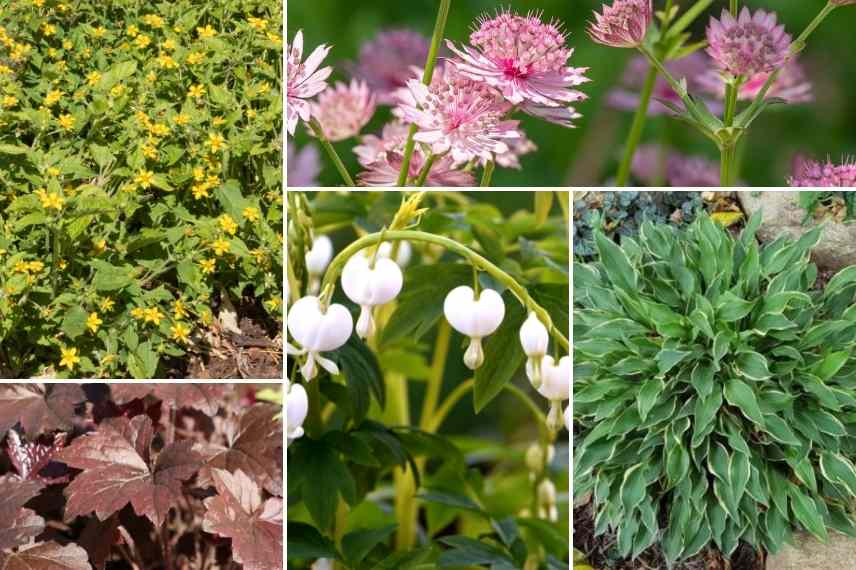
Chrysogonum, Astrantias, Heuchera ‘Blackout’, Dicentra spectabilis ‘Alba’ and Hosta ‘Little Devil’
- Subscribe!
- Contents
![[association_plantes nom="Chrysogonum"] in the garden](https://en.promessedefleurs.eu/blogwp/wp-content/uploads/2022/06/Associer-le-Chrysogonum.jpg "Associate the Naked Ladies")
Comments