





























Pairing ideas with Inulas
Sunshine in your borders!
Contents
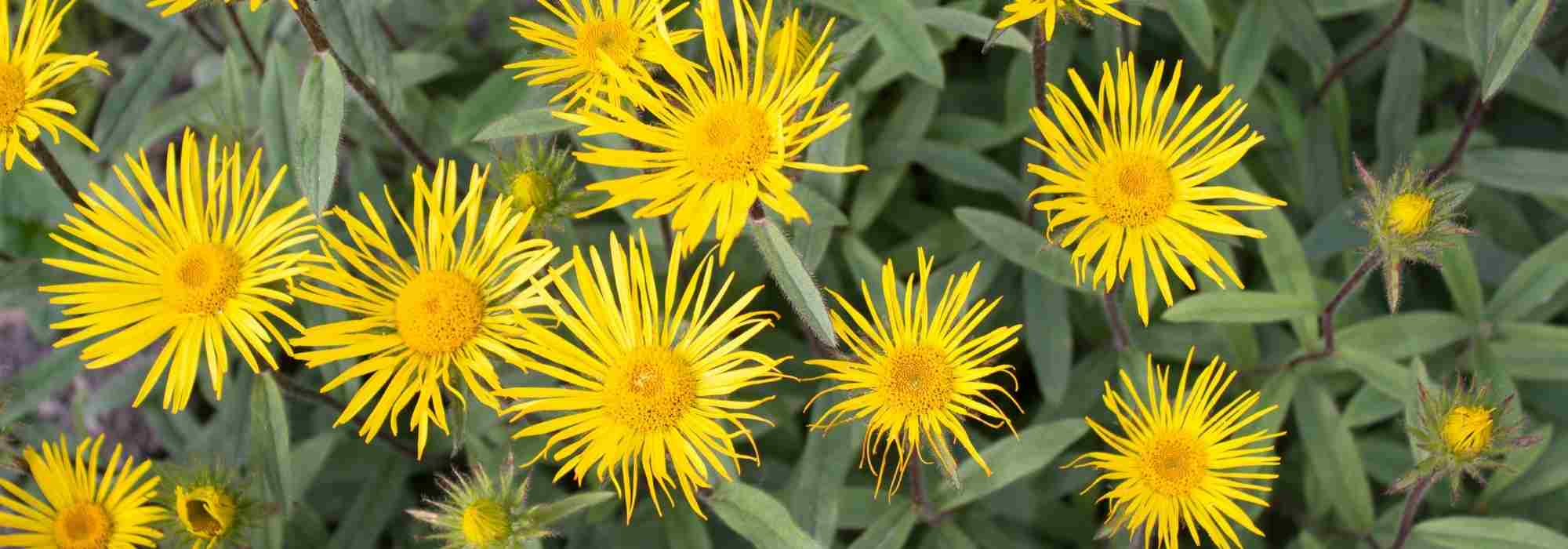
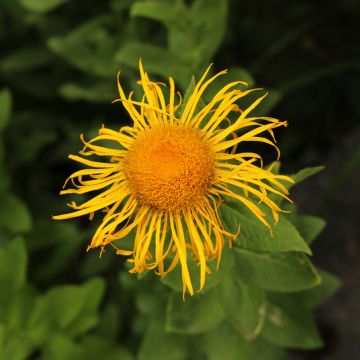
The golden yellow, ultra-bright of the Inulas (or aune) brings a vibrant touch to the garden! This beautiful, lesser-known perennial features spectacular flowers with spreading petals, resembling wild daisies in full yellow bloom. With impressive stature, as some varieties grow up to 2 m tall, it also includes much smaller species, the shortest of which do not exceed 10 cm in height. The hardiness of Inulas allows them to be planted throughout the hexagon, even in alpine gardens.
Here are 5 ideas to incorporate this beautiful, luminous perennial into different areas of the garden.
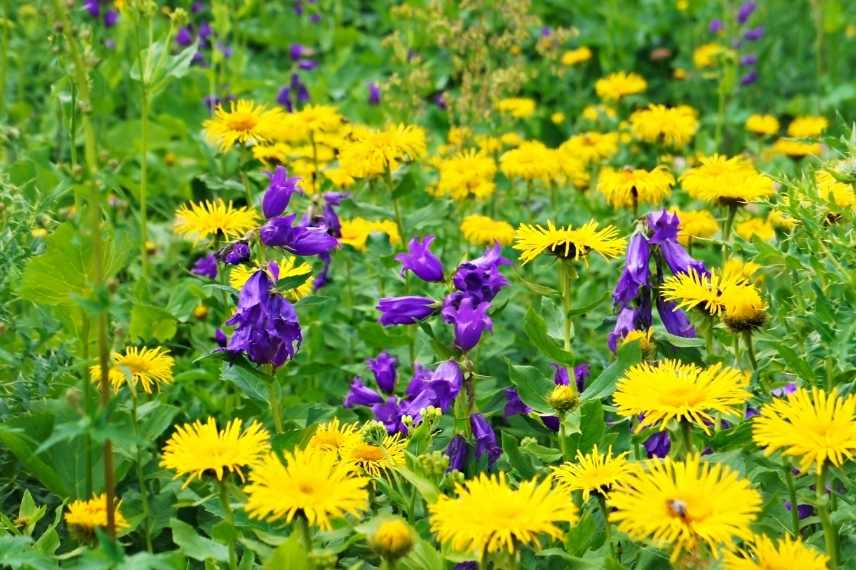
Inulas, sunny flowers that pair well with blue and other colours in a garden

In a natural meadow
A vigorous and hardy plant, belonging to the same family as daisies, Inula naturally fits into large natural spaces, such as meadows or wild gardens. The spontaneous sowing of Inula is well-suited for this mass planting in a naturalistic garden where you may not always remove the faded inflorescences.
Choose medium to large varieties for this area (Inula helenium, Inula magnifica or Inula hookeri). Their simple appearance and interesting height provide a flexible vertical element that blends well with tall and wild perennials like Verbascum or the Sisyrinchium striatum with its paler yellow flowers, thriving in fresh, fertile, and sunny soil. Achillea millefolium with its flat inflorescences contrasts beautifully with the spike forms, chosen in warm colours from orange to red, while Echinacea pallida white, Echinacea purpurea ‘Magnus’, or sunny Helenium will complement the heads of the Inulas. Also, add some blue accents to this meadow setting with Echinops ritro or azure balls, or purple teasels Dipsacus. Enjoy the airy pom-poms of many Sanguisorba (burnet). Finally, the essential touch of graceful and natural movement will be provided by a few grasses such as Calamagrostis, Miscanthus, or the light foliage of Chasmantium latifolium.
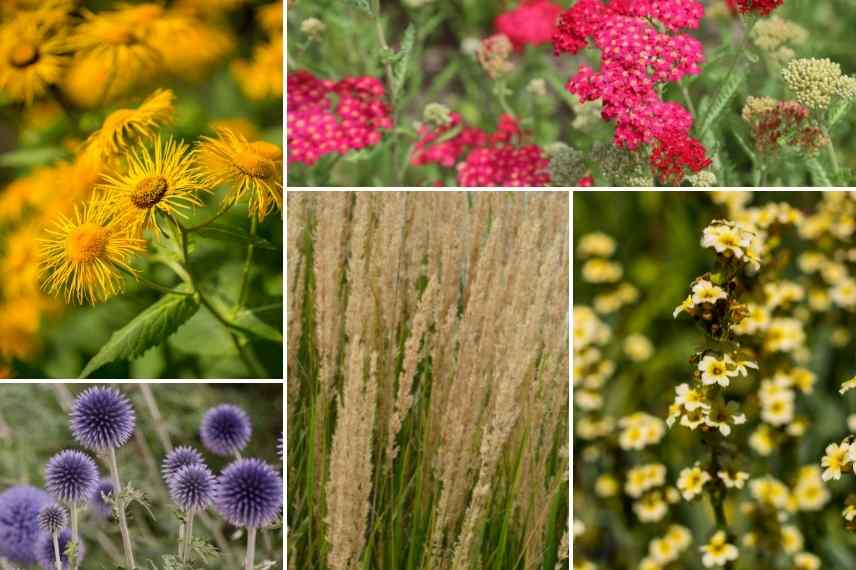
Inula helenium, Achillea millefolium, Echinops ritro, Calamagrostis, Sisyrinchium striatum
In a yellow and orange mixed border
The warmth radiated by the yellow inflorescences of Inulas is a true invitation to summer borders, so sunny and spicy. Inula helenium or Inula racemosa, which is very tall, will position itself at the back of the border, while a Inula magnifica will take centre stage in an opulent mixed border. Repeat this motif of Inulas in two or three separate clumps and surround them with exuberant perennials with fiery temperaments: you will then create a striking mixed border at the height of summer. The yellow and orange tones will be stunning, with even a few red touches for added vibrancy.
For example, you can insert orange to red Crocosmias like Crocosmia ‘Fire King’, some marigolds, and impressive bicoloured or lemon-yellow Kniphofias like ‘Bees Lemon’, as well as coppery orange heleniums like Helenium hybrid ‘Moerheim Beauty’. The upright habit and striking beauty of some Digiplexis from the Illumination series will add lasting vibrancy to this border. Also plant two or three evergreen shrubs with warm foliage, such as a Berberis in purple or a Cornus ‘Alba’, along with some golden foliage like that of a Physocarpus opulifolius ‘Dart’s Gold’.
Surround this generous border with Carex eburnea, with particularly fine and light green foliage, or Carex morrowii ‘Irish Green’. Some dwarf Coreopsis like Coreopsis alpinus ‘Early Sunrise’ with double golden-yellow flowers will elegantly highlight this mixed border.
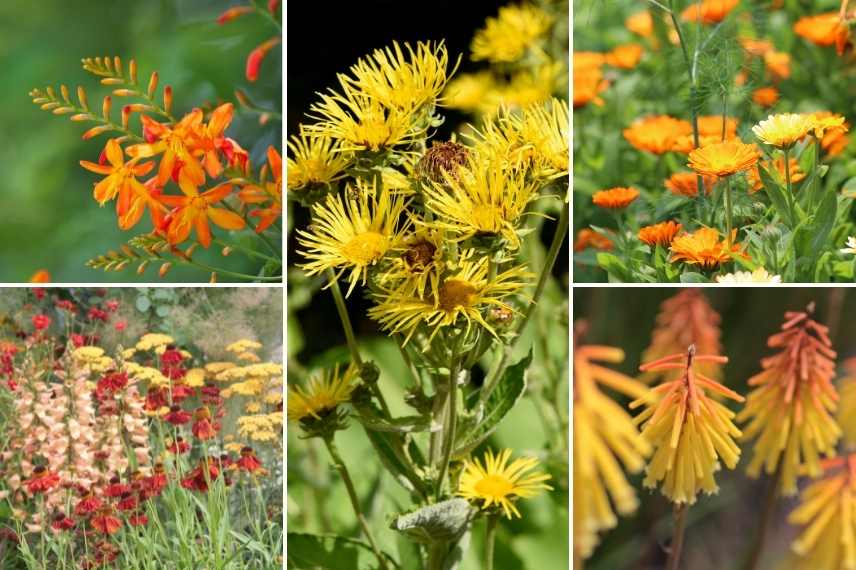
In the centre, Inulas, accompanied by a fiery mix in yellow-orange tones: Crocosmias, Calendula officinalis, Digiplexis, Heleniums, Achilleas, and Kniphofias
Discover other Inula
View all →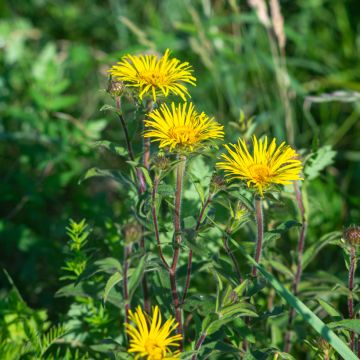
Available in 1 sizes
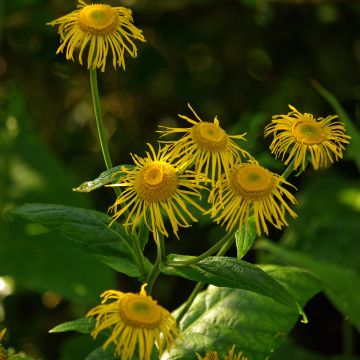
Available in 1 sizes
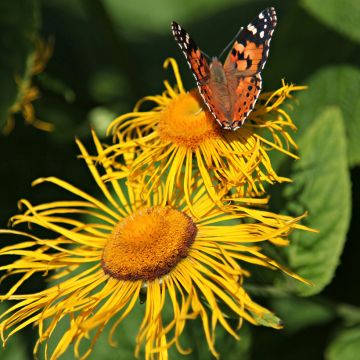
Available in 1 sizes
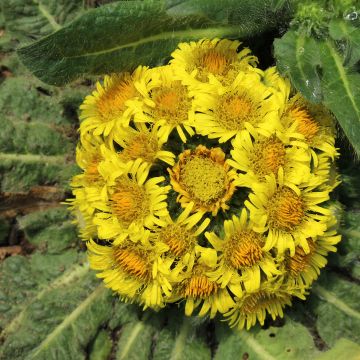
Available in 1 sizes
Available in 1 sizes
Available in 1 sizes
Available in 1 sizes
In a striking contrast of yellow and blue
Play with the complementarity of yellow, namely blue, to create a striking scene that captures all eyes! By using bright yellow flowers, such as those of Inulas, the blues will appear even more intense. Blue to violet flowers work well in this type of combination.
Plant some sunflowers near tall Inula helenium or racemosa, as they will balance the scene with their impressive stature. Incorporate a few other yellow blooms according to the size of your bed, choosing evergreen or semi-evergreen foliage like St John’s wort ‘Little Mystery’ with leaves also variegated with yellow, as well as yellow ‘Le Chandelier’ lupins, and why not a few Helianthus or Rudbeckias. Doronicums resembling them will ensure yellow presence in late spring. For a touch of blue, insert more upright plants like a spike of Veronica spicata with vertical spikes, a clump of blue lupins, Agastaches with a more violet hue like ‘Black Adder’, or even a Hebe ‘Autumn Glory’ to bring in some evergreen foliage. As groundcover, the intense blue of the Meadow Cranesbill (Geranium vivace pratense ‘Cluden Sapphire’) will be a superb companion blooming for a good part of the summer. Finally, a beautiful soft grass like Miscanthus sinensis ‘Graziella’ will add a lot of lightness and cohesion among these lovely summer plants.
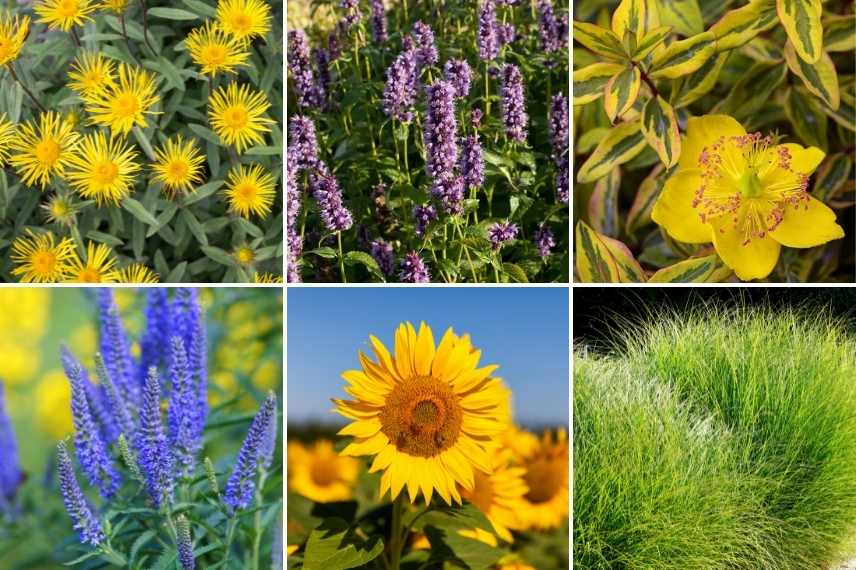
Inulas, Agastache ‘Black Adder’, Hypericum (x) moserianum ‘Little Mystery’, Veronica spicata, Helianthus, Miscanthus sinensis ‘Graziella’
Read also
Helenium: 6 pairing ideasIn a sunny border or rockery
The small, yet charming Inula ensifolia is much shorter and more compact than its counterparts. With a height of 30 cm, it will be beautifully showcased positioned at the edge of a sunny border, as a bright cushion in a rockery, or in a garrigue garden. You can also choose Inula acaulis, which is even smaller, about 10 cm in height, or Inula rhizocephala, which is almost prostrate.
Perennials with a creeping habit or small stature, in warm colours paired with blue, will complement the small clumps of Inula very well: the blue-tinged evergreen foliage and the acid green flowering of a Corsican Spurge (Euphorbia myrsinites), and Lithodora diffusa ‘Heavenly Blue’ in gentian blue will start flowering in late spring, followed by an orange wallflower. The Inula will then rely on the simultaneous flowering of a silver santolina, and that of Gazania throughout the summer. Install a dwarf pine such as Pinus strobus ‘Horsford’ or Pinus mugi ‘Hesse’ in a rockery.
For a border, intersperse Inula ensifolia with a Pennisetum alopecuroides ‘Little Bunny’ for a natural look, or for a more colourful effect in a mild climate, with Felicia amelloides (Cape Aster), blooming in a bright blue enhanced by a yellow centre reminiscent of the Inulas.
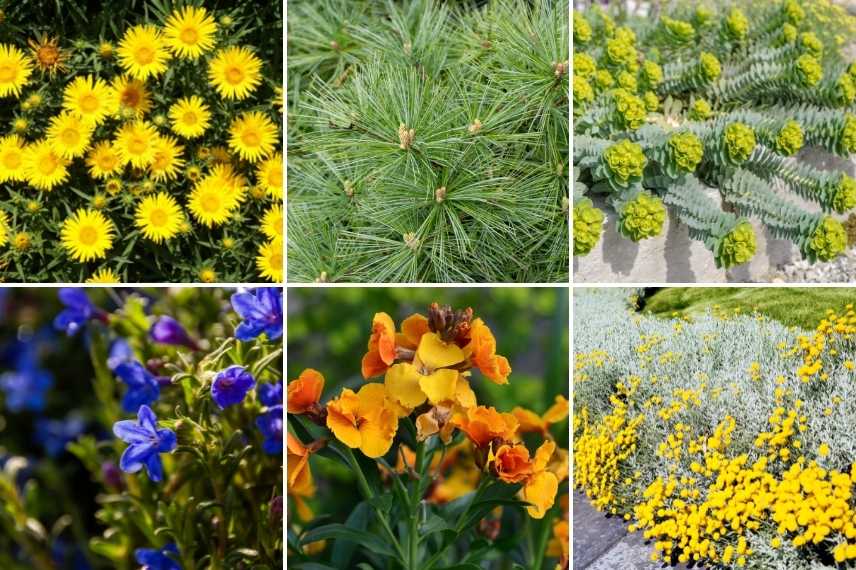
Inula, Pinus strobus ‘Horsford’, Euphorbia myrsinites, Lithodora diffusa ‘Heavenly Blue’, Erysimum, Santolina chamaecyparisus
In a medicinal plant garden
The root of Inula helenium and Inula racemosa has been cultivated since antiquity for its medicinal properties. It is a fleshy, ramified rhizomatous root that is edible and aromatic. Once dried, the Aunée root also possesses, among other things, recognised antispasmodic, emmenagogic, antibacterial, and antiseptic properties.
With its melliferous flowers, Inula can perfectly accompany other lovely medicinal or aromatic plants in a dedicated garden bed: it will join plants also cultivated for their roots such as marshmallow (Althaea officinalis), comfrey (Symphytum officinale), common valerian, or horseradish. It will also provide a beautiful height and light among Roman chamomile (Chamaemelum nobile), marigolds (Calendula officinalis), Angelica, or mallow (Malva sylvestris). It will bloom at the same time as all the plants, including Arnica, burdock, or peppermint…
The association of these perennials used in aromatherapy and phytotherapy will prove not only interesting for those wanting to embark on medicinal concoctions (to be reserved for experts nonetheless!), but for any gardener in search of somewhat more obscure plants.
→ Also read our article on 15 medicinal flowers to grow in your garden.
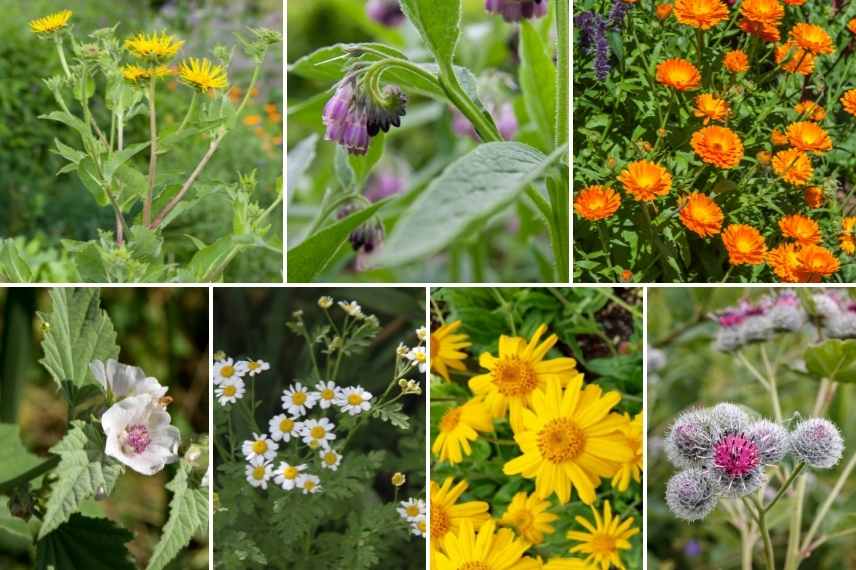
Inula helenium, comfrey, marigolds, marshmallow, Roman chamomile, arnica, and burdock
- Subscribe!
- Contents
![[naked] association inule inula [naked] elecampane in the garden](https://en.promessedefleurs.eu/blogwp/wp-content/uploads/2022/04/Associer-les-Inulas-1.jpg "Associate the Inulas")
Comments