





























Pairing ideas with Tulbaghia
5 ideas for garden and terrace combinations
Contents
With its resemblance to a small agapanthus, the Tulbaghia is a delightful bulbous perennial, highly valued for its long summer flowering period. Its stems provide beautiful star-shaped flowers in white, pink, or purple, gathered in umbels, from July to October. They are delicately scented, although the garlic-like aroma of its leaves is quite pronounced. Its foliage is formed of fine, narrow, slightly arching grey-green leaves. Completely edible, this plant is used to enhance summer salads with its delicious hint of garlic. Easy to grow, Tulbaghia prefers to be planted in full sun, in slightly moist, well-drained, fertile soil. It is perfect for decorating a rockery, a border, in a perennial bed, and even in pots!
Discover 5 ideas for pairing tulbaghia in the garden or on a terrace!
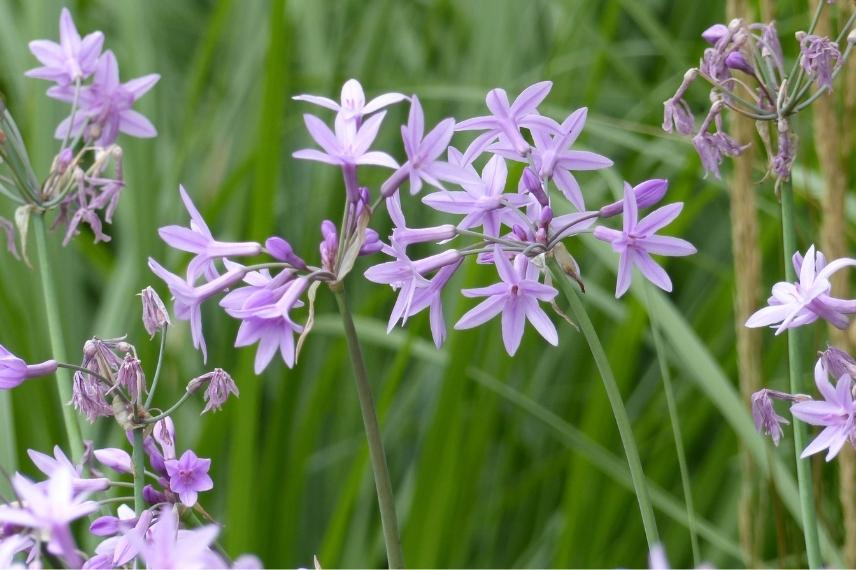
With its star-shaped flowers, the Tulbaghia violacea resembles a small agapanthus

In a vegetable or herb garden
With its garlic scent, tulbaghia keeps unwanted insects away from the vegetable garden, such as aphids. Additionally, its roots release substances into the soil that have fungicidal and repellent effects. Edible from bulbs to flowers, including its leaves, it enhances summer salads with its garlicky flavour. It certainly has its place in the vegetable garden.
Tulbaghia can be planted alongside lettuces, carrots, and even a peach tree for its protective virtues. However, it should be kept away from peas and beans, which do not appreciate its presence. It can be associated with Tansy, another repellent plant used to make tansy manure, a natural fungicide and repellent. Tulbaghia can also accompany aromatic plants such as Thyme, Oregano, Parsley, Basil, Chamomile, Common Verbena, and Rosemary. To enhance salads, it can be planted with chives or bulbs of wild garlic and shallots.
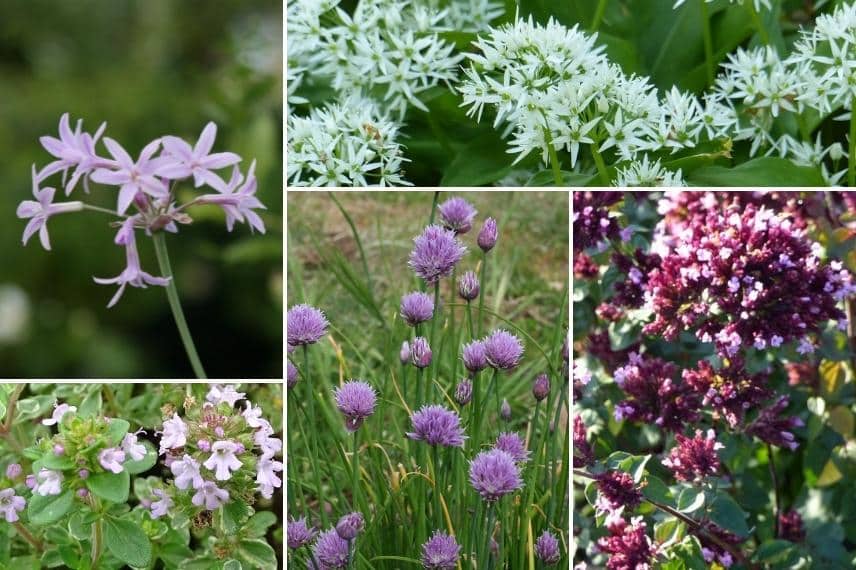
Tulbaghia violacea ‘Silver Lace’, thyme, wild garlic, chives, and oregano ‘Rosenkuppel’
Read also
Growing Tulbaghia in potsIn a pot
Tulbaghia is a plant that enjoys the warmth of Mediterranean regions but is sensitive to cold temperatures below -7°C. In cooler climates, it is advisable to grow it in a pot that can be brought indoors during winter. With its lovely silhouette resembling a small agapanthus, Tulbaghia will naturally find its place in a container. Its strong garlic scent may be appreciated or, conversely, off-putting for some sensitive noses. In this case, opt for the variety Tulbaghia Himba, which has a milder fragrance than other cultivars.
In a large pot or container, it can be grown alongside other perennials with summer flowering, such as Hardy geranium ‘Rozanne’, an Alchemilla, a Salvia greggii ‘Mirage Salmon’, and an Agastache. For an annual display, you can create a colourful and summery combination by pairing mauve and orange with a Verbena Vepita ‘Pearl Blue’, a Petunia ‘Giant Blue’, and a Diascia ‘Breeze Plus Orange’.
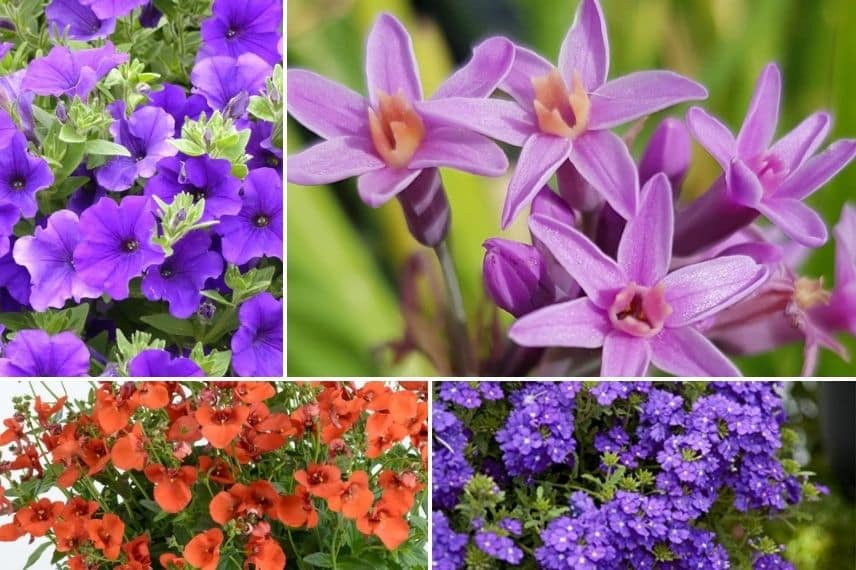
Petunia ‘Giant Blue’, Tulbaghia Himba, Diascia ‘Breeze Plus Orange’, and Verbena Vepita ‘Pearl Blue’
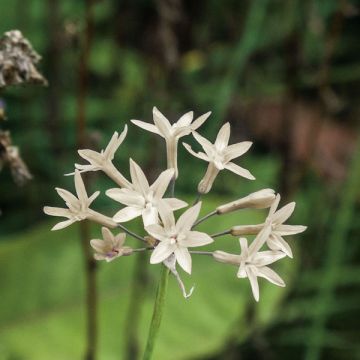
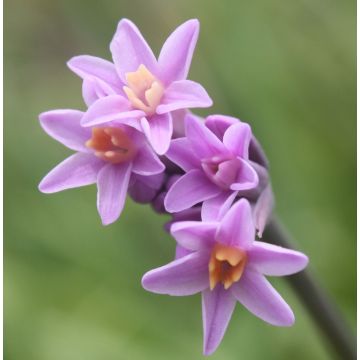
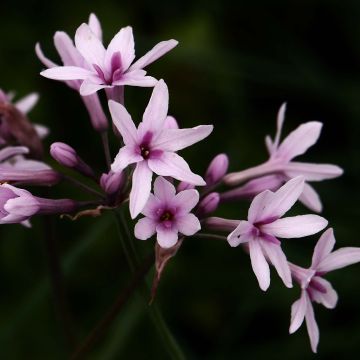
Discover other Tulbaghia
View all →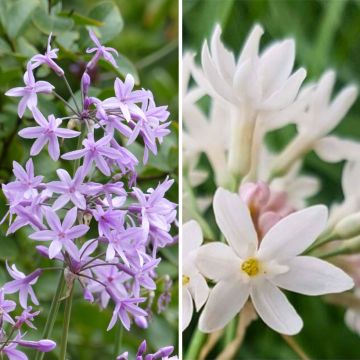
Available in 0 sizes
Available in 1 sizes
Available in 2 sizes
Available in 2 sizes
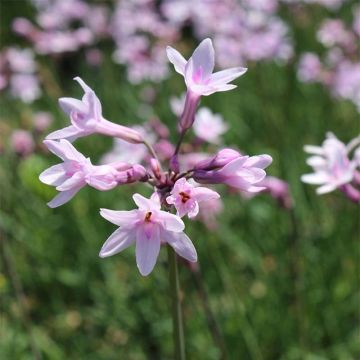
Available in 2 sizes
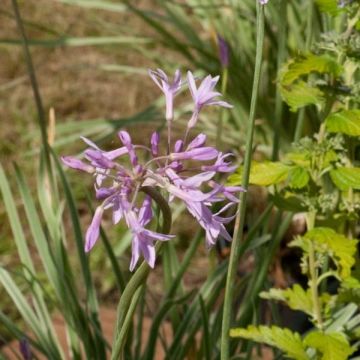
Available in 3 sizes
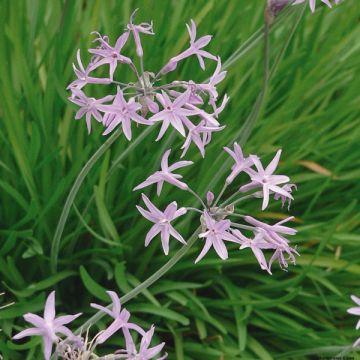
Available in 2 sizes
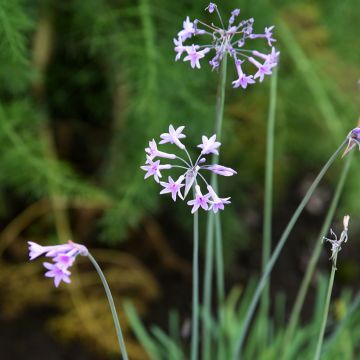
Available in 1 sizes
Available in 2 sizes
Available in 2 sizes
on the edge
The long flowering period of Tulbaghia will be perfect for adding colour to a border, along pathways, or at the front of a flower bed until autumn. It is appreciated for its tuft of narrow leaves, topped by floral stems bearing beautiful tubular and star-shaped flowers.
Its light flowers will replace those of agapanthus or, conversely, will pair beautifully with them, such as the lovely variety ‘Pitchoune Blue’ with its ultramarine flowers. Still in shades of blue and mauve, it can be combined with a Nepeta, a sage, a lavender, and a campanula. Its tuft of narrow leaves will blend perfectly with those of grasses such as carex, stipa, or even fescue. To create a natural and rustic atmosphere, plant alongside it an Erigeron, an Anthemis carpatica ‘Karpatenschnee’, an Iberis, a hardy geranium, and a creeping gypsophila to add a touch of lightness. Finally, an Aster with sedum-like leaves will extend the flowering period right up to the gates of winter.
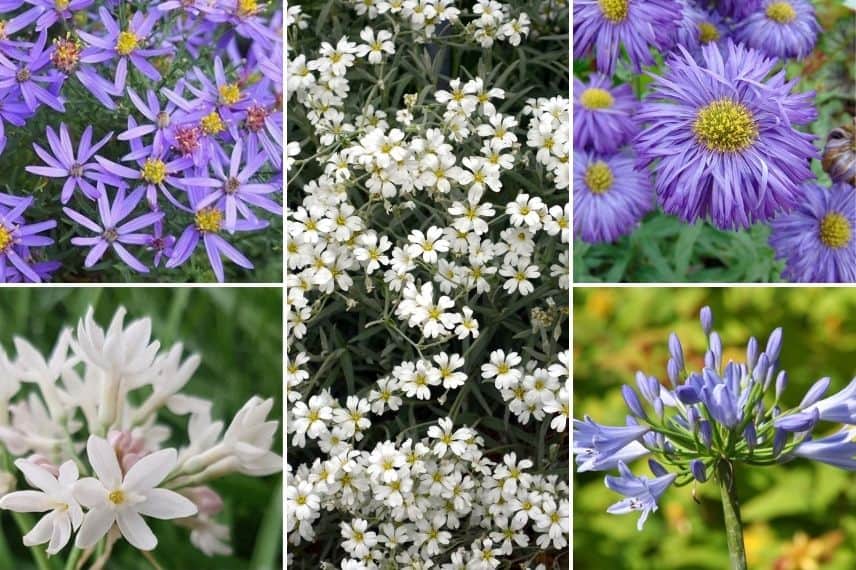
Aster with sedum-like leaves, Tulbaghia violacea ‘Pearl’, creeping gypsophila, Erigeron ‘Schwarzes Meer’, and Agapanthus ‘Pitchoune Blue’
In a dry rockery
The Tulbaghia will thrive naturally in sunny rockeries, where it will bloom throughout the summer. Highly decorative, it is perfectly suited to regions with mild winters and dry summers, where it can remain in the ground. Its tubercles should be planted among stones, in well-drained soil, alongside other flowering plants.
It can be paired with rock garden perennials, such as Campanula muralis, an aubrieta, a Delosperma, a moss phlox, an Iberis, and an Erigeron. For an attractive display, alternate heights by including an Aster, a sea thrift, a Corsican spurge, not forgetting lavender and the Cistus in this dry rockery. Also consider adding some succulents, a houseleek, a sedum, and an Stachys byzantina for its silver foliage. Also plant some grasses to enhance your rockery and add verticality, such as blue fescues or a Chinese fountain grass with its graceful plumes.
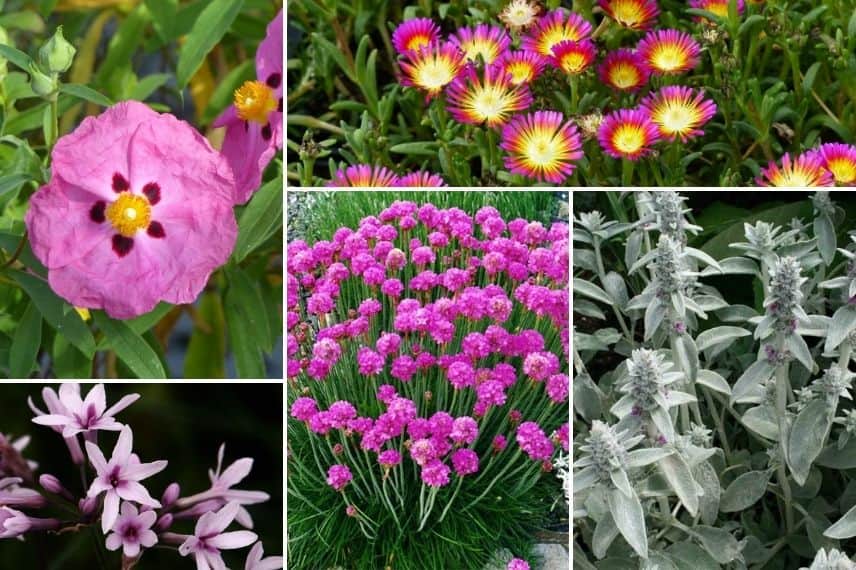
Cistus purpureus, Tulbaghia ‘Purple Eye’, Delosperma ‘Wheels of Wonder Hot Pink’, Sea thrift and Stachys byzantina
In a Mediterranean garden
Native to South Africa, Tulbaghias thrive in regions with a warm, dry climate. They will therefore flourish beautifully in a Mediterranean garden. Not fearing the summer heat, they will provide us with their umbel flowering from May to October. Additionally, they withstand sea spray and coastal winds perfectly.
The silhouette of Tulbaghia will pair wonderfully with that of agapanthus, as their flowers share a great similarity in shape and colour. They can be combined with typical Mediterranean plants, such as lavender, rosemary, ’Achillea taygetea, fleabane, cinquefoils, and Corsican spurge. We will also add some long-flowering perennials such as bushy sages and gauras. Tulbaghias will also enjoy being at the feet of small bushes like cistus, a caryopteris, and a oleander. And if you have space in the garden, we can plant large trees emblematic of southern regions, such as palms, figs, strawberry trees, as well as citrus trees.
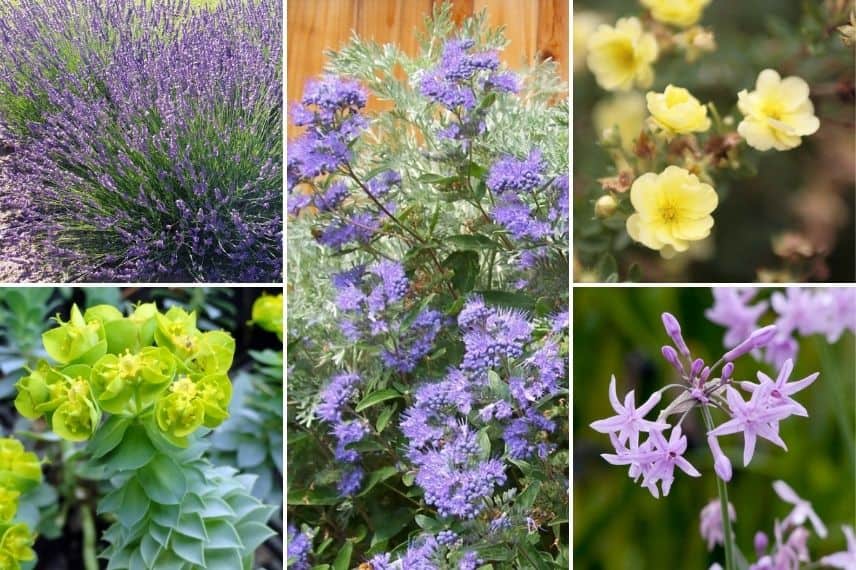
Phenomenal Lavender (Niko), Corsican Spurge, Caryopteris ‘Heavenly Blue’, Potentilla ‘Lemon Meringue’, and Tulbaghia ‘Flamingo’
For further reading
- Discover all our varieties of tulbaghia
- Browse our sheet to learn everything about tulbaghia: how to plant, grow, and care for
- Subscribe!
- Contents
Comments