





























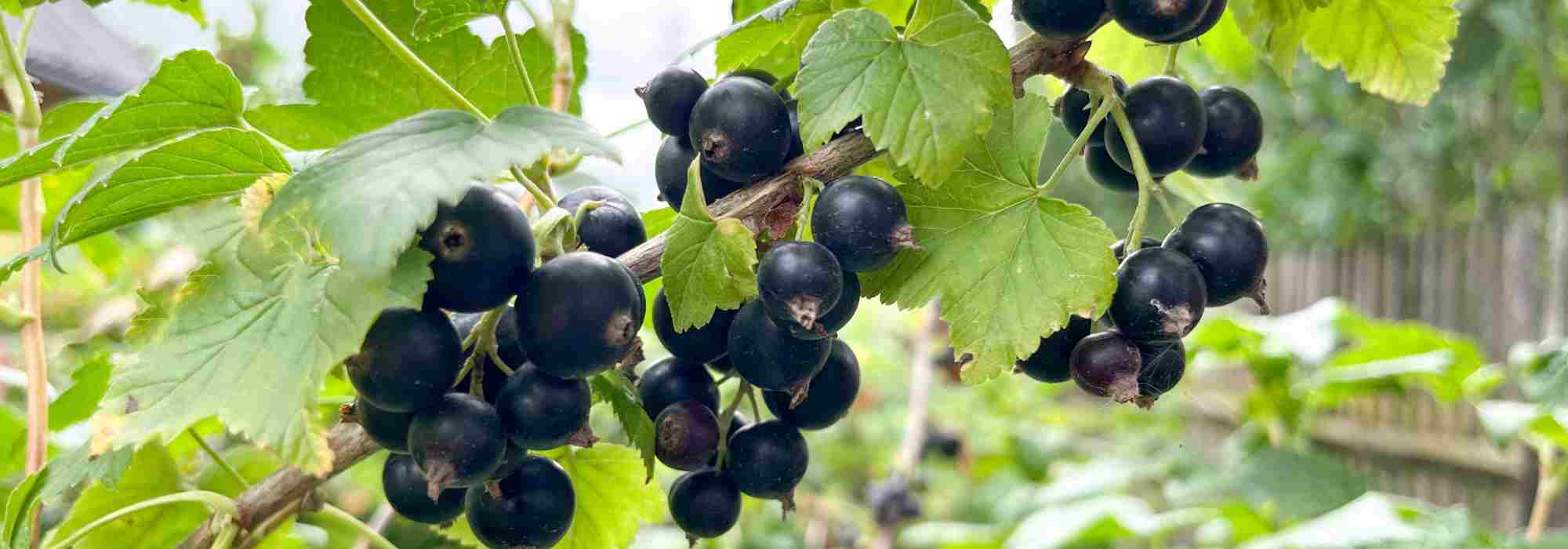
Blackcurrant: choosing the ideal variety with our buying guide
The best blackcurrant varieties according to your criteria
Contents
Blackcurrant (Ribes nigrum) belongs to the category of small-fruit crops, a close cousin of the Redcurrants and Gooseberries. It is grown for its production of small edible berries, very black, with a tart, slightly astringent flavour. These berries, rich in vitamins, iron and calcium, and also in anthocyanins, which are beneficial for the eyes, are mainly used in jams and jellies, juice and purée, ice creams, syrups or liqueurs, or incorporated into desserts, game dishes…
The blackcurrant bush forms a deciduous, vigorous, bushy shrub, 1.2 to 2 m tall. The greenish spring flowering is often inconspicuous. That is why the blackcurrant bush, an ultimately not particularly ornamental shrub, is frequently used as a hedge around the vegetable plot, alongside redcurrants and raspberries. It grows in all soils but needs winter chill to bear fruit. It can, moreover, be planted up to 1,500 m above sea level. By contrast, it hates drought. Therefore, in southern regions, it should be planted in partial shade.
If you would like to plant a blackcurrant bush in your garden or vegetable plot, discover our buying guide to help you choose according to our various criteria relating to fruit flavour, productivity, disease resistance or its originality.
For more information: Blackcurrant: planting, pruning and care.

Depending on the fruit flavour
Next to the gooseberry bush, blackcurrant offers a pale white-green flowering, discreet, which yields black berries with an acidic flavour, not very sweet and slightly astringent. This distinctive flavour means blackcurrants are not typically eaten fresh. Only in combination with raspberries and strawberries does the acidity of the berries become mellowed. Nevertheless, blackcurrants are delicious when cooked, used in jams, jellies, juice, syrups, liqueurs…
Nonetheless, the flavour of the fruit varies considerably from one variety to another. And some varieties really stand out for a slightly higher level of sweetness than average. Beginning with the variety ‘Wellington’, originally from Great Britain, which offers beautiful clusters of medium-sized berries, with relatively firm skin, but a pleasantly sweet flavour. The variety ‘Andega’, resulting from the cross-breeding of two very popular varieties, ‘Noir de Bourgogne’ and ‘Öjebyn’, produces numerous clusters bearing plump berries, of medium size, fairly firm, acidic, but very aromatic, which gives them an excellent flavour. Note that the foliage and buds of this variety are just as fragrant as the fruits.
The variety ‘Neva’ produces beautiful clusters of large, jet-black berries that are slightly tart, and very fragrant when they reach full ripeness. As for the berries of the variety ‘Géant de Boskoop’, obtained at Boskoop in the Netherlands in 1887, they are fairly large, with a very thin skin, very tender, slightly tart, but very fragrant at full ripeness.
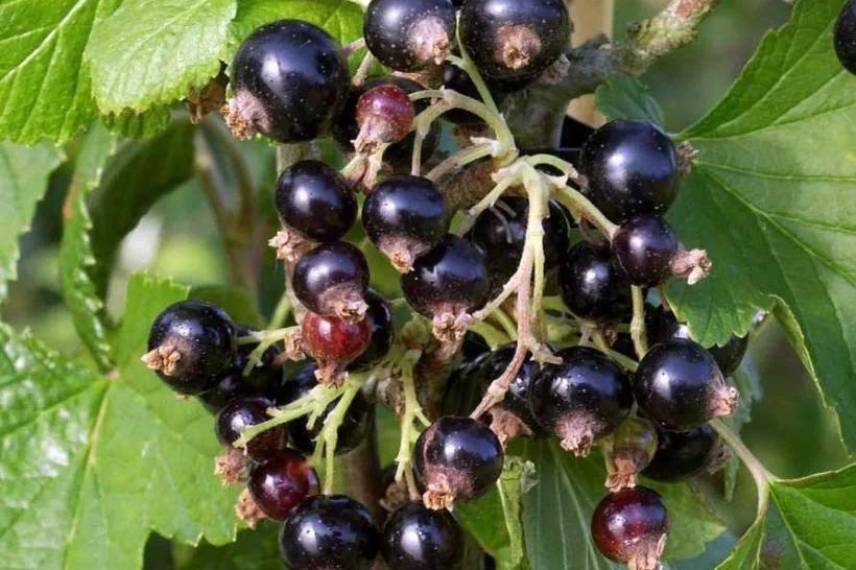
The variety ‘Noir de Bourgogne’ is a good compromise between flavour and productivity
We cannot finish this selection without mentioning the popular ‘Noir de Bourgogne’, certainly the best variety in terms of flavour and aroma. Indeed, this blackcurrant bush, widely used by the processing industry, yields berries small to medium, firm, rather acidic, but full of aroma. It is undoubtedly the most traditional variety of blackcurrant, planted in the Dijon region, essential for crème de cassis, the liqueur that goes into kir.
According to productivity
Many gardeners will select their blackcurrant primarily for productivity. And in this regard, several varieties stand out. Thus, ‘Ben Nevis’ is intended to be very productive, with large clusters of dark berries with little acidity. It is truly a vigorous blackcurrant bush with high productivity, easy to grow and therefore ideal for beginners. The INRA-created variety named ‘Andega’, already mentioned earlier for its flavour, proves to be also very productive. It forms a very vigorous bush, with a semi-erect and semi-open habit, which makes an excellent compromise between flavour and productivity.
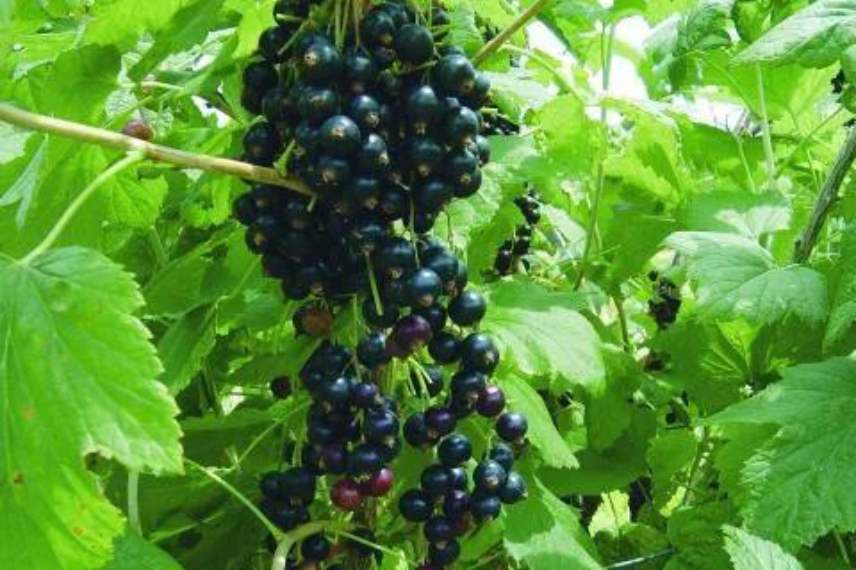
The ‘Andega’ variety is recognised for its excellent productivity
Another blackcurrant is notable for productivity: the variety ‘Blackdown’, derived from the cross-breeding between ‘Baldwin’ and ‘Brödtorp’. It is a late-ripening variety, with regular production, of medium vigour that forms a bush. It produces firm berries, dark purple-black, of medium size, borne on numerous short clusters, but with excellent flavour due to their sweetness and juiciness.
Finally, the new variety ‘Titania’ shows very good productivity, but its berries, not very acidic, are not very strong in flavour.
According to their disease resistance
Blackcurrant is relatively easy to grow. It can, however, be susceptible to certain diseases, in particular powdery mildew and anthracnose, two fungal diseases. Thus, the variety ‘Géant de Boskoop’ is known for its high susceptibility to these diseases, hence to be avoided in rainy regions. Some varieties such as ‘Troll’ are also prone to phytoptid mites, an acarine that causes abnormal swelling of the buds and is a source of virus. It is a productive blackcurrant, yielding large berries with delicious, sweet and tangy flesh.
By contrast, other varieties are chosen for their strong resistance to these fungal diseases : ‘Perles d’Auvergne’, a recent variety developed by Delbard, has been selected for its strong resistance to diseases and the flavour of its fruits.Robusta, another variety selected by Delbard, with large berries that are tangy, sweet and fragrant, benefits from good resistance to the oïdium. ‘Wellington’, an early and vigorous variety, is also renowned for its excellent resistance to the disease. Just like ‘Titiana’ which offers beautiful clusters of berries with low acidity. ‘Andega’ will prove resistant to the oïdium, ‘Blackdown’ to rust.
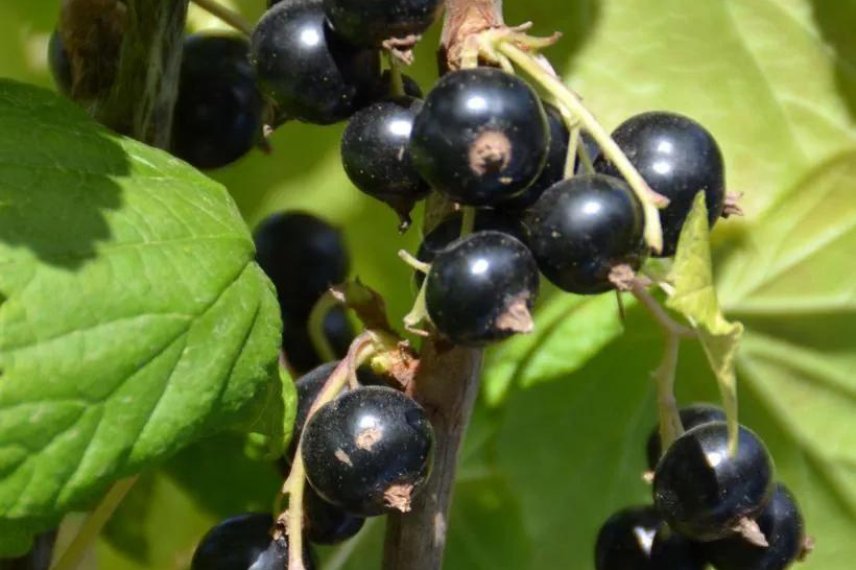
The variety ‘Perles d’Auvergne’ is particularly resistant to diseases
Read also
Blackcurrant: diseases and pestsAccording to their fertilisation method
Thanks to varietal selection, most currant bushes are self-fertile, meaning that a single young plant can produce fruit. However, fruiting will be better with at least two compatible varieties planted nearby, thanks to cross-pollination.
This is the case for ‘Noir de Bourgogne’. If you want to plant it in your garden for its very aromatic small berries, you will need to plant a late-flowering pollinator variety, either ‘Géant de Boskoop’, or ‘Andega’, two excellent pollinators.
‘Merveille de Gironde’ with large, black, juicy fruits, and a sweet flavour that is finely aromatic, is also self-sterile. You will need to grow it not far from varieties such as ‘Noir de Bourgogne’, ‘Andega’ or ‘Blackdown’.
Depending on the harvest period
Blackcurrant generally bears fruit from June to August, with some varieties being more or less early- or late-ripening. Thus, by varying the varieties, it is possible to stagger the harvests to have blackcurrants for almost three months.
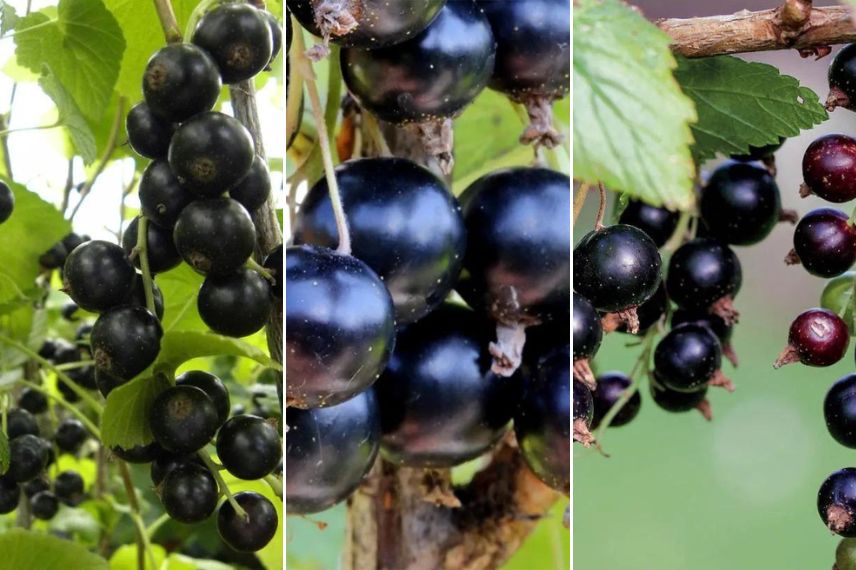
By planting ‘Géant de Boskoop’, ‘Ojebyn’ and ‘Blackdown’, fruit can be harvested for almost three months
Among the earliest varieties, one can cite ‘Géant de Boskoop’ which bears fruit from the end of June or the first week of July. ‘Noir de Bourgogne’ yields fruit at roughly the same season. This is, in fact, one reason why they pollinate each other. Among the early varieties, we also mention ‘Troll’, an INRA creation, a very productive blackcurrant with large, coloured berries. Having reduced winter chill requirements, it is particularly suited to regions with a mild climate. By contrast, thanks to their flexibility, the branches bend under the weight of the fruits, which can affect their quality.
Mid-season varieties bear fruit in mid‑July. ‘Wellington’, a variety well suited to mild climates, is part of this category. Just like ‘Andega’. As for ‘Ojebyn’, an old Swedish-origin variety, it produces in mid-July a profusion of juicy berries, delicately sweet and tangy. It is an exceptionally hardy variety.
Finally, among the late varieties, which bear fruit in late July, one can highlight ‘Blackdown’, which flowers late.
Based on their size
If you don’t have a garden, but a balcony or a terrace, you can also treat yourself to growing a blackcurrant bush. It will only be necessary to choose a variety that has a compact habit and smaller dimensions. For this pot culture, the variety Little Black Sugar is perfect. It does not exceed 90 cm in height, 80 cm in width, and nevertheless yields large fruits with a sweet, sugary and aromatic flavour, only mildly acidic, which reach ripeness fairly early from the end of June.
To finish, a few varieties selected for their originality
If it’s typicity you’re after, turn to three original varieties in more than one respect:
-
- ‘Green Life’ bears fruit that stays green despite ripeness. These berries are medium-sized and have translucent flesh. It is a mid-early variety that bears fruit in mid-July.
- ‘Jostaberry’ is a gooseberry-cassis hybrid bush that yields large black fruits, tart in July. It is a very hardy bush, disease-resistant and low-maintenance.
- ‘Black’n Red Première’ is a very decorative blackcurrant bush that is distinguished by its red-purple foliage which becomes darker as autumn approaches. These fruits are large, juicy, sweet and aromatic.
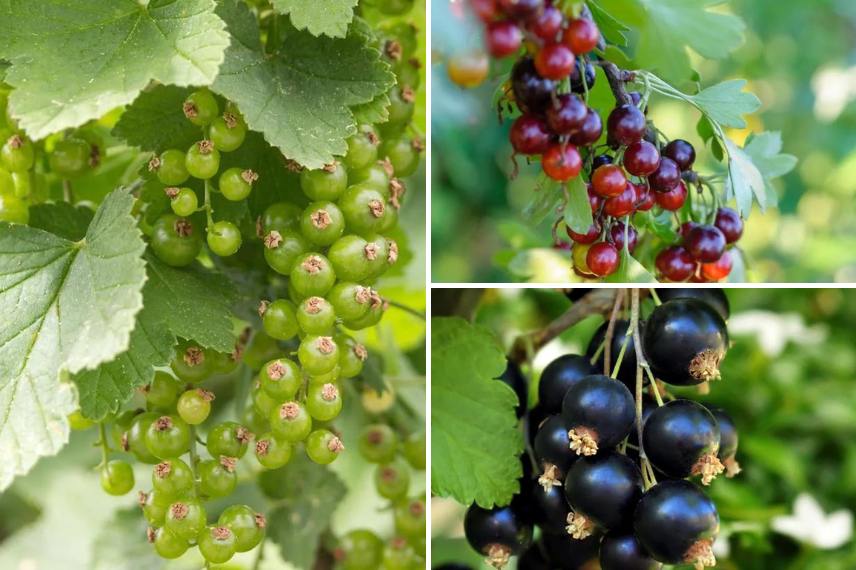
‘Green Life’, ‘Jostaberry’ and ‘Black’n Red Première’ are more remarkable varieties
- Subscribe!
- Contents

Comments