


Choosing a forsythia
For a vibrant touch to your garden, balcony, or terrace.
Contents
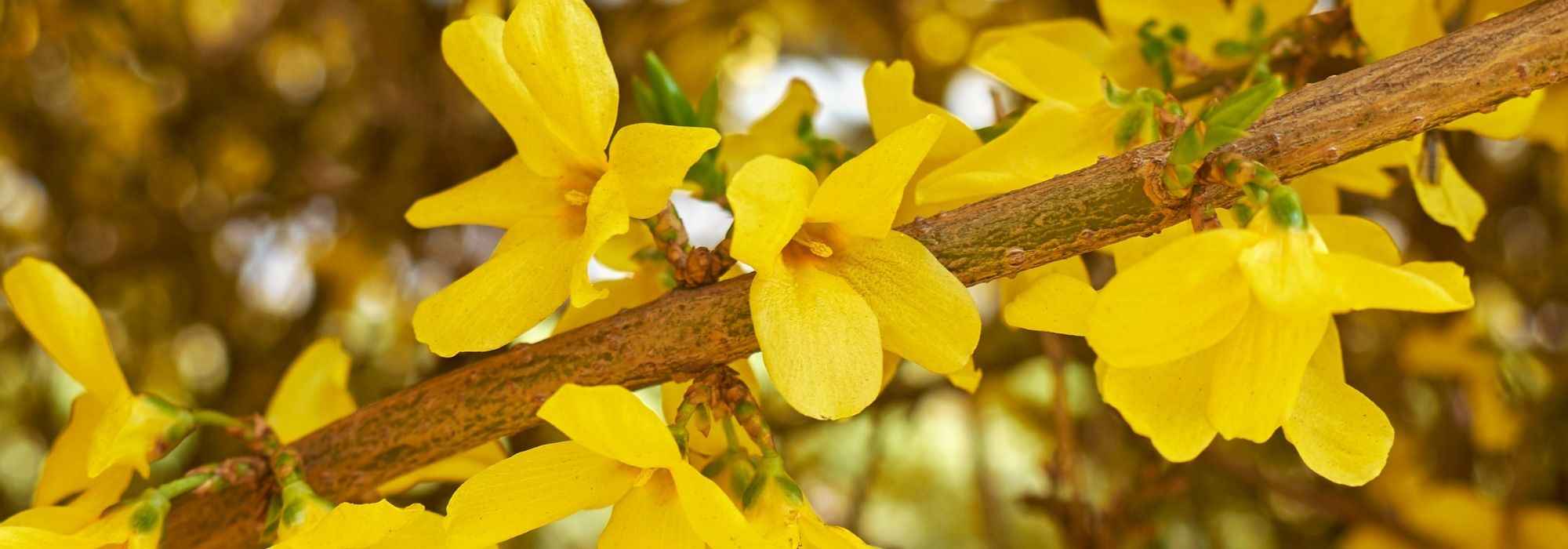
Renowned for its abundant and vibrant yellow flowering, the forsythia, also known as “mimosa of Paris”, is one of the first bushes to bloom as winter ends. Its excellent hardiness and ease of cultivation have further contributed to its popularity. One might think that all forsythias look alike, but there is actually a beautiful diversity within this genus. For instance, you can play with the flowering period of forsythias, as it can slightly vary depending on the species and varieties. Regarding the foliage, this deciduous bush sometimes reveals interesting decorative leaves. The size of the forsythia and its habit will allow you to use it in various ways. Finally, if its yellow flowers do not inspire you, we offer another bush similar to forsythia that comes in different colours. So, discover our buying guide to find the forsythia that suits your desires and environment.
⇒ To learn more, check our sheet Forsythia: planting, cultivation and maintenance

According to the colour of the flowers
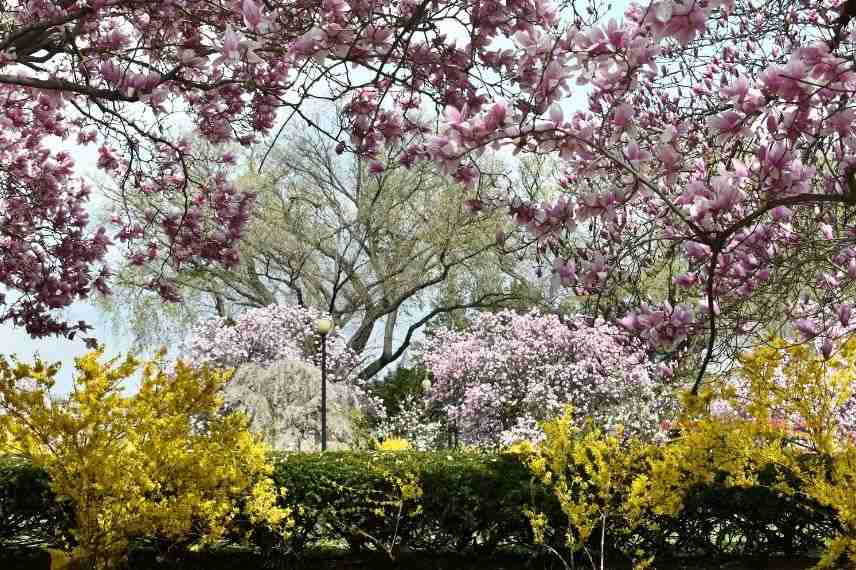
To date, there is no variety of forsythia that produces flowers in any colour other than yellow. No matter how hard you search, you will only find forsythias with spring yellow flowers.
- With yellow flowers of varying intensities, the species Forsythia x intermedia is the most well-known, and its varieties are numerous. Notable mentions include the highly floriferous Forsythia intermedia ‘Spectabilis’, the small Forsythia intermedia ‘Marée d’or’ and Forsythia intermedia ‘Minigold’, as well as the vigorous Forsythia intermedia ‘Week-End’.
- The flowering of Forsythia viridissima ‘Citrus Swizzle’ blooms in lemon yellow from March to April.
- Rare and less known, the Forsythia koreana ‘Kumsun’ has a more slender and delicate silhouette than Forsythia x intermedia. From March to May, it produces small yellow flowers.
However, there is a shrub very similar to forsythia that offers a similar flowering but in different colours. This is abeliophyllum. Belonging to the same family as forsythia, it comes in white or pink:
- Also known as Korean white forsythia, Abeliophyllum distichum reveals a pinkish white flowering in February/March.
- The Abeliophyllum distichum ‘Roseum’ (Korean pink forsythia) showcases pink flowers with a sweet almond-like fragrance.
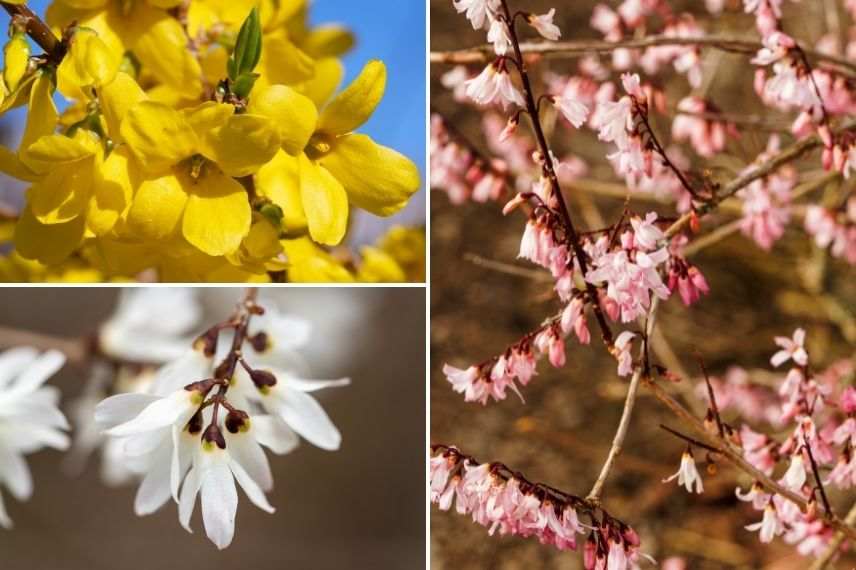
Yellow flowers of Forsythia x intermedia, white and pink flowering of Abeliophyllum distichum and Abeliophyllum distichum ‘Roseum’
Read also
Forsythia : planting, pruning and careAccording to the colour of the foliage
Forsythias generally have a simple, dentate deciduous leaf that is green in colour. However, it can sometimes be semi-evergreen depending on the species or the climate (regions with milder winters).
Some stand out with more original foliage:
- Parisian mimosa ‘Citrus Swizzle’ displays variegated green leaves with yellow and cream, turning a red hue in autumn
- Korean forsythia ‘Kumsun’ produces unique foliage that is green with strongly marked veins of cream and yellow
- Parisian mimosa ‘Minogold’, like forsythia ‘Golden Times’, features stunning green foliage marginate with yellowish-green. Sometimes, it takes on yellow or orange-red tones in autumn.
Be aware that some varieties of forsythia display beautiful autumn colours (yellow, orange, or purplish-red) before shedding their leaves for the winter period. Here are a few examples:
- Dark green leaves blaze in late season for Abeliophyllum distichum: turning yellow, orange-red, or purple-red.
- Forsythias ‘Mêlée d’Or’ and ‘Weekend’ turn dark purple-violet in autumn.
- Dark green cultivars of Forsythia intermedia ‘Lynwood’, ‘Gold Rausch’, and ‘Mindor’ turn orange and violet in autumn.
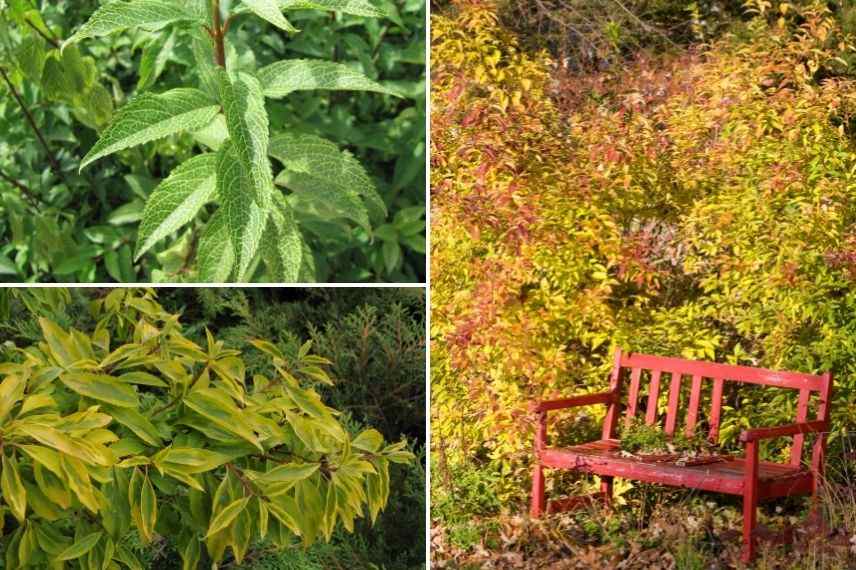
Forsythia koreana ‘Kumsun’ (photo wallygrom), Forsythia intermedia ‘Golden Times’ (photo Elektryczne jabłko) and forsythias in autumn (photo Barbara Eckstein – Flickr)
Discover other Forsythia
View all →
Available in 3 sizes
Available in 3 sizes

Available in 2 sizes
Available in 1 sizes
Available in 4 sizes
Available in 1 sizes
Available in 1 sizes
Available in 1 sizes

Available in 3 sizes
Available in 2 sizes
According to the flowering period
Forsythias are part of the early flowering bushes. Indeed, early in spring, the flowers bloom on the wood of the previous year, well before the leaves. While many other plants are still in dormancy, the bare branches of the Paris mimosa are covered with a multitude of single flowers measuring 1 to 4 cm, composed of 4 petals. For most forsythias, flowering occurs in March/April.
However, like the Abeliophyllum distichum, the Paris mimosa ‘Lynwood’ flowers earlier from February to March.
On the other hand, others extend their flowering from March to May, for example, forsythia ‘Marée d’Or’ and Forsythia koreana ‘Kumsun’.
According to its dimensions
Bushy or creeping, forsythia can vary in size depending on the species and varieties. Generally, three size categories can be distinguished:
Small forsythias under 1.5 m tall
Among the smallest Paris mimosas, forsythia ‘Marée d’Or’ is very useful as a groundcover bush that naturally layers itself. It does not exceed 80 cm in height with a spread of 1 m.
Reaching about 1 m tall, we can mention the Forsythias intermedia ‘Mikador’ and ‘Minigold’ with compact and slightly spreading foliage.
The Forsythias intermedia ‘Mêlée d’or’ and ‘Nimbus’, as well as Forsythia viridissima ‘Citrus Swizzle’, form a homogeneous bushy clump of approximately 1 m in all directions.
Reaching 1.2 m in all directions at maturity, the Korean forsythia ‘Kumsun’ has a more flexible bushy habit than other forsythias.
Medium forsythias 1.5 to 2 m tall
Medium-sized forsythias exhibit an upright habit. In our collection, for example, the varieties of Forsythia intermedia ‘Golden Times’ and ‘Mindor’ reach 1.5 m in all directions at maturity, just like the white and pink Abeliophyllum distichum.
A bit taller, the Forsythia x intermedia ‘Gold Rausch’ typically grows to about 2 m tall. Its silhouette is naturally regular and well-rounded.
Large forsythias over 2 m tall
There are Paris mimosas that can exceed 2 m in height. For example, the varieties Forsythia intermedia ‘Lyngold’, ‘Lynwood’, ‘Spectabilis’, and ‘Week-End’ can grow up to 2.5 m tall and develop a spread of 2 to 2.5 m.
The largest in our collection is the species type Forsythia intermedia, which becomes a large bush of 3 m tall with a diameter of 2 m.
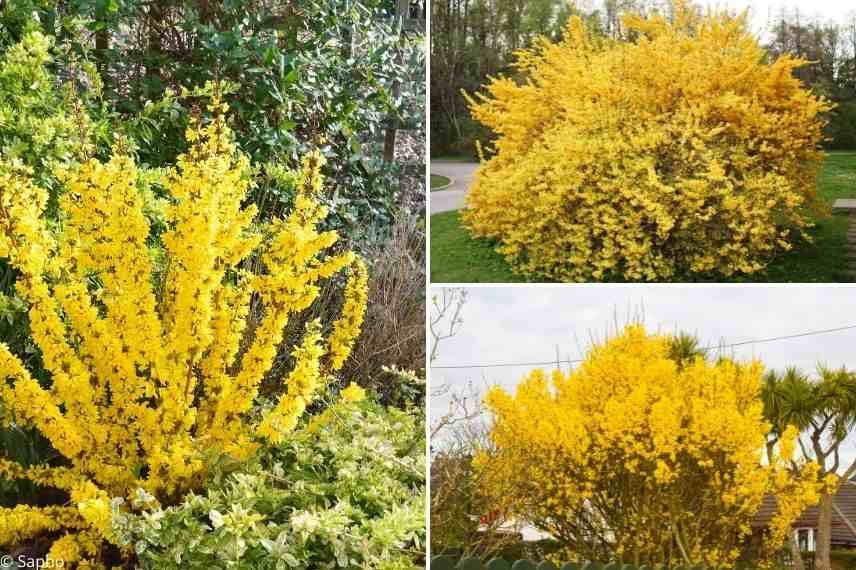
The dwarf forsythia ‘Mikador’ (under 1.5 m), a medium forsythia (1.5 to 2 m), and the large Forsythia x intermedia exceeding 2 m tall
According to the habit and use
Forsythia is used differently depending on its habit and size. Originally, the Paris mimosa is naturally upright, but hybridization has led to the creation of new creeping bushes. These smaller varieties create a lovely groundcover effect in rockeries, slopes, and border beds (for example, Forsythia intermedia ‘Marée d’Or’). These dwarf varieties also fit well in low hedges or in pots and containers on the terrace or balcony (notably the Forsythia (x) intermedia ‘Nimbus’, which is low, upright, and stocky, or the Minigold Paris mimosa with its bushy and spreading habit).
Conversely, medium and large forsythias are perfect for the back of a flowering bed due to their upright habit. This profusion of small golden-yellow flowers on erect branches beautifully complements spring-flowering shrubs, perennials, or spring bulbs. In hedges, pair them with evergreen shrubs to maintain a lovely display even after the flowers have faded. Having little interest in summer, dress up a forsythia by planting a summer-flowering clematis at its base. The forsythia then serves as a support for climbing plants that adds a splash of colour to the green foliage. You can also plant your large forsythia as a specimen or even train it against a wall!
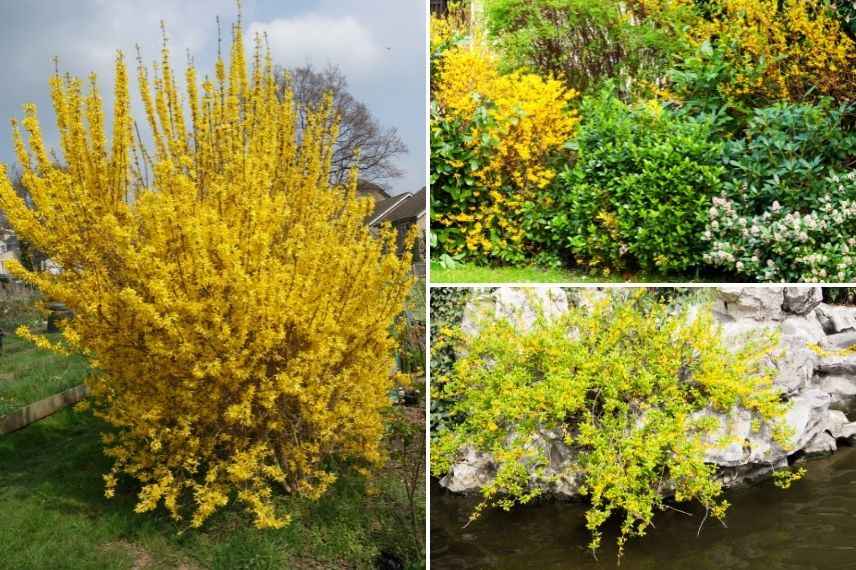
Forsythia as a specimen, in a mixed hedge, or in a rockery
For further reading
- Discover our tutorial on pruning forsythia
- Get inspired by our advice sheet: Forsythia: 7 ideas for garden combinations
- Subscribe!
- Contents
![[plant id="1234" name="Forsythia" color="yellow"]](https://en.promessedefleurs.eu/blogwp/wp-content/uploads/2022/04/choisir-un-forsythia.jpg "[choose] a forsythia")
Comments