






























Companion plants in the vegetable garden
How the companionship of certain plantscan be beneficial to vegetables and fruits growth
Contents
Let’s face it, the company of certain people can be unbearable, while others bring much simply by their presence. Why should it be any different with plants? This is, in fact, the premise of companion planting that underpins organic or natural gardening. Indeed, it is recognised by gardeners and botanists that some plants may have an influence on their neighbouring plants, either positive or negative. While some of these interactions can be explained by the presence of toxins or other substances in the plant’s tissues, others remain quite mysterious, even though they are well established.
Even though this companionship relies more on transmission, experimentation, and observation than on pure science, adhering to this method of cultivation remains accessible and easy to implement. Companion plants also have the advantage of reducing the need for fertilisers and other plant protection products, which, although organic, are never entirely harmless to the fauna and flora.
Let’s take stock of the main companion plants that, beyond their allelopathic properties, bring a welcome (bio)diversity to the vegetable garden.

What exactly are companion plants?
An allelopathic plant… Admit that the term is sufficiently impressive to lend a scientific credibility to today’s topic: companion plants. Often, when faced with somewhat enigmatic terms, a look at etymology is warranted: allelopathy is formed from “allelon” meaning “one another” and “pathos” meaning “suffering” in Greek. An allelopathic plant is therefore a plant that influences another through the chemical compounds it contains and releases into its immediate environment. It is important to note that this influence can be beneficial and largely positive, or harmful and negative.
All these allelopathic plants contain different chemical compounds that interact with their neighbours. Among these chemical compounds, we find alkaloids, flavonoids, folic acids… secreted in the plant’s tissues, roots or flowers, as well as through stems or foliage.
In short, companion plants are defined as plants that exert an influence on other plants, establishing favourable or unfavourable relationships with them. This occurs in various ways and for different purposes.
Companion plants that repel pests
Among companion plants, the most popular among gardeners are undoubtedly those that have the power to repel pests and all kinds of parasites. These plants are proud, useful, and highly effective allies for gardeners in that they help avoid the use of all sorts of insecticides and other extermination methods, which, although organic, can have consequences for both fauna and flora.
These companion plants are referred to as repellent because they possess the ability to ward off unwanted insects. This is achieved thanks to the scents emitted by their foliage or flowers. Others, like marigold (Tagetes) or calendula (Calendula), have even greater powers. Indeed, their root system is said to be nematicidal, killing nematodes (the harmful ones, not to be confused with beneficial nematodes used in biological control) present in the soil.
Integrating these companion plants into the vegetable garden would therefore help prevent the invasion of certain pests by keeping them at bay. Many of these repellent companion plants, beyond their repellent virtues, also add a splash of colour to the vegetable garden:
- Marigold and calendula are known to repel aphids, whiteflies, or flea beetles
- The wormwood (Artemisia), which emits a camphor-like scent, would deter aphids and caterpillars of many butterflies
- The common rue (Ruta graveolens), also known as fetid rue, keeps many insects at bay
- The common sage with its pungent aroma repels ants that “raise” aphids
- Planting garlic near roses would protect them from aphids
- The basil (Ocimum basilicum) keeps whiteflies away
- The mint (Mentha) repels ants
- The large-flowered flax (Linum grandiflorum) would deter Colorado potato beetles…
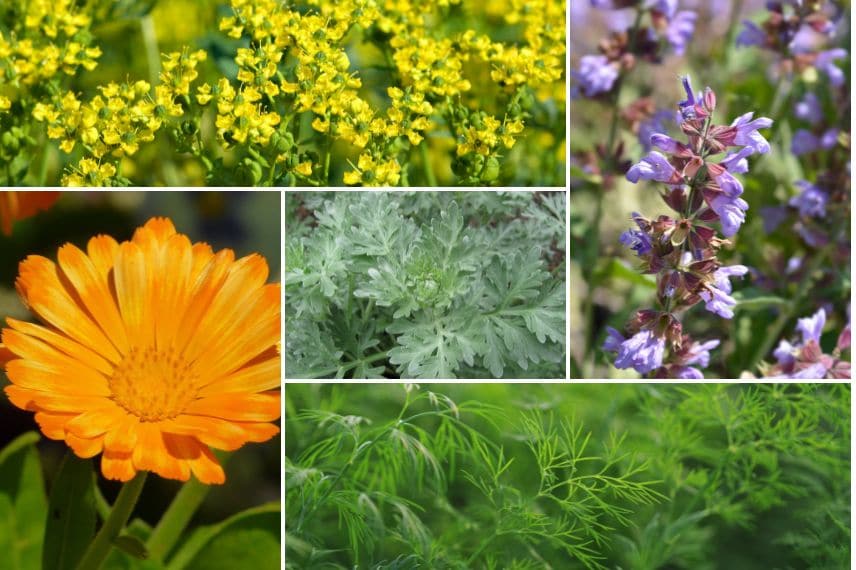
The calendula, common rue, wormwood, common sage, and dill
We could also mention lavender, rosemary, summer savory… as repellent companion plants.
Other vegetable plants play reciprocity to protect themselves from their own pests. The most well-known companionship in this regard is that of carrots and leeks. Indeed, the strong scent of leeks repels the carrot fly, and in return, carrots drive away the leek fly!
Others act differently by attracting pests. These are trap plants that allow for the detection of an infestation and addressing it before it spreads. Among companion plants, the nasturtium is the queen! Indeed, it has the ability to attract aphids that will concentrate on it. Once it is covered, do not hesitate to destroy it!
Tonifying companion plants
Some companion plants nourish and improve the soil and thus indirectly benefit the plants growing in it. This is the case with Fabaceae (formerly legumes) such as beans, peas, broad beans, chickpeas… but also lupins, which have the ability to capture atmospheric nitrogen thanks to the nodosities on their roots and return it to the soil. Thus, these Fabaceae fertilise the soil, as plants of this genus can be considered green manures. This is why it is advisable to plant these legumes alongside greedy plants like tomatoes or squashes.
Other companion plants will directly influence the development of their neighbours by stimulating their growth or improving their foliage. Among the companion plants that boost the growth of their neighbours, we can mention:
- The chamomile, which tones and stimulates the growth of nearby plants
- The comfrey is also a fertilising plant, as its taproot brings essential minerals and trace elements to the soil. It thus plays a fertilising and revitalising role for neighbouring plants
- The garden valerian (Valeriana officinalis) is said to attract earthworms, which are known for their effectiveness in aerating the soil.
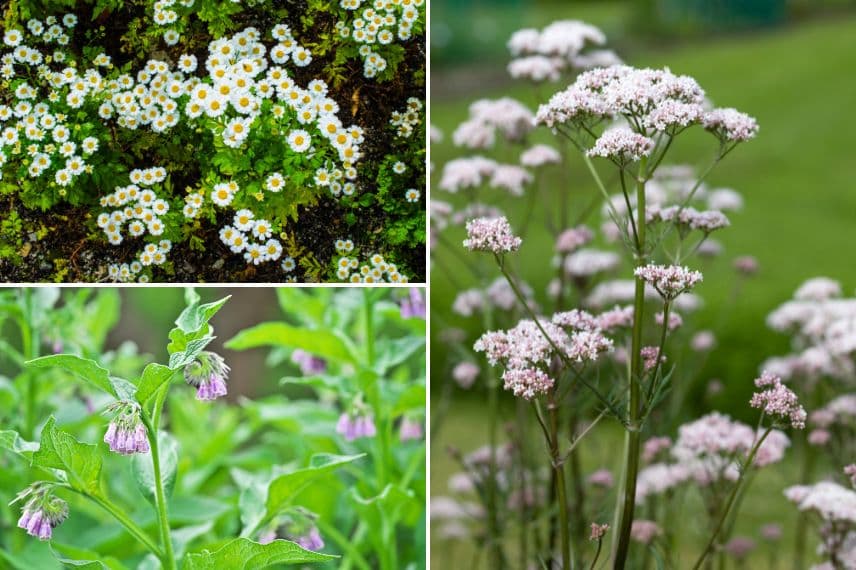
The chamomile, comfrey, and garden valerian
Companion plants that protect against diseases
Some plants are considered companions because they have the power to protect their neighbours from the most common diseases in the vegetable garden. Admittedly, this is a fact that is difficult to prove scientifically, but generations of gardeners observe or test it daily.
Among these super-powered plants, we cannot overlook the marigold. “Not again,” you might say, but this small annual plant with yellow or orange flowers is imbued with a true strength that makes it a very good companion. The roots of the tagetes actually emit toxins (including triophene) capable of not only killing soil nematodes but also destroying the germs of fungal diseases.
Another popular companion plant among gardeners is basil. When grown close to tomatoes, it is said to protect them from blight. All you need to do now is add mozzarella and olive oil!
Garlic is known to be effective against black spot disease, which often affects rose leaves.
In a different vein, chives are also very useful. When planted near roses, they help limit the invasion of rust. Plus, you benefit from their culinary leaves.
→ Read also: What to plant at the base of my roses?
Companion plants that help pollination
It is also interesting to grow plants known for the melliferous and nectariferous properties of their flowers in the middle of your vegetable garden. Insects will rush to forage and, from flower to flower, will participate in the pollination of the fruit vegetables in the garden.
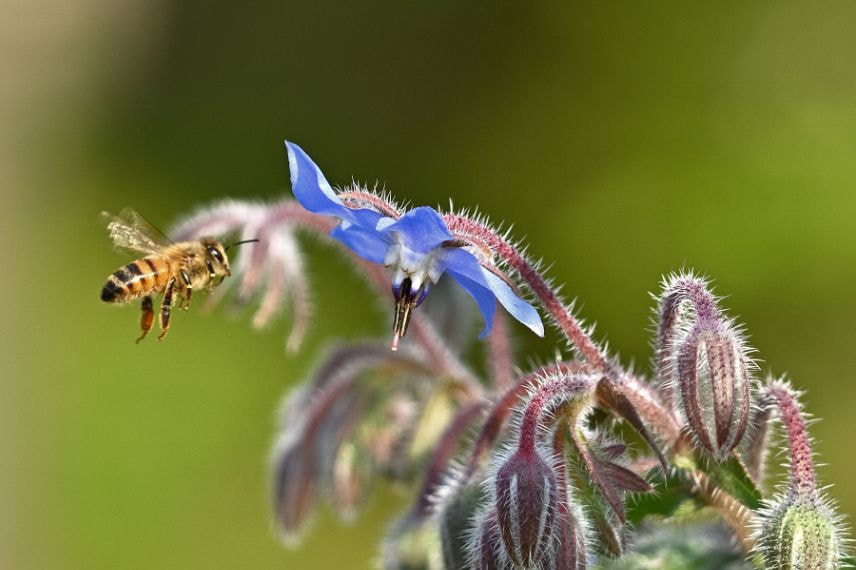
Borage is a plant with very melliferous flowers
Melliferous annuals or perennials are quite numerous, but among the champions, we can mention the essential Indian carnation, the common borage with its lovely blue flowers, the lupins with their long coloured spikes, cornflowers, echinaceas, phacelia, and wallflowers… These flowering plants will also have the merit of attracting beneficial insects such as hoverflies, which are useful in biological pest control.
→ Read also: Flowers for bees
Companion plants that fight invasive plants
For this chapter, I will start by mentioning… the marigold! This flowering annual certainly has many qualities! Planted in the vegetable garden, the marigold has the merit of limiting the spread of bindweed and couch grass, two sworn enemies of the gardener.
For other companion plants with weeding virtues, I refer you to Sophie’s excellent article: Natural weedkiller: discover allelopathic plants!
Summary of the most well-known companion plants
Feel free to plant in your vegetable garden:
- Wormwood, paired with all vegetables, to deter mites
- Garlic, which repels all insects, protects strawberries from fungal diseases and roses from black spot disease (do not plant near cabbages, leeks, and legumes)
- Dill repels aphids
- Artemisia has a repellent effect on many insects (do not plant near fennel, potatoes, and sage)
- Basil drives away Colorado potato beetles, whiteflies, cabbage flies, and strengthens tomatoes
- Borage promotes strawberry production and attracts pollinators
- Chamomile stimulates the growth of companion plants
- Chives limit the spread of rust
- Comfrey adds minerals to the soil
- Lavender repels aphids
- Large-flowered flax is a repellent for Colorado potato beetles
- Lemon balm is melliferous and deters mites
- Mint repels flea beetles, cabbage flies, and aphids
- Forget-me-nots deter raspberry worms
- Marigold is the best companion plant there is!
- Rosemary repels cabbage flies
- Savory is repellent to black aphids and attracts bees
- Common sage repels carrot and cabbage flies, cabbage whites, Colorado potato beetles, and ants
- Calendula is a powerful repellent against many insects
Vegetables can also be paired with each other and become effective companion plants. This is known as crop association (which includes flowers and herbs). Ingrid B. explains everything in her article: Crop association in the vegetable garden: why, how? Benefits and examples.
- Subscribe!
- Contents
Comments