


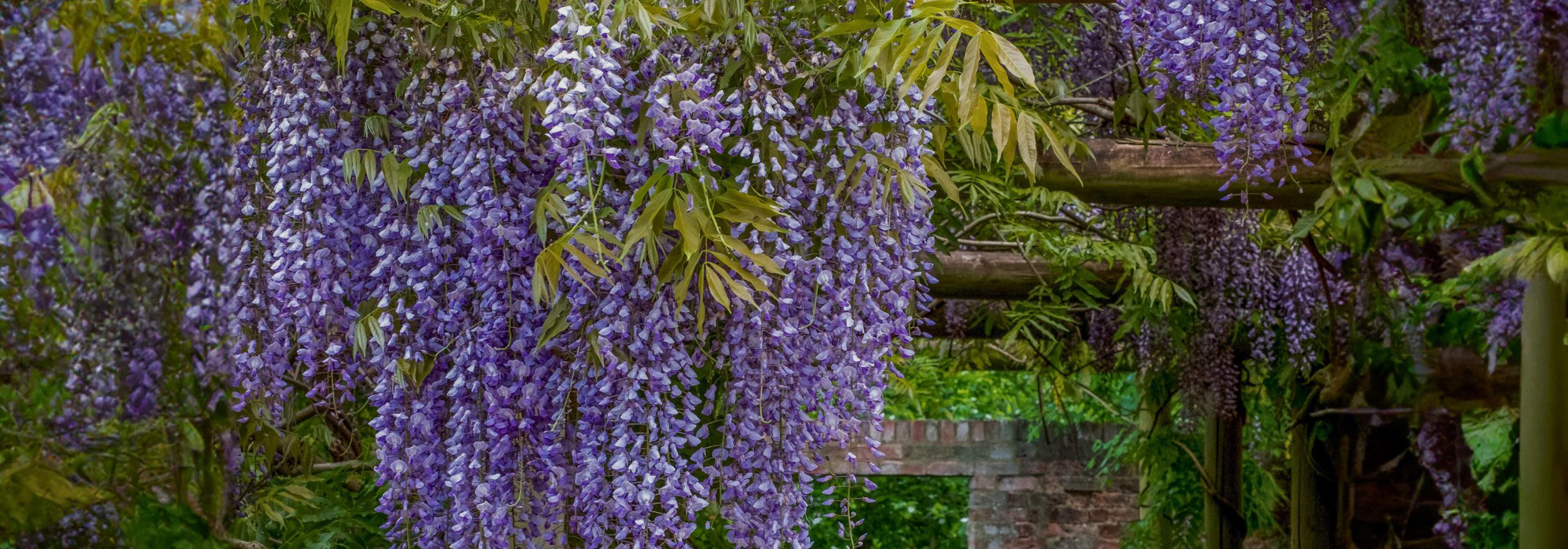
Create an opulent garden with an abundance of cascading flowers!
Discover the plant cascade trend
Contents
A new trend is emerging in the garden this year: cascading plants. Wisterias, tamarisks, Cytisus, and other bushes with a weeping habit come to break up the garden’s ordinary lines, bringing a vertical and airy dimension. Their lush growth or their long clusters of flowers cascade gracefully to the ground. These plants help create a genuine haven of peace, in a style that is both wild and opulent. They can be integrated into different garden styles: romantic, naturalistic or cottage garden. Discover all our tips on which plants to choose and how to incorporate them into your garden!

Plant cascades: what are they?
These are plants with a trailing habit, whose stems or clusters of flowers hang down toward the ground. You might immediately think of climbers such as the wisteria, the Akebia longeracemosa, the clematis, the hops… But it can also be weeping trees and shrubs or at least arching: weeping trees and shrubs or arching: tamaris, cytisus, Lespedeza, Kolkwitzia, weeping pear… In this regard, plants with a weeping habit are generally identifiable by their variety name in ‘Pendula’ or ‘Pendulum’ (for example, Sophora japonica ‘Pendula’, Cercidiphyllum japonicum ‘Pendulum’, etc.). They can also be small perennials with a spreading or trailing habit, which, for example when placed in hanging baskets, in a window box or on top of a low wall, will have their stems and flowers descend gracefully toward the ground. A few examples: Aubrietias on a wall, Lobelias, Campanula muralis, ivies or Muehlenbeckia in hanging baskets, Lysimachia nummularia… All of these plants help create a real cascading effect.
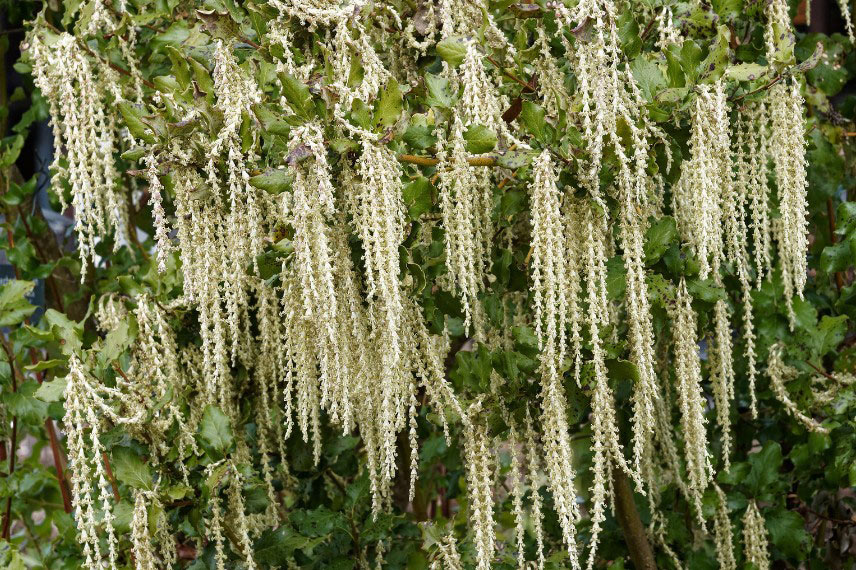
Garrya elliptica ‘James Roof’
Read also
7 weeping shrubsWhy including them in the garden?
Plant cascades are highly ornamental in the garden:
-
- They bring a style that is at once very natural and romantic. They give the garden a slightly wild feel, their distinctive form lending it a less restrained and more natural look. These plants with a weeping habit also bring a certain privacy, creating vertical lines that screen prying eyes.
- They create a sense of botanical opulence. As they spread, these plants can easily give the impression that the garden overflows with vegetation and flowers! The same is true for trailing perennials installed in hanging baskets or on a low wall: they seem to spill over their support and cannot be contained.
- During flowering, shrubs with a weeping habit and climbing plants such as wisteria appear to bow under the weight of their blossoms.
- They help to break up more formal lines, such as those of paths, buildings or hedges. They can create a nice contrast alongside plants with more rigid shapes.
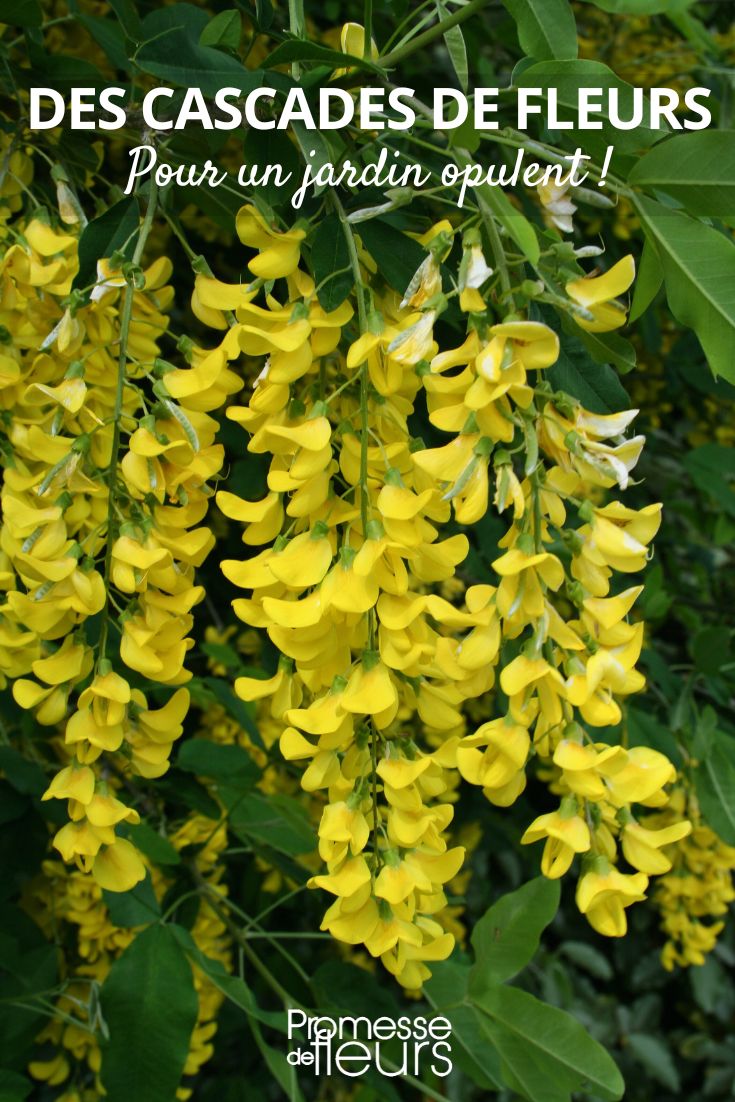
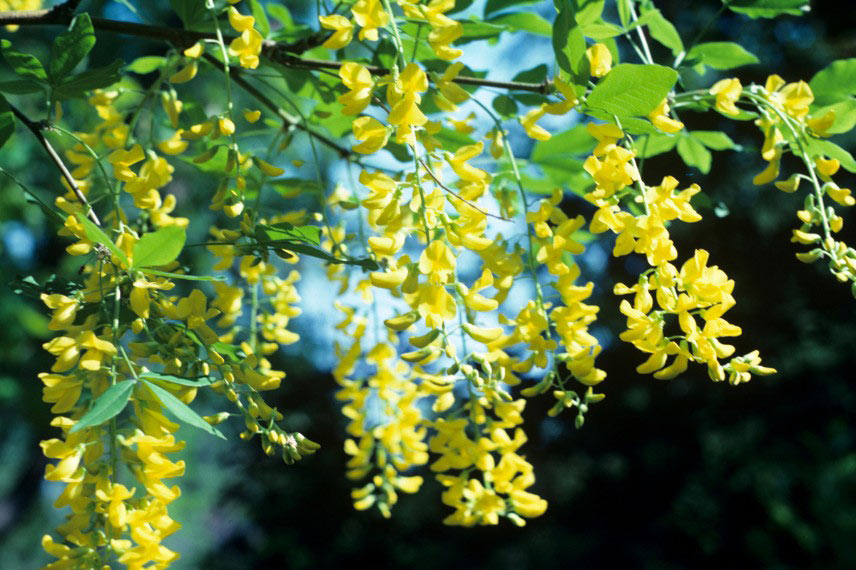 Laburnum watereri ‘Vossii’
How to incorporate them into the garden?
With their habit and their very distinctive shapes, these plants aren’t the easiest to integrate into the garden or to pair with other plants.
- Don’t hesitate to play with contrasts of shapes : the very vertical habit of these cascading plants will be particularly highlighted if they are surrounded by ground-cover plants, with a very horizontal habit, or shrubs pruned into topiary, for example.
- Take advantage of climbing plants (wisteria, Clematis…) to embellish a pergola, an arbor, or to dress a wall. They will bring a romantic ambience and soften the straight lines.
- The most attractive specimens will benefit from being planted in isolation : a tree or shrub with a weeping habit can be prettily showcased at the centre of a lawn, which will bring out its unusual silhouette
- Conversely, climbing voluble and trailing perennials with a trailing habit can easily be mixed with other vegetation, including other trailing plants, to create a real sense of botanical opulence, a lush garden teeming with vegetation and flowers!
- Finally, perennials (Aubrietas, Campanulas, Muhlenbeckia, Lysimachia…) can easily be installed on a low wall, in a raised pot or in a hanging basket to highlight their trailing vegetation.
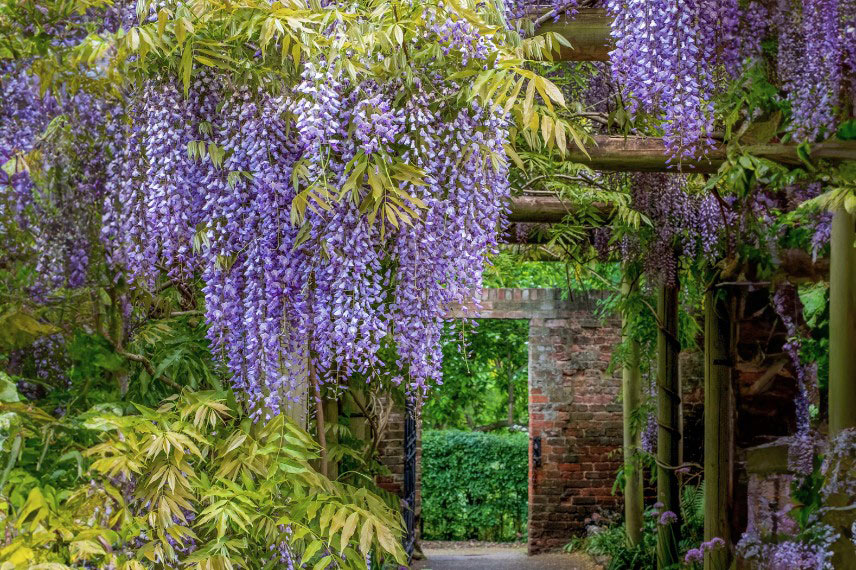
The wisteria Wisteria floribunda ‘Macrobotrys’
Read also
Trees with a weeping habitFor which style of garden?
Trailing plant cascades will find a place in a variety of garden styles:
- Romantic garden : They blend beautifully into a romantic-style garden. The clusters of trailing flowers on wisteria, and the arching, abundantly in-bloom branches of a Kolkwitzia, will create a lush, opulent yet delicate effect. Choose flowering in soft, pastel colours: pale pink, white, sky blue, mauve, apricot…
- Naturalistic garden: Trailing plant cascades will bring a spontaneous, wild feel to the garden, breaking up the formal lines of lawns, paths and buildings.
- Cottage garden : They help create an ambience that is both very soft and a little vintage. Also favour pastel colours, and don’t hesitate to incorporate garden furniture and decorative elements, preferably in wrought iron, wood or stone, to maintain a very natural look.
- Exotic garden : Their trailing vegetation will create a lush, transporting atmosphere, provided you choose suitable plants. We particularly recommend trumpet vines, Akebia longeracemosa, passionflowers, Callistemons, fuchsias, cytises… And why not also a bamboo with a weeping habit, such as the Fargesia denudata?
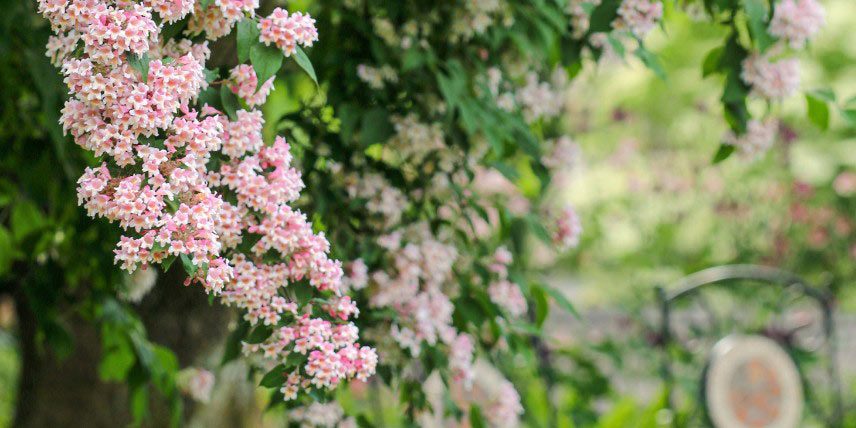
With its trailing branches covered in pink flowers, the Kolkwitzia amabilis is ideal in a romantic garden!
Which plants to choose?
Perennials
On a low wall or in a sunny rock garden, you can plant aubrietas, creeping rosemary, Campanula muralis, a Russelia juncea. For a shady corner, choose Lysimachia nummularia ‘Aurea’, with very bright golden foliage.
Climbing plants
With their long voluble stems, climbing plants are ideal for creating cascading greenery! We particularly recommend the wisteria, whose long blue, mauve or white clusters will create a real cascade effect: you can choose, for example, the Japanese wisteria with violet flowers Wisteria floribunda ‘Macrobotrys’ or with white flowers, Wisteria floribunda ‘Alba’. You can also opt for bignones, clematis, hops, ivy… Also discover the superb Akebia longeracemosa, which offers pretty foliage divided into 5 leaflets, and flowers in long clusters of purple blooms.
Bushes
Prefer bushes with a weeping or arching habit. You can opt for the weeping ornamental pear, Pyrus salicifolia ‘Pendula’, the Kolkwitzia amabilis, the Buddleja lindleyana, the Lespedeza thunbergii or the Tamarix tetrandra. Enjoy also the long, trailing inflorescences of Garrya elliptica ‘James Roof’ and of Laburnum watereri ‘Vossii’.
Trees
Trees will help structure the garden. Here again, choose varieties with a weeping habit: for example Cercidiphyllum japonicum ‘Pendulum’, Sophora japonica ‘Pendula’, the weeping willow Salix babylonica, the very distinctive Larix kaempferii ‘Stiff Weeper’, the cedar Cedrus atlantica ‘Glauca Pendula’… To enjoy splendid spring flowering, opt for flowering cherries Prunus ‘Kiku Shidare Sakura’, Prunus ‘Snow Fountains’ or Prunus subhirtella ‘Pendula Rubra’. We also recommend the goat willow Salix caprea ‘Kilmarnock’.
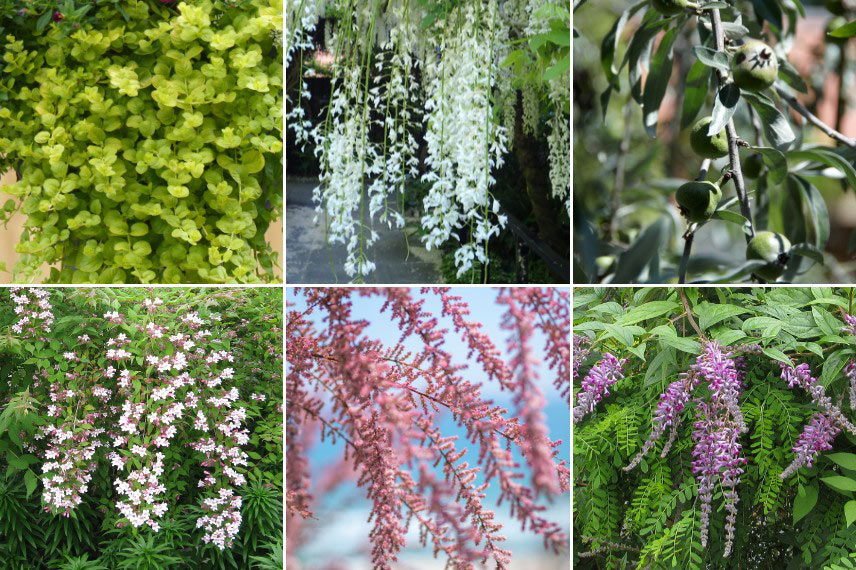
Some examples of cascading plants : Lysimachia nummularia ‘Goldilocks’, Wisteria floribunda ‘Alba’ (photo : Krzysztof Ziarnek), Pyrus salicifolia ‘Pendula’ (photo : Wouter Hagens), Kolkwitzia amabilis (photo : Kenpei), Tamarix tetrandra et Buddleia lindleyana
- Subscribe!
- Contents
Comments