


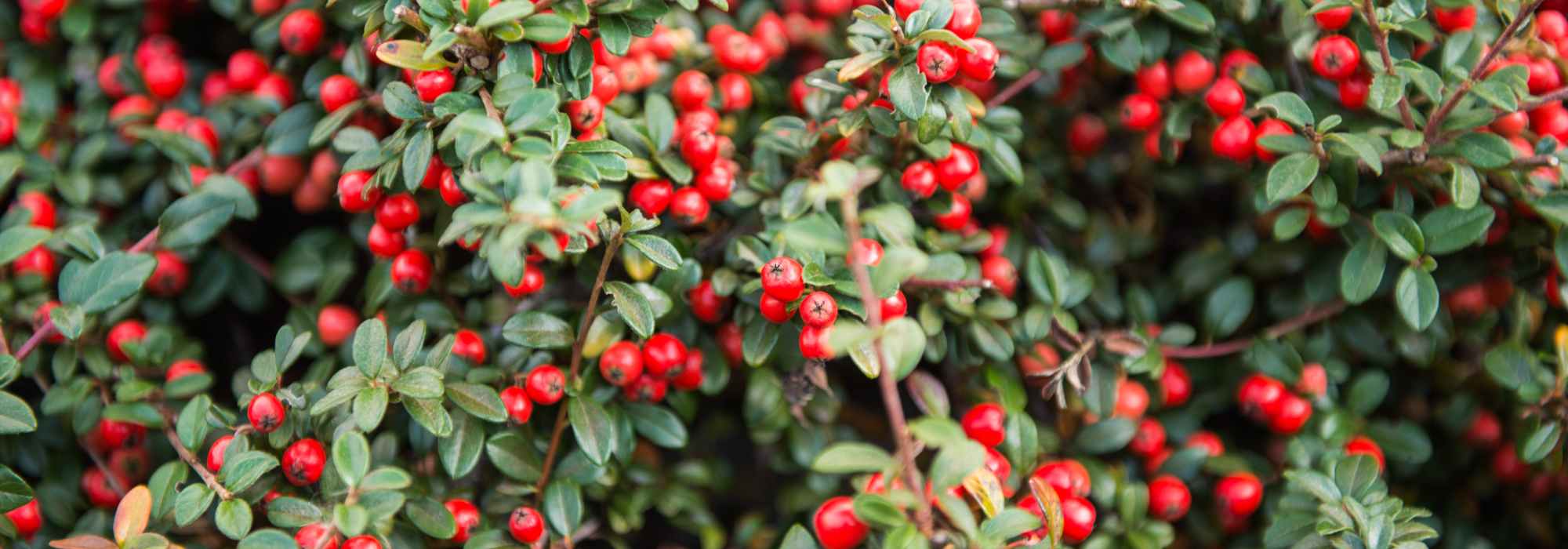
Five Cotoneaster varieties perfect for hedges
Our selection to easily create a privacy screen or windbreak
Contents
Cotoneaster is a small shrub that is easy to grow and very hardy, adapting to all exposures, climates and to all well-drained soils. Its rapid growth and dense foliage, deciduous or evergreen depending on the climate, make it ideal for windbreak and privacy hedges, pruned to a straight line or left natural. It can also be grown in large pots on a terrace or a spacious balcony to create dense screens. In spring, it bursts into a profusion of flowers followed by berries or very decorative foliage in autumn. For a hedge that looks good in all seasons, prefer evergreen species. Discover our selection of cotoneasters perfect for forming low or tall hedges, deciduous or evergreen!
To learn all about this handsome shrub, view our comprehensive guide “Cotoneaster: planting, pruning and care”

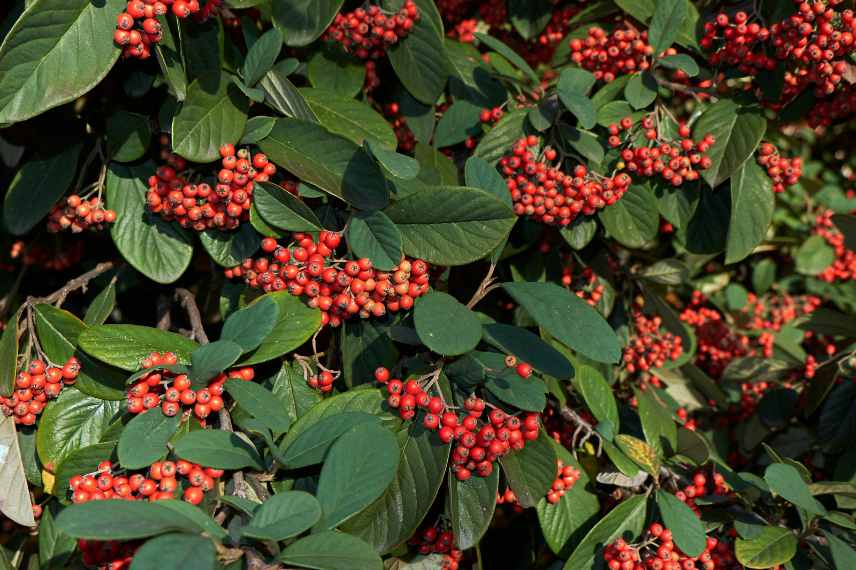
Cotoneaster lacteus
Particularly vigorous, Cotoneaster lacteus is one of those fail-safe choices for creating an evergreen hedge, thanks to its tolerance of almost any situation and its rapid growth. It resists short-lived drought once well established as well as very harsh winters (down to -20°C) and accepts any ordinary soil! It will enjoy sun as well as partial shade, or even full shade in our most exposed regions. It forms a soft, evergreen screen, flexible and natural, whose dark green foliage lights up from May to July depending on the climate, with a pretty white flowering, fragrant and melliferous. Measuring 3 m in all directions, its bushy habit will be ideal for quickly creating privacy in the garden or sheltering from the wind. And as it responds very well to pruning, it’s a perfect candidate for a neat and well-tended hedge, regularly maintained in a more contemporary setting. Flowering gives way to vermilion-red berries which persist for a long time on the shoots, delighting birds and adding colour to the garden in winter. In a large evergreen hedge, it will easily pair with its cousin the Pyracantha, which, like it, in autumn, yields a profusion of berries in vivid colours.
Read also
Cotoneaster: planting, pruning, careCotoneaster franchetii
The Cotoneaster franchetti, with a spreading, dense habit, is ideal for forming a hedge. It can reach up to 3 m in height and 3.5 m in spread at maturity. Its arching shoots bear evergreen foliage in a pretty matte green. In May–June, it blooms with clouds of white-pink flowers, followed by an abundance of red-orange berries, decorative in autumn and winter. Very tolerant, this Cotoneaster will tolerate partially shaded situations, but dislikes north-facing exposures in regions with harsh winters. Versatile, it makes a striking hedge, whether informal or clipped. It can also make a handsome specimen as a standalone shrub if pruned into a ball. In a large evergreen hedge and windbreak, pair it with, for example cherry laurel, such as the Prunus laurocerasus ‘Obelisk’, equally adaptable and featuring glossy green foliage, as well as a cream-white flowering a little earlier, in April–May.
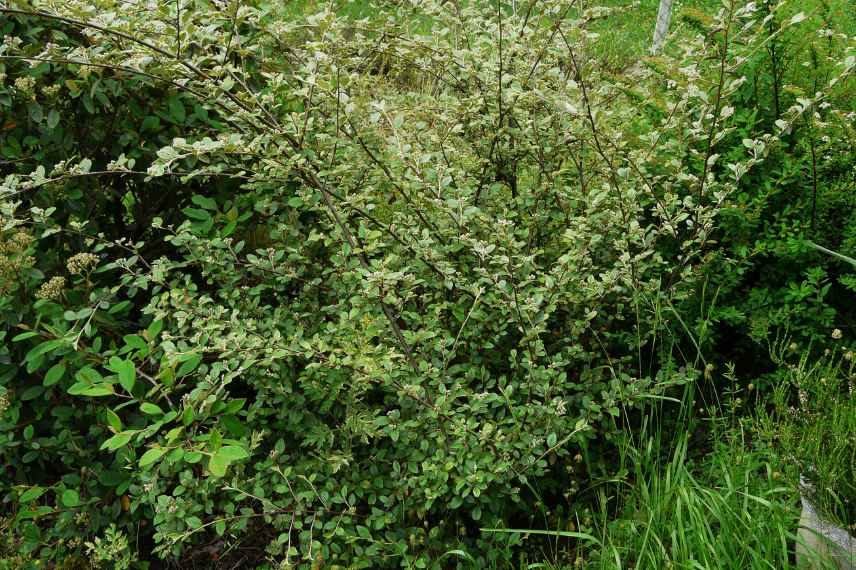
Cotoneaster franchetii (© Père Igor)
Cotoneaster lucidus
Cotoneaster lucidus though deciduous, is far from lacking in qualities! Its leaves, a beautiful dark-green glossy shade, take on sumptuous autumn colours before shedding. Its leaves take on yellow to red-purple hues, while it dresses with berries in a dark, deep red in September-October that will persist through winter on the bare twigs. Its more modest size, 2 m tall by 1.5 m wide, allows it to be planted in smaller gardens. Vigorous, easy to grow, and well formed, it is perfect for creating a beautiful colourful leafy screen in a hedge, whether mixed, bocage or countryside, trimmed or not. In a natural hedge, for a flamboyant pairing, bring it near Aronia arbutifolia ‘Brilliant’, another very ornamental bush, with dark-green foliage turning to bright red in autumn and white spring flowering. Very easy to grow, like other Cotoneasters, it adapts to all soils and climates.
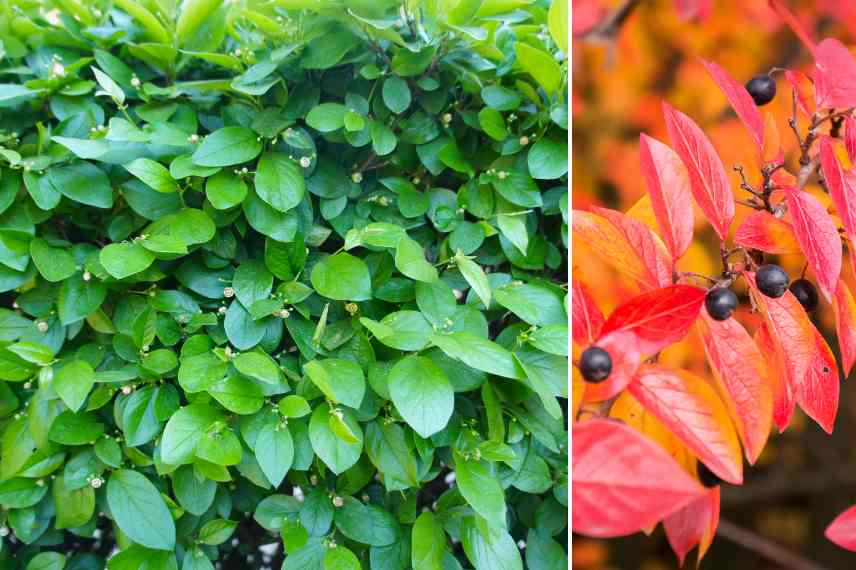
Cotoneaster lucidus. On the right, autumn foliage blazing.
Read also
Cotoneaster: which to choose?The Cotoneaster simonsii
Originating from the Himalayas, this very handsome bush, 2.5 m tall and wide, is hardy, with a compact, upright habit. The Cotoneaster simonsii forms a bushy mass almost as wide as tall, perfect for forming a hedge. Its rapid growth and easy cultivation allow it to readily establish a hedge that is continually visited by garden wildlife. It will grow in any well-drained soil, even when dry in summer. Accommodating, with its semi-evergreen foliage, it remains decorative for a large part of the year. Its foliage is part of its ornamental assets: it bears a dark, glossy green, velvety with glaucous green on the reverse. In spring, it unveils numerous corymbs of white flowers that delight pollinators. This flowering, slightly fragrant, gives way to pretty vermilion-red berries, loved by birds. In a cottage garden hedge, this ornamental cotoneaster, in all seasons, will benefit from being paired with Berberis, for example, and with Cornus alba ‘Baton Rouge,’ whose red stems are so graphic in winter and will echo the colour of its decorative berries.
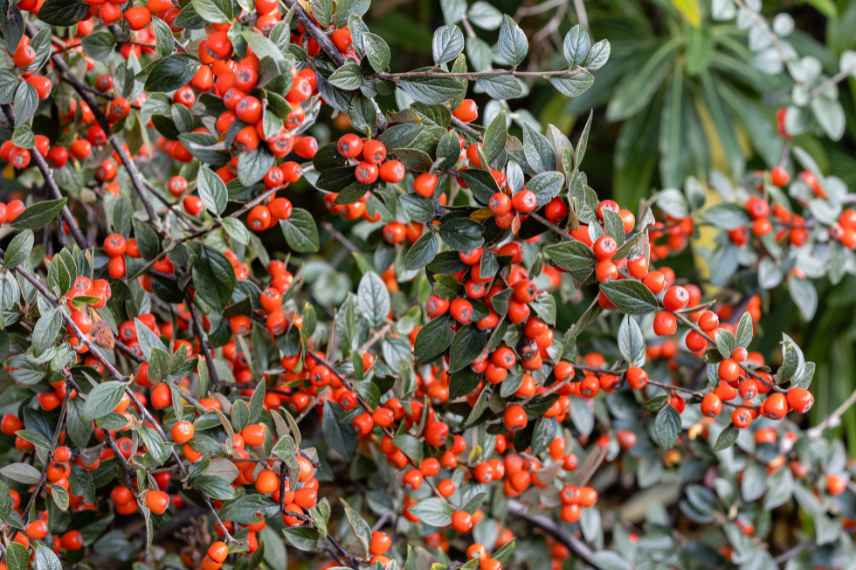
Cotoneaster divaricatus
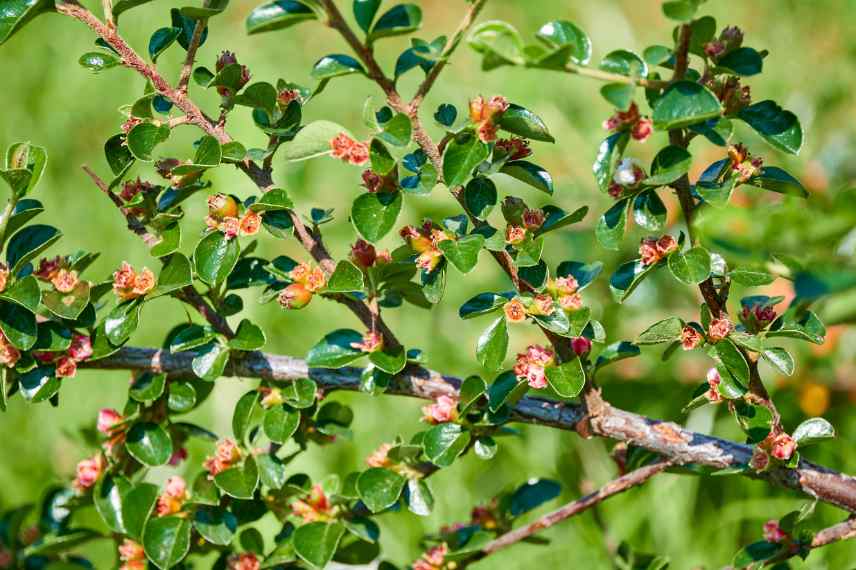
Cotoneaster divaricatus, or divaricate cotoneaster is not among the most common cotoneasters. And yet, it proves interesting for forming an informal hedge, across France. It is distinguished by its distinctive habit. Its branches arch strongly over time to form a parasol, which makes it indispensable for adding originality and colour in sunny or semi-shaded areas! This handsome shrub with a broad habit reaches on average 2.5 m in height and up to 5 m in spread. It shows fairly slow growth and has foliage that densifies with age, composed of small deciduous leaves turning dark orange to orange-brown in autumn. Another decorative asset: its flowering in clusters of white-pink flowers in late spring and its fruiting in oval berries of a beautiful dark glossy red, which persists well into winter if not eaten by birds. This shrub is as ornamental as it is easy to grow in ordinary soil, in a sunny position to enhance its colours. You can pair it with a shiny viburnum whose foliage reddens in autumn, or with a Nandina, with red-purple leaves and berries in autumn as well, two excellent choices for bringing colour to the garden in the late season.
- Subscribe!
- Contents
Comments