


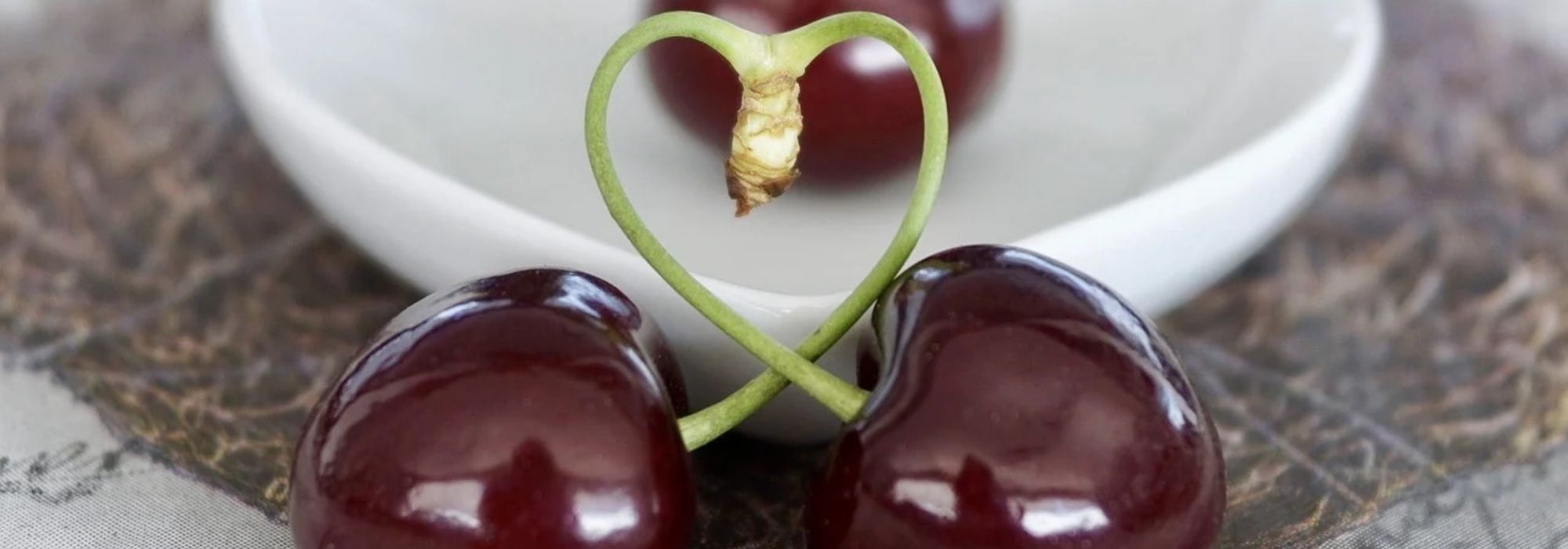
How to choose a cherry tree?
5 criteria to consider
Contents
Majestic tree, highly regarded for both its delicious fruits and beautiful spring flowering, the cherry tree can be grown in pots or in the ground in all regions of France. In Europe, two species originating from Asia Minor are distinguished: the sweet cherry (bigarreau, guigne) and the sour cherry with a more pronounced acidity. From these, hundreds of varieties are available, some of which are self-fertile, while others require a second cherry tree nearby to delight you with their fruits.
We offer you this little guide to choose your cherry tree based on 5 essential criteria: the type of cultivation (in pots or in the ground), the self-fertile or pollinator character, the fruiting period, the variety of cherries, and the use of the fruits… enough to guide your choice among the many varieties!

Pot or ground cultivation?
Planting a cherry tree is not just for large gardens: this beautiful fruit tree can also thrive on a balcony or terrace, provided you choose the variety suited to these growing conditions.
The varieties of cherries that do well in pots are the “mini cherry trees” or “dwarf cherry trees”, which do not exceed 2.5 metres in height at ripeness. Examples include the Garden Bing with its bright red, sweet fruits and the highly fragrant Griotella with its shiny red, tangy fruits.
The planting of a cherry tree in the ground is identical in every way, but opens up a wider range of varieties. The Bigarreau is the most well-known and widespread family of cherries in gardens, and the varieties Burlat, Napoléon, and Coeur de Pigeon are the tastiest, sweetest, and most consumed. However, ensure you have enough space for the tree’s development at maturity and choose a variety suitable for the size of your garden: these are generally vigorous trees reaching 5 to 10 m in height when mature. In the garden, the cherry tree is typically planted alone on a lawn, at the back of a flower bed, or within an orchard.
Also, read Marion’s tips in Dwarf cherry trees, perfect for balconies, terraces, and small spaces.
Read also
Cherry tree: planting, pruning, careSelf-fertile cherry tree or not?
The success of a good cherry harvest directly depends on the properties of the chosen fruit tree: can it develop on its own, or does it need to be planted near another variety of cherries to enhance its fruiting? While sour cherries are self-fertile, most sweet cherries require pollination – which means selecting a cherry variety with a matching flowering period and compatible pollen.
Among the self-fertile cherry trees, you can choose the Montmorency sour cherry, the Bigarreau ‘Sweetheart Sumtare’, or the Bigarreau ‘Summit’. For the others, and to ensure good pollination, you can opt for these pairs:
- Bigarreau ‘Burlat’ Cherry and Bigarreau ‘Napoléon’ Cherry for a bountiful harvest in May and June.
- Bigarreau ‘Hedelfingen’ Cherry and Bigarreau ‘Cœur de pigeon’ Cherry, a perfect duo for large spaces.
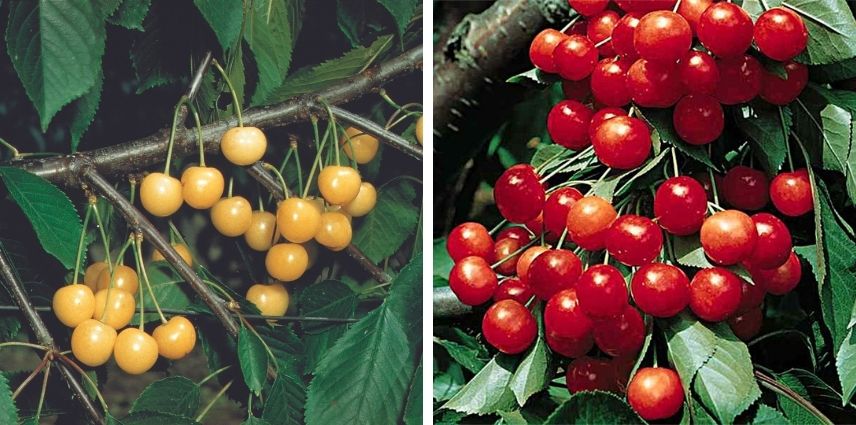
- Bigarreau ‘Napoléon’ Cherry and Bigarreau ‘Cœur de pigeon’ Cherry for bicoloured fruits, yellow and red.
- Bigarreau ‘Summit’ Cherry and Bigarreau ‘Hedelfingen’ Cherry for pot cultivation in a cold region.
→ Also, check out our article on: “Self-fertile cherry trees, perfect for small gardens“.
Discover other Cherry trees
View all →
Available in 0 sizes
Available in 0 sizes
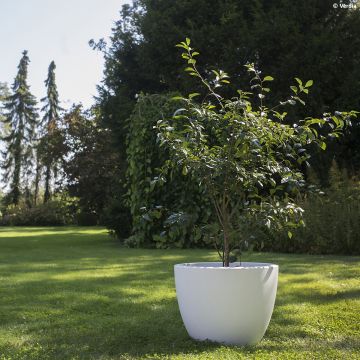
Available in 2 sizes
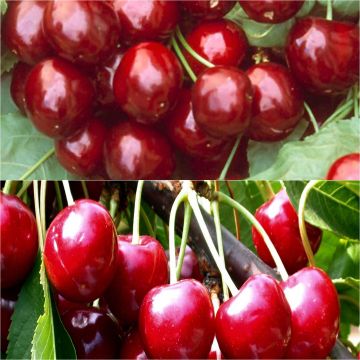
Available in 0 sizes
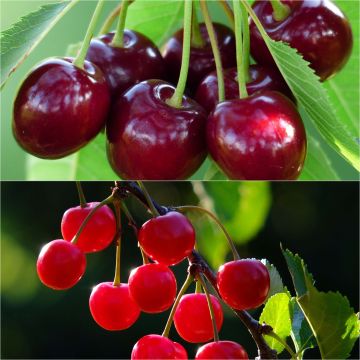
Available in 0 sizes
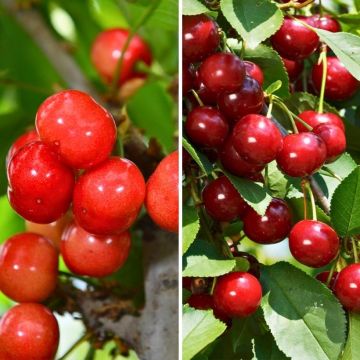
Available in 0 sizes
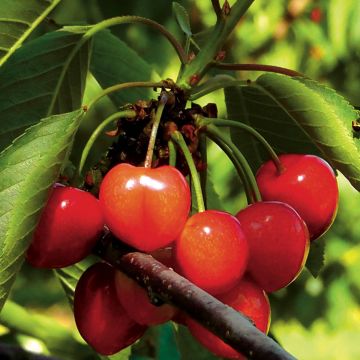
Available in 4 sizes
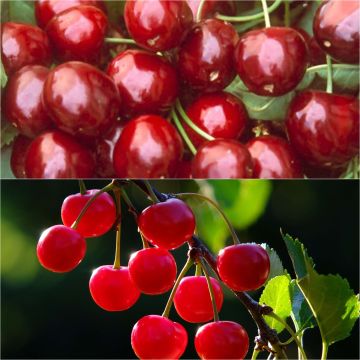
Available in 0 sizes
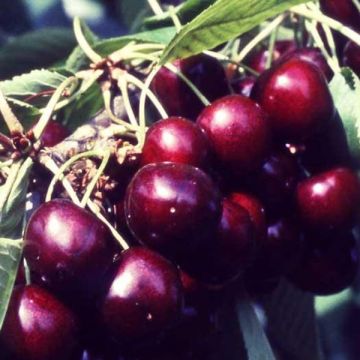
Available in 1 sizes
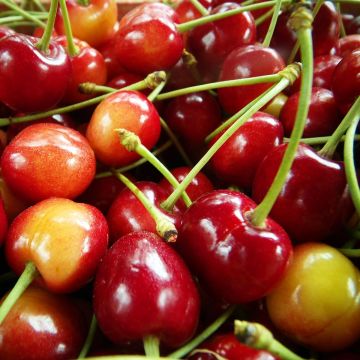
Available in 4 sizes
The fruiting period
Depending on the variety of cherries selected, the fruiting period will vary between May and July. Naturally, if you decide to plant several, it may be beneficial to stagger the harvests – while ensuring, if necessary, their pollination.
The ‘Burlat’ cherry tree has a very good yield, producing large cherries that are both red and shiny from the end of May, just like the ‘Moreau’ black cherries (although their yield is lower). For the ‘‘Cœurs de pigeon’, identifiable by their yellow and red heart-shaped colour, you must wait until the end of June. And it is only in July that the very productive ‘Chatenay’ griottes appear, with red flesh that is sometimes tart and sometimes sweet.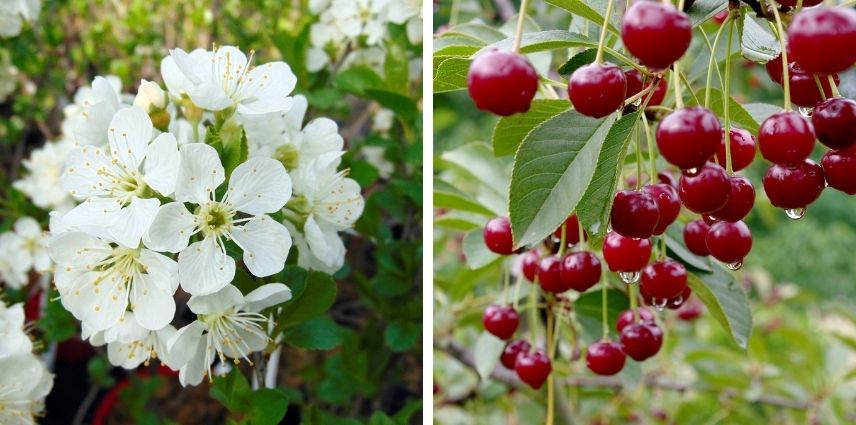
The flavour of fruits
Beyond growing conditions, a cherry tree is also chosen based on the taste of its fruits! From the two original species, the sweet cherry (Prunus Avium) and the sour cherry (Prunus cerasus), many varieties of cherries have emerged.
Highly popular in France, Bigarreaux have firm, crunchy flesh, available in white or red. For instance, the ‘Canada Giant’ cherry tree is productive and vigorous (but not self-fertile!) or the ‘Marmotte’ cherry tree, which is later fruiting but ideal to pair with a Burlat.
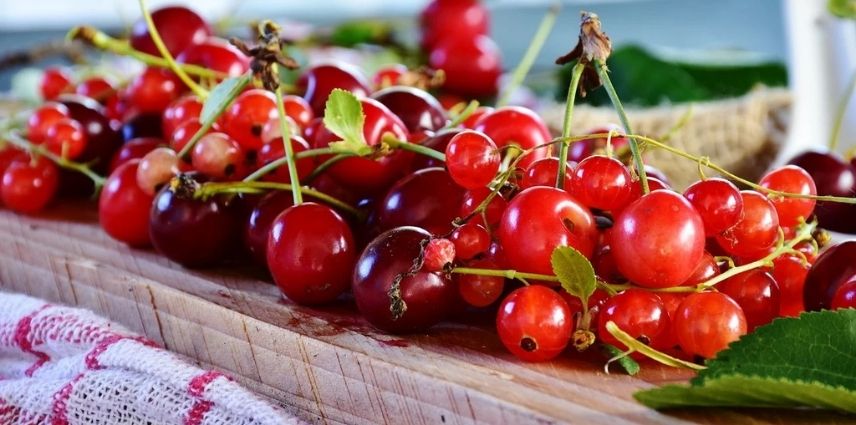
Guignes, on the other hand, offer sweet fruits with soft flesh, like the ‘Early Rivers’ cherry tree. However, if you prefer more acidic cherries, you should opt for amarelles with clear juice or griottes with coloured juice.
Read also: Which cherry tree to plant for a harvest of large sweet cherries?
The use of fruits
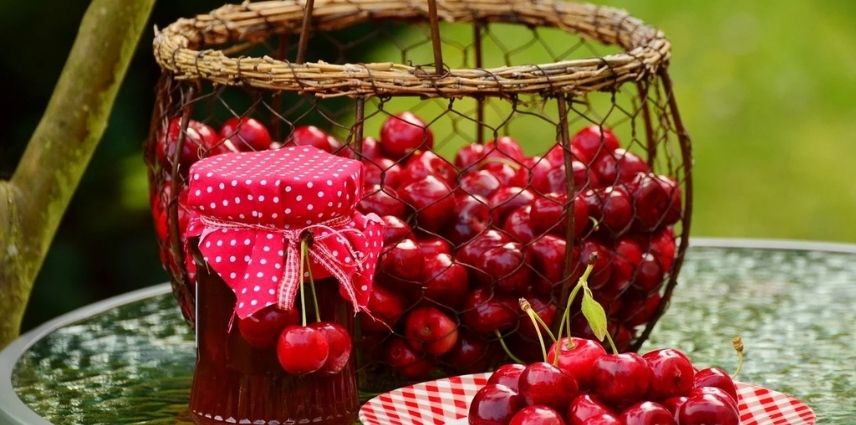
Last criterion to consider before choosing your cherry tree: what will be your use of its fruits? Table consumption, jams, preserves, accompaniments, brandy, kirsch, or pastry, each variety of cherries has its preferred uses.
For example, the cherry varieties ‘Cœurs de pigeon’, ‘Reverchon’ or ‘Napoléon’ are often used for eating fresh, directly from the tree! Just like ‘Burlat’, although they are also recommended for pastry and coulis. ‘Marmotte’ cherries are perfect for making jam, due to their satisfactory fruiting and slight acidity. Traditionally, morello cherries enhance dishes (duck, pork…) and serve as a base for brandy, along with ‘Montmorency’ cherries. For making kirsch, it is best to prefer guignes: the ‘Belle Magnifique’ cherry tree offers fruits with tender, juicy flesh, with a sweet and tangy taste. For winter tasting purposes, opt for English cherries (Prunus cerasus ‘Anglaise Hâtive’).
- Subscribe!
- Contents
![[select id="cerisier" placeholder="Choose a cherry tree"]](https://en.promessedefleurs.eu/blogwp/wp-content/uploads/2022/10/Comment-choisir-un-cerisier-.jpg "[plant_selector category=\"fruit-trees\" species=\"cherry\"]")
Comments