





























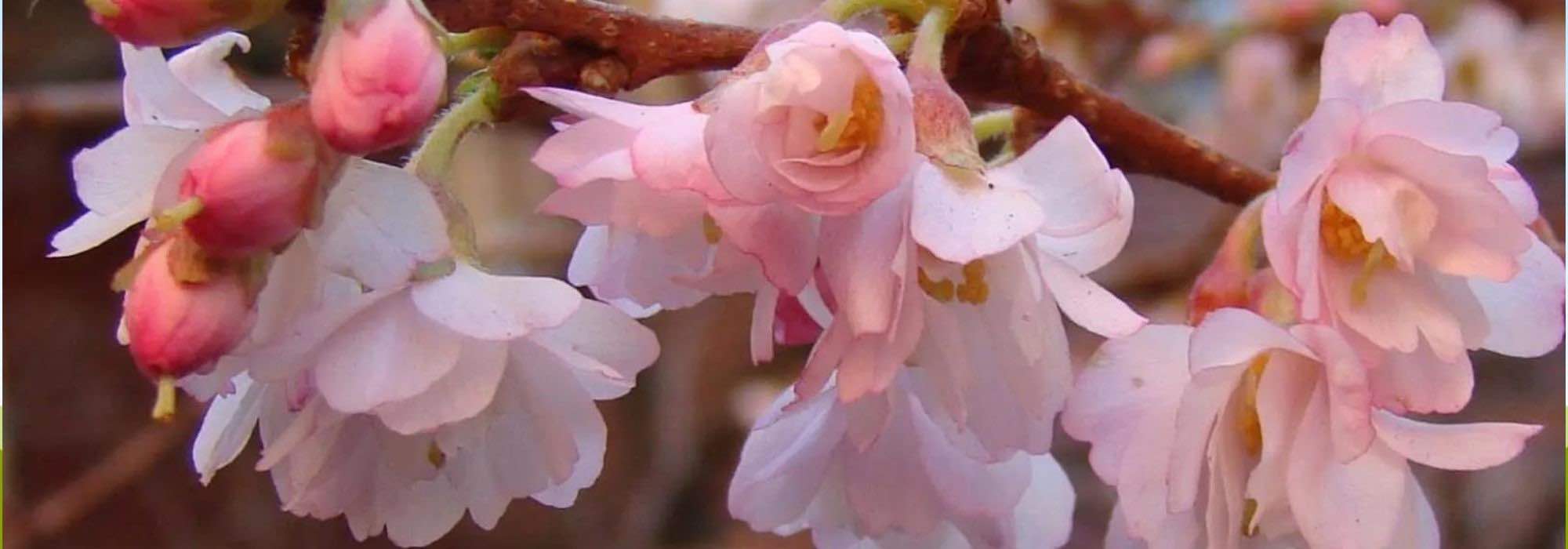
How to choose the right ornamental cherry tree?
Buying guide to find the best flowering cherry variety
Contents
The ornamental cherries (Prunus) enchant the spring with their delicate flowering, adorning branches that may still be bare of leaves. They are true heralds of the return of warmer days.
Japanese cherry trees are, of course, among the best-known ornamental cherries, but there are also other species. All stand out for their flowers, flowering period, silhouette, and their use in the garden. Based on these criteria, discover our buying guide to find the perfect variety of ornamental cherry.
And to learn all about cultivating these bushes, see our feature: Japanese cherry trees: planting, pruning and care.

Choosing an ornamental cherry tree based on the colour of the flowers
Pink flowering
Flowers display a gradient from a pretty, very soft pale pink to a more pronounced pink.
In the lightest, pastel colours, we note Prunus serrulata ‘Amanogawa’, with its pale pink flowers turning to white. The Prunus incisa ‘Oshidori’ also blooms in light pink, as does the Prunus hillieri ‘Spire’.
For its part, the Prunus serrulata ‘Kanzan’ produces red flower buds, which open to reveal flowers of a vibrant raspberry pink. ‘Kiku Shidare Zakura’ also offers a vivid pink flowering.
For its part, the Prunus incisa ‘Paean’ combines two shades of pink : pale pink on the outside and darker at the heart.
White flowering
White-flowering cherry trees offer elegance and refinement. At the Prunus pumila ‘Depressa’, the pure white flowering accompanies the emergence of the leaves.
In the variety ‘The Bride’, the shoots still leafless become covered with a multitude of flowers, creating a true cloud-like effect. They are initially pink before turning white.
On the small Prunus incisa ‘Mikinori’, the flowers are pink in bud, before opening white. They are semi-double, with a slightly ruffled appearance, yet always very delicate.
The Prunus incisa x serrulata ‘Umineko’ in turn produces small cut flower arrangements, invariably consisting of 2 to 3 single flowers, pure white, simply enhanced by a centre of golden stamens.
Choosing an ornamental cherry based on the shape of the flowers.
Ornamental cherry trees often produce single flowers, made up of five petals and a clearly visible centre of stamens. But some species offer a more sophisticated flowering, revealing semi-double or double flowers, with several ranks of petals. The stamens of the flower are, in fact, replaced by extra petals. They thus form true little floral pom-poms, as in the Prunus glandulosa ‘Rosea Plena’, flowering in pastel pink on naked shoots. This is also the case with the Prunus incisa ‘Oshidori’ which produces clusters of pale pink double flowers. Let us also mention the Prunus serrulata ‘Shirofugen’, with its large pure white double pompoms, which often emerge before the foliage.
In terms of flower size, most reach between 2 and 5 cm in diameter. Prunus yedoensis stands out, with flowers among the largest.
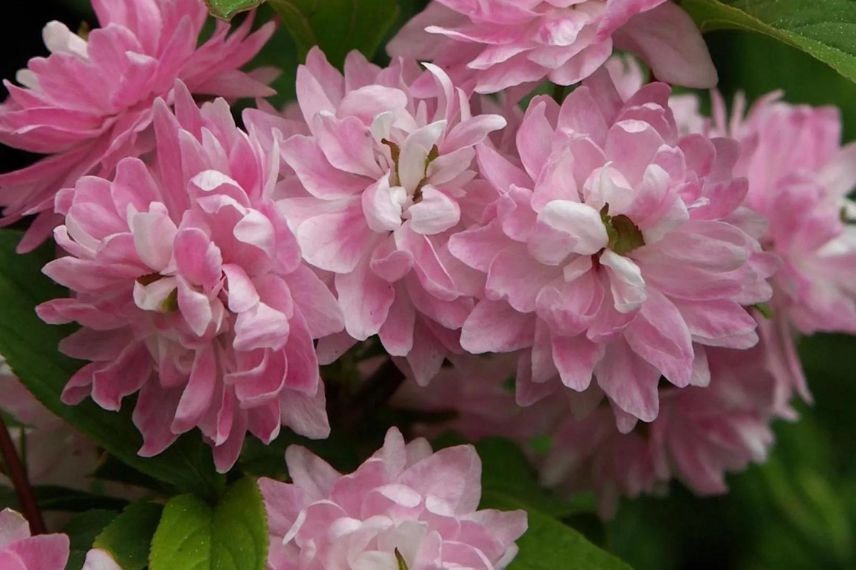
The Prunus glandulosa ‘Rosea Plena’ bears very abundant double flowers
Choosing an ornamental cherry tree for its fragrance.
Beyond their beautiful flowering, some Prunus varieties are also fragrant. This is the case with Prunus serrulata ‘Amanogawa’. The Prunus yedoensis also produces fragrant flowers, just like the variety ‘Shidare Yoshino’, which exudes an almond fragrance.
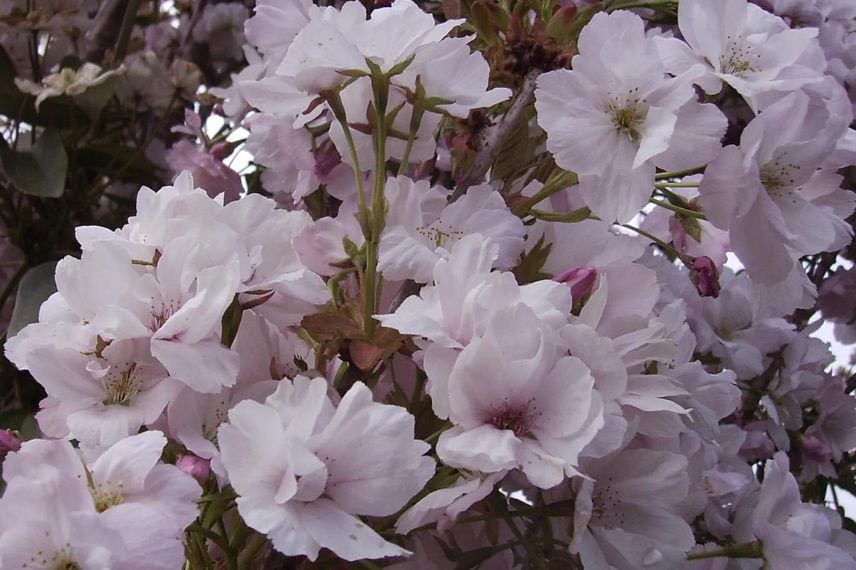
The Prunus serrulata ‘Amanogawa’ has fragrant flowers
Read also
6 winter-flowering PrunusChoosing an ornamental cherry tree according to its flowering period
Prunus subhirtella ‘Autumnalis Rosea’ has the peculiarity of brightening the cold season, flowering from November to February–March, in an intermittent fashion when the weather is mild. It then produces small semi-double pale pink flowers.
On the other hand, Japanese cherry ‘Brillant’ is able to brave the last winter frosts. It indeed rewards us with a fragrant flowering. Among the earliest, which like to bloom before the others, we also note Prunus kurilensis ‘Ruby’, whose dark pink flowers open from February–March. In the south of the country, the small Prunus incisa ‘Yamadei’ will also be able to show its flowers from February.
Conversely, some ornamental cherries prefer to wait for warmer temperatures before flowering. Among these late varieties, we may mention Prunus glandulosa ‘Alba Plena’, Prunus serrulata ‘Pink Perfection’ or another ‘Shirofugen’, all of which bloom in May.
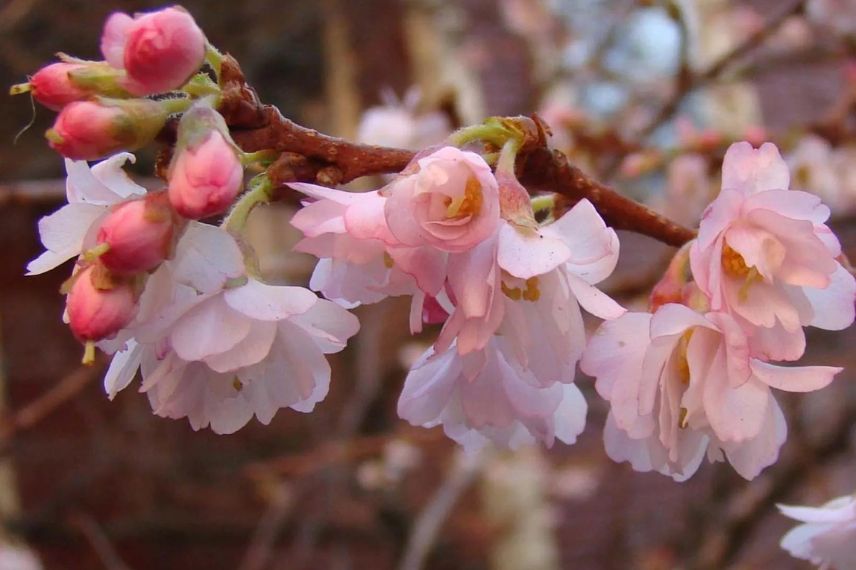
Prunus subhirtella ‘Autumnalis Rosea’ flowers throughout the cold season
Choosing an ornamental cherry tree based on its bark.
Flowering isn’t the only decorative asset of ornamental cherry trees. Some also reward us with a highly ornamental bark, especially in winter. Smooth in appearance, it may bear horizontal striations. This is due to the presence of lenticels, pores that facilitate exchanges between the air and the plant.
Among the most remarkable barks, let us mention the Tibetan cherry (Prunus serrula). Its wood, a luminous mahogany-brown or caramel, has bark that peels away in long bands curling around themselves. It is also the case with the variety ‘Amber Scots’, with cinnamon-red bark, or also with ‘Branklyn’, with coppery bark, truly glossy and striated with white bands.
On the Manchurian cherry (Prunus maackii ‘Amber Beauty’), the bark displays warm amber and coppery hues. It also peels away in strips.
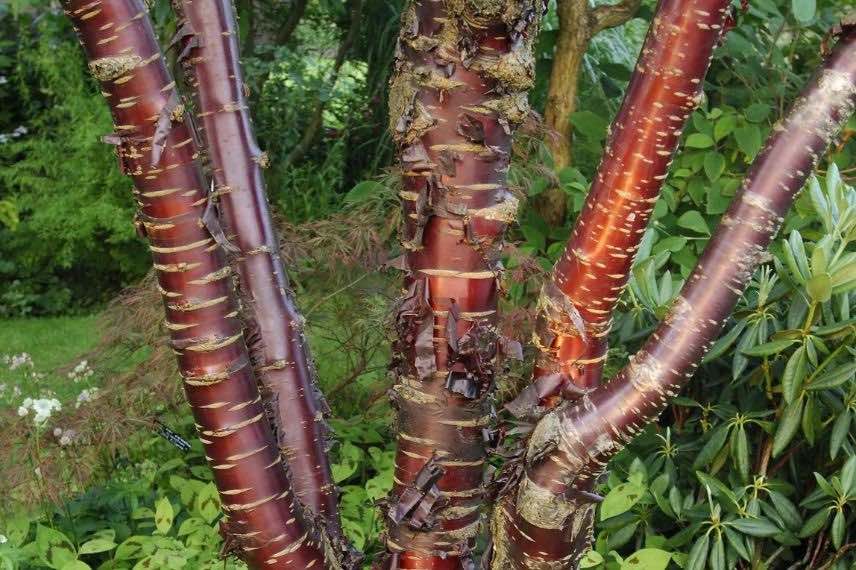
The bark of Prunus serrula ‘Amber Scots’
Choosing an ornamental cherry tree for its foliage
To top things off, ornamental cherry trees also offer foliage of particular interest, especially in autumn. Leaves often take on red, orange or yellow hues before falling. This is the case, for example, with Prunus incisa ‘Kojo no mai’, which takes scarlet hues once the summer season has ended.
Sometimes, the young foliage is also coloured, as demonstrated by Prunus serrulata ‘Shirofugen’, with its young leaves red-bronze.
Also worth noting ‘Pink Perfection’: its leaves are bronze at bud burst, before turning dark green, then take red and orange hues in autumn. In creeping cherry Prunus pumila ‘Depressa’, the green leaves have a bluish-white underside, then turn red and orange after summer.
Among other remarkable foliage, ‘Royal Burgundy’ produces green and red foliage, which unfolds alongside the pink-purple flowering.
Choosing an ornamental cherry according to its form and use
There are different growth habits and sizes among ornamental cherry trees, suited to almost any use: free-standing hedge, specimen, back of a border, in a pot, etc. Most of them reach between 2 and 8 metres in height.
Dwarf varieties
Dwarf varieties are perfect for small gardens or for pot culture, due to their small size and compact habit.
Among them, notably the flowering cherry ‘Rosea Plena’measuring 1.5 metres across, or the Prunus incisa ‘Yamadei’measuring 2 metres high and wide.
The weeping varieties
Elegant and graceful, the silhouettes of these ornamental cherries feature pendulous branches, beautiful in bloom as well as in leaf.
Prunus ‘Snow Fountains’ lives up to its name, turning into a true cascade of pure white flowers in spring, borne on flexible and drooping branches. It reaches 3 metres tall and wide. On its side, the Prunus serrulata ‘Kiku Shidare Zakura’ will delight gardeners who favour pink flowering, highlighted by a weeping habit. It will reach 3–4 metres in height with a 3 metre spread.
The same applies to the Prunus subhirtella ‘Pendula Rubra’ with a pendulous habit, reaching around 4 metres in height and width.
The parasol varieties
These varieties provide sun protection in summer, offering shade and coolness. They feature a crown that spreads horizontally, with a fairly flat shape. These are the most common silhouettes.
For example, Prunus serrulata ‘Shirofugen’ is a small tree, 8 metres tall and 6 metres across. It offers a broad and spreading habit, but paired with slightly drooping branches. It reaches 3 metres tall and wide.
Other notable varieties
Among ornamental cherries with an interesting silhouette, let’s also mention the flowering cherry ‘Kojo No Mai’. Its branches are twisted, growing surprisingly in a zigzag. Its slow growth and this characteristic make it a bush well suited to bonsai cultivation.
Tall varieties bring a lot of verticality, as with Prunus hillieri ‘Spire’, a small tree reaching 6–8 metres in height with a 3–4 metre spread. On the other hand, Prunus serrulata ‘Amanogawa’ reaches 6 metres in height, but its branches pressed against the trunk give it a columnar and narrow silhouette, with a spread of only 1.5 metres.
Finally, consider Prunus pumila ‘Depressa’, a creeping groundcover, with a silhouette wider than tall. It grows to just 30 cm in height with a 2.5 metre spread.
Choosing an ornamental cherry according to growing conditions
Hardiness
Ornamental cherry trees tolerate average temperatures of -15 to -20°C. If you live in a region with very harsh winters, favour frost-hardy varieties, such as ‘Pandora’, ‘Umineko’ or ‘Depressa’, capable of withstanding frosts down to around -30°C.
Other specific conditions
Ornamental cherry trees prefer soils that are fairly neutral to slightly calcareous. Among varieties that tolerate more acidic soils, opt for ‘Brillant’.
Similarly, most flowering cherry trees prefer cool, moist soils. The Prunus maackii ‘Amber Beauty’ has the advantage of better tolerating occasional drought once established. It will also tolerate full sun exposure.
- Subscribe!
- Contents
Comments