




























Original and Colourful Potatoes
And what if you added a bit of colour to your chips?
Contents
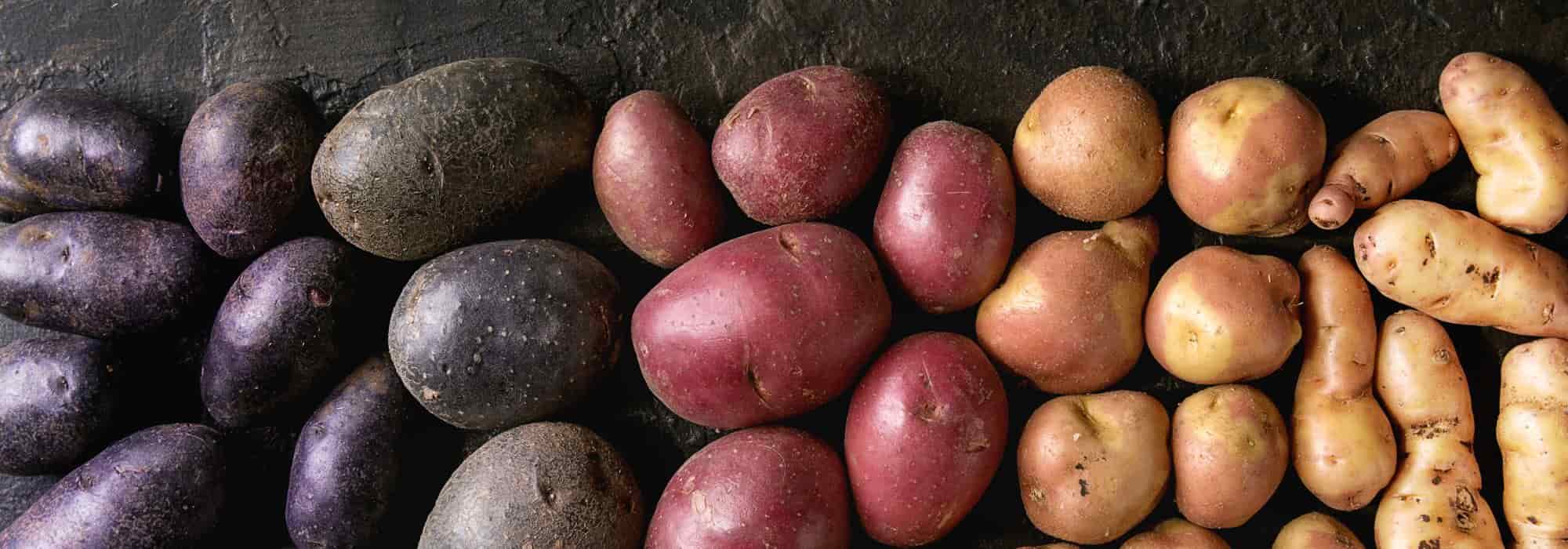
With potatoes, we stick to white or yellow! Light skin and uniformly coloured flesh, often to meet consumer standards. However, it is entirely possible to add a bit of flair to your chips! This can be achieved by choosing varieties of potatoes that are naturally coloured purple, blue, pink, or red… Some tubercles even assert their uniqueness with bicoloured flesh!
So, if you want to add some zest to your gratins, give your salads a twist, or bring a splash of colour to the fields of your potatoes, don’t hesitate to plant these amazing varieties that are sure to pique your guests’ curiosity. They can be grown just like any other varieties of potatoes. So, let’s add a bit of colour to our vegetable garden with our selection of colourful and original potatoes.

Why are some potatoes coloured?
Certain varieties of potatoes don their colourful coats in all circumstances. They indeed display an epidermis that ranges from pink to red, blue to purple. Some even showcase these beautiful colours right through to their flesh… and all this as naturally as possible, without the addition of any colourants. But where does this pronounced colouring come from? Simply from the presence of anthocyanins, natural colourants, in the tubercles. These same colourants or pigments, members of the polyphenol or antioxidant family, give their lovely colourful appearance to many fruits and vegetables, such as aubergines, onions, red cabbage, blueberries, and other berries. In addition to being beautiful, these potatoes are therefore good for well-being thanks to their antioxidant properties!
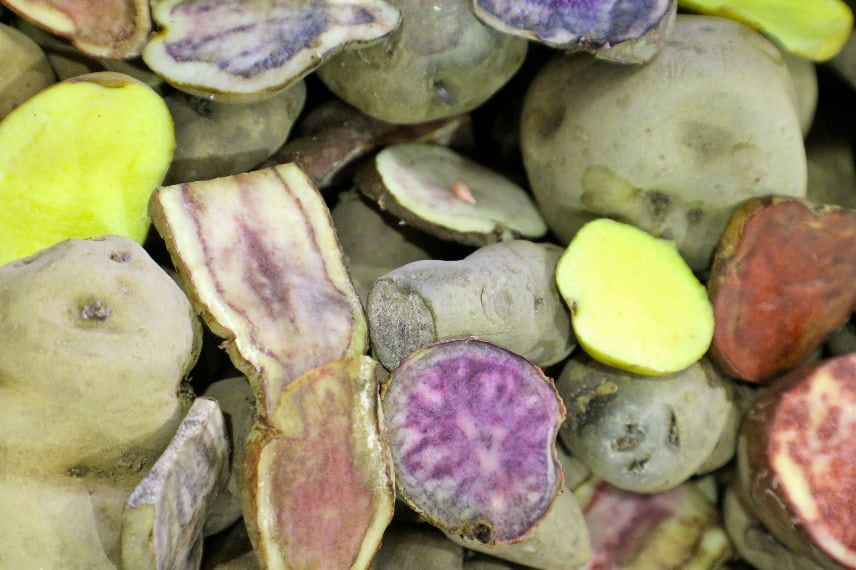
The colouring of potatoes is due to anthocyanins, antioxidants
Most of these colourful potatoes originate from the Andes, but not exclusively. Others have been created more recently to add a bit of flair to the plates of potato enthusiasts.
As for the colour, it holds up more or less well during cooking. Boiling has a greater impact as anthocyanins are soluble in water.
Read also
Potatoes: planting, growing, harvest'Vitelotte', the most popular of the coloured potatoes
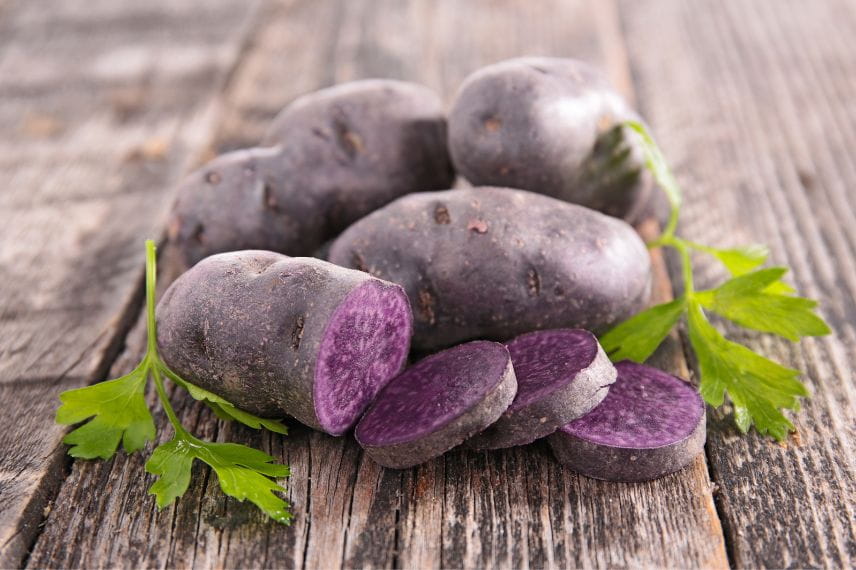
The ‘Vitelotte’
Among colourful potatoes, the ‘Vitelotte’ is the most well-known and widespread, including in major retailers. It must be said that this traditional French variety is quite surprising with its very thick, dark purple almost black skin, and its blue-purple flesh that holds its colour during cooking. Commonly sold at the Halles de Paris in the early 19th century, this knobbly, elongated potato is a late variety that is making a strong comeback in our vegetable gardens.
With a slight taste of hazelnut and chestnut, the ‘Vitelotte’ is planted from mid-March to mid-May depending on the region, and is harvested 120 to 150 days after planting. It is a potato that stores very well in a cool, dry place away from light. It prefers loose, light, deep, and well-drained soils. However, it has a rather low yield, but its taste qualities make up for this drawback.
In the kitchen, the ‘Vitelotte’ has a rather floury flesh that breaks down during cooking. This is why it is ideal for making purées or soups. It can also be turned into crisps as it absorbs little fat.
Discover other Seed potatoes
View all →
Available in 2 sizes
Available in 0 sizes
Available in 1 sizes
Available in 0 sizes
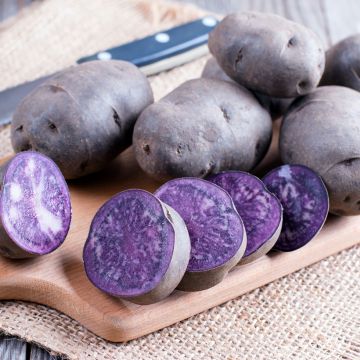
Available in 1 sizes
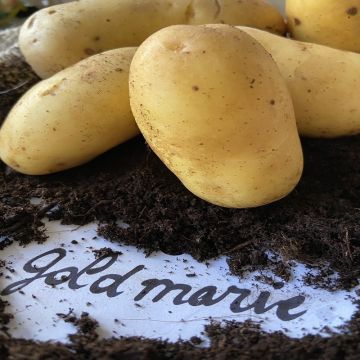
Available in 2 sizes
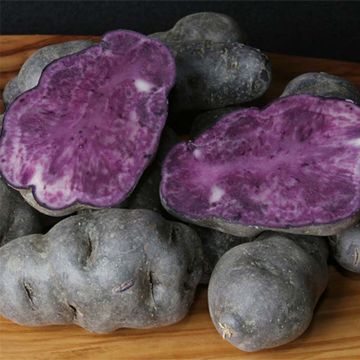
Available in 1 sizes
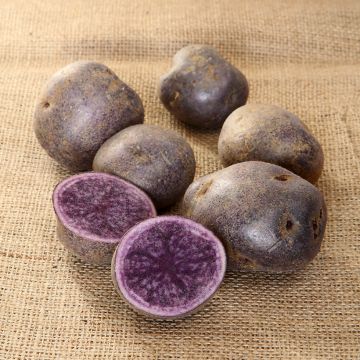
Available in 1 sizes
Available in 3 sizes
Available in 1 sizes
The 'Ulysse' that has nothing to envy from the Vitelotte
Let’s focus on potatoes with a violet skin and flesh, particularly the ‘Ulysse’. A shade of violet that leans towards slate blue, ‘Ulysse’ is a result of the cross-breeding between ‘Bleue d’Artois’ and ‘Ditta’. It is a relatively recent French variety that produces ovate and regular tubercles. As a semi-late variety, it offers a good yield. However, its storage capabilities are quite average.
It is planted in April and May for a harvest 120 days later, which takes place from July to September. This variety is interesting for amateur gardeners as it is not very susceptible to blight, resistant to water stress, and to fusarium.
In the kitchen, it is well-suited for making purées, chips, and holds up well to steaming.
Read also
Diseases and pests of potatoesThe 'Rose of France', to see the garden in pink
The ‘Rose de France’, also known as ‘Cirielle’, is a recently developed French potato with a beautiful light pink skin. In contrast, the flesh is yellow. This early to semi-early variety produces oblong tubercles. It boasts a very good yield and is particularly noteworthy for its excellent resistance to blight and other diseases such as common scab, as well as drought.
It is planted from March to May in light, deep, well-worked, and drained soil, and is harvested 90 days after planting.
With a fine and firm flesh, the ‘Rose de France’ retains excellent cooking qualities. It is perfect for boiling or steaming, as well as for roasting or stewing.
Feel free to explore our other pink-skinned potatoes: the ‘Rosabelle’ and the ‘Cheyenne’.
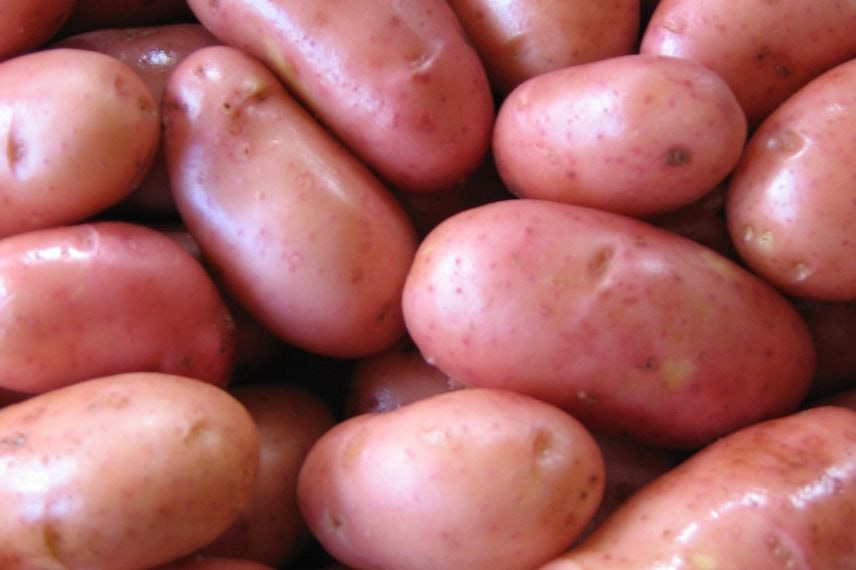
The ‘Rose de France’
The 'Rouge des Flandres', a late-season potato of good size
The variety ‘Rouge des Flandres’ is a potato with a very attractive appearance: beneath its bright red skin lies a red centre and yellow edges. It is a late variety that offers a very good yield. Its tubercles, oblong and elongated, are of a nice size. Furthermore, it is very hardy (but it dislikes heat), and is not very susceptible to viruses and common scab.
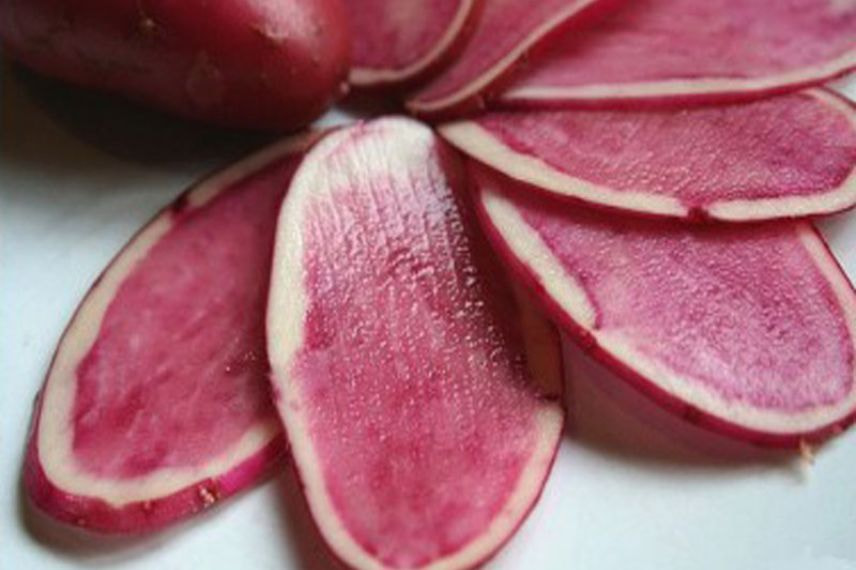
The ‘Rouge des Flandres’
The ‘Rouge des Flandres’ is planted from mid-March to May, and is harvested 120 to 150 days after planting. It stores quite well over winter in a cool, dry, dark place.
In the kitchen, this variety of potato offers a fluffy flesh with a slightly sweet flavour. It retains its red colour when cooked and allows for the preparation of original and delicious purées, soups, or crisps. As for chips, they will be crispy due to its ability to absorb less oil.
Our other red potatoes include ‘Franceline’, ‘Chérie’, and ‘Roseval’.
The 'Bleue d'Artois'... Oh, the beautiful blue!
The ‘Bleue d’Artois’’ or Bleue de la Manche is an ancient hardy variety. It produces tuberculate potatoes with blue-violet to almost purple skin and flesh, small in size and round in shape. This is a semi-early variety with a very good yield. It also boasts good resistance to diseases and can be stored for a long time in a dry, cool, and dark place.
Its slightly floury yet fine flesh is very tasty as it has nutty flavours. It remains relatively firm after cooking, making it suitable for boiling or steaming, stewing, or frying.
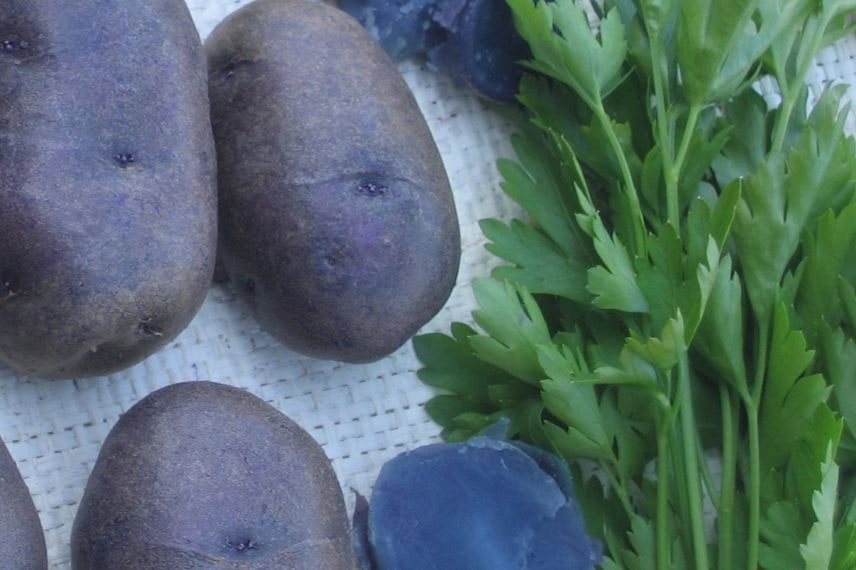
The ‘Bleue d’Artois’
Bicolours for twice the pleasure!
Some varieties of potatoes play on two fronts by displaying two colours: the flesh of ‘Perupas® Pink Love’ is pink and cream, under a pink skin, while that of ‘Double Fun’ is cream white edged with violet, hidden beneath a dark violet skin.
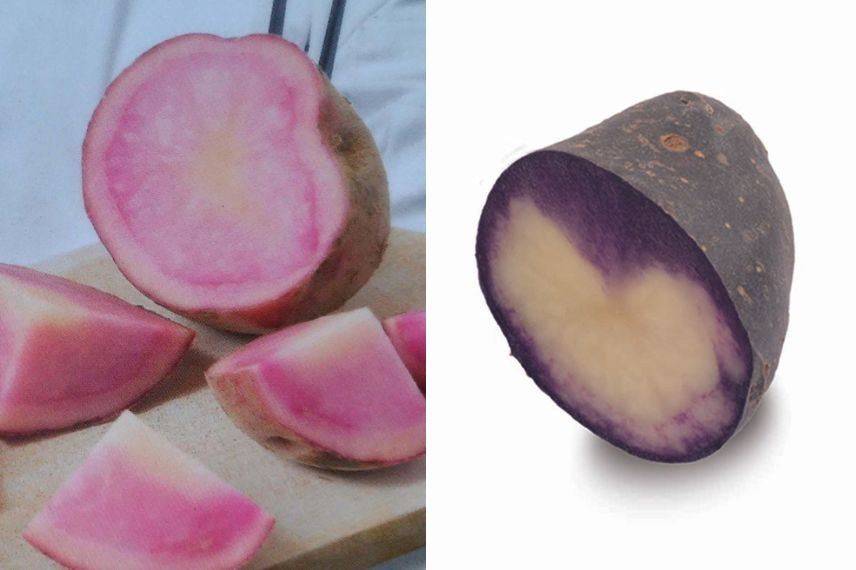
The ‘Perupas® Pink Love’ and ‘Double Fun’
These two ancient, almost wild varieties offer unique flavours and a quite satisfactory yield. The first is early and produces potatoes up to 45 mm in diameter. The second is semi-early and is harvested 110 days after planting.
In terms of cooking, these are versatile potatoes that can be used to prepare mash, chips, salads, fries…
- Subscribe!
- Contents
Comments