


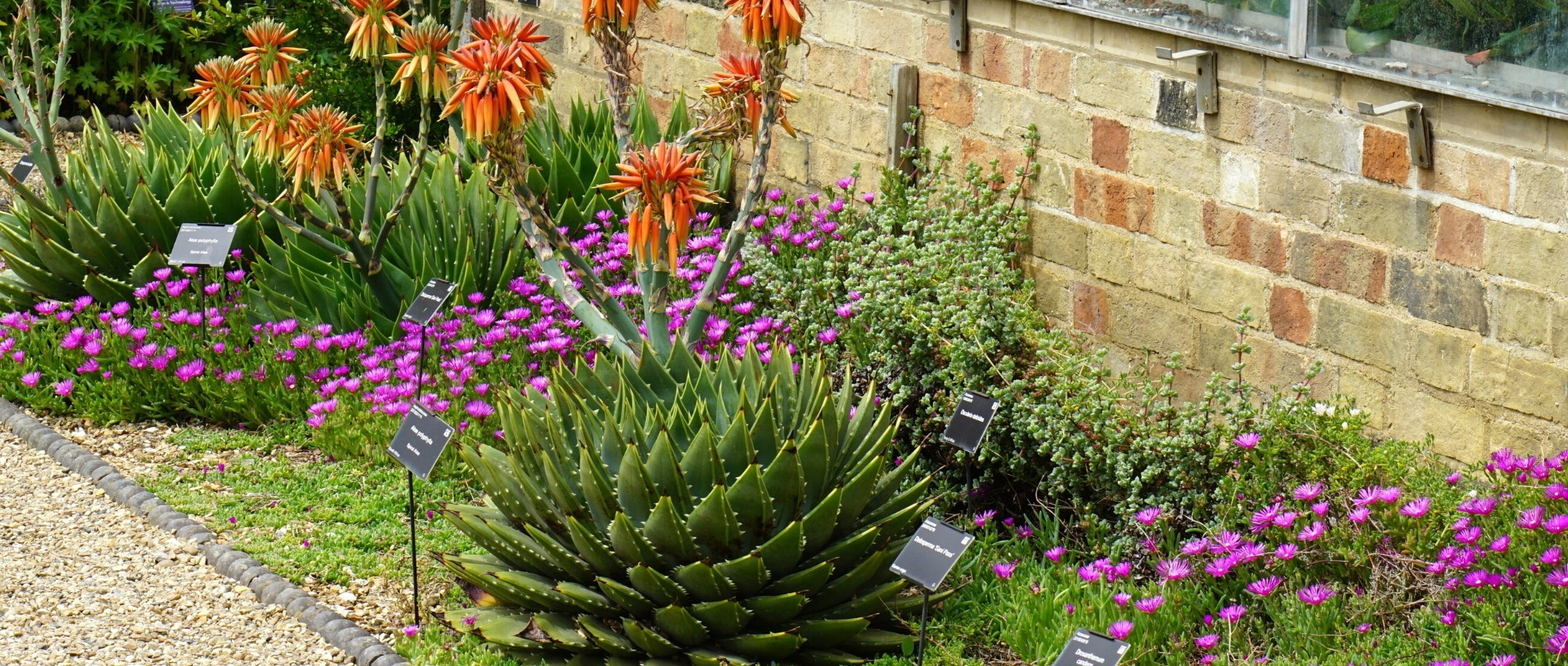
Pairing Aloe
6 successful pairing ideas
Contents
Aloe is a beautiful succulent plant that forms rosettes of fleshy leaves, which are very graphic. The most well-known is Aloe vera, valued for its medicinal properties, but there are many species and varieties that are highly ornamental and will find their place in the garden. Moreover, some of them are hardy, able to withstand temperatures as low as -10 °C (such as Aloe aristata, Aloe polyphylla and Aloe striatula). The more tender species can be grown in pots and brought indoors for the winter or planted outdoors in regions with a very mild climate, where the risk of frost is low, such as around the Mediterranean.
Aloes thrive in sunlight and warmth, and require well-draining, stony or sandy soil that is rather poor. Like other succulent plants, they are drought-resistant and require little maintenance. They are perfect for enhancing a sunny rock garden and will easily find their place in a Mediterranean or exotic-style garden. Discover in this guide our best ideas and inspirations for combining them in the garden and creating harmonious flower beds!
And to learn more about their cultivation, feel free to check our complete guide “Aloes: Planting, Growing and Caring”.

In an exotic and lush garden
You can create a very exotic atmosphere in a tropical style by placing large plants with lush foliage, for example around a terrace or a pool. Choose the largest and most opulent Aloes, such as Aloe arborescens or Aloe striatula. Install alongside them plants with generous foliage, formed of large, broad, green leaves. Consider palms, the banana plant Musa basjoo, Tetrapanax papyrifera, and Gunnera manicata. You can also incorporate some Phormiums, Cordylines, Yuccas, and Ricins. For flowering plants, choose crocosmias, cannas, hedychiums, eucomis, kniphofias, and agapanthuses. We recommend placing a garden lounge at the heart of this exotic decor to fully enjoy it in summer! If your climate allows, grow the stunning Strelitzia reginae, which offers large flowers resembling exotic birds in orange tones. If you live in a region with a relatively cool climate, you can place it in a large container, which you can bring indoors in winter to protect it from the cold!
Discover our advice sheet for designing an exotic garden, and feel free to check out Ingrid’s article on our blog: “10 exotic and hardy plants for a jungle garden”
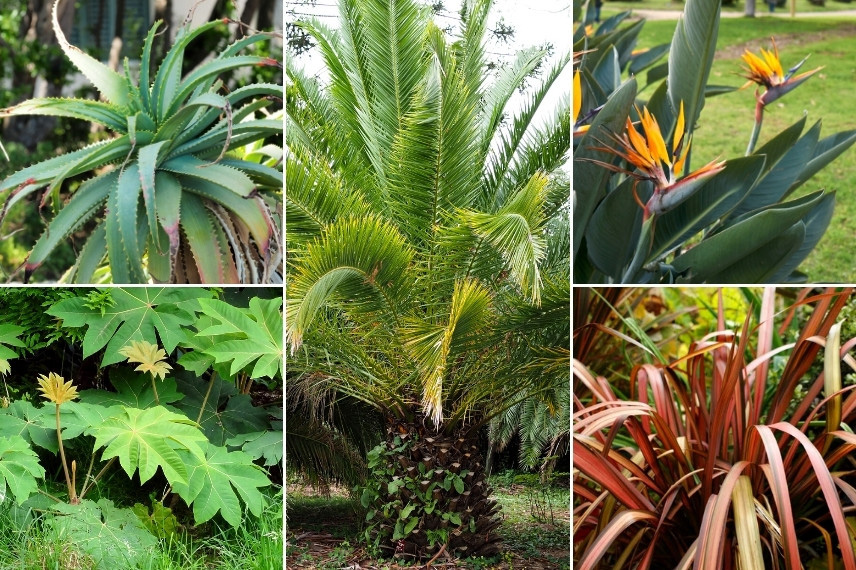
Aloe arborescens, Phoenix canariensis, Strelitzia reginae, Tetrapanax papyrifera ‘Rex’, and Phormium ‘Pink Panther’
Read also
Aloes: planting, growing and careIn a sunny rockery
Aloe thrives in full sun in well-draining, gravelly, or sandy soil. You can easily incorporate it into a rockery, a perfect situation to showcase it. We recommend choosing a small-sized Aloe, or one with a spreading habit, such as Aloe aristata, Aloe perfoliata, Aloe polyphylla, or Aloe brevifolia. Pair it with other small drought-tolerant plants that have generous flowering, such as Iberis sempervirens, Cerastium tomentosum, Draba aizoides, Phlox subulata, Arabis caucasica, helianthemums, or aubrietas. Consider houseleeks, whose shape, with its succulent leaves imbricate in rosettes, will resemble the silhouette of aloes, just on a smaller scale! You can also incorporate sedums, as well as small grasses, such as Stipa, Carex, and blue fescues. Discover Convolvulus cneorum, a shrub that does not exceed 40 cm in height and features beautiful silver foliage along with lovely white funnel-shaped flowers.
Explore our advice sheets for creating a rockery and choosing plants suitable for a sunny rockery.
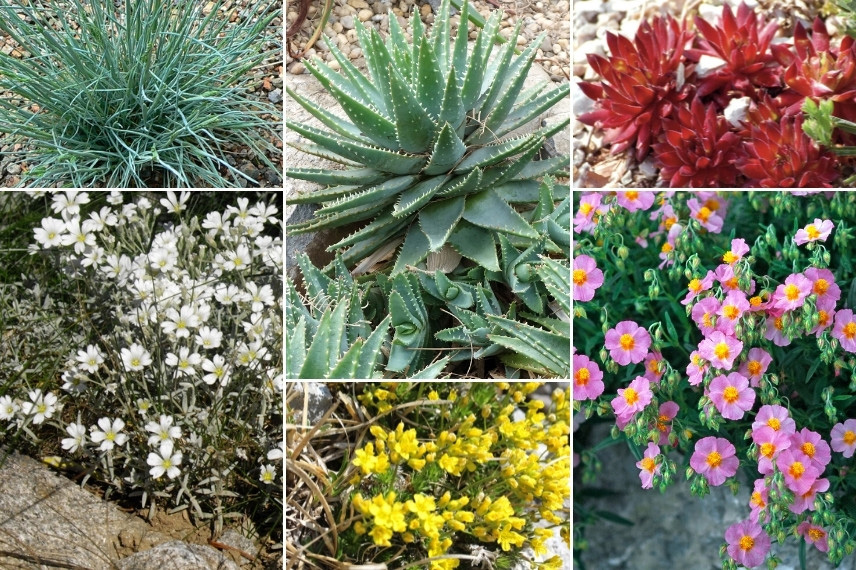
Festuca glauca, Aloe brevifolia, Sempervivum ‘Othello’, Cerastium tomentosum ‘Yo Yo’, Draba aizoides (photo Björn S.) and Helianthemum ‘Lawrensons Pink’ (photo Friedrich Strauss – MAP)
Discover other Aloe
View all →
Available in 1 sizes
Available in 1 sizes
Available in 1 sizes
Available in 1 sizes
Available in 1 sizes
Available in 2 sizes
Available in 3 sizes
Available in 1 sizes
Available in 1 sizes
Available in 2 sizes
In a pot or container, to create a display
You can create a stunning pot or container display with Aloe, or even craft a miniature rockery, which will enhance your terrace or balcony in full sun. Choose the most compact Aloes: we particularly recommend Aloe ‘Safari Sunrise’, but you can also opt for Aloe aristata or Aloe brevifolia. Plant it in a well-draining substrate, such as a mix of potting soil, garden soil, and coarse sand, supplemented with small gravel. Integrate other small plants with a carpet or cushion habit alongside the Aloe. For example, choose houseleeks, sedums, saxifrages, and possibly a miniature prickly pear, like Opuntia compressa ‘Millevaches’. You can let the very decorative foliage of Muehlenbeckia axillaris. cascade over the edge of the container.
If you plan to bring the container indoors in winter or if you live in a region with a very mild climate, feel free to include slightly more tender plants: Aeoniums, Crassulas, Echeverias, Dyckias, small cacti… They will bring a lovely exotic atmosphere to your terrace or balcony!
Discover our entire range of cacti and succulents by clicking here.
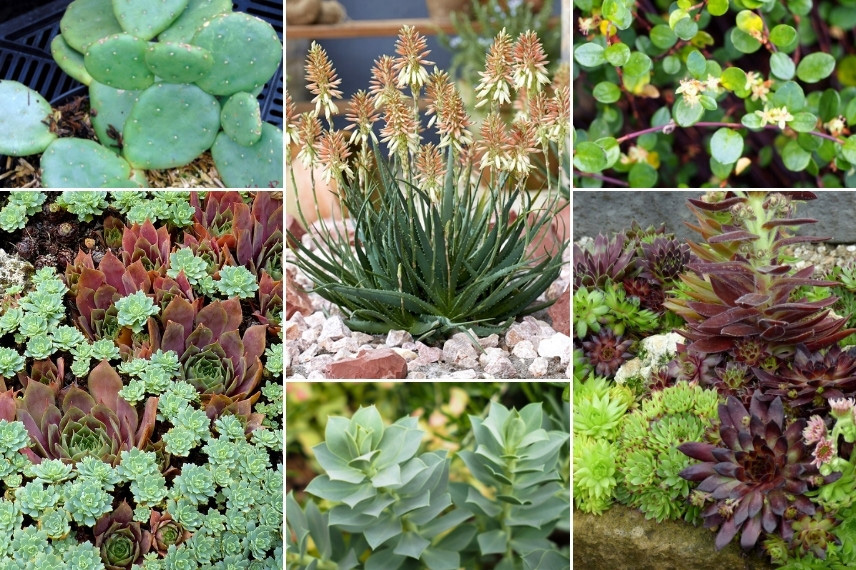
Opuntia compressa ‘Millevaches’, Aloe ‘Safari Sunrise’, Muehlenbeckia axillaris (photo Agnieszka Kwiecień), Sempervivum ‘Granat’ and Sedum pachyclados, Euphorbia myrsinites and houseleeks
Read also
Choosing an Aloe for your gardenIn a Mediterranean-style garden
Aloe integrates very easily into Mediterranean-style gardens. For example, choose the Aloe spinosissima and create a pleasant and warm atmosphere by pairing it with the exotic foliage of the palm Chamaerops humilis, as well as the colourful flowering of oleander, lagerstroemia, and cistus. Aromatic and fragrant plants also have their place in Mediterranean gardens: integrate lavenders, thymes, rosemaries, santolines, and helichrysums. Enjoy the colourful flowering of agapanthus, Phlomis fruticosa, and Eryngium maritimum. You can add some bushes such as the strawberry tree and the stunning Anthyllis barba-jovis, as well as climbing plants: bignonia, jasmine, bougainvillea… For their exceptional graphic quality, plant agaves and opuntias alongside the Aloe.
Discover our advice sheet for creating a Mediterranean garden, as well as our range of Mediterranean perennials.
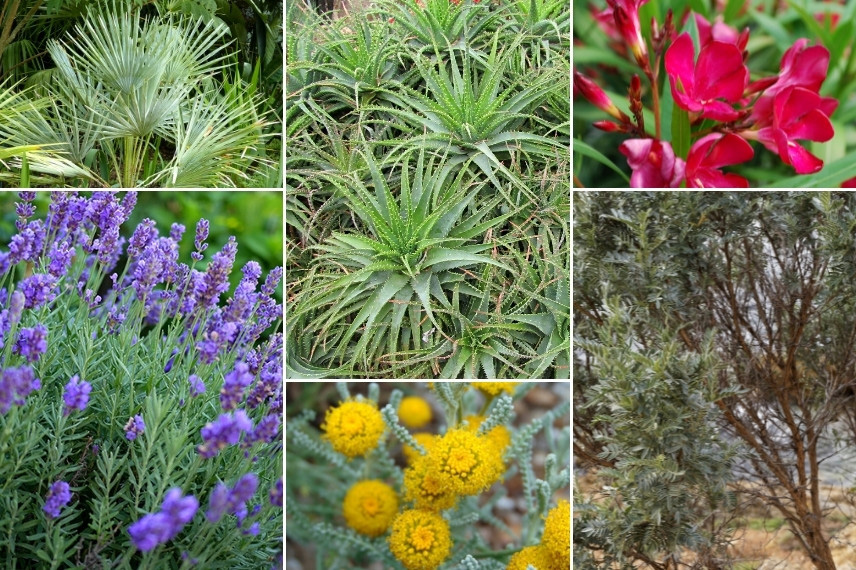
Chamaerops humilis ‘Cerifera’, Aloe spinosissima (photo Leonora Enking), Nerium oleander, Lavandula intermedia ‘Dutch group’, Santolina chamaecyparissus, and Anthyllis barba-jovis
With cacti and succulents
For a truly exotic atmosphere, incorporate Aloe into a bed of cacti and succulents. You can create this style of bed even if you don’t live in the very mild regions of the Mediterranean basin or the Atlantic coast, as some species are quite hardy! Choose a relatively cold-resistant Aloe, such as Aloe polyphylla or Aloe striatula, and plant alongside it Cylindropuntia imbricata, Agave havardiana, and Agave montana. Also consider Opuntia engelmanii or Opuntia phaeacantha ‘Mojavensis’, which can withstand temperatures between –20 and –25 °C. You can also integrate some houseleeks, sedums, and Delosperma. The Echinopsis subdenudata is a bit more sensitive to cold but can still tolerate temperatures between –5 and –10 °C in well-draining soil. Plant these cacti in a well-draining substrate, in a sunny spot sheltered from cold winds. We also recommend, for winter, placing a glass or clear plastic sheet over these plants to protect them from rain, as they are sensitive to excess moisture.
Feel free to consult our complete guide to successfully growing outdoor cacti and succulents.
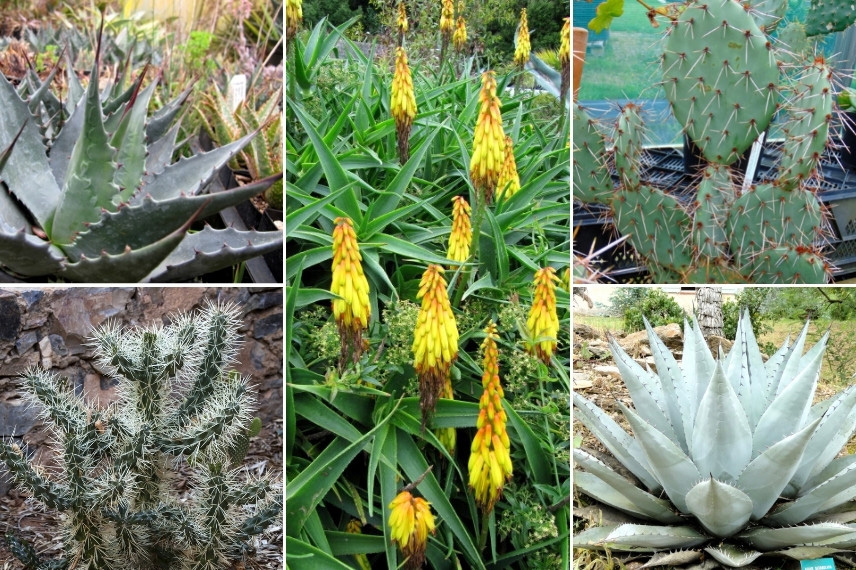
Agave montana (photo M. Hansen), Aloe striatula (photo Leonora Enking), Opuntia phaeacantha ‘Mojavensis’, Cylindropuntia imbricata (photo Gilles Le Scanff & Joëlle – Caroline Mayer – Biosphoto), Agave havardiana
In a dry garden with warm tones
You can enjoy Aloe to create an arid atmosphere by installing plants with narrow leaves and a graphic habit: consider Dasylirion, Yuccas, Phormiums, and Cordylines. Also consider Mangave, whose highly graphic foliage comes in a beautiful range of colours, depending on the varieties. Alongside them, integrate warm flowerings in yellow, orange, and red tones. For example, choose kniphofias, crocosmias, and daylilies. Also discover the beautiful flowering of Sparaxis tricolor, Californian poppy seeds, and Osteospermum ‘Cape Daisy Fireburst’. Aloes will fit wonderfully into this style of garden, especially as they also offer flowering in warm tones, with tubular flowers in spikes of yellow, orange, or red, reminiscent of kniphofia.
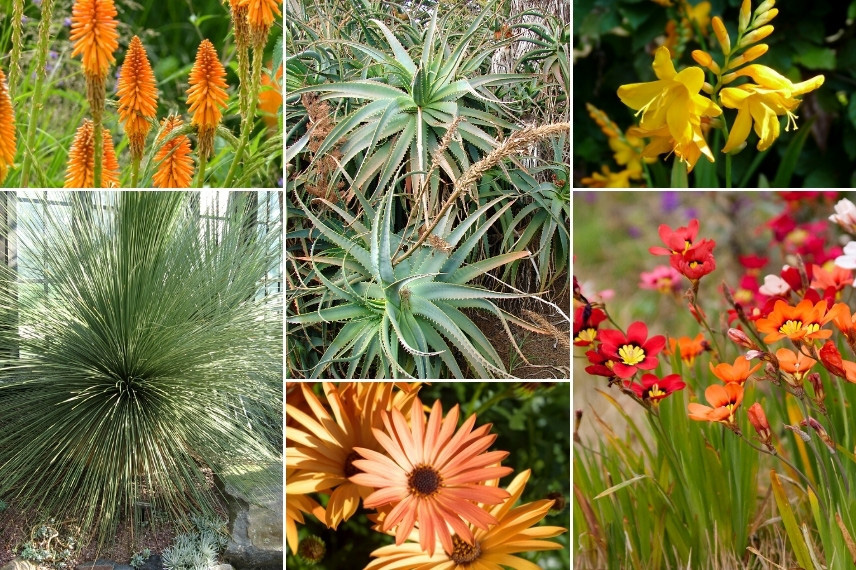
Kniphofia ‘Fiery Fred’, Aloe arborescens (photo Forest and Kim Starr), Crocosmia ‘Buttercup’, Dasylirion longissimum, Osteospermum ‘Cape Daisy Terracotta’, and Sparaxis tricolor (photo Richard Shiell – GWI – Biosphoto)
- Subscribe!
- Contents
Comments