






























Peach diseases and pests
Identification, prevention and natural treatments
Contents
The peach tree (Prunus persica) is a fruit tree valued for its fruits, the peaches harvested in summer. Fast-growing, self-fertile, but sensitive to cold, it easily bears fruit in the mild regions of southern France. Like many fruit trees, the peach tree can be affected by certain diseases and pests, such as peach leaf curl, brown rot, and the caterpillar.
Discover the main diseases affecting peach trees, how to care for a sick peach tree, what treatment is available for peach leaf curl, as well as natural and preventive methods to combat its most common aggressors!
→ Feel free to consult our complete guide: “PEACH TREE: PLANTING, PRUNING AND HARVESTING ITS FRUITS”

Peach leaf curl
The peach leaf curl is one of the most common diseases affecting Nectarines and Peaches. It is a fungal disease caused by the presence of a fungus (Taphrina deformans) that overwinters under the scales of the buds and re-emerges after a mild, wet winter followed by a cool, rainy spring (temperatures between 10 and 20°C).
Identification and Symptoms
It first attacks the foliage. The affected leaves develop a blistered appearance and show raised yellow spots. They curl, turn yellowish then reddish-purple, and eventually fall off. In cases of severe attack, the young shoots become distorted and twisted, the fruits swell and develop a grey-brown felt-like covering. The tree is weakened, which compromises the peach harvest.
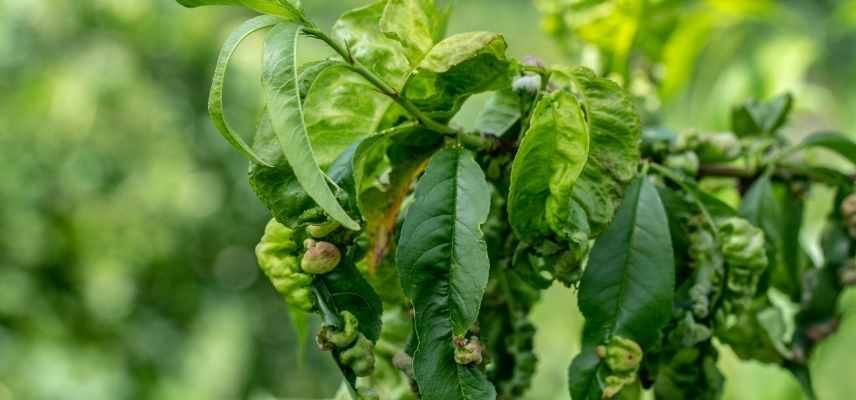 Leaves affected by peach leaf curl
Prevention and Treatment
- Strengthen your peach tree’s resistance by adding compost or manure at its base each autumn
- Remove and burn damaged shoots bearing cankers
- Choose varieties resistant to peach leaf curl such as Amsden (syn. May Flower) or Reine des Vergers
- In autumn, after leaf fall, and then in spring before bud break, spray Bordeaux mixture over the entire canopy to inhibit the germination of the fungus spores. Repeat the sprays three times, at 10-day intervals.
- Alternate with horsetail decoctions in spring and then every 15 days until summer
→ Discover more tips to prevent the establishment or consequences of peach leaf curl
Read also
How to protect fruit trees from birds?Powdery mildew
The powdery mildew is another fungal disease affecting the peach tree. The culprit? A fungus whose development is favoured by warm air and high humidity. It typically appears from mid-spring and towards the end of the season.
Identification and Symptoms
It is characterised by a greyish-white powdery coating that covers the leaves, buds, and flower buds, earning it the nickname “white disease.” In cases of severe infestation, young fruits display whitish, floury patches, drying out and becoming unfit for consumption.
Prevention and Treatment
- Prune regularly to maintain well-aerated branches
→ Follow Pascale’s advice on properly pruning a peach tree
- Water your fruit tree at the base regularly during hot periods, avoiding wetting the foliage
- Mulch to keep the soil cool
- Collect and burn affected parts to prevent the fungus from overwintering and reactivating in spring or summer
- Make regular sprays of horsetail manure or nettle manure every two weeks in spring and autumn
- Sprays of bicarbonate of soda in spring and autumn are also effective
→ Learn all about natural treatments for powdery mildew or white disease
Discover other Peach and Nectarine trees
View all →
Available in 1 sizes
Available in 1 sizes
Available in 1 sizes
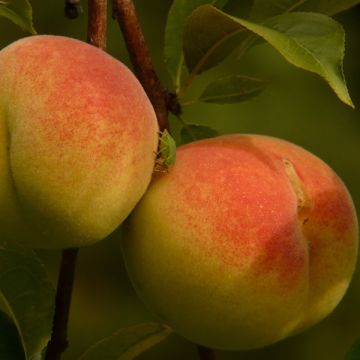
Available in 1 sizes
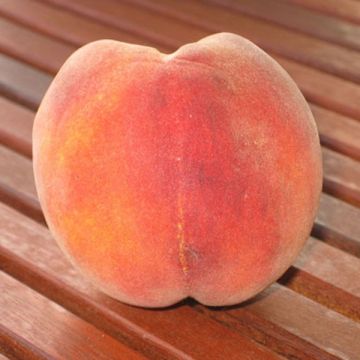
Available in 4 sizes
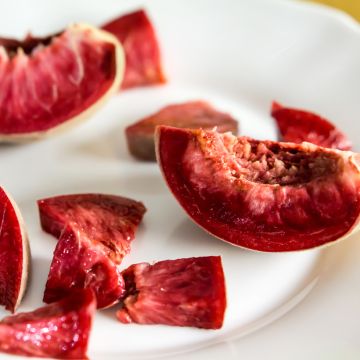
Available in 1 sizes
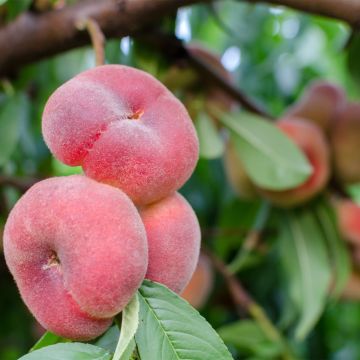
Available in 1 sizes
Available in 2 sizes
Available in 1 sizes
Available in 1 sizes
Moniliosis
Brown rot is another fungal disease that regularly affects peach trees and primarily targets stone fruits. The spores of the fungus (Monilia fructigena or Monilia laxa) overwinter beneath the bark, identifiable by the presence of cankers harbouring the overwintering forms of the fungus on the branches. The disease manifests during mild, humid weather, especially when it rains during flowering. It mainly affects fruits damaged by hail or bird beaks; any injury serves as an entry point for the spores.
Identification and Symptoms
Damage can be significant. The shoots dry out, showing longitudinal wrinkles. Affected leaves and flowers wilt and emit a characteristic bitter almond smell. The fruits mummify and can remain suspended on the tree throughout winter without falling.
Prevention and Treatment
- In winter, using a well-disinfected pruning shear or loppers, remove and burn the cankers and damaged or wilted shoots to prevent the disease from reappearing.
- Collect and burn all mummified fruits left on the tree and those that have fallen to the ground.
- Protect the fruits from wasps and birds.
- Monitor for the appearance of rot on developing fruits.
- In spring, when the foliage begins to unfurl, apply a copper-based fungicide treatment, such as Bordeaux mixture, to the entire canopy. Repeat this application when the flower petals fall.
- As a preventive treatment, starting at flowering, spray every 2 weeks with horsetail decoctions or nettle manure.
→ Brown rot of fruit trees – PREVENTING AND TREATING THIS DISEASE
Bacterial canker
Here is another common disease affecting fruit trees. It is caused by a fungus (Fusicoccum amygdali). The contamination by canker is severe and can lead to the death of the entire tree. Once again, the spores of the fungus remain well protected during winter between the scales of the buds, in the cracks of the bark, and within the cankers. They reactivate and spread during warm, humid weather. Damage can occur as early as spring, as the circulation of sap is hindered by the cankers, leading to the inevitable drying out of buds, shoots, and flowers. The canker fungus Fusicoccum infects the tree’s tissues through wounds, primarily entering through cuts.
Identification and Symptoms
The disease causes necrosis, calluses, and other cracks on the bark, leading to the splitting and drying out of twigs, or even an entire branch. Brown concentric spots can be observed on the trunk or branches, sometimes accompanied by a gum exudate. Young peaches wilt and dry out.
Prevention and Treatment
There is no treatment to eradicate bacterial canker. Therefore, the following preventive measures are useful:
- Choose, whenever possible, less susceptible varieties
- Canker enters through poorly healed pruning wounds: prune with sharp, disinfected tools and then coat the wounds with a healing paste. Avoid pruning in autumn and when it is humid.
- Burn pruning waste
- With a pruning shear thoroughly disinfected with 70°C alcohol, remove and burn all twigs affected by canker
- Limit nitrogen fertiliser applications
- In autumn, at leaf fall, and then at the bud burst period, spray the tree with Bordeaux mixture, which has fungicidal action
- In cases of severe infestation, it is better to fell and then burn the pruning waste from your peach tree to prevent it from contaminating the entire orchard
→ Find our article on canker of trees and fruit trees: treatments and control
The sieve
Another disease caused by a fungus, Coryneum beijerinckii! The Coryneum or “shot hole disease” affects stone fruit trees. The disease survives in the tree’s tissues and re-emerges in spring and autumn during mild, rainy weather. It affects all parts of the tree: the leaves, branches, and peaches.
Identification and Symptoms
Round reddish spots about 3 mm in diameter invade the leaves, surrounded by black, then transform into perforations, hence the name shot hole or the nickname “gunshot disease”. Brown, corky, and bumpy spots are also present on the fruits, leading to stunted growth and premature drop. Severe attacks weaken the tree.
Prevention and Treatment
- Prune and burn infested branches
- Collect and burn fallen dead leaves
- Collect infested fruits that carry spores
- At the start of the growing season and just before flowering, treat with horsetail decoctions or spray with Bordeaux mixture
- Repeat the treatment after petal drop and in autumn
→ Find our article on Coryneum or Shot Hole Disease of Stone Fruit Trees
The Sharka virus
Sharka is a serious viral disease caused by the Plum pox potyvirus (PPV), which threatens the peach tree as well as other fruit trees in the Prunus family (apricots, plums, cherries, almonds…). The disease is primarily transmitted by aphids or through plant material (rootstocks, scions). In France, the “Markus” strain (strain M) is the most virulent and the most common on our peach trees. Symptoms appear from spring to early summer.
Identification and Symptoms
Characteristic mottling and chlorotic spots are observed. The petals of peach flowers show discolouration. The lamina of the leaves also discolours in the form of lighter rings following the veins of the leaves. The fruits are covered with discoloured rings and drop before ripeness.
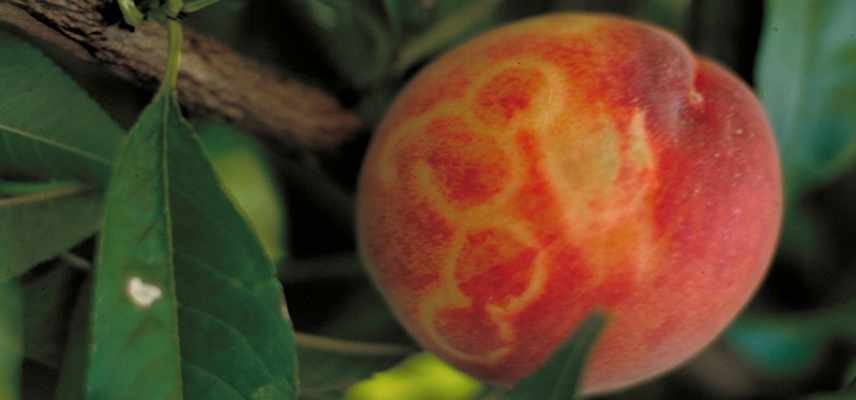
Sharka on peach (© US Department of Agriculture)
Prevention and Treatment
There is no effective treatment for SHARKA. Once established, the “M” strain spreads rapidly and is very difficult to eliminate. Uprooting and destroying infected plants are the only active solutions for combating it. This virus is subject to obligatory control measures. In case of suspicion, you must inform your local council or the Regional Plant Protection Service.
The tortrix moth
The oriental fruit moth (OFM), Cydia molesta, is a caterpillar that attacks young shoots and fruits. It overwinters as a caterpillar in a cocoon on the trunk or on the ground at the base of the peach tree. Emerging as butterflies in spring, these insects continue their cycles of laying eggs until autumn. Egg-laying occurs when twilight temperatures exceed 15°C.
Identification and Symptoms
The oriental fruit moth caterpillars, as soon as they hatch from the eggs, enter the buds and then bore galleries into the young shoots and fruits down to the stone. They cause significant damage, compromising fruit harvests that become unfit for consumption.
Prevention and Treatment
- Encourage the establishment of natural predators of the oriental fruit moth in the garden (bats)
- Install pheromone traps that will catch the males, thus preventing them from fertilising the females
Other peach pests
Aphids
The green aphids can quickly colonise the leaves, flowers, and young shoots of peach trees. These piercing-sucking insects feed on sap. Infestations typically occur in early summer. They are particularly virulent in warm weather. They cause leaf distortion and lead to sooty mould, a black, sticky substance on leaves and fruits that hinders photosynthesis and thus fruit production.
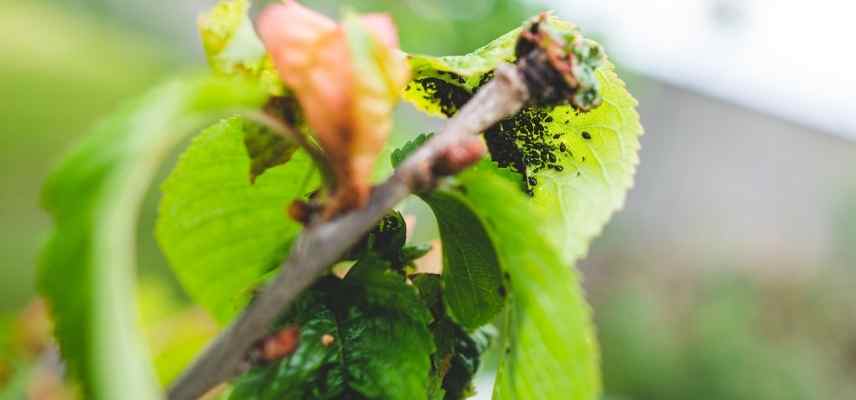
Aphid attack on peach tree
Prevention and Treatment
- Dislodge aphids with a hose
- Place a glue strip on the trunk to capture ants that tend aphid colonies
- Install trap plants nearby, such as nasturtiums that will attract natural aphid predators
- Whitewash the trunk and main branches in winter with a whitewash to destroy overwintering forms that take refuge in the bark
- Spray tansy decoctions or nettle manure to naturally repel aphids
- As a last resort, use a natural insecticide based on pyrethrum or an anti-aphid product based on paraffin oil that will suffocate the pests.
Scale Insects
Attacks from scale insects are common. These piercing-sucking insects, barely visible to the naked eye, attack many fruit trees. Larvae appear in spring, feeding on the sap of leaves, causing crusting on branches and fruits. Leaves become covered in sooty mould, turning black with soot, which hinders photosynthesis and compromises growth and flowering.
Prevention and Treatment
- Encourage the presence of beneficial insects in your garden and natural predators of scale insects such as ladybirds and lacewings
- In winter, cut and burn infested branches
- At the very beginning of spring and every 8 days, spray black soap on your tree to reduce the scale insect population
Thrips
More small piercing-sucking insects! California thrips, also known as “small fruit thrips,” are small insects with very narrow wings fringed with long bristles. They feed by piercing the sap-filled plant organs. Larvae develop in flowers and young fruits. They thrive in dry, warm conditions. Their attacks are visible as silver streaks and necrosis they leave on the attacked organs.
Prevention and Treatment
- Set up pheromone traps for California thrips
- Pyrethrum extract can also be effective
Codling Moths
The codling moth (Cydia pomonella) is a grey-brown nocturnal moth from the family of tortricids. It is very difficult to detect as it is active at night and overwinters in a cocoon under the bark of trees. In summer, the small larvae burrow galleries in peaches down to the stone. Their presence compromises the formation of young fruits and the harvest. Once the larvae have entered the fruit, it is too late to act.
- In winter, brush the trunks with a bristle brush to remove the cocoons
- Encourage biodiversity and the establishment of natural predators of codling moths (tits, bats, earwigs…)
- Collect infested fruits
- In autumn, place a glue strip on the trunks to trap the caterpillars
- From April to September, you can also spray a treatment based on Bacillus thuringiensis, a bacterium effective against the caterpillar of the box tree moth that will neutralise those of the codling moths
→ Discover more tips to naturally combat codling moths in our dedicated sheet.
- Subscribe!
- Contents

Comments