





























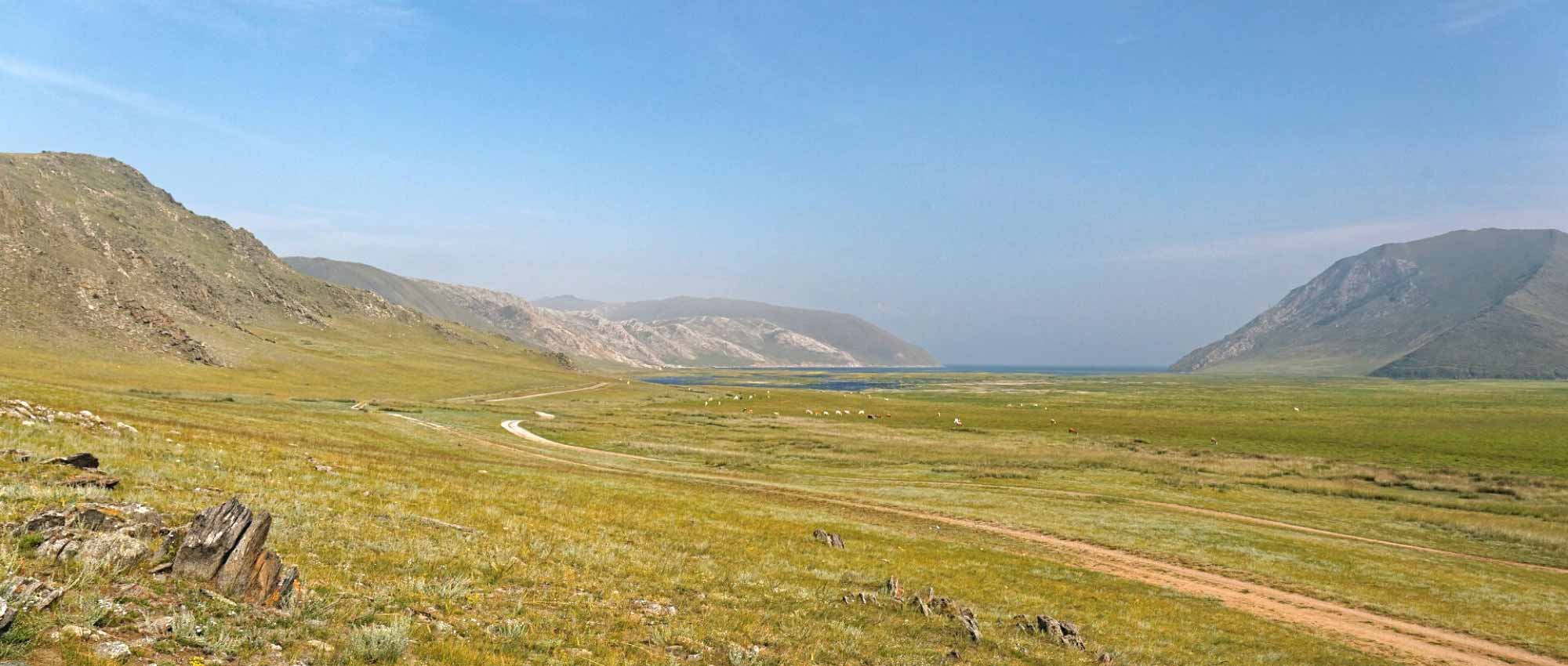
Steppe lawn
An eco-friendly lawn, perfect for a garden without watering.
Contents
With increasingly frequent summer droughts and heatwaves, lawn tends to yellow in summer due to heat and lack of water. It requires regular watering to remain green, making it poorly suited for periods of drought and water restrictions. Plants native to the steppes, on the other hand, have the advantage of tolerating dry, poor soils well, and can be included in the display of a new type of ecological lawn that does not require watering or fertiliser. Discover all our tips for creating a steppe lawn: which plants to choose, how to plant them, and how to maintain this type of lawn.

What is a steppe lawn?
Steppes are a plant formation consisting of large expanses of xerophilous herbs. This term originally refers to the Eurasian steppes (which are the most well-known and can be found in Eastern Europe and Central Asia, particularly in Ukraine, Russia, Mongolia, Uzbekistan, Kazakhstan…), but there are steppes at different latitudes. Similar plant formations can indeed be found in the central United States and western Canada, in Patagonia, and in South Africa.
These are dry lawns comprising xerophilous plants, adapted to a lack of water. The plants have deep roots, allowing them to seek water from deep underground. Steppes are generally subjected to an arid climate, with hot, dry summers and long, cold winters. Temperature differences are pronounced between day and night and between summer and winter. The soils are shallow, rich in mineral elements, but very poor in organic matter. The various plants making up the steppe typically form discontinuous carpets. In the garden, a lawn inspired by the steppes will not create a lush, homogeneous lawn; rather, there will be different groups of plants, gathered in discontinuous patches, with true floral diversity.
You can find both grasses, some succulent plants (Sedums, Euphorbias…), flowering bulbs, perennials, and possibly some annuals. Far from being monotonous throughout the year, the steppe lawn bursts into colour at key times, during the flowering of bulbous plants and certain perennials. The steppe lawn will be particularly suitable if you have rocky, poor, and dry soil, where most plants struggle to thrive.
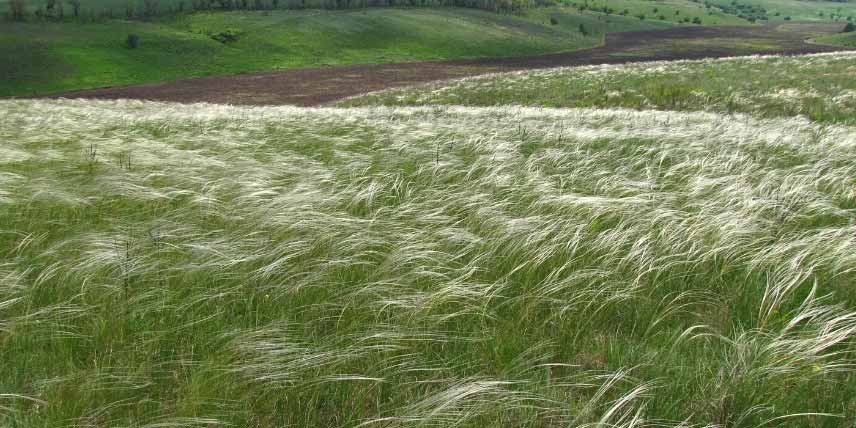
The grass Stipa pennata, in a steppe in Ukraine
Which plants to choose?
Many plants can find their place in steppe lawns. Choose species that are adapted to drought, poor and dry soils. The plants should be low, forming small tufts or groundcovers, allowing the entire space to be visible without obstructing the view. Plant numerous grasses such as Stipas to create a lawn effect, and integrate bulbs, perennials, and possibly some annuals among them.
Grasses:
- Stipa tenuifolia: charmingly nicknamed “angel hair”, this grass has a very natural style, forming tufts of very fine leaves, bearing silky, blonde, and light spikes in summer that undulate with the slightest breeze.
- Stipa barbata: this stipe produces long, silvery, soft, and silky inflorescences in June-July, emerging above its medium green linear foliage. It reaches about 60 cm in height when in flower.
- Sporobolus heterolepis: this is a very beautiful grass native to North American steppes, particularly suited to poor, dry, and rocky soils. It forms silky tufts, 30 cm in all directions, made up of fine, flexible, and arching leaves, emerald green in spring and then coppery orange in autumn.
- Koeleria glauca: blue koeleria is a grass from Eastern Europe with evergreen blue-green leaves, bearing fine silvery panicles in early summer.
- Bouteloua gracilis: this grass forms tufts of fine, stiff, and upright leaves, and bears very original horizontal floral spikes in summer, resembling a comb.
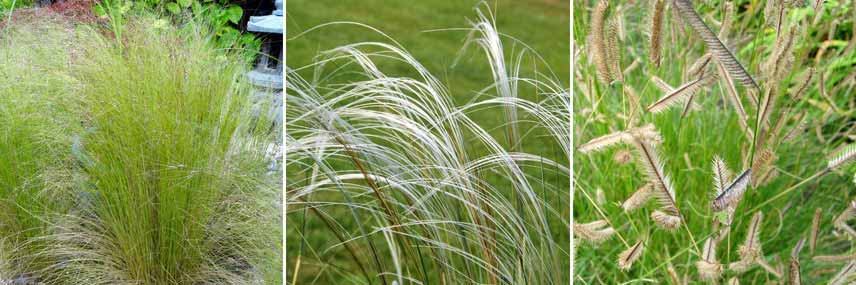
Stipa tenuifolia, Stipa barbata, and Bouteloua gracilis (photo Agnieszka Kwiecień, Nova)
Bulbs:
- Triteleia laxa: also known as Brodiaea, this lesser-known bulb produces umbels of about ten star-shaped blue flowers in May-June. It is hardy down to -10 °C.
- Gageas: these lovely little plants offer star-shaped yellow flowers with six petals in spring. They are native to the Mediterranean region, where they grow on dry, calcareous soils.
- Botanical tulips: offering colourful flowers, often smaller and more delicate than those of horticultural varieties, botanical tulips are close to wild species, and several of them are native to the steppes of Central Asia. For example, you can choose Tulipa greigii, which has bright flowers, usually red, sometimes yellow or orange, or Tulipa turkestanica, whose stems bear a dozen small star-shaped white and yellow flowers each.
- Crocus: they have the advantage of flowering very early in spring, between February and April, and offer very delicate, cup-shaped flowers in white, purple, mauve, or yellow. Easy to grow, they prefer poor, well-drained soils, making them perfect for a steppe lawn.
- Allium karataviense: known as Turkestan onion, this ornamental garlic from Central Asia has broad, bluish-grey leaves and produces umbels of white or pink flowers in spring, measuring 7 to 10 cm in diameter.
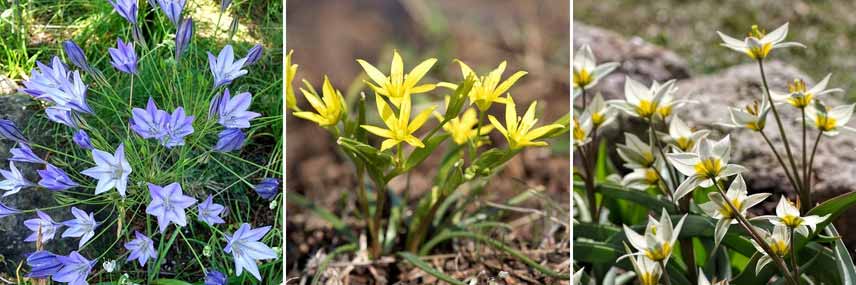
Triteleia laxa, Gagea fibrosa (photo Zeynel Cebeci), and Tulipa turkestanica
Perennials:
- Adonis vernalis: spring adonis is a perennial plant that grows spontaneously in Eurasian limestone steppes as well as in dry lawns and rocky slopes. It produces beautiful yellow flowers, 5 to 7 cm in diameter, and has finely divided foliage.
- Euphorbia rigida: this spurge forms bluish-grey tufts, 40 to 50 cm tall, made up of fine leaves arranged all around upright and spreading stems. In spring, it bears light green-yellow inflorescences.
- Euphorbia myrsinites: Corsican spurge is a small plant with spreading, mat-forming stems, bearing bluish-green leaves and chartreuse flowers.
- Delosperma: this is a small groundcover perennial for dry soil, with succulent and evergreen leaves, as well as spectacular flowers in purple, pink, orange, or yellow. It blooms from June until the first frosts.
- Sedum acre: this stonecrop forms a carpet of creeping stems bearing small imbricate leaves. From June to August, it is covered with countless small star-shaped yellow flowers. A frugal plant, drought-resistant, it is often used on green roofs.
- Sedum album: white stonecrop is a mat-forming plant with fleshy, rounded leaves that change colour depending on the season and exposure. It produces beautiful star-shaped white flowers in summer.
- Sedum spurium: native to the Caucasus mountains, this sedum is also mat-forming and bears green leaves that are more or less washed with red, sometimes variegated depending on the varieties. It also adorns itself in summer with star-shaped white, pink, or purple flowers.
- Thymus hirsutus: hairy thyme forms a low carpet of dark green, evergreen leaves, and is covered in May-June with numerous small pink flowers.
- Goniolimon tataricum: perennial statice is a plant native to the steppes of southeastern Europe, the Caucasus, and Russia, offering superb airy inflorescences in summer, made up of countless tiny light blue mauve flowers.
- Achillea crithmifolia: this is a beautiful groundcover yarrow with grey-green leaves, very finely divided, and summer flowering in cream-white umbels.
- Iris pumila: native to Eurasian steppes, this dwarf iris forms beautiful tufts adorned in April-May with superb pale blue, violet, mauve, yellow, or purplish-red flowers depending on the varieties. It measures 10 to 20 cm in height.
- Anaphalis triplinervis: Himalayan everlasting is a very beautiful plant with grey felted foliage that bears bouquets of silver-white flowers in summer.
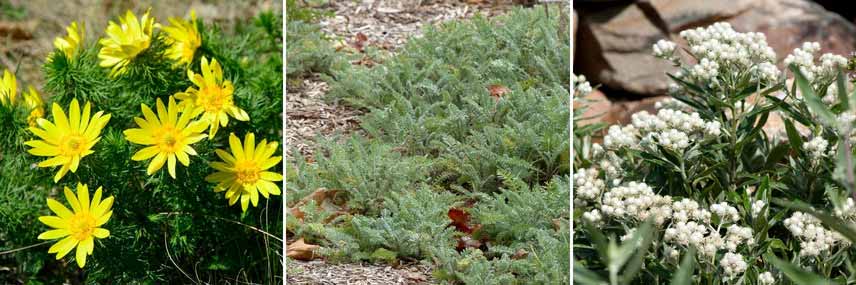
Adonis vernalis, Achillea crithmifolia, and Anaphalis triplinervis
How to install them?
We recommend installing steppe lawn in autumn, as this is the ideal time to plant spring-flowering bulbs (Crocus, Tulips…), and you can also install the perennials and grasses that will make up the lawn at the same time.
- Start by preparing the ground: loosen the soil and weed. Do not add fertiliser, compost, or potting soil. Depending on the nature of your ground, you may add drainage materials: coarse sand, gravel, and stones, to prevent the soil from retaining water.
- Dig</strong planting pockets and then plant the perennials and bulbs that will make up your steppe lawn. We recommend installing them in groups to create patches of colour.
- Water after planting and in the following weeks.
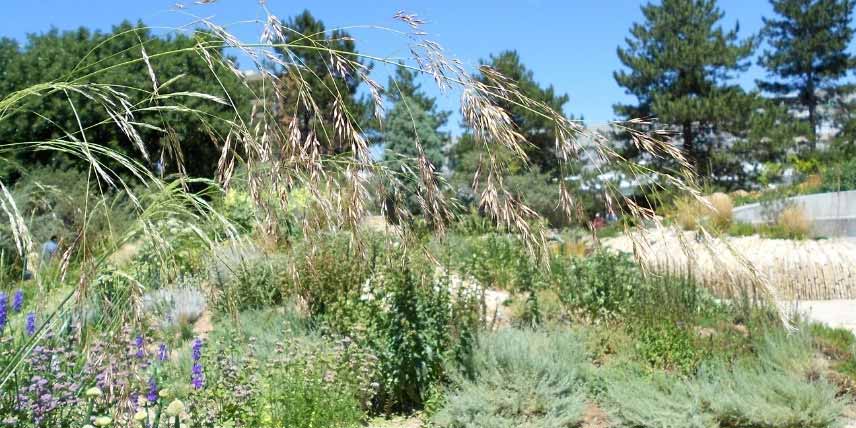 The grass Achnatherum splendens, in the steppe zone of the Denver botanical garden</caption]
Read also
9 grasses for dry soilHow to maintain a steppe lawn?
Steppe grass requires very little maintenance, as the plants that make it up are self-sufficient and drought-resistant. Once well established, they will not need watering or fertiliser. You can carry out occasional weeding if you notice any adventive plants settling among them. Trim and limit the most vigorous plants if necessary. Regarding grasses, at the end of winter, you can tidy up evergreen species like Stipa and Koeleria to remove dead leaves, and cut back deciduous species like Bouteloua to the ground.
On this subject, check out Michael’s article on our blog: “Grasses: those that are pruned, those that are clipped”
- Subscribe!
- Contents
Comments