





























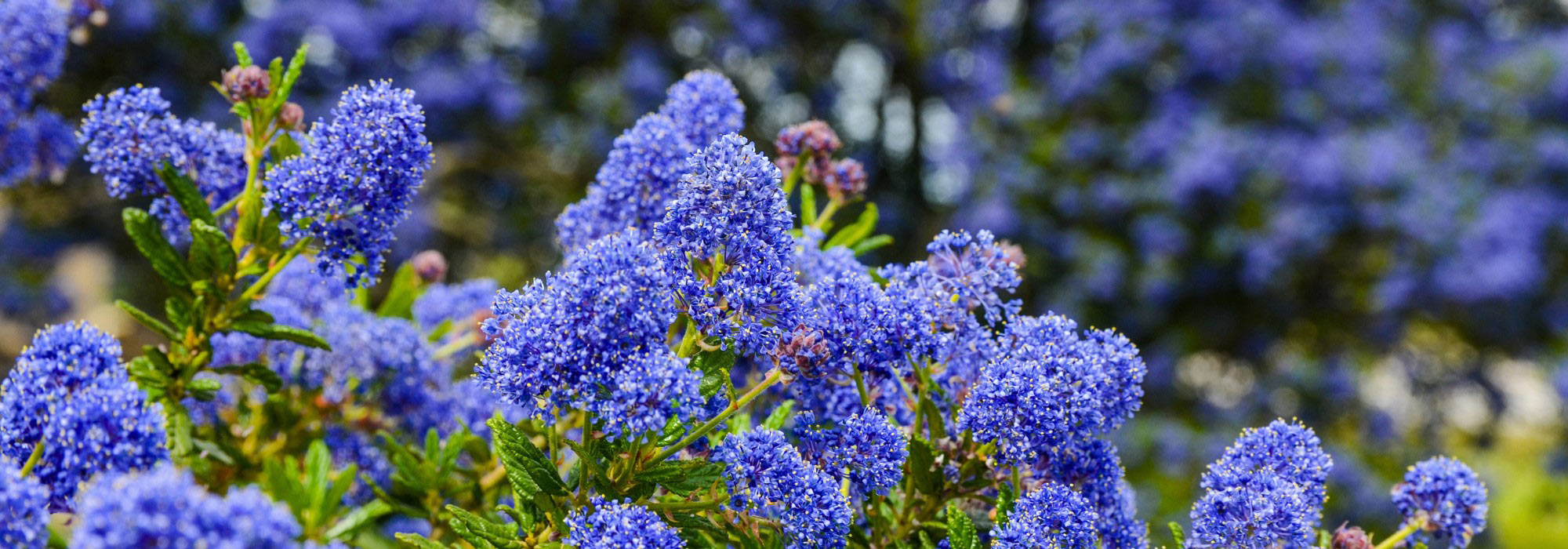
Garden trend: indigo blue
Ideas and Inspiration
Contents
Today garden colour trend is indigo blue. Intense and deep, it sweeps across the garden! That hue, positioned between blue and purple on the colour spectrum brings a touch of freshness, mystery and elegance, giving the garden a hint of Greece or Morocco. In drought conditions and a dry garden, the longing for blue, a symbol of water and freshness, reassures and soothes. Indigo invites escapism and relaxation. A monochrome garden is on trend, even though this strong, cool colour can also be used in small touches. But how to incorporate indigo into the garden? Which plants should you choose to evoke distant, mysterious horizons? Here are our inspirations and tips for using this electric and luminous shade in the garden!

Why incorporating indigo blue into the garden?
What are the characteristics of this blue like no other? More intense than classic blue, more vibrant, this shade lying between blue and purple is an enchanting and complex colour which draws inspiration from natural indigo, a mythical pigment with a powerful dyeing ability, used for millennia and derived notably from the indigo plant (Indigofera). Renowned for its intensity, indigo blue invites escapism and serenity, evoking at once the vastness of a sky at dusk, the southern seas and the depths of the ocean. Applied in small touches, it dynamises a display without overdoing it, while remaining calm and soothing. This iconic colour of the sky and the sea adds depth, helps introduce visual focal points and creates a calm and contemplative atmosphere in the garden.
Indigo blue enriches the garden :
- It creates an ambience : indigo blue, with its depth and intensity, adds a touch of mystery and serenity to the garden. It can transform an ordinary green space into a place inviting exploration.
- It heightens contrasts : paired with warm colours such as yellow or orange, it can energise a space and, when combined with greens, whites or pinks, it brings a subtle and refined harmony.
- It brings visual depth : as a cool colour, it conveys a sense of perspective and infinity, and gives a sense of space and openness.
- It fosters unity : indigo blue can serve as a unifying thread in garden design, bringing together diverse parts of the landscape. By repeating this colour, one can induce a sense of unity and visual cohesion.
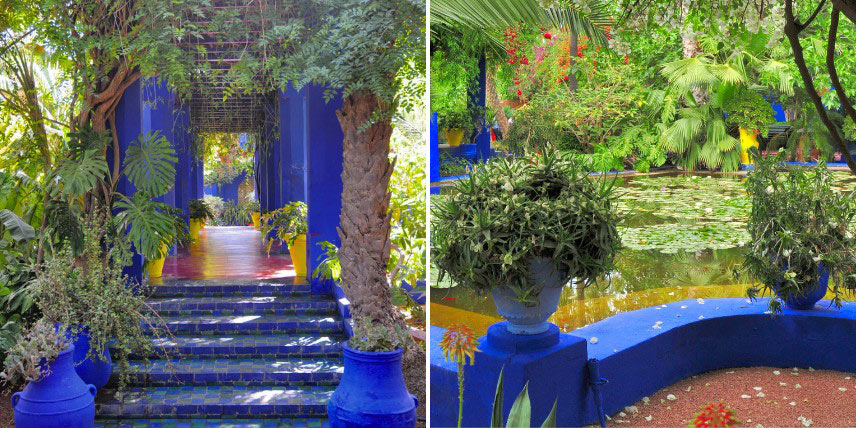
The Majorelle Garden in Marrakech is a superb example of using indigo blue. This colour unifies the garden and truly acts as a unifying thread.
Read also
Designing a blue gardenHow to use indigo blue in the garden?
There is something interesting about playing with this particular blue, but overusing indigo risks saturating the eye. Using indigo in the garden offers a multitude of possibilities, ranging from crafting a monochrome garden — where blue is omnipresent — to integrating subtle and energising touches. For a harmonious scene, you should ensure the right proportion of indigo. It all comes down to the judicious use of other colours. It’s a very expressive colour that should be used to best effect to avoid overload. Here are our colour combinations to elevate this colour and ensure its integration into the garden:
- Avoid overload: excessive use can make the space feel oppressive or cold. Play with blue hues: opt for lighter blues alongside it for softness and freshness, or dare deeper blues, even shades leaning towards purples toward blacks, which will heighten the sense of blue and the depth of indigo. This combination instantly adds chic and a very modern look to a scene.
- Use indigo in small touches to draw the eye and create focal points across the garden. Pair it with complementary colours so that it stands out even more.
- Avoid colours that are too close: the pairing of indigo with colours that are too similar, but without variation in tone or lightness, can lead to monotony.
- Be wary of neon colours or colours that are too vivid: the excessive use of extremely vivid colours beside it can create a discordant atmosphere, eclipsing indigo as the star of the show by their intensity.
- With yellow and orange: these complementary colours (citron yellow, mustard and curry, sand, coral, burnt orange) create a vibrant contrast with indigo blue, evoking energy and liveliness. Together, they will light up a garden, especially in the sunlight.
- With greens: chartreuse green and anise green allow contrasting colour play, but work well with flowers that have indigo accents.
- With white: this combination brings a great sense of freshness and brings out the depth of indigo, especially in shaded areas.
- With pale pink and purple: these colours form a soft pairing with indigo.
- Coppery tones: they reflect sunlight, bringing brightness and emphasising its intensity.
- Avoid scarlet red: too aggressive, especially in large quantities. A delicate balance must be found to avoid a visual clash that is too strong.
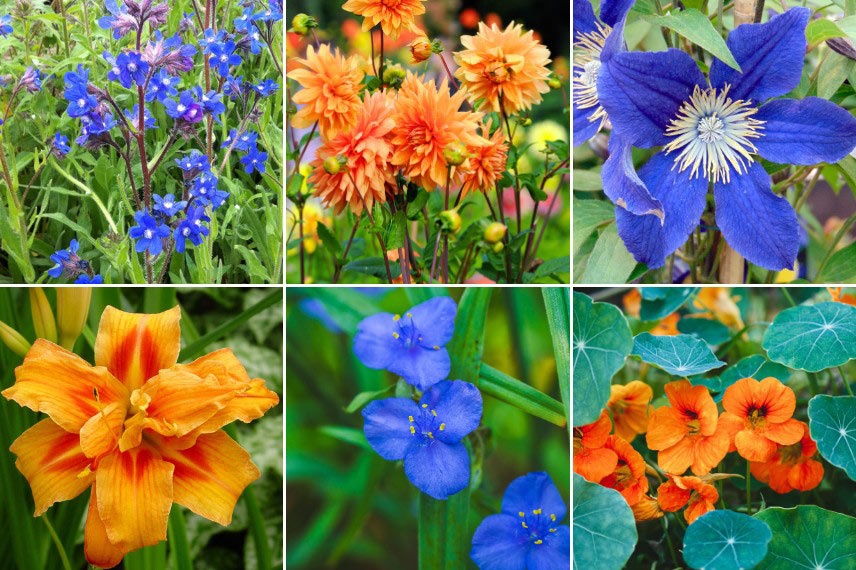
Blue flowers stand out beautifully when paired with orange flowering blooms. Anchusa azurea ‘Loddon Royalist’, Dahlia ‘Motto’, Clematis ‘Hudson River’, Hemerocallis ‘Apricot Beauty’, Tradescantia ‘Isis’ and nasturtiums
Which garden style?
- A small garden, a patio, a mini terrace with Moroccan accents : indigo blue widens the perspectives and enhances the sense of depth. The space will thus appear larger than it actually is.
- A seaside garden : indigo blue invites travel and takes its cue from coastal landscapes. In a coastal garden or a holiday garden, it recalls the ocean and the sky, pairing perfectly with sandy and ochre hues.
- A Mediterranean garden is a backdrop for blue flowering plants, sun-loving and often drought-tolerant. Indigo reinforces the sunny, warm character of this type of garden.
- A dry garden : in a desert-inspired garden, where the choice of plants focuses on drought-tolerant species that require little maintenance, indigo blue brings a welcome freshness to a setting dominated by neutral tones. It acts as a booster for the grey-green hues of the succulents and the blond or coppery tones of the grasses.
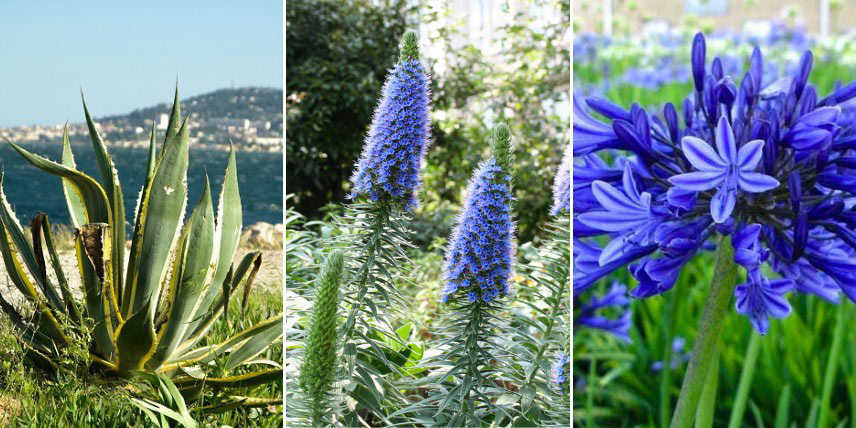
In a seaside garden, enjoy the beautiful blue flowering of Echium fastuosum and the Agapanthus ‘Midnight Blue’
Read also
6 blue and violet CampanulasWhich plants for an indigo-blue garden?
Agapanthus, Ceanothus, Veronicas or sages: there is a large number of plants bearing this deep, vibrant hue. Here is a (small!) selection of indigo flowers chosen from perennials, bulbous plants, bushes, annuals and climbing plants.
- Essential indigo-blue perennials : Veronica spicata ‘Ulster Dwarf Blue’, Anchusa azurea ‘Loddon Royalist’, Virginia Spiderwort ‘Isis’, Delphinium ‘Dark Blue-Black Bee’, Shrub Sage ‘Black and Blue’,Iris germanica ‘Blue Crusader’, Baptisia ‘Blueberry Sundae’ or Faux Indigo, Campanula ‘Sarastro’.
- The bulbous plants: Agapanthus hybrid ‘Blue Thunder’, Anemone coronaria ‘Mr Fokker’, Muscari botryoides ‘Superstar’, Hyacinth ‘Twin Pearl’.
- The indigo-blue flowering shrubs: Teucrium ‘Indyho’,Caryopteris clandonensis ‘Beyond Midnight’, Dichroa versicolor ‘Round Blue’, Ceanothus ‘Blue Sapphire’, Vitex agnus-castus ‘Magical Summertime Blues’, Hydrangea macrophylla ‘Hovaria Hopcorn’.
- The annuals and biennials: Nigella damascena ‘Moody Blues’, Primula ‘Veristar Late Blue F1’, Petunia Surfinia ‘Giant Blue’, , Petunia ‘Blue Picotee’, Lobelia erinus ‘Regatta Deep Blue’, Verbena ‘Vepita Pearl Blue’.
- The climbers: Clematis ‘The President’, Clematis ‘Kingfisher Evipo037’, Ipomoea indica, Sweet pea ‘Lord Anson’s Blue’.
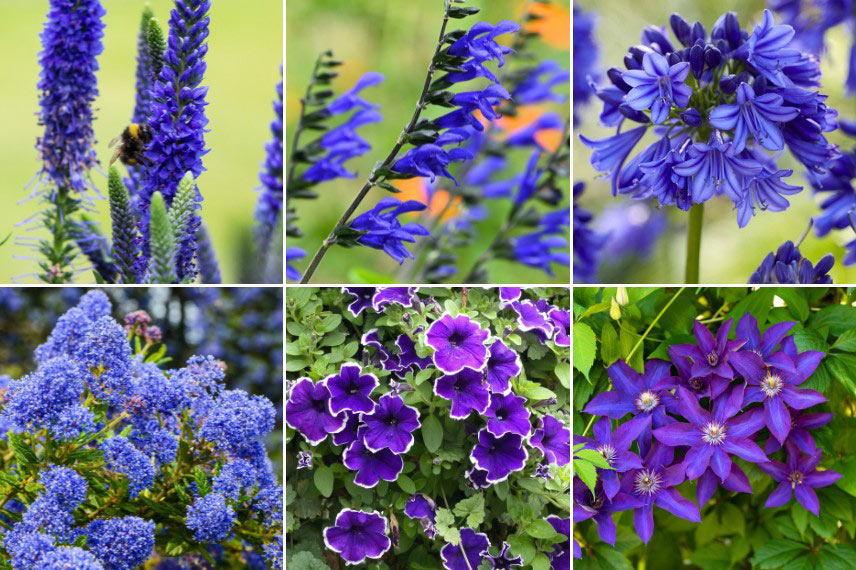
Veronica spicata ‘Ulster Dwarf Blue’, Salvia guaranitica ‘Black and Blue’, Agapanthus ‘Blue Thunder’, Ceanothus ‘Blue Sapphire’, Petunia ‘Blue Picotee’ and Clematis ‘The President’
A blue garden to suit your sun exposure
In full sun
Full sun is ideal for indigo flowering, with many plants thriving in very sunny exposures. Sages, Nigellas, delphiniums, agapanthus thrive in full sun, attracting pollinators. Indigo blue intensifies in the sun’s rays.
In shade or partial shade
Shade or partial shade areas are not to be overlooked and can accommodate plants offering beautiful Indigo-blue flowering, even with less direct light. Hyacinths, Anemones, muscari, campanulas, Ceanothus, hydrangeas thrive in less sunny conditions, and brighten shady corners.
Further reading
- The Guide to Colour in the Garden, Francis Peeters and Guy Vandersande, Editions Ulmer. A definitive guide to using colour!
- The Gardener’s Colour Book, Andrew Lawson, 2020, Ysec Editions. Another reference work for mastering colour in the garden.
- Blue: A History of Colour, Michel Pastoureau, 2000, Editions Seuil. To go well beyond the garden, a collector’s book.
- The Jardin Majorelle site in Marrakech, world-renowned with unforgettable blue accents.
- Subscribe!
- Contents
Comments