





























Unknown trees and shrubs
10 original species to discover
Contents
Among the infinite variety of trees and bushes available for our gardens, some remain relatively unknown or even unfamiliar, as they are not part of the standards easily found in garden centres or nurseries. There are many that are worthy of interest for their originality, flowering, foliage, fragrance, and interesting hardiness… sometimes all of these at once. These confidential trees and shrubs are sought after by amateur gardeners as well as enthusiasts of novelties or collectors to further enhance the garden.
Daphniphyllum, Lomatia, Maackia… These names mean nothing to you? We present them along with a few trees and bushes to get to know better. There’s no doubt you’ll fall for at least one of them!

Daphniphyllum
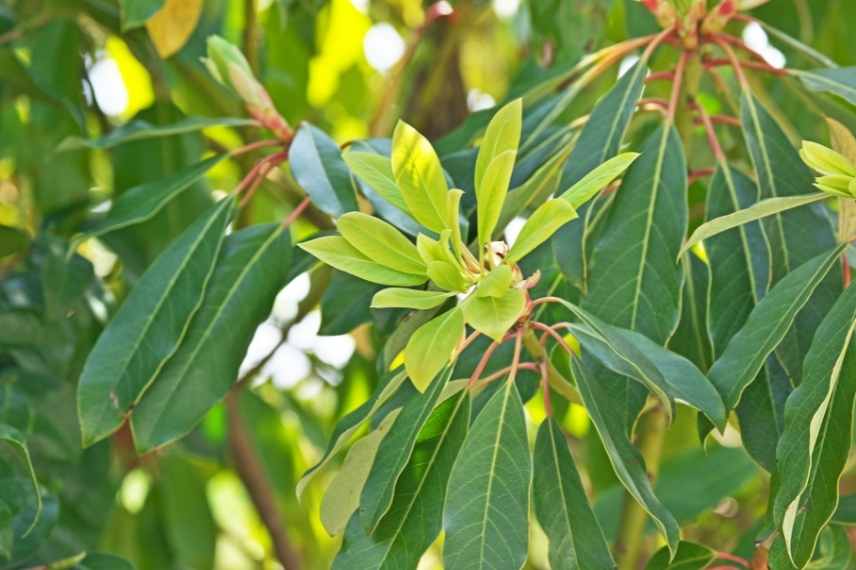
Daphniphyllum himalayense is a large evergreen shrub, still rarely seen in gardens. This “false daphne” grows on several short stems and develops a beautiful compact and rounded shape above, with large thick and oblong leaves (about 20 cm). The English call it “Red-necked Rhododendron”, and it is true that the Daphniphyllum himalayense has a somewhat similar appearance, and it is also a plant for partial shade. However, while it thrives in exotic or Japanese-style gardens, it is more for the beauty of its foliage than for its flowering: the new leaves emerging in spring are superbly coloured red at their base, as well as their petiole, creating a striking effect in the garden, as the plant gracefully sheds its old leaves.
Flowering occurs in May or early June, with apetalous flowers, fuchsia to red on male plants and green on female specimens, just below the lighter new leaves. The Daphniphyllum himalayense grows quite slowly, reaching about 3 m when mature (it can sometimes reach up to 5 m in height).
With a good cold resistance (hardy down to -15 °C), this beautiful Asian shrub deserves a prominent place in the garden, either in a heather soil bed or as a specimen plant.
Daphniphyllum macropodum
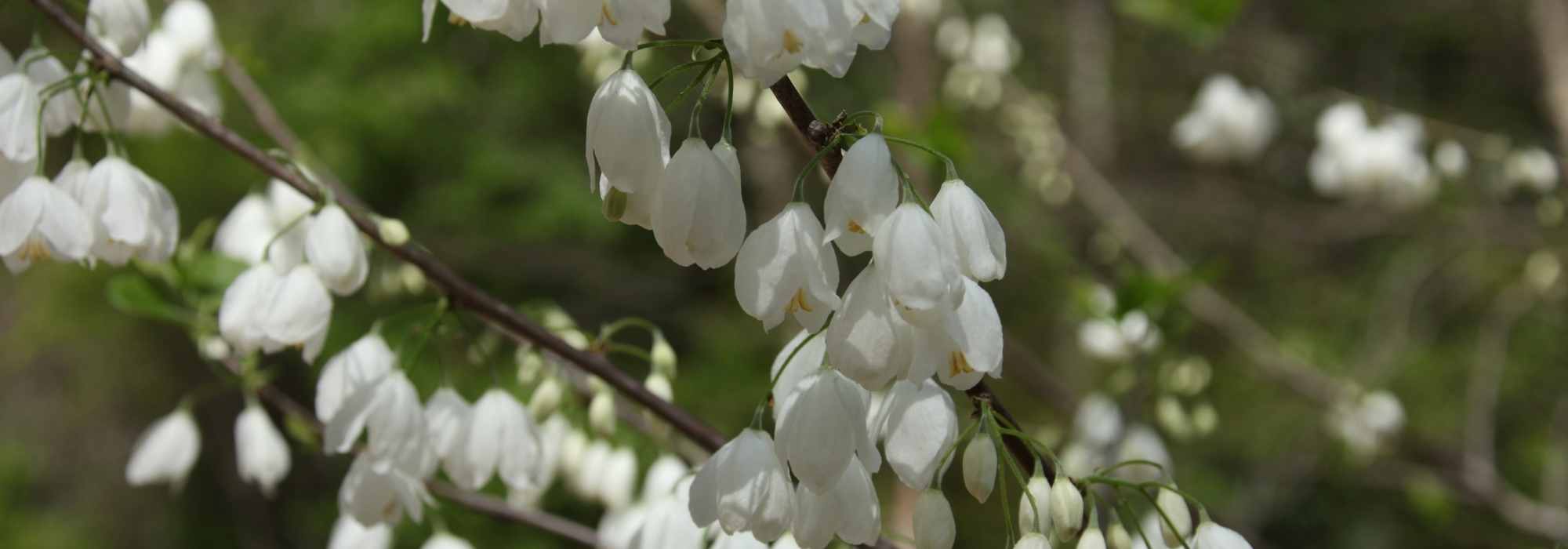
Halesia carolina
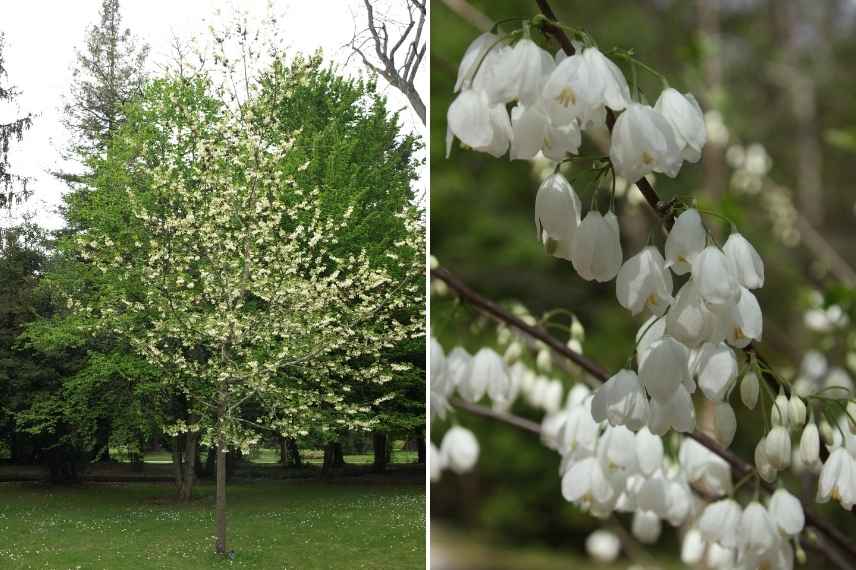
It is certainly the least known on this list. The Halesia carolina is, however, not yet widely established in our gardens, which is a shame. From the same family as Styrax, another beautiful ornamental shrub, the silver bell tree, as it is also called, is a large shrub that can grow up to 8 m or more in its natural habitat (it is native to the southeastern United States), but generally remains between 3 m and 6 m here.
Its charm comes from its habit, a rounded crown that gradually spreads and becomes loose, wider than it is tall, and from its very ornamental flowering, in the form of clusters of pure white bells. This occurs in April or May, depending on the climate, at the same time as the bud burst period of the leaves, or just before. The foliage is deciduous, formed of finely dentate green leaves that turn yellow late in autumn.
The Halesia carolina thrives in sunny to partially shaded locations, in any soil as long as it remains cool and well-drained. This shrub is sensitive to chlorosis, so it requires slightly acidic to neutral soil.
→ Note: The Halesia monticolata, native to the forests of northeastern North America, has larger flowers (about 2.5 cm long), which are pink when in bud.
Halesia carolina
Discover other Rare and collectors' bushes
View all →
Available in 1 sizes
Available in 1 sizes
Available in 1 sizes
Available in 1 sizes
Available in 1 sizes
Available in 1 sizes

Available in 1 sizes
Available in 1 sizes
Available in 1 sizes
Available in 1 sizes
Toona sinensis
Here is an astonishing shrub with the colour of its spring foliage: Toona or Cedrela sinensis, also known as Chinese mahogany or Chinese cedar. This name, derived from cedar, refers to its pinkish-brown wood, but it is its long, bright pink paripinnate leaves that captivate in spring. This large shrub or small tree (growing between 10 and 15 m) is truly spectacular, especially as the petioles also display a beautiful reddish hue, varying according to the cultivars. The foliage gradually transitions from pink to cream, then to a glossy green and golden yellow in autumn, with the underside always remaining whiter.
The Toona sinensis ‘Flamingo’ is particularly interesting due to its very fastigiate silhouette, as it broadens to a maximum of 2 or 3 m. Its upright tufted shape is unique and is especially highlighted during the bud burst period. It can therefore fit into medium-sized gardens or large gardens, creating a beautiful vertical element.
Flowering occurs in late spring, around June or even July, in the form of pendulous panicles of cream colour.
Another advantage of this Chinese tree is its rapid growth in the first few years (somewhat like Ailanthus, with which the species type could be confused in summer), making it a useful specimen for bare gardens.
Very hardy (it withstands temperatures down to -20 °C), this beautiful tree is certainly worth discovering, and should be planted in isolation to enjoy its splendour, in a sunny area of the garden, in cool, well-drained soil.
→ Note: The Toona sinensis is a “vegetable tree”: its young pink foliage, with an onion-like, slightly bitter taste, is widely used in cooking in Asia (China, Vietnam, Korea…).
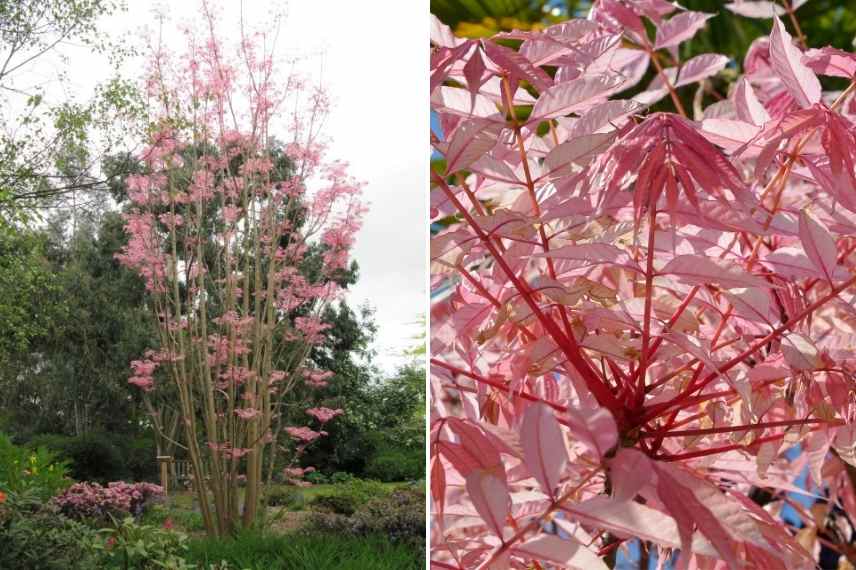
Toona or Cedrela sinensis (© Leonora Enking)
Read also
7 Trees with Unusual FoliageAzara serrata
There aren’t many large shrubs with yellow flowering, and the Azara serrata adds a refreshing touch to the genus. This beautiful shrub is stunning when it is covered in small, golden-yellow pompom flowers, somewhat like mimosa. It brings a wonderful glow in spring (usually between May and July) alongside concurrent blue flowerings, such as wisteria or ceanothus. Its flowers are notably fragrant, reminiscent of vanilla, and melliferous, attracting bees, butterflies, and bumblebees.
Its small, glossy, dark green, and leathery foliage is evergreen in mild climates (semi-evergreen elsewhere), making it very useful for inclusion in flowering hedges. Growing up to 5 m tall when mature (it grows quite slowly), it forms a bushy silhouette, with branches gradually bending under the dense flowering.
Native to Chile, the Azara serrata is somewhat frost-sensitive: it is best to avoid planting it in regions where temperatures dip close to -8 °C. It thrives in Atlantic coastal areas or around the Mediterranean, perfect for integrating into a shrub hedge or a boundary hedge, or for inclusion in a large display. It should be planted in full sun or light shade, in well-drained, even sandy, but humus-bearing soil. It is a low-maintenance shrub in the garden: never sick and requiring no special care!
→ Note: The genus Azara includes many species, including Azara lanceolata, the Azara microphylla, and two varieties with cream variegated foliage, Azara microphylla ‘Variegata’ and Azara integrifolia ‘Variegata’.
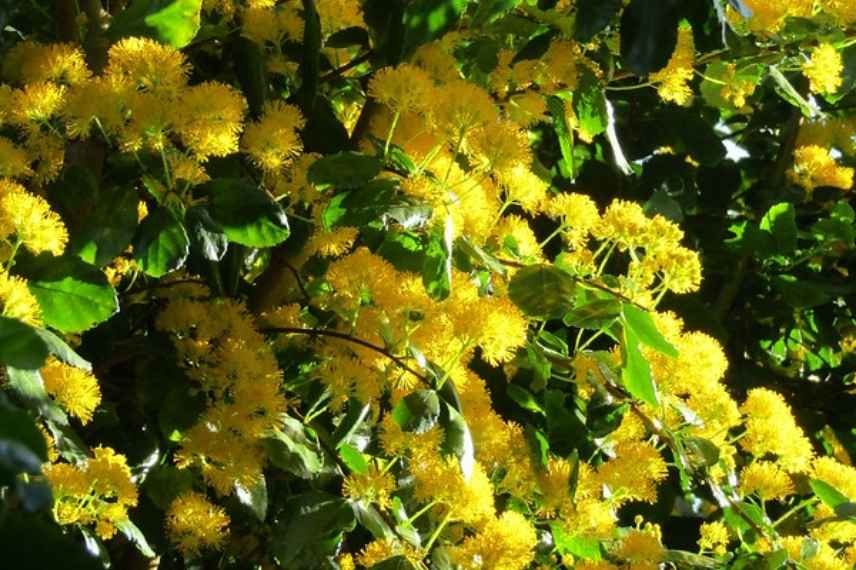
Azara serrata (© Leonora Enking)
Maackia amurensis
Here is a small tree that is very interesting for its great hardiness, allowing it to be planted almost anywhere in France. The Maackia amurensis, or Amur Maackia (or from the Amur River) gets this lovely name from its origin in Southeast Asia, where the Amur River flows. Measuring about 10 m at maturity, with a slightly larger spread, this beautiful tree charms not only with its graceful flowering melliferous in long cream-white clusters, upright at the ends of the branches, during July, but also with its foliage and overall appearance.
The leaves, deciduous, are compound with around ten leaflets, a lovely grey-green at bud burst, turning to a darker green in summer. Its silhouette is superb, spreading out to gradually form a small parasol tree that can be used for shade.
You will plant it in full sun, in ideally cool, well-drained soil, slightly acidic to neutral. Once established, the Maackia amurensis is quite drought-resistant and truly has all the qualities to enhance a large or medium garden!
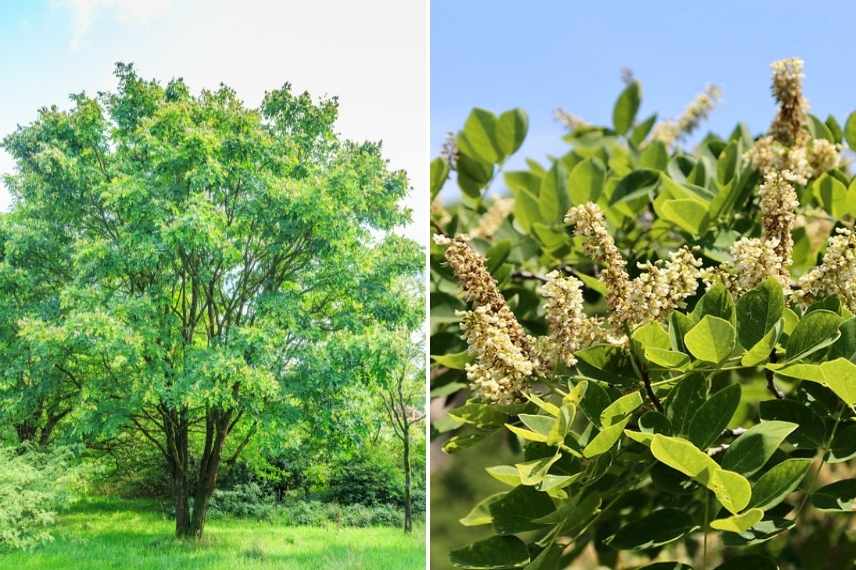
Maackia amurensis
Rostrinucula dependens
The Rostrinucula dependens can sometimes be mistaken for a butterfly bush. It is also known as tree mint… While it shares certain characteristics with the Buddleia (silver-green foliage, arching habit, flowering, cracked bark), this small shrub does not belong to its botanical family, nor to that of mint… So who is this original shrub really?
Highly ornamental with its long, trailing, fluffy pink-violet inflorescences and its silhouette that is both arched and spreading, the Rostrinucula dependens is a shrub that reaches a height of 1 m to 2 m at most, with a similar spread, or even wider. It is particularly interesting for its late flowering, which often begins in September and continues into October, or even November. This allows the garden to bloom at a time when it is losing some of its colours, and it also serves as a good larder for pollinating insects, as it is, like the Buddleia, nectariferous. Its foliage is slightly aromatic, with a minty scent when crushed. It is cultivated and maintained like the Buddleia, in full sun, in well-drained soil that ideally remains cool and can be poor. Plant it in a mixed border, as a free-standing hedge, or in isolation to enjoy its lovely habit.
The variety ‘Happy Cascade’, which has slightly longer and more curved flowers than the type, is a bit less hardy but will always regrow from the stump if frosts are below -10 °C.
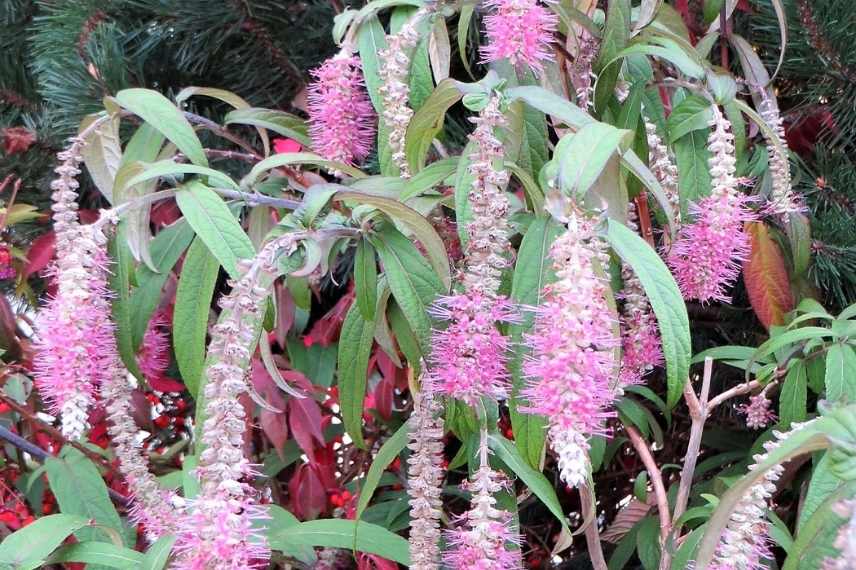
Rostrinucula dependens
Brachychiton
With the Brachychiton acerifolius, we are (almost) off to Australia with an impressively vigorous tree! While it will be reserved for the fortunate gardeners of the Mediterranean fringe, it remains a stunning tree that we wish to present to you. Its nickname, the Australian flame, is evocative: the Brachychiton acerifolius is enchantingly exotic, with a rare flowering of bright coral red.
The apetalous flowers (without corolla), shaped like cups or pendulous bells, are arranged at the tips of the branches and bloom between May and July. The specificity of the Brachychiton is that it is cauliflorous, meaning its flowers grow directly from the trunk and branches. It is at this moment that the Brachychiton is breathtakingly beautiful. The lobed foliage appears just after flowering, or sometimes at the same time. It resembles maple leaves, as its Latin name suggests. The tree, deciduous, thrives in full sun, in rich, cool, and well-drained soil.
Although the Brachychiton takes a long time to grow and flower, it reaches an adult height of about 10 m in our gardens, presenting a beautiful pyramidal crown. It is sometimes referred to as the bottle tree due to the swollen shape of its trunk that it acquires as it ages. It stores reserves of water, becoming very drought-resistant. This is a tree for exotic gardens on the Côte d’Azur and in Corsica, and who knows, it may perhaps, with climate warming, find its way into the protected gardens of the Atlantic fringe?
→ Note: The Brachychiton populneus (or Kurrajong), with white flowers speckled with pink and evergreen foliage, and the smaller Brachychiton bidwillii, which can grow in a large pot, can also be found in France.
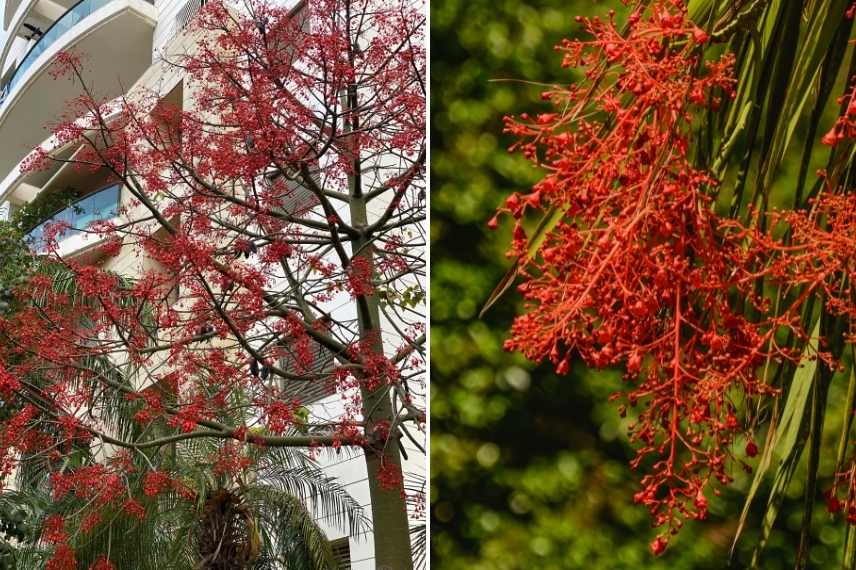
Brachychiton acerifolius
Lomatia
Lomatia belongs to the Proteaceae family, a large group comprising evergreen shrubs native to the Southern Hemisphere (Oceania, South Africa, Latin America, etc.). The Lomatia alone includes around ten species, all fascinating for their beautiful foliage resembling finely cut ferns in some cases, and their exoticism also brought by their flowering.
Among them, Lomatia ferruginea, a shrub reaching 2 to 3 m in height, boasts an astonishing reddish-pink and golden flowering in long clusters. Inside the curved flowers, an acid green pistil enhances the almost bicoloured appearance. The young bronze foliage is stunning, intricately cut, and remains elegant even when the plant is not in bloom!
You can also easily find Lomatia silaifolia in our gardens, a superb frilly shrub of small size (1.75 m), and Lomatia tinctoria from Tasmania, a charming compact shrub (1 m) with graceful cream-white flowers, both of which can be grown in pots.
Lomatia flowers in our gardens in July or August. They require acidic soil to thrive, with either full sun or light shade. They should be reserved for less frosty gardens (no temperatures below -8 °C), always in a sheltered position, to create clusters of southern plants along the Atlantic and Mediterranean coasts.
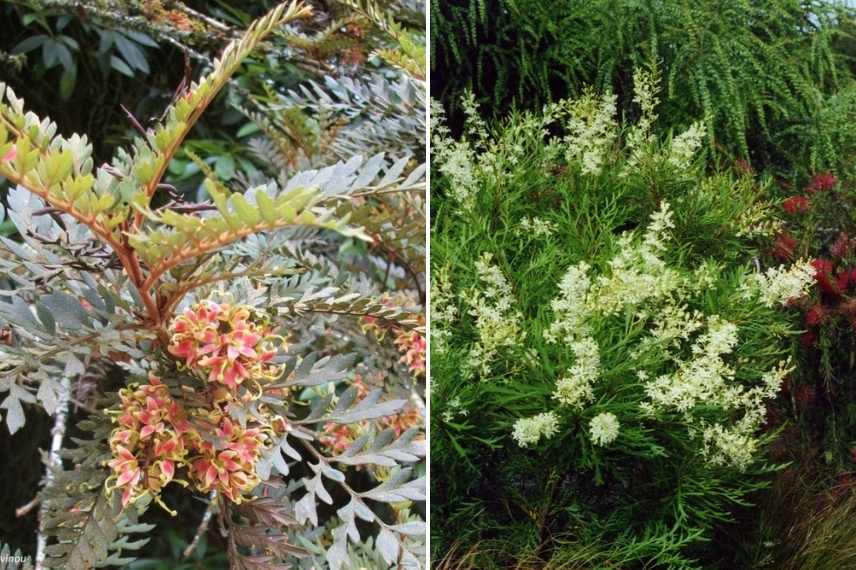
On the left, Lomatia ferruginea; on the right, Lomatia silaifolia (© Clivid)
Staphylea
Here is a European shrub that is not so common in gardens. The Staphylea can be planted almost anywhere due to its excellent hardiness (almost identical whether we refer to the Staphylea colchica, native to the Caucasus, or the Staphylea pinnata, native to Asia and Eastern Europe).
Also known as the false pistachio, it is familiar in the eastern part of France. In addition to its beautiful and generous flowering in April or May, it is melliferous, and the ivory bell-shaped flowers, which are fragrant, turn into decorative fruits, resembling small pouches, which change from beige to rust, persisting for a good part of the winter. Inside, there is an edible almond, giving the shrub its vernacular name. The foliage of the Staphylea is deciduous, with a bushy and spreading silhouette.
Of medium size, between 2 and 5 m, the Staphylea has the advantage of growing quickly. It thrives in rich and moist soil. This shrub is perfect for countryside gardens, hedges, or as a backdrop in large shrub borders.
→ Note: Varieties with purple foliage in S. colchica allow for an appealing contrast in the garden, such as the Staphylea colchica ‘Black Beauty’.
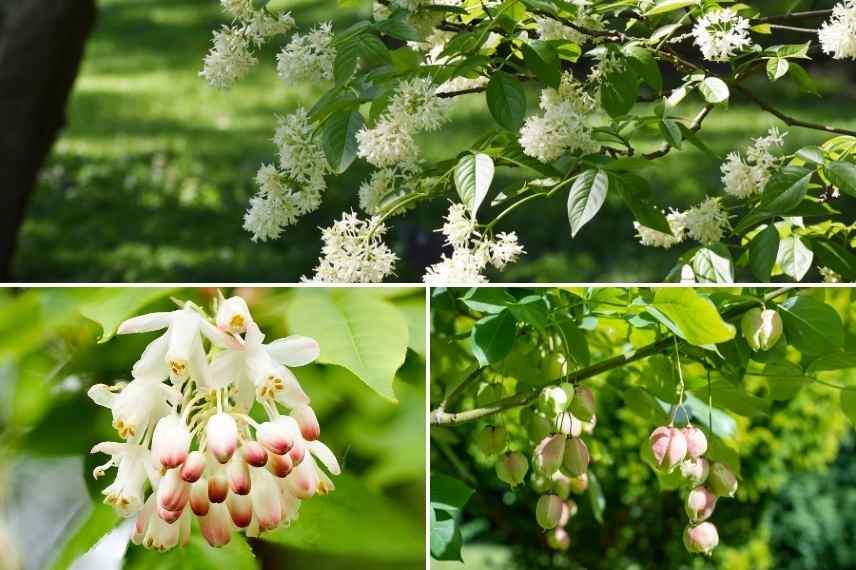
Staphylea colchica in bloom above, and Staphylea pennata below (flower and fruits)
→ Also discover our complete file on the Staphylea, false pistachio: planting and growing.
Castanopsis cuspidata
Finally, here is a small tree that is seldom talked about, planted in some botanical gardens or arboreta in France, but still rare among private individuals: the Castanopsis cuspidata.
This tree hails from Japan, where it often grows by the sea. It is remarkable for its flowering in June, featuring long white aments that literally cover and illuminate the crown. Also appreciated for its evergreen foliage, lanceolate to ovate and undulate, with a vibrant green colour, it can thrive in many gardens due to its limited growth here (between 10 and 15 m in height) and its hardiness (-15 °C). The Castanopsis requires a bright and sunny location, or even partial shade, and a soil that remains cool, always well-drained, neutral or acidic (it tolerates clay soils). It is magnificent when planted alone or in a grove of trees.
→ Note: the Castanopsis belongs to the beech family (Fagaceae); it was named Quercus castanopsis until the end of the 19th century.
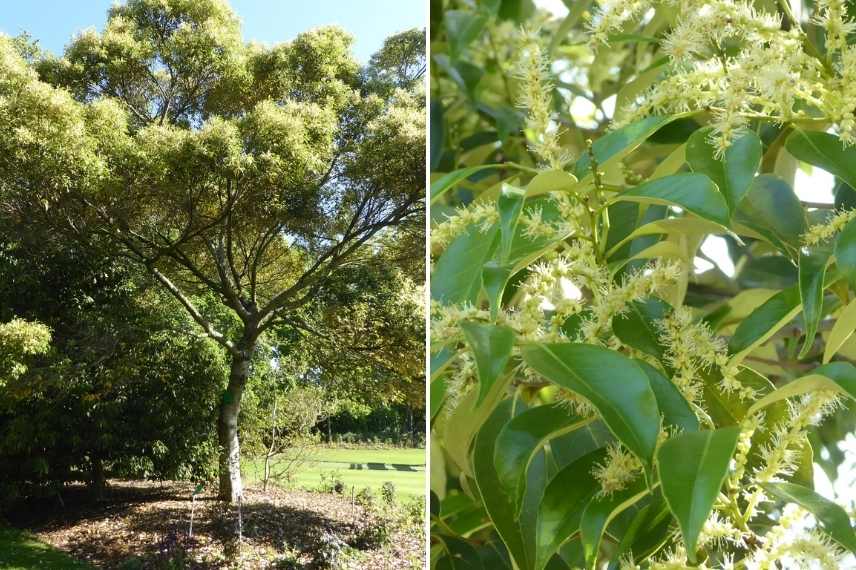
Castanopsis cuspidata in the botanical garden of Nantes (© Gwenaëlle David)
- Subscribe!
- Contents
Comments