





























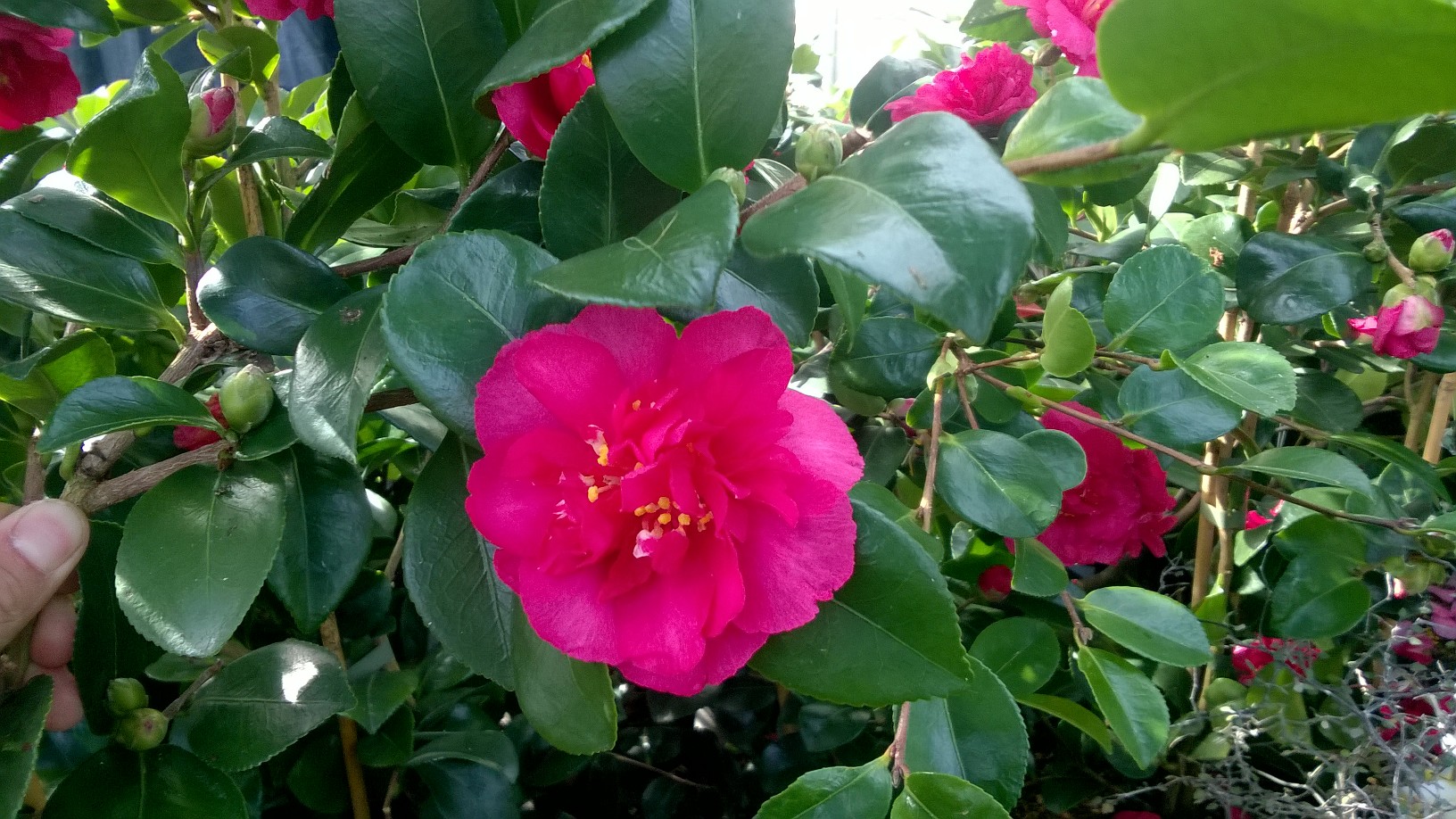
Camellia sasanqua, pronounced "Ka-mel-ee-ah sah-sahn-kwah", is currently showcasing its late flowering... and enchanting fragrance in gardens. Also known as autumn camellia, it blooms continuously until December. However, to enjoy its long flowering and sweet scent right up to the gates of winter, here are 3 key points to know:
- For which region?
The autumn-flowering camellia performs better in a mild and temperate climate than in colder regions where its hardiness can sometimes be challenged, and its flowering destroyed by early frost. Its average hardiness ranges between -10°C and -15°C for short periods. Traditionally, autumn camellias are cultivated in Brittany, Normandy, and along the entire Atlantic coast. Elsewhere, cultivation is quite possible but requires a sheltered position protected from cold winds.
- For which soil?
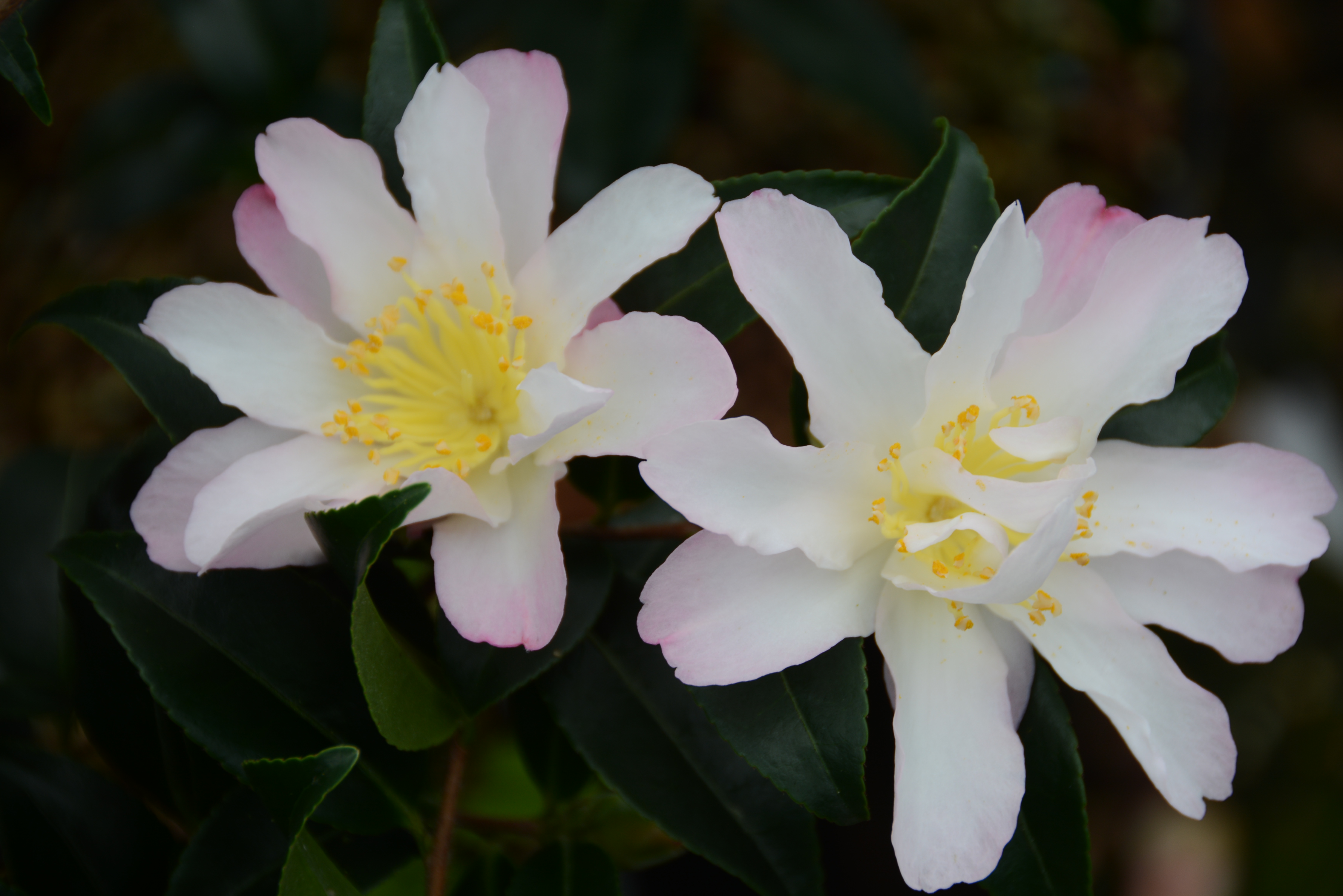
Like many so-called "heath" plants, Camellia sasanqua thrives in any good acidic and light soil. It requires a soil that is both rich and well-draining, never waterlogged in winter. Its thick, leathery foliage allows it to withstand short periods of drought; however, if it does not lack water in summer, its flower buds will form quickly, resulting in a more abundant flowering.
For which exposure?
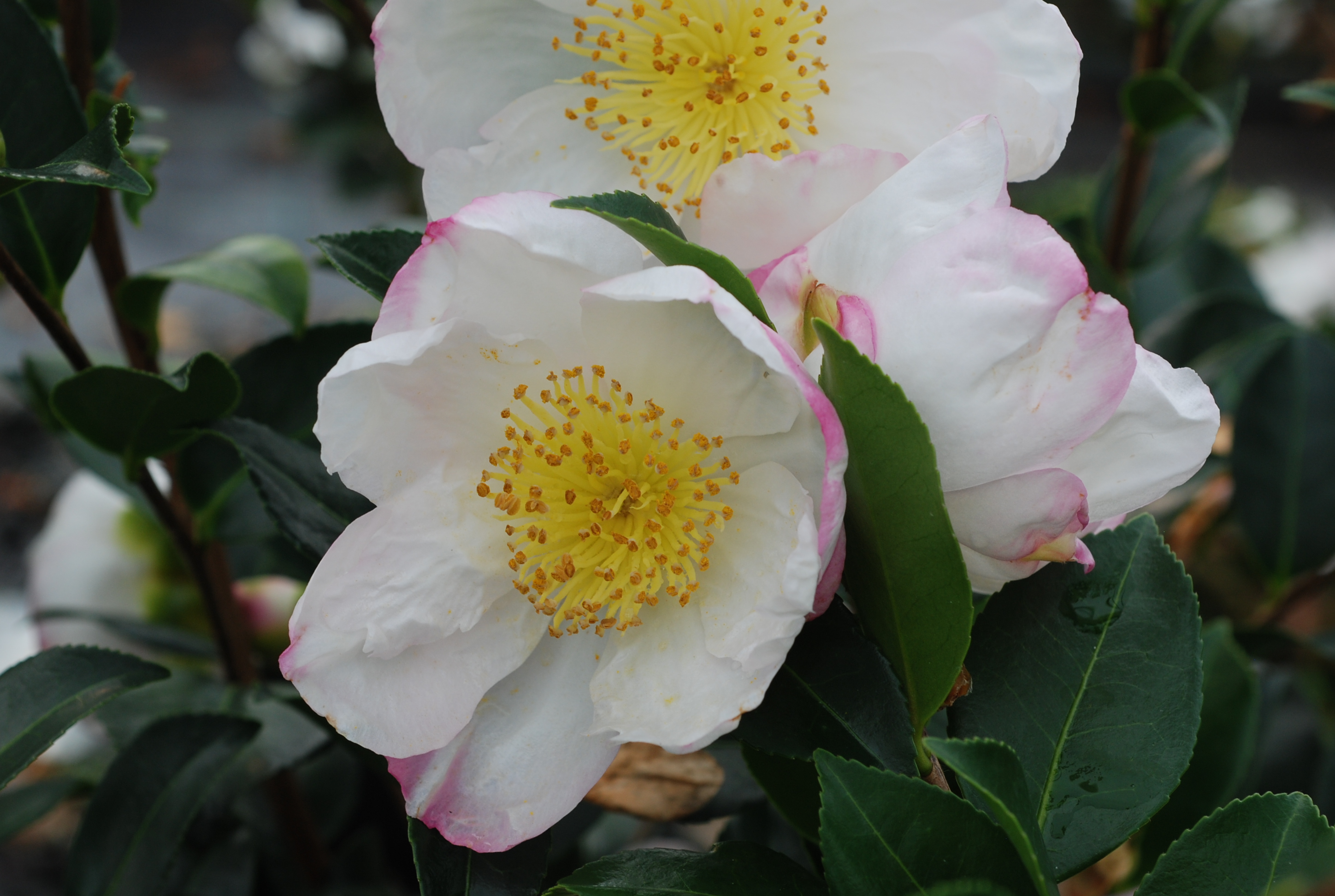
- Exposure is the cornerstone of successful cultivation. Camellias prefer protected spots, particularly from cold and prevailing winds. They also enjoy a partially shaded, bright, and warm exposure. Heat is essential for abundant flowering; the longer the heat lasts, the longer and more fragrant the flowering will be.
For those who lack the soil or climate to plant an autumn camellia, know that this slow-growing shrub grows very easily in pots; it would be a shame to miss out on such beautiful autumn blooms!
Camellia sasanqua, pronounced “Ka-mel-ee-ah sah-sahn-kwah”, is currently showcasing its late flowering… and enchanting fragrance in gardens. Also known as autumn camellia, it blooms continuously until December. However, to enjoy its long flowering and sweet scent right up to the gates of winter, here are 3 key points to know: The autumn-flowering camellia performs better in […]
Three years ago, I decided to redesign this bed by simplifying it as much as possible. I wanted a bed that wasn't too colourful, quite graphic, lush, and wild, without veering into anything too exotic.
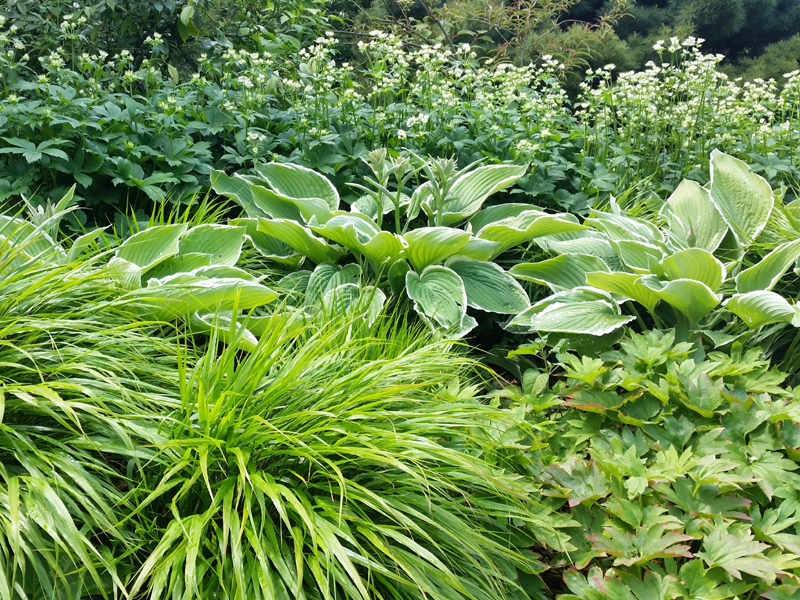
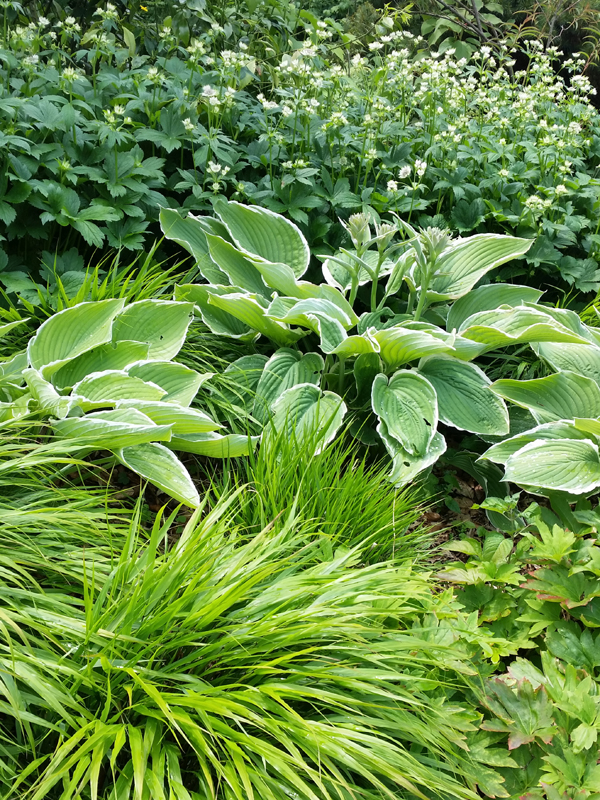
Hosta, Hakonechloa and Astrance in mix
I initially chose Hakonechloa macra. I had large mother clumps planted not far away, so it was easy to transplant and divide them. From 7 large clumps, I made a good dozen, planted quite randomly, sometimes leaving large spaces between some, thus covering the middle and the edge of the bed. I love the movement of this grass; when grown freely, it forms hemispherical clumps, while when planted at the edge and lacking space to spread, the leaves arch and take on a wave-like movement. Very inspiring, this grass served as the base, the structure for arranging this bed, bringing the wild, graphic, and lush aspect all on its own.
To add contrast and enhance the lushness, I then divided a few Hostas 'Frosted Jade', large enough not to be "overwhelmed" by the hakonechloas but not too large to suffocate them. Here, I planted 6 clumps, also distributed randomly but mainly from the middle towards the back of the bed. Next, to create a sharp edge, dress the border, and ensure the transition between the middle and the edge of the bed, I planted Mukdenia 'Karasuba'. I really like this groundcover with palmate foliage; in autumn, the leaves turn red, adding a pop of colour to the bed.
Finally, I needed a large perennial or a small bush to anchor the bed. Not wanting to add more contrast and wanting to accentuate the wild and lush aspect while staying within a green-white colour scheme, I opted for Astrance 'Star of Billion', which is undoubtedly one of my favourites along with Astrantia maxima. This very floriferous variety bears small, natural white-green flowers. They bloom from June until the first frosts, ensuring a display for 6 months of the year.
Three years ago, I decided to redesign this bed by simplifying it as much as possible. I wanted a bed that wasn’t too colourful, quite graphic, lush, and wild, without veering into anything too exotic. I initially chose Hakonechloa macra. I had large mother clumps planted not far away, so it was easy […]
Everything contrasts this heuchera 'Plum Pudding' with the sweet woodruff (Galium odoratum), apart from the fact that both of these perennials tolerate dry shade in heavy soil under the roots of a hornbeam hedge. And that’s why it’s a successful pairing!
The dark purple, coarsely rounded leaves of the heuchera provide a perfect counterpoint to the mossy apple green carpet formed by the whorls of fine foliage of the sweet woodruff. Moreover, the numerous small pure white flowers gathered in light clusters add a level of colour contrast to the opposition of foliage textures, completing this light and shadow association from April to June.
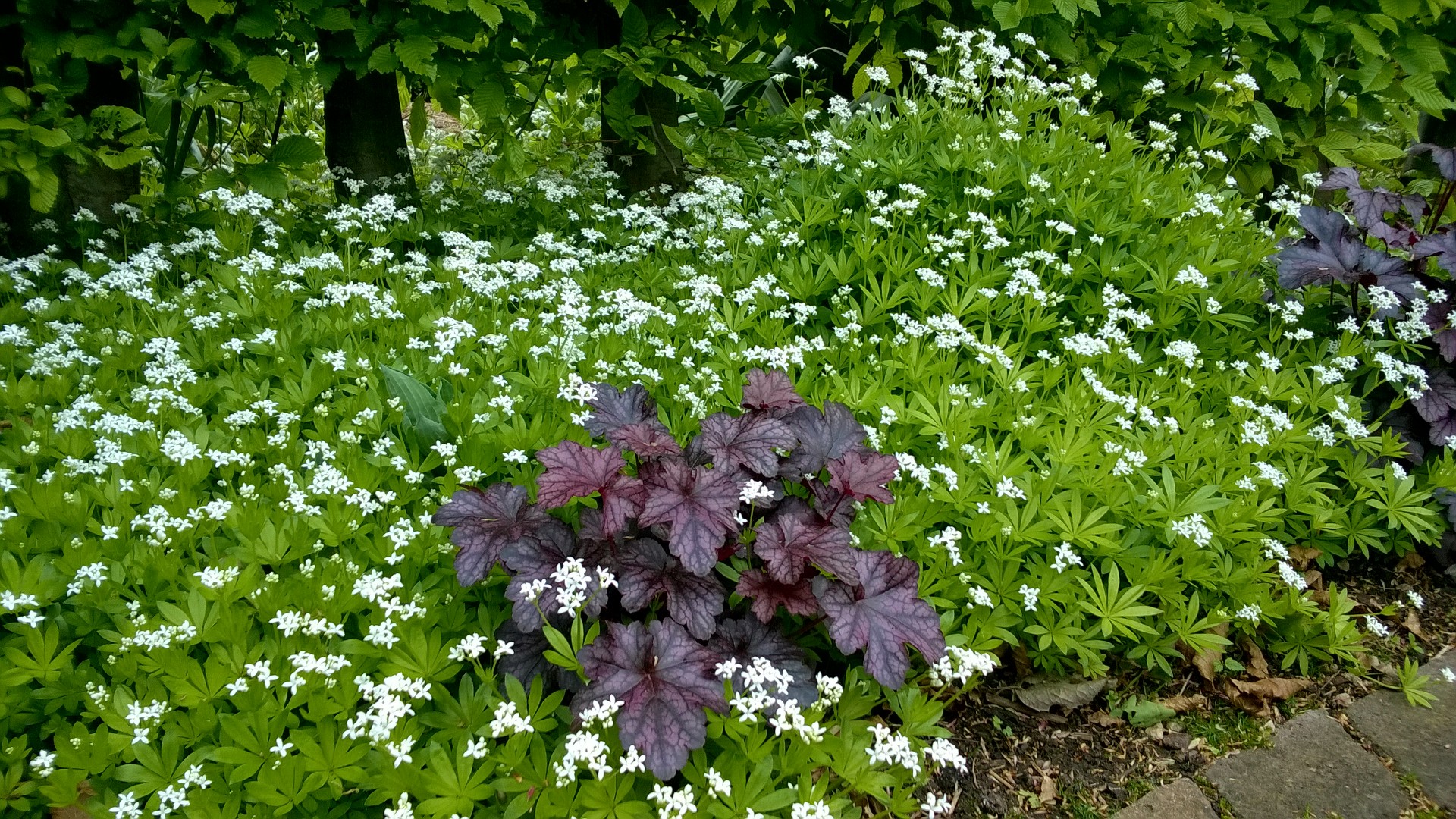
Purple heuchera and sweet woodruff: a successful light and shadow pairing for difficult shady spots
Everything contrasts this heuchera ‘Plum Pudding’ with the sweet woodruff (Galium odoratum), apart from the fact that both of these perennials tolerate dry shade in heavy soil under the roots of a hornbeam hedge. And that’s why it’s a successful pairing! The dark purple, coarsely rounded leaves of the heuchera provide a perfect counterpoint to […]
Who has not noticed after several years of planting that the beneficial shade of the tree, once so small, became increasingly dense, while the nearby plants dwindled in favour of the tree in question?
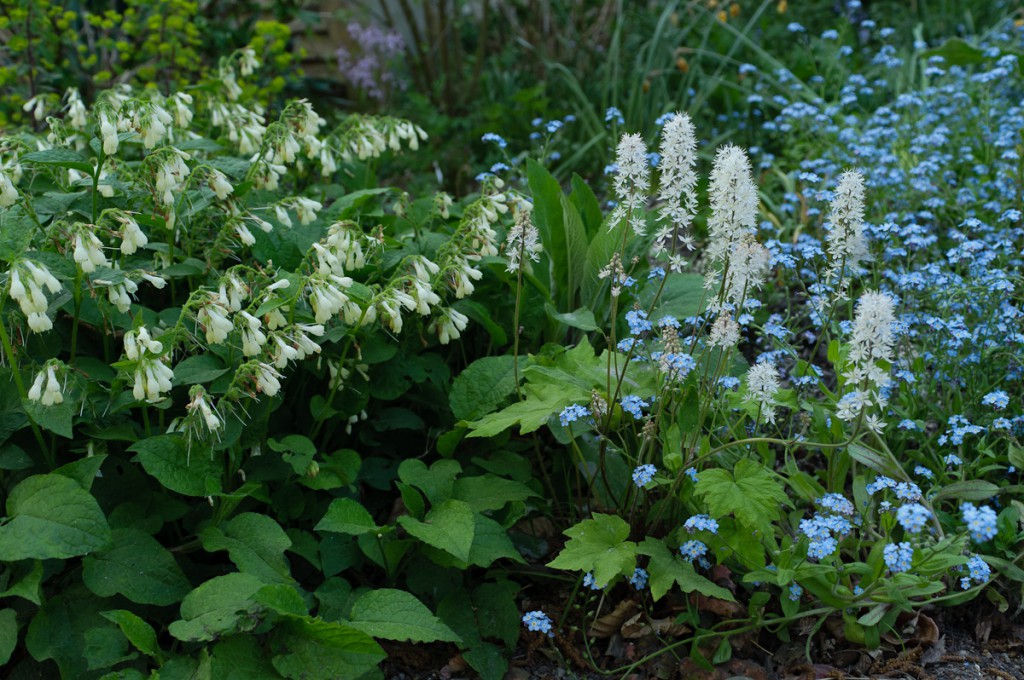
Tiarellas and large-flowered comfrey
While in winter, light and water penetrate at the base of trees, by early summer, the soil, colonised by roots, dries out and light only sporadically reaches it, a condition known as dry shade. Perennial plants have developed various strategies to thrive in these challenging conditions; Geranium macrorrhizum and large-flowered comfrey (Symphytum grandiflorum) anchor themselves in the soil with a few large roots, while their rhizomes spread out, exploring the surface and re-rooting whenever conditions are favourable. Acanthus mollis "vegetates" in summer and takes advantage of autumn and winter rains to flourish. The Podophyllum peltatum, on the other hand, boasts lush foliage in spring and enters dormancy in mid-summer when moisture becomes scarce.
In these challenging conditions, these plants will need water during the first year of planting to develop a robust root system. By the second year, they will require no further maintenance and will form beautiful carpets in the dry shade of trees.
Who has not noticed after several years of planting that the beneficial shade of the tree, once so small, became increasingly dense, while the nearby plants dwindled in favour of the tree in question? Tiarellas and large-flowered comfrey While in winter, light and water penetrate at the base of trees, by early summer, the soil, […]
Every year we search for the rare bulb that is hard to find, highly sought after, and will surprise you. Among the new offerings in our spring catalogue this year, we have uncovered some gems for you.
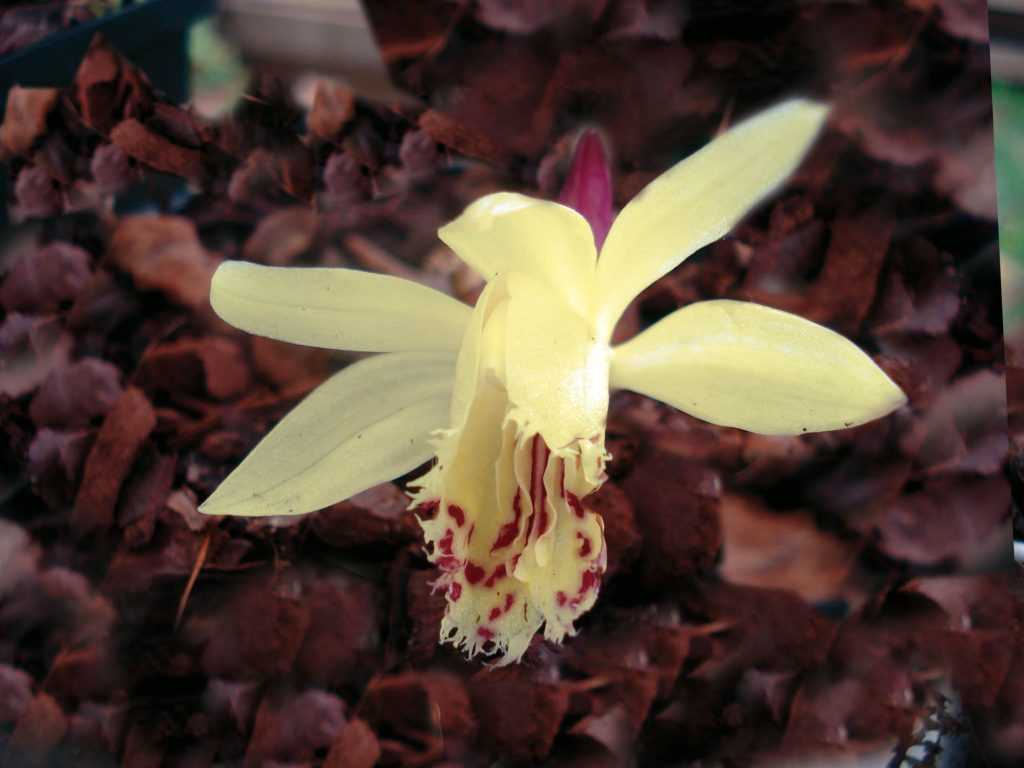 Pleione forrestii: The lemon-yellow flowers of this terrestrial orchid reveal a subtle spicy fragrance. Hardy down to -5°C, it can be grown in a pot or in a shady rockery, protected.
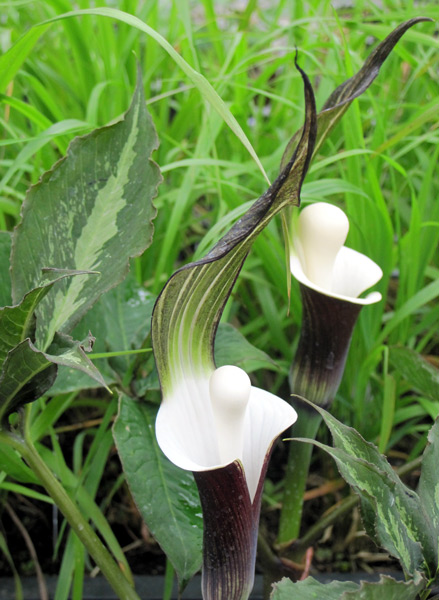 Arisaema sikokianum: This is the earliest species of the genus and undoubtedly one of the most graceful.
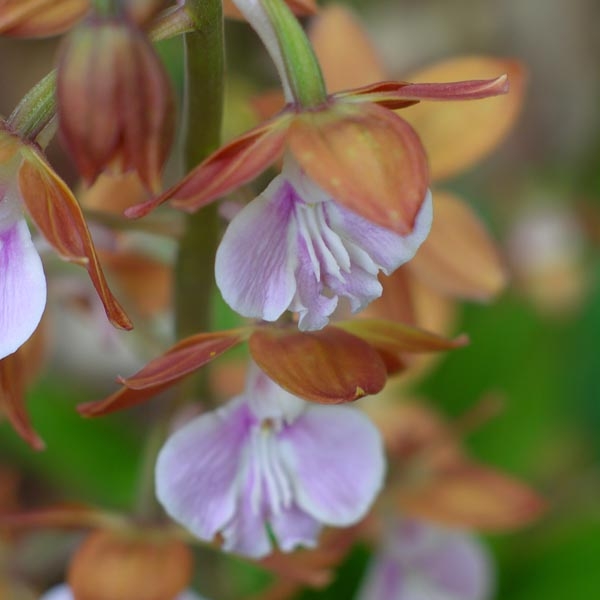 Calanthe discolor: Native to the Japanese mountains, this terrestrial orchid with evergreen foliage is quite hardy in our woodlands. It is hardy down to -12°C.
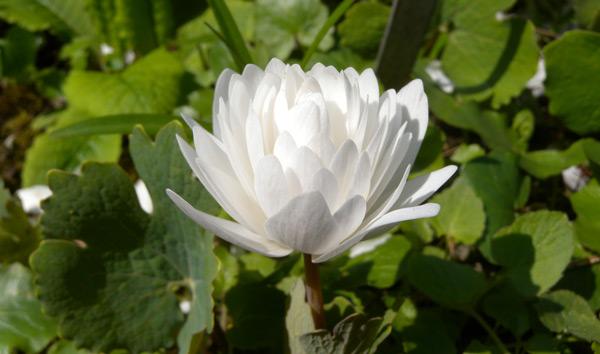 Sanguinaria canadensis Flore Pleno: This small perennial groundcover reveals magnificent double flowers of immaculate white. Its stump suckers in rich, cool, and light soils.
A rare plant is not always synonymous with "uncultivable plant"; rare bulbs are not necessarily the hardest to grow, they are rare due to their shape, cross-breeding, colour, fragrance... But all possess a touch of originality. They do not like excess: not too much shade, sun, wind, water, or dryness.
The ideal conditions for growing them long-term involve having light, cool soil rich in humus with a neutral or acidic tendency. They should ideally be planted in a shady rockery or in a bed facing north or west, against the wall of the house, with the soil amended with compost.
Rest assured, if you do not have these conditions, rare bulbs adapt very well to pot cultivation; in fact, the more tender varieties will be exclusively planted in pots. Just be careful not to overwater them during dormancy, as they do not tolerate excess water. A tip: when planting, place your bulb on a bed of 5cm of gravel or sand to ensure good drainage and promote longevity.
Every year we search for the rare bulb that is hard to find, highly sought after, and will surprise you. Among the new offerings in our spring catalogue this year, we have uncovered some gems for you. Pleione forrestii: The lemon-yellow flowers of this terrestrial orchid reveal a subtle spicy fragrance. Hardy down to -5°C, […]
Awarded at the Chelsea Flower Show, the prestigious English horticultural exhibition, the ‘Wild Swan’ anemone is a unique variety. Both graceful and robust, it captivates with its prolonged flowering and natural elegance.
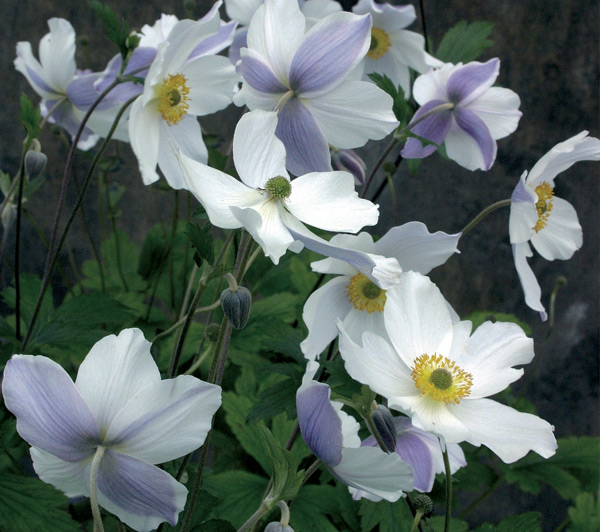
A long-lasting and refined flowering
Unlike classic Japanese anemones, which often have a limited summer or autumn flowering period, ‘Wild Swan’ offers a remarkable display from spring until early autumn. It stands out with its large, slightly satin white flowers that brighten up the garden.
But its true asset lies in a fascinating detail: when the flower closes at the end of the day or a breeze lifts its petals, beautiful purple stripes appear on their underside, adding an unparalleled touch of refinement. This subtle play of colours makes it a plant full of surprises, always changing throughout the hours.
An elegant silhouette and delicate foliage
The ‘Wild Swan’ anemone does not just have exceptional flowering. Its airy and natural habit makes it an ideal perennial for structuring borders. Its dark green, finely cut foliage provides a backdrop that highlights the delicacy of the flowers.
It reaches about 40 to 50 cm in height and spreads 50 cm wide, forming a beautiful, dense, and harmonious clump. Whether at the edge, in a border, or even in a pot on a terrace, it easily finds its place thanks to its balanced silhouette.
Where and how to Grow the ‘Wild Swan’ Anemone?
This anemone is valued for its hardiness and ease of maintenance. It adapts to many situations but expresses its full potential when grown under the right conditions.
Ideal Exposure
- It prefers a partially shaded position, where it receives light without being exposed to the scorching rays of the sun.
- It can also be planted in gentle sun, provided the soil remains cool.
Soil Type
- A rich, light, and well-drained soil is essential to avoid excess moisture that could weaken the plant.
- A humus-bearing and slightly acidic soil is ideal for promoting healthy growth.
Maintenance and Watering
- Water regularly in summer, especially during dry spells, but without overwatering to avoid saturating the roots.
- Remove faded flowers to encourage continuous blooming.
- A winter mulch can be beneficial in regions with very harsh winters.
Successful garden combinations
The ‘Wild Swan’ anemone is perfect for creating natural and romantic scenes. Here are some pairing ideas to showcase it:
- With light grasses (Stipa, Carex) for a contrast between softness and structure.
- With other shade perennials such as ferns, hostas, or heucheras for a fresh and green atmosphere.
- With English roses or astrantias for an English-inspired garden.
Why adopting the ‘Wild Swan’ Anemone?
With its elegant habit, long-lasting flowering, and subtle contrasts, the ‘Wild Swan’ anemone is an exceptional perennial that adds a sophisticated touch to the garden. Easy to grow, it appeals to both novice gardeners and enthusiasts. It offers a beautiful alternative to traditional Japanese anemones and integrates wonderfully into a harmonious composition.
Don't hesitate to adopt it in your garden to enjoy its unique charm season after season!
Further reading
- Discover our 5 favourite double-flowering Japanese anemone varieties
- And everything you need to know about Japanese anemones: planting, growing, and caring.
Awarded at the Chelsea Flower Show, the prestigious English horticultural exhibition, the ‘Wild Swan’ anemone is a unique variety. Both graceful and robust, it captivates with its prolonged flowering and natural elegance. A long-lasting and refined flowering Unlike classic Japanese anemones, which often have a limited summer or autumn flowering period, ‘Wild Swan’ offers a […]