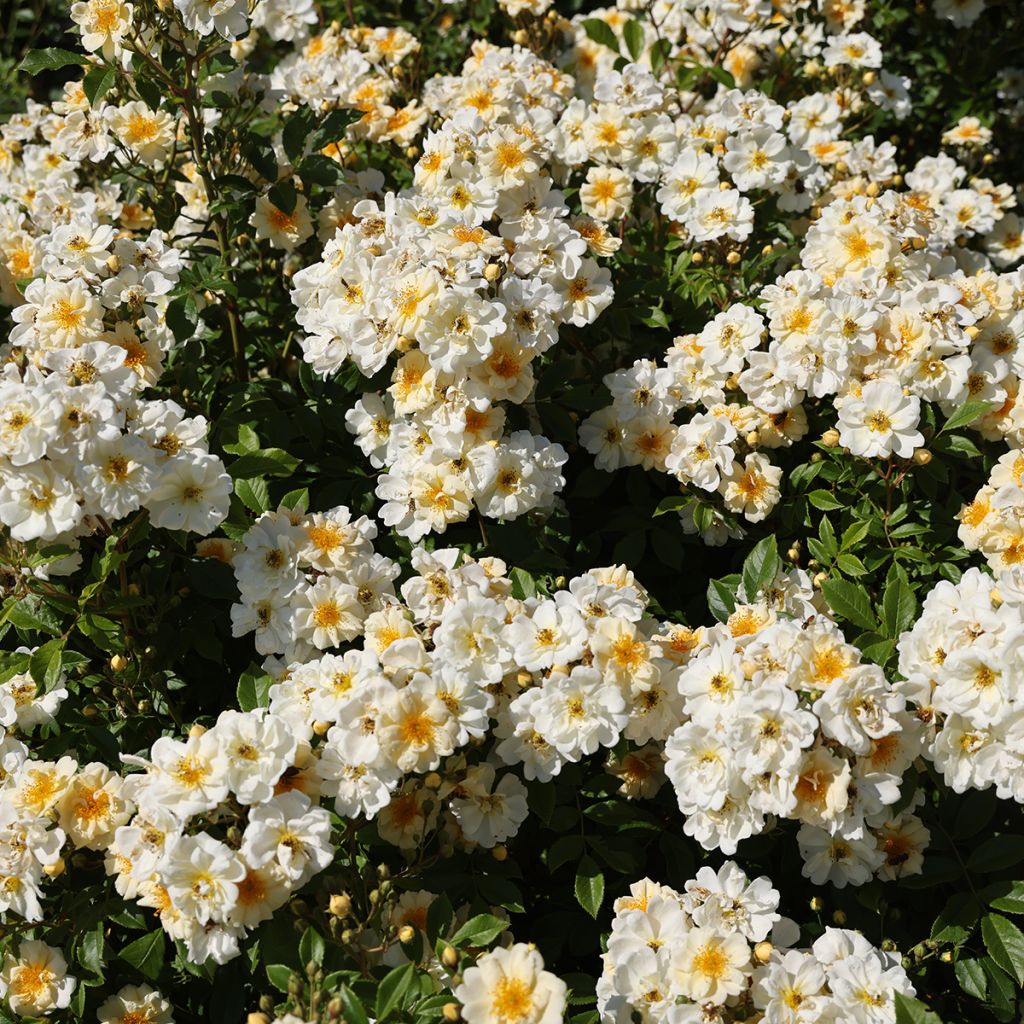
Rosa Goldfinch - Rambling rose
Rosa Goldfinch - Rambling rose
Rosa Goldfinch
Rambling Rose
Back-to-school special offer!
Get €10 off for every €50 you spend! And get up to €40 off on a single order.
How does it work?
1. Shop your favourites
Add your favourite plants to your basket. For every €50 you spend (excluding delivery charges, store credit and the plastic-free option), you’ll receive a €10 voucher.
€50 spent = €10 voucher
€100 spent = €20 voucher
€150 spent = €30 voucher
€200 spent = €40 voucher
2. Place your order
Once your basket reaches one of the spending thresholds, place your order. You can even choose your delivery date!
3. Receive your voucher
As soon as your order has been shipped, you’ll receive an email containing your personal voucher code and its value.
4. Use it on your next order
Your voucher is valid for 90 days from the date you receive it. It can be used once only, on a new order worth at least the value of the voucher, excluding delivery charges.
Please note: Vouchers can be combined with other offers, but cannot be split or refunded.
Why not try an alternative variety in stock?
View all →
Available in 2 sizes
Available in 2 sizes
Available in 2 sizes
Available in 2 sizes
Available in 2 sizes
Available in 3 sizes
Available in 3 sizes
Available in 3 sizes
Available in 2 sizes
Available in 2 sizes
This plant carries a 6 months recovery warranty
More information
We guarantee the quality of our plants for a full growing cycle, and will replace at our expense any plant that fails to recover under normal climatic and planting conditions.
Description
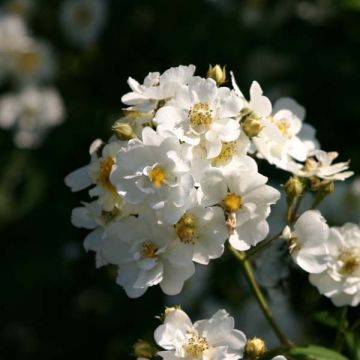
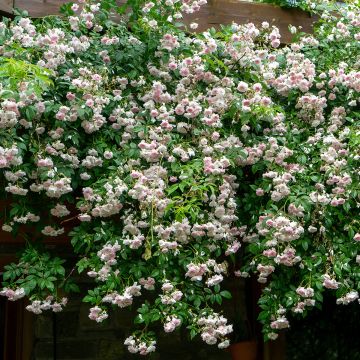
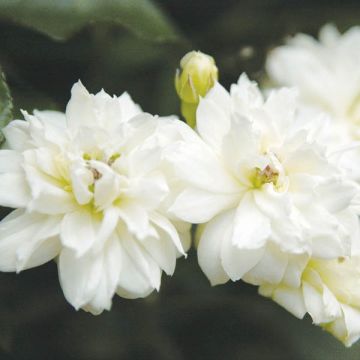
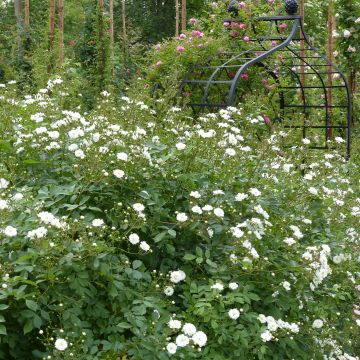
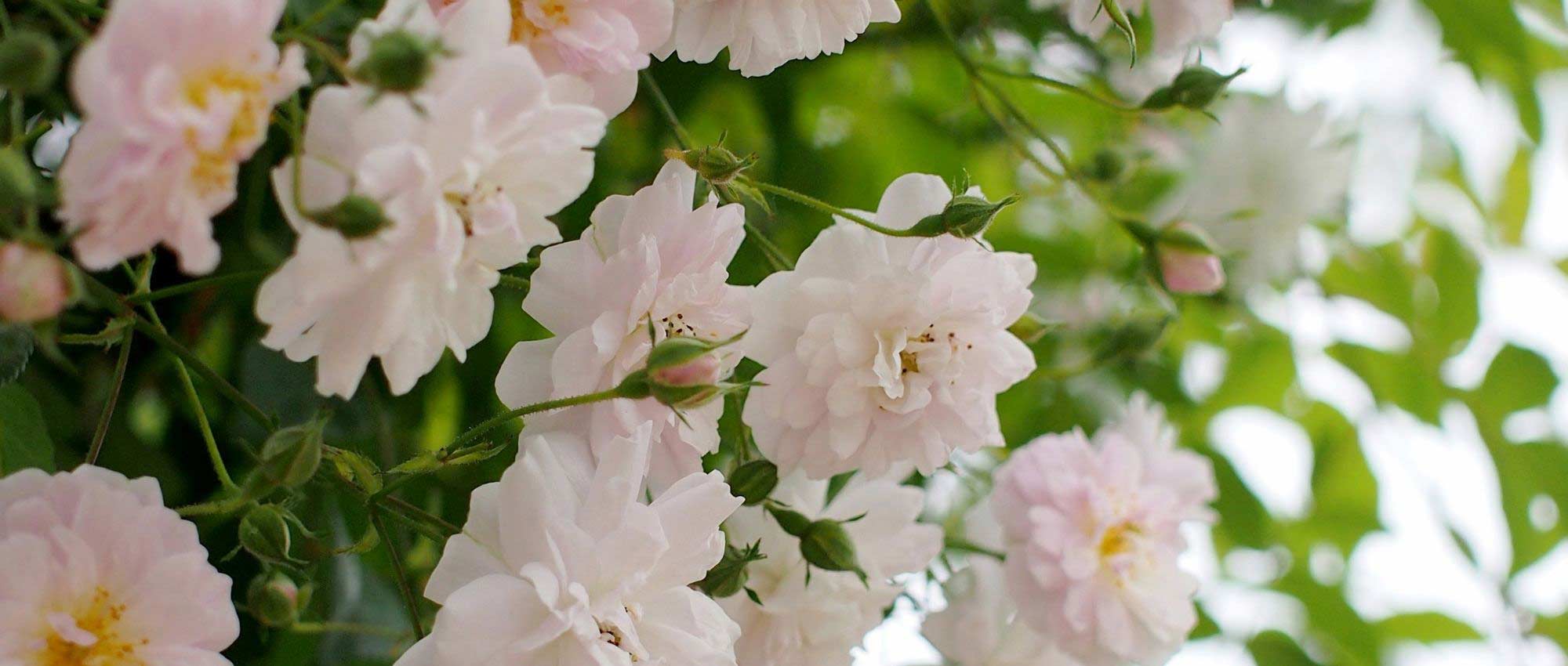
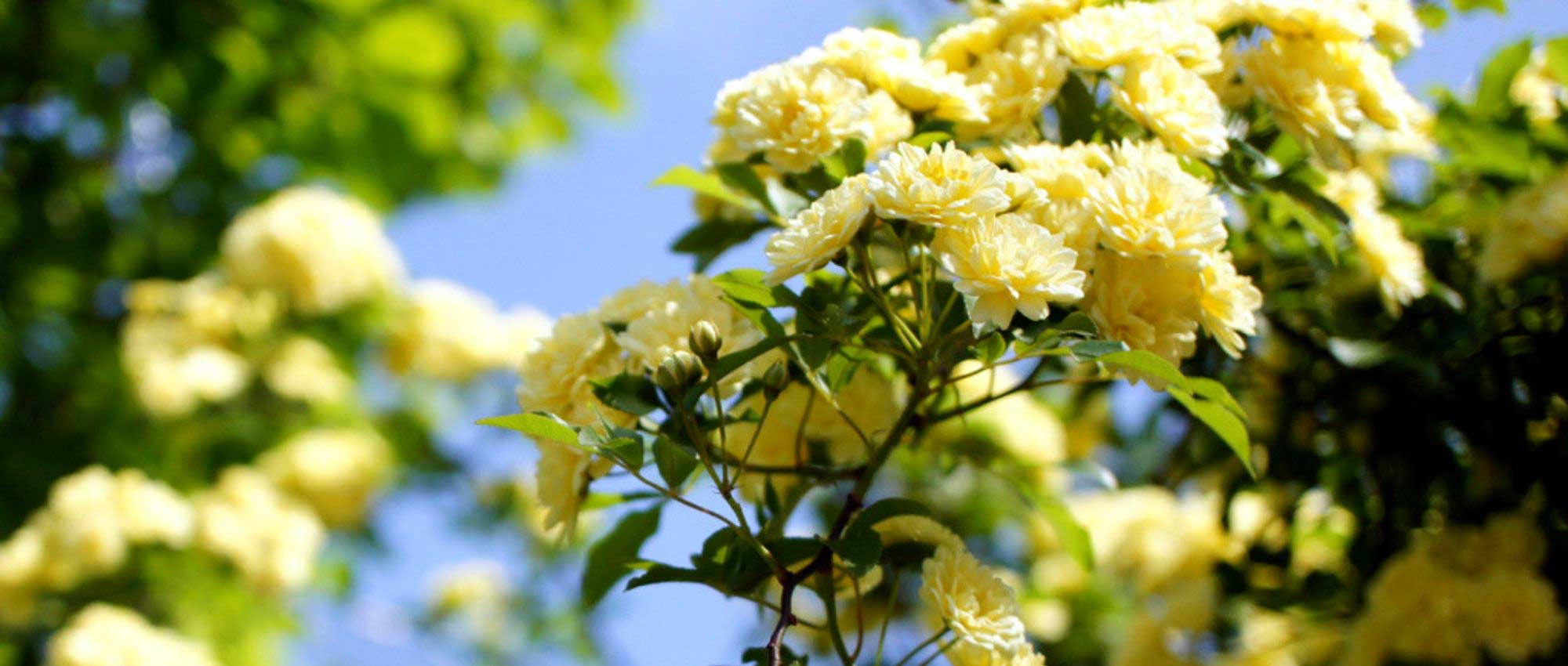
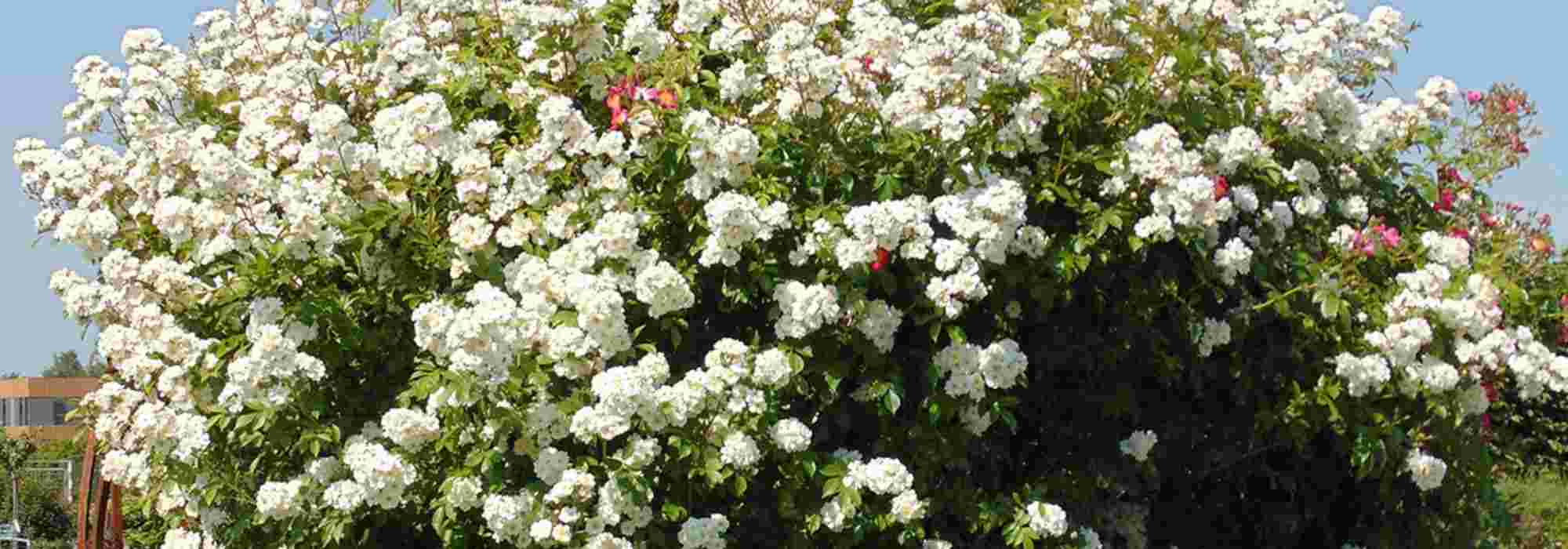
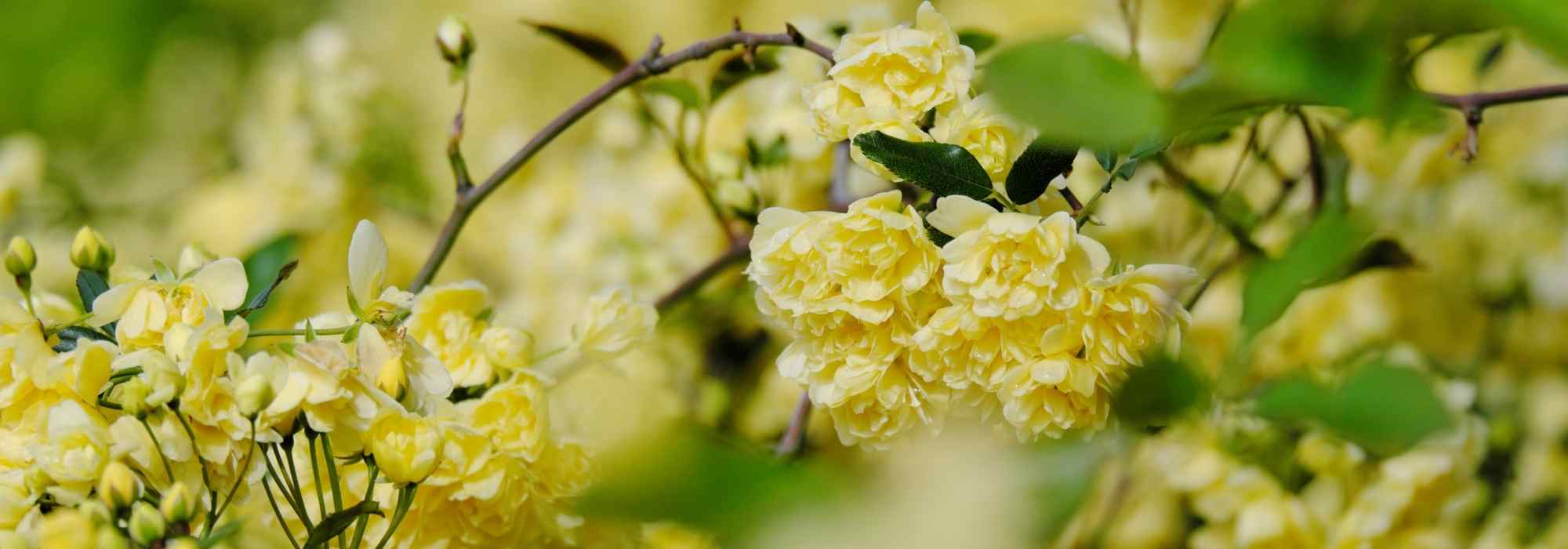
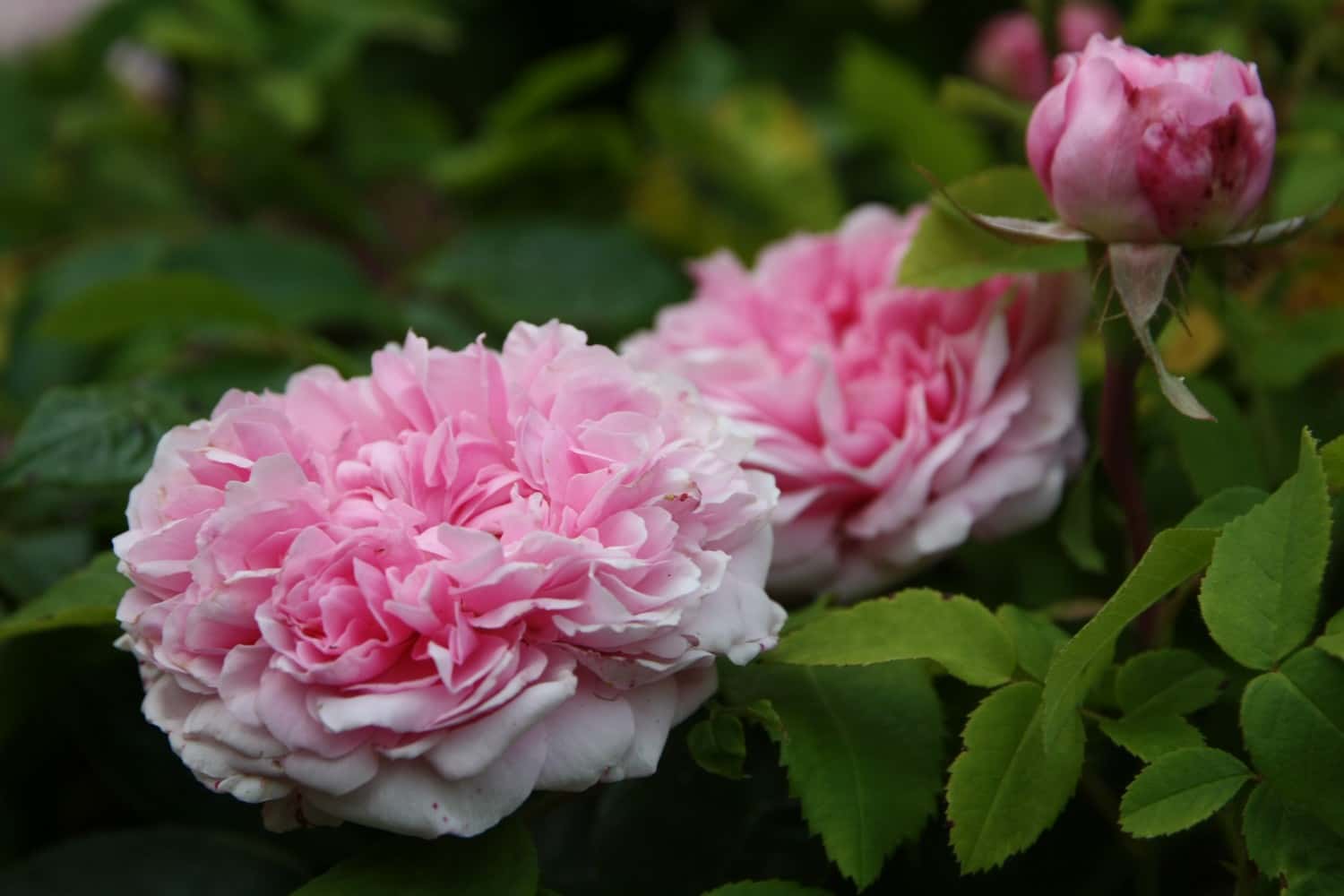
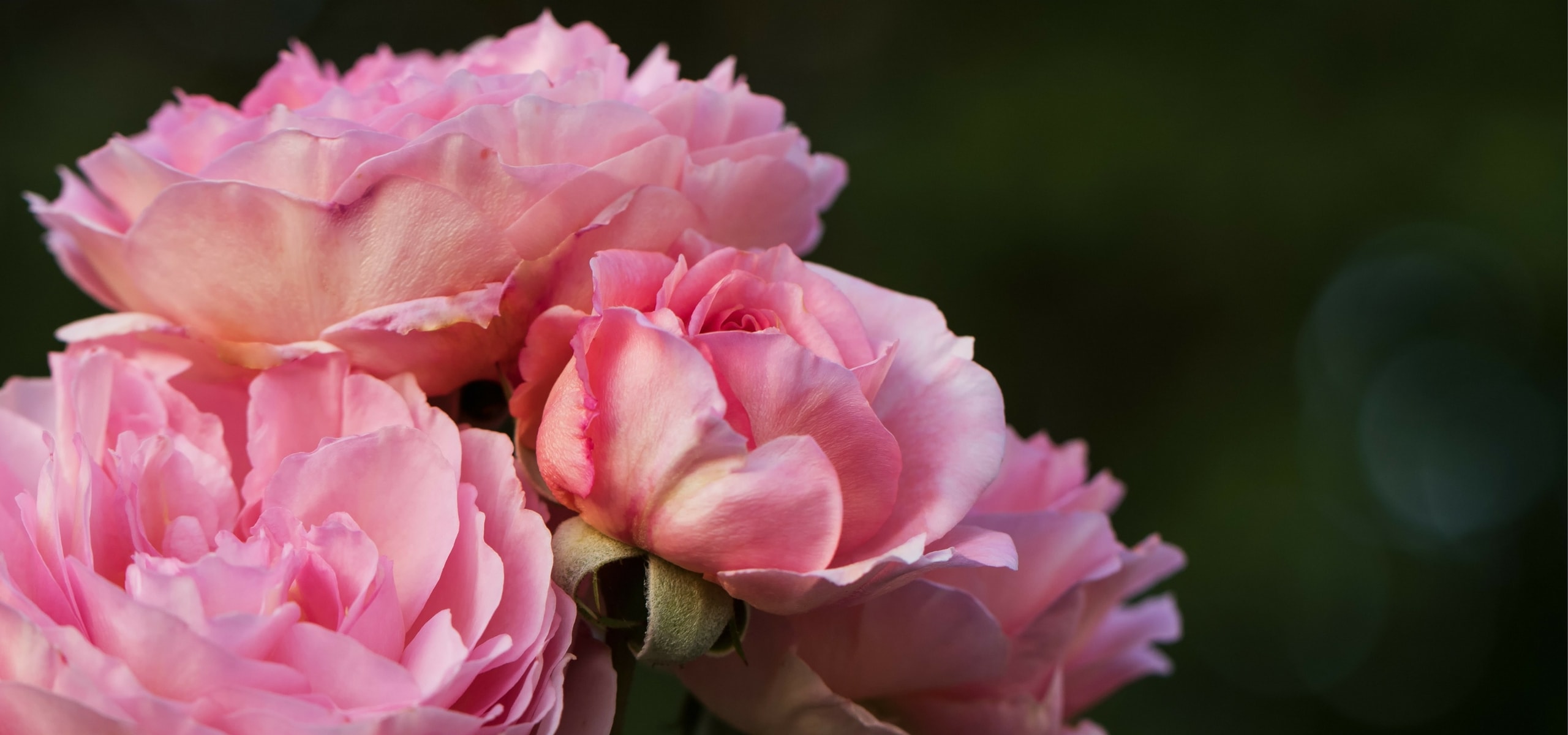
Rambling rose 'Goldfinch' bears captivating, large clusters of primrose-yellow flowers that quickly fade to creamy white. They bloom profusely in early summer against a very healthy, glossy foliage. With almost thornless stems, this old rose can adorn a pergola, a large arch, a sunny wall, or weave through a small tree. It can also be trained as a large bush in an English or romantic garden.
Rambling rose 'Goldfinch' belongs to the Rosaceae family and descends from Rosa multiflora; it is sometimes found under the horticultural name 'Goldfinch rambler'. It is a cultivar created in the United Kingdom by George Paul (son) and introduced in 1907, resulting from the cross-breeding of 'Hélène' (a R. multiflora hybrid obtained by Lambert in the late 19th century) with an unnamed seedling. The species, Rosa multiflora, is native to East Asia (Japan, Korea, China) where it colonises hedgerows, woodland edges, and hillsides; its species name, multiflora, means "many-flowered", alluding to the large floral clusters it passes on to its offspring.
Rosa 'Goldfinch' distinguishes itself by its creamy yellow colouring and its almost thornless stems. The plant has rapid growth, developing long, light green canes, turning greenish-brown with age, with a few short thorns. Its deciduous, glossy, medium to dark green foliage is formed of small, slightly crinkled leaflets. It reaches up to 3.50-4 m in height with good support, for a spread of 1.20 m to 2 m, depending on how it is trained. This rose renews its framework with vigorous basal shoots, but does not produce running suckers.
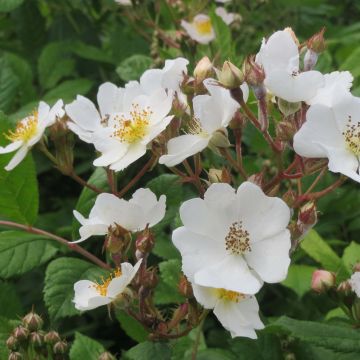
The flowering, which is not repeat, occurs from June to July in very large clusters of small, flat, semi-double corollas, 3 to 4 cm in diameter, with 9 to 16 petals. They are a soft yellow upon opening, quickly paling to cream or milky white, while the centre reveals clearly visible yellow stamens. The fruity fragrance is more or less perceptible depending on exposure and soil moisture. Small decorative hips may appear in late summer-autumn. This variety is hardy down to -15 °C.
Rambling rose 'Goldfinch', emblematic of Edwardian gardens, quickly travelled beyond the United Kingdom. Its cultivar name "Goldfinch" echoes the yellow of the flower buds and freshly opened corollas.
To showcase it, plant it where its long stems can be fanned out on a support: on a pergola, a double arch, or an east or southeast-facing façade. Its creamy yellow colouring pairs well with summer blooms in plum or purple tones. Let it climb with a clematis that flowers in July-August, for example Clematis viticella ‘Étoile Violette’ or ‘Madame Julia Correvon’. Nearby, plant a fragrant honeysuckle like Lonicera periclymenum ‘Serotina’ which perfumes the air at dusk. At ground level, plant hardy geranium ‘Rozanne’ or a lesser periwinkle 'Flower Power'. In a small tree (rowan, serviceberry), let it weave in a spiralled fashion; guide 5 to 7 main framework stems at a slight incline.
Plant habit
Flowering
Foliage
Botanical data
Rosa
Goldfinch
Rosaceae
Rambling Rose
Rosa 'Goldfinch' ( Paul ), Rosa 'Goldfinch' CLIMBING GOLDFINCH
Cultivar or hybrid
Planting and care
Rambling rose 'Goldfinch' adapts to ordinary, deep, well-worked soil, preferably rich in humus and properly drained. It flowers better in full sun but tolerates partial shade. Preferably plant in autumn (avoiding frost) or early spring in cold climates, water regularly during the first year to encourage rooting, and add a bucket of mature compost each late winter. Avoid excess nitrogen, which elongates stems at the expense of flowers. The hardiness of 'Goldfinch' is around -15°C: in case of severe frost, it will regrow from the base if the collar is healthy.
If you have space, you can let it develop freely; to train it as a large bush, guide 5 to 7 long canes onto a central support.
Planted at the foot of a living tree, 'Goldfinch' inevitably competes with the already established roots. To control watering during the first few months, a trick is to plant it in a large container with an open bottom, buried at the foot of the tree: the tree's roots will take time to colonise the rose's volume. After a year, remove this container (by splitting one side) without disturbing the root ball: the rose will have already explored the soil deeply and will be more self-sufficient.
Roses are often spotted or unsightly by late summer, but this is not a problem for their development. These spots are not dangerous for the rose; it is a natural phenomenon.
Planting period
Intended location
Care
Planting & care advice
-
-
-

-

-
-
-
-
This item has not been reviewed yet - be the first to leave a review about it.
Recently viewed products
Haven't found what you were looking for?
Hardiness is the lowest winter temperature a plant can endure without suffering serious damage or even dying. However, hardiness is affected by location (a sheltered area, such as a patio), protection (winter cover) and soil type (hardiness is improved by well-drained soil).

The flowering period indicated on our website applies to countries and regions located in USDA zone 8 (France, the United Kingdom, Ireland, the Netherlands, etc.)
It will vary according to where you live:- In zones 9 to 10 (Italy, Spain, Greece, etc.), flowering will occur about 2 to 4 weeks earlier.
- In zones 6 to 7 (Germany, Poland, Slovenia, and lower mountainous regions), flowering will be delayed by 2 to 3 weeks.
- In zone 5 (Central Europe, Scandinavia), blooming will be delayed by 3 to 5 weeks.
In temperate climates, pruning of spring-flowering shrubs (forsythia, spireas, etc.) should be done just after flowering.
Pruning of summer-flowering shrubs (Indian Lilac, Perovskia, etc.) can be done in winter or spring.
In cold regions as well as with frost-sensitive plants, avoid pruning too early when severe frosts may still occur.
The planting period indicated on our website applies to countries and regions located in USDA zone 8 (France, United Kingdom, Ireland, Netherlands).
It will vary according to where you live:
- In Mediterranean zones (Marseille, Madrid, Milan, etc.), autumn and winter are the best planting periods.
- In continental zones (Strasbourg, Munich, Vienna, etc.), delay planting by 2 to 3 weeks in spring and bring it forward by 2 to 4 weeks in autumn.
- In mountainous regions (the Alps, Pyrenees, Carpathians, etc.), it is best to plant in late spring (May-June) or late summer (August-September).
The harvesting period indicated on our website applies to countries and regions in USDA zone 8 (France, England, Ireland, the Netherlands).
In colder areas (Scandinavia, Poland, Austria...) fruit and vegetable harvests are likely to be delayed by 3-4 weeks.
In warmer areas (Italy, Spain, Greece, etc.), harvesting will probably take place earlier, depending on weather conditions.
The sowing periods indicated on our website apply to countries and regions within USDA Zone 8 (France, UK, Ireland, Netherlands).
In colder areas (Scandinavia, Poland, Austria...), delay any outdoor sowing by 3-4 weeks, or sow under glass.
In warmer climes (Italy, Spain, Greece, etc.), bring outdoor sowing forward by a few weeks.
Shipping country and language
Your country of residence may be:
Your country of residence is:
For a better user experience on our website, you can select:
Your shipping country:
-
 Austria
-
 Belgium
-
 Bosnia & Herzegovina
-
 Bulgaria
-
 Croatia
-
 Cyprus
-
 Czechia
-
 Denmark
-
 Estonia
-
 Finland
-
 France
-
 Germany
-
 Greece
-
 Hungary
-
 Iceland
-
 Ireland
-
 Italy
Italy
-
 Latvia
-
 Liechtenstein
-
 Lithuania
-
 Luxembourg
-
 Malta
Malta
-
 Netherlands
-
 Poland
-
 Portugal
-
 Romania
-
 Serbia
-
 Slovakia
-
 Slovenia
-
 Spain
Spain
-
 Sweden
-
 Switzerland
Language:
-
French
-
 English
-
Spanish
-
Italian
-
German
-
Portuguese
-
Dutch
-
Finnish
My Account
Hello
My wish lists
My cart
Log in / Register
Existing customer?
This form is protected by reCAPTCHA - the Google Privacy Policy and Terms of Service apply.
New customer?
Create an account to track your orders, access our customer service and, if you wish, make the most of our upcoming offers.