






























6 evergreen viburnums
Varieties that retain their leaves all year round, to grow in the garden or in pots
Contents
If the viburnums or Viburnum are so widespread and appreciated, it’s because they have many qualities. Easy to care for, generous during flowering, and rewarding us with generally very decorative foliage, they fit into all gardens.
While most varieties lose their leaves in autumn, others produce evergreen leaves, which remain in place throughout the year. These viburnums provide excellent privacy screens and add colour to the garden even during the cold season.
Here is our selection of 6 easy-to-pair evergreen viburnums.

Viburnum tinus ‘Purpureum’: a dense foliage beautifully tinted in spring
On no longer needs to introduce the famous laurel tin, which is very common in gardens. Here, we have chosen the variety ‘Purpureum’! It features beautiful evolving foliage, initially an original purple-bronze colour in spring. Over time, it gradually becomes greener. The elliptical leaves, pointed at the tip, have a leathery and slightly glossy texture. This evergreen foliage creates a lovely backdrop for the long flowering period. The pink flower buds emerge in autumn from November. They then open in late winter, between February and April, revealing small clusters of fragrant white-pink flowers. Decorative berries appear afterwards, delighting the birds.
This variety has a modest silhouette (approximately 1.75 m in height and 1 m in spread). This allows it to fit well in both gardens and pots, dressing up terraces and balconies in all seasons.
The reason the laurel tin is so widespread is that it is easy to cultivate and truly low-maintenance. It adapts to almost all exposures and soil types, even calcareous and very dry soils, while tolerating root competition. Quite hardy, it withstands temperatures down to -12 to -15°C and is relatively resistant to diseases.
Its dense foliage that remains in place all year makes it an excellent candidate for privacy hedges, whether free-form or trimmed. Its resistance to wind and salt spray makes it ideal for coastal gardens. To effectively shield yourself from prying eyes, pair it with other evergreen bushes, such as the Mexican orange blossom, which will take over the flowering, as well as photinia, whose colourful foliage will harmonise well with our viburnum. In regions with mild winters (not dropping below -5 to -10°C), also consider pittosporum and Griselinia or English spindle.

Viburnum tinus ‘Purpureum’
Viburnum davidii ‘Angustifolium’: an astonishing spreading habit
The Viburnum davidii ‘Angustifolium’ is particularly interesting for its low, spreading habit, wider than it is tall. It measures 80 cm in height with a minimum spread of 1.20 m, making it a very good groundcover. This viburnum will form a lovely cushion to brighten up even shaded areas. It can be grown in pots as well as in the ground.
The evergreen foliage consists of leathery, veined, glossy leaves, green at ripeness. They are tinged with red when they are young shoots. This foliage enhances the spring flowering, which occurs between April and May. Our viburnum then adorns itself with small white flowers gathered in clusters, quite discreet and slightly fragrant. They give way to very ornamental blue-black fruits (on female plants), which will remain in place at least until autumn.
Easy to grow and hardy down to about -15°C, it thrives in non-calcareous, consistently moist (not dry) soil. Our bush appreciates acidic substrates, allowing it to be paired with ericaceous plants. Offer it companions such as rhododendrons and azaleas, hydrangeas, and Japanese andromedas. To dress a rockery, pair it with saxifrages and dwarf conifers.
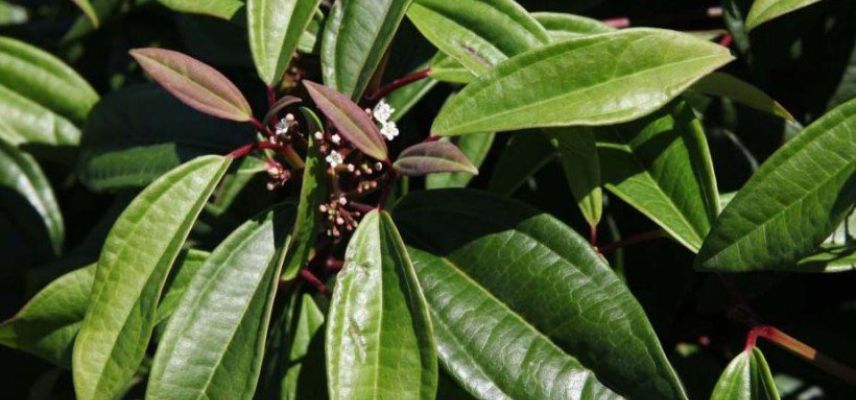
Viburnum davidii ‘Angustifolium’
Discover other Viburnum
View all →
Available in 3 sizes
Available in 3 sizes
Available in 2 sizes
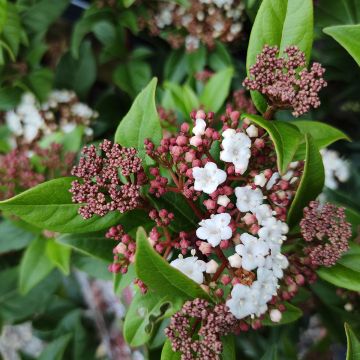
Available in 3 sizes
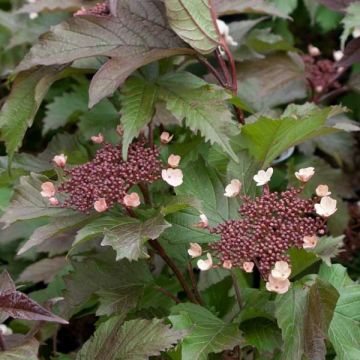
Available in 2 sizes
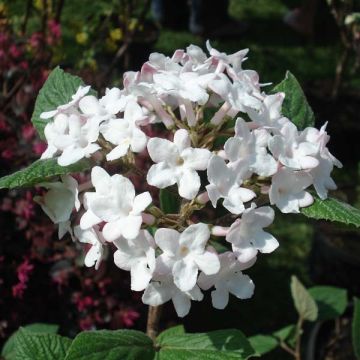
Available in 1 sizes
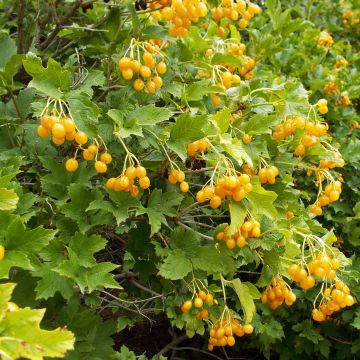
Available in 1 sizes
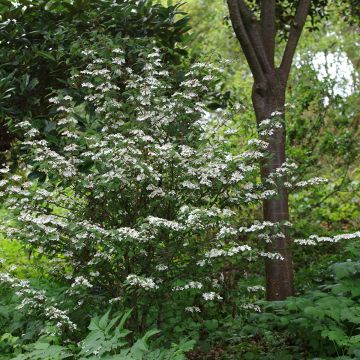
Available in 2 sizes
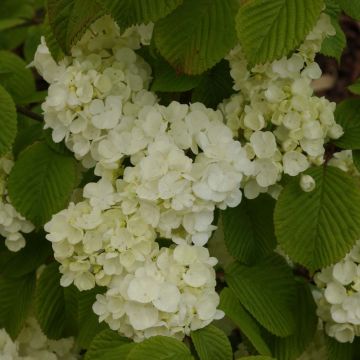
Available in 2 sizes
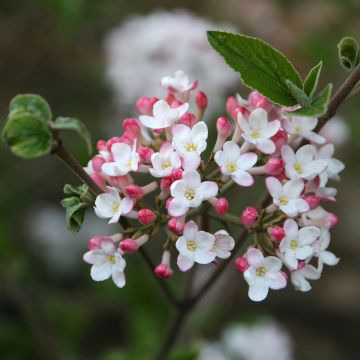
Available in 1 sizes
Viburnum rhytidophyllum: an impressive decorative silhouette all year round
The Viburnum rhytidophyllum or the wrinkled-leaf viburnum certainly stands out. Its beautiful bushy silhouette, reaching about 3 to 5 metres in all directions at ripeness, first catches the eye. But this viburnum also has the advantage of being ornamental all year round.
The foliage consists of crinkled and veined leaves, which are well trailing, measuring 15 to 20 cm long. They display a deep, glossy green, with a velvety matte grey underside. This year-round foliage beautifully highlights the flowering, which is, in contrast, very light. In spring, large flat corymbs of cream-white flowers, nearly 20 cm in diameter, appear. Small red and black fruits follow, delighting the birds.
This viburnum is valued for its rapid growth, ease of cultivation, great hardiness, and minimal maintenance. Provide it with a sunny or partially shaded location, in ordinary soil, even calcareous.
Grow this variety in isolation, or as a backdrop to a naturally charming hedge. Pair it with other flowering bushes such as spiraeas, dogwoods, mock oranges, or even physocarpus. They will all bloom in harmony with shades of pink or white, creating a stunning display.
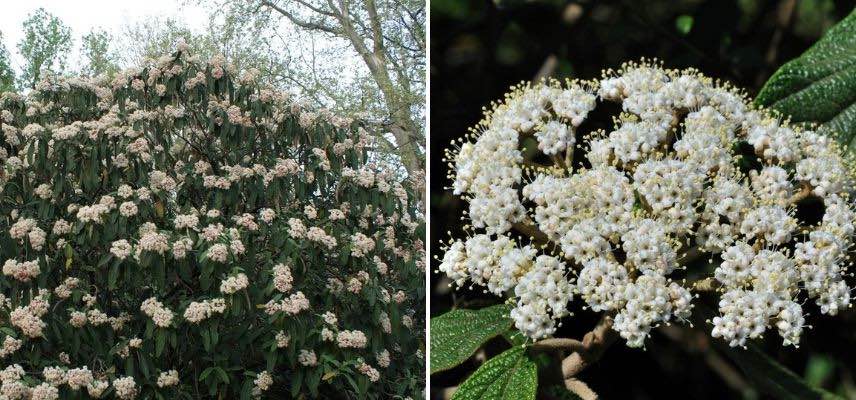
Viburnum rhytidophyllum
Read also
Viburnum: 8 successful pairing ideasViburnum odoratissimum: a fragrant variety with evolving foliage
Another evergreen viburnum: Viburnum odoratissimum or fragrant viburnum. Its particularity is to offer foliage that remains in place all year round, but still changes colour in autumn. The leaves are leathery and veined, initially green with a glossy appearance. From September to October, they then take on beautiful reddish hues, further enhancing their ornamental effect.
This variety flowers in spring between May and June, revealing a multitude of small cream-white flower clusters that are delicately scented. This flowering attracts many pollinating insects. Following this, small decorative berries appear which, like many of its relatives, will delight the garden birds.
At maturity, our fragrant viburnum will reach about 2 metres in all directions, offering an increasingly regular silhouette over time.
Tolerant of soil conditions and fairly drought-resistant once well established, it proves easy to care for. Its only drawback? A hardiness limited to around -6 to -9°C, which will require a location sheltered from cold winds.
In a mild coastal climate or protected behind a wall, pair this viburnum with a oleaster, a Japanese spindle, and a shiny viburnum, another evergreen variety that takes on reddish-purple hues in autumn.
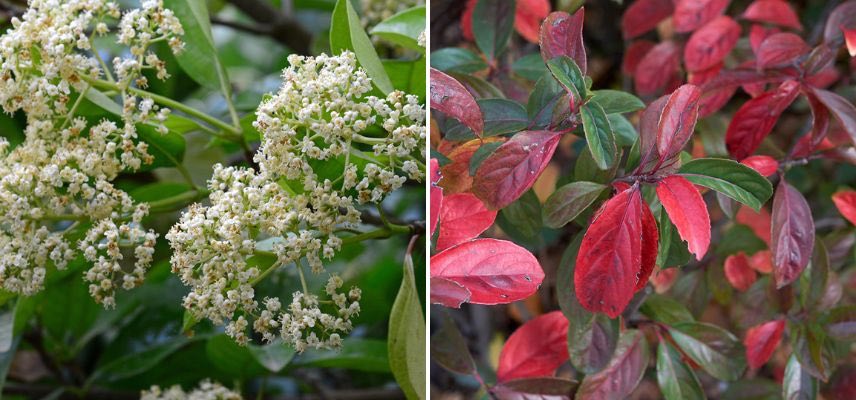
Viburnum odoratissimum
Viburnum pragense: an award-winning evergreen variety
The Prague viburnum (Viburnum pragense) is a descendant of the wrinkled-leaf viburnum, retaining its original textured and decorative foliage. The long, veined leaves have a crinkled appearance, displaying a glossy green on the top and a fluffy brown-grey underside.
Between May and June, the bush rewards us with lovely flattened inflorescences about 10 cm in diameter. The buds are initially pink before opening into cream-white flowers. As is often the case, the flowering gives way to small red berries that will feed the birds.
This shrub, reaching 2.5 m in all directions, has a bushy, slightly flattened silhouette. The branches are upright, but the trailing shoots give our viburnum a very soft overall appearance.
Like most viburnums, V. pragense is truly easy to grow, even for beginner gardeners. It only requires a rather sunny position in ordinary, even calcareous, soil. Just ensure that the substrate remains moist (does not dry out completely). For its qualities, this variety received an Award of Garden Merit in England in 1993.
The Prague viburnum can be accompanied by shrubs with bright foliage, such as the Viburnum tinus ‘Variegatum’ variegated with yellow and cream or the Cotoneaster horizontalis ‘Variegatus’. A star magnolia, a Japanese quince, and a lilac will precede the flowering in spring. And for a garden that evolves almost all year round, add a sarcococca and a sasanqua camellia, which will bloom in autumn-winter.
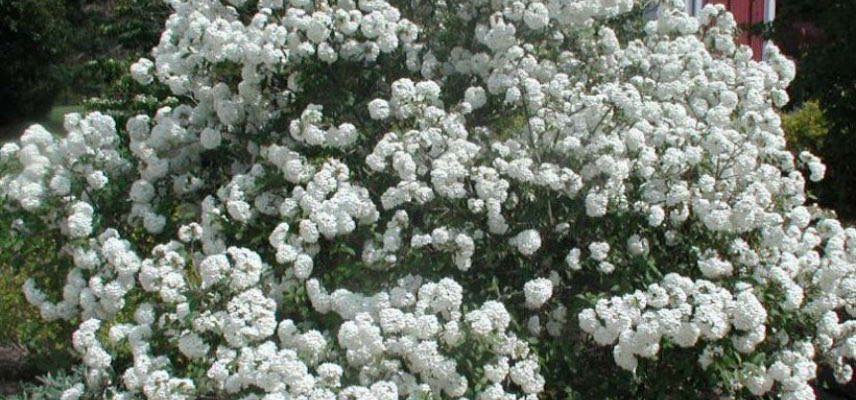
Viburnum pragense
Viburnum globosum ‘Jermyns Globe’: a bush with long flowering
The Viburnum globosum ‘Jermyns Globe’ is noteworthy for its flowering that lasts several months. It begins in spring around May, then renews irregularly throughout the summer, sometimes even continuing into early autumn. The cream-white flowers are grouped in soft, flat clusters, measuring about 5 cm in diameter. This is followed by decorative fruit that will provide interest at least until autumn. The blue-black fruits contrast beautifully with the red peduncles that bear them.
The evergreen foliage of this viburnum is, of course, another of its assets. The leaves are a deep, intense green, leathery, glossy, and veined. They can take on a purplish hue in cold weather, harmonising with their red petioles.
At maturity, this viburnum reaches just over 2 m in all directions, forming a lovely bush.
Our bush will acclimatise very easily to the garden. Its hardiness may be challenged in regions with harsh winters (it is sensitive to temperatures below -12 °C). Plant it in full sun or partial shade, in even calcareous soil.
The dark colour of its foliage beautifully highlights the colours of its neighbours. A weigela with its spring flowering and autumn foliage will be perfect to accompany it, as will a deutzia.
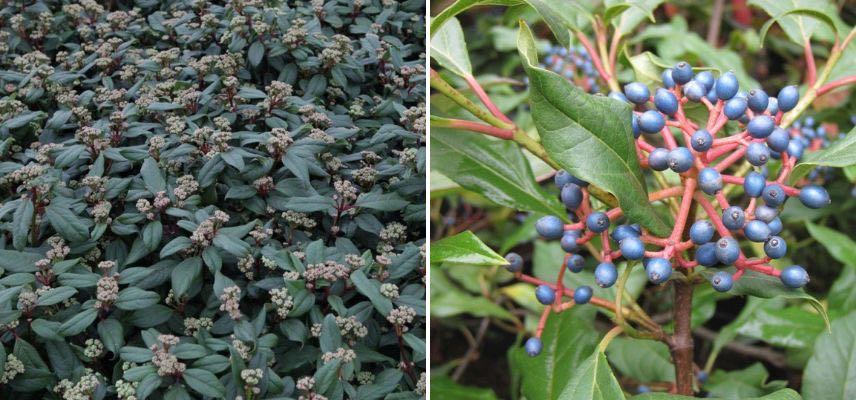
Viburnum globosum ‘Jermyns Globe’
- Subscribe!
- Contents
Comments