


7 perennials ideal to landscape a bank
Discover our selection
Contents
In the garden, banks are rather ungrateful spaces, challenging to landscape and maintain, but it is important to vegetate them to limit erosion caused by rainwater runoff, as well as for aesthetic reasons. This is why it is beneficial to cover the soil with perennial plants that are low-maintenance. For example, you can install groundcover shrubs (ceanothus, groundcover roses, cotoneasters…) or perennials, mainly carpeting types, by choosing sturdy and robust plants that require little maintenance and can withstand drought. Rock garden plants generally suit this purpose very well. Indeed, these species are perfectly adapted to cover a sloping bank, retain soil, and limit runoff, all while requiring minimal upkeep. We present to you 7 ideal perennial plants to meet these challenges!

Aubrieta
Aubrieta is a spreading perennial with evergreen foliage, producing a profusion of small purple flowers in spring, typically from April to June. There are also varieties with white, pink, red, or blue-mauve flowers. The flowers measure 1 to 2 cm in diameter and consist of 4 petals arranged in a cross around a yellow or white centre. Aubrieta forms carpets that do not exceed 15 cm in height. Its ability to spread quickly and withstand drought makes it an excellent choice for stabilising a sloping bank. Aubrieta thrives in full sun, in well-drained, rather light, poor, and stony soil. However, it prefers that the soil does not dry out too much in summer. Place it preferably towards the bottom of the slope rather than at the top, and pair it with hardy geraniums or wall campanulas.
Discover our complete guide on growing aubrieta
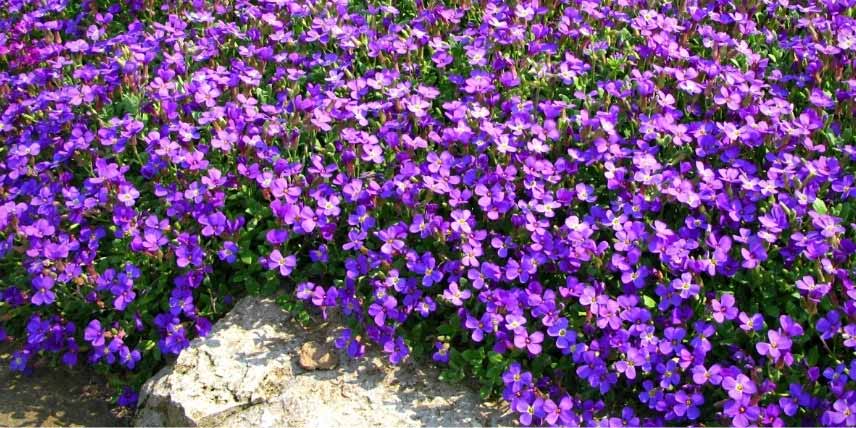
Aubrieta forms generous carpets of purple flowers
Sedum
Sedum, also known as stonecrop, is a particularly appreciated groundcover plant for its drought tolerance and ease of maintenance. It features fleshy leaves and typically produces lovely star-shaped flowers in white, pink, or yellow at the end of summer. There are numerous creeping species to choose from: for example, you can select Sedum spurium ‘Album Superbum’ or Sedum reflexum ‘Angelina’. Feel free to combine different varieties, especially since they offer variously coloured foliage: you can create patterns of spots or waves of colour. You might also choose Sedum spectabilis, which is distinguished by its upright habit and displays large, flattened inflorescences in pink tones at the top of its stems in autumn. Sedum also pairs well with ornamental grasses like Stipa tenuissima for a contrast of textures, as well as with Delospermas, houseleeks, and Euphorbia characias.
Discover our complete guide on growing Sedum
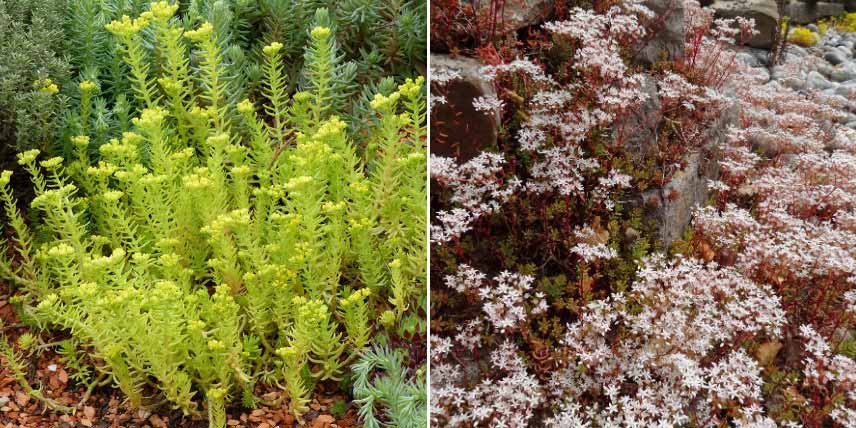
Sedum reflexum ‘Angelina’ and Sedum album
Phlox subulata
The Phlox subulata, also known as moss phlox, is a creeping perennial that brightens slopes in spring with its vibrant pink, white, or purple flowers. It literally becomes covered in star-shaped flowers with five petals. This creeping plant spreads quickly and can cover large areas in no time, helping to retain the soil. The Phlox subulata thrives in well-drained, rather dry soil, even calcareous. Pair it with other small rock garden plants, such as aubrietes, Arenaria montana, and Draba aizoides. Also consider blue fescues and stipas, which are ideal for adding a touch of graphic design and lightness.
To learn everything about Phlox, feel free to check our sheet: “Phlox: planting, growing, and care”
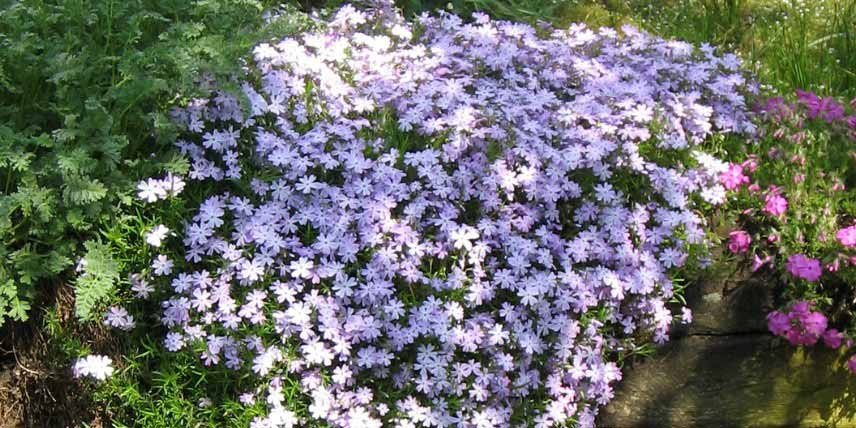
The abundant flowering of Phlox subulata ‘Emerald Cushion’
Vinca
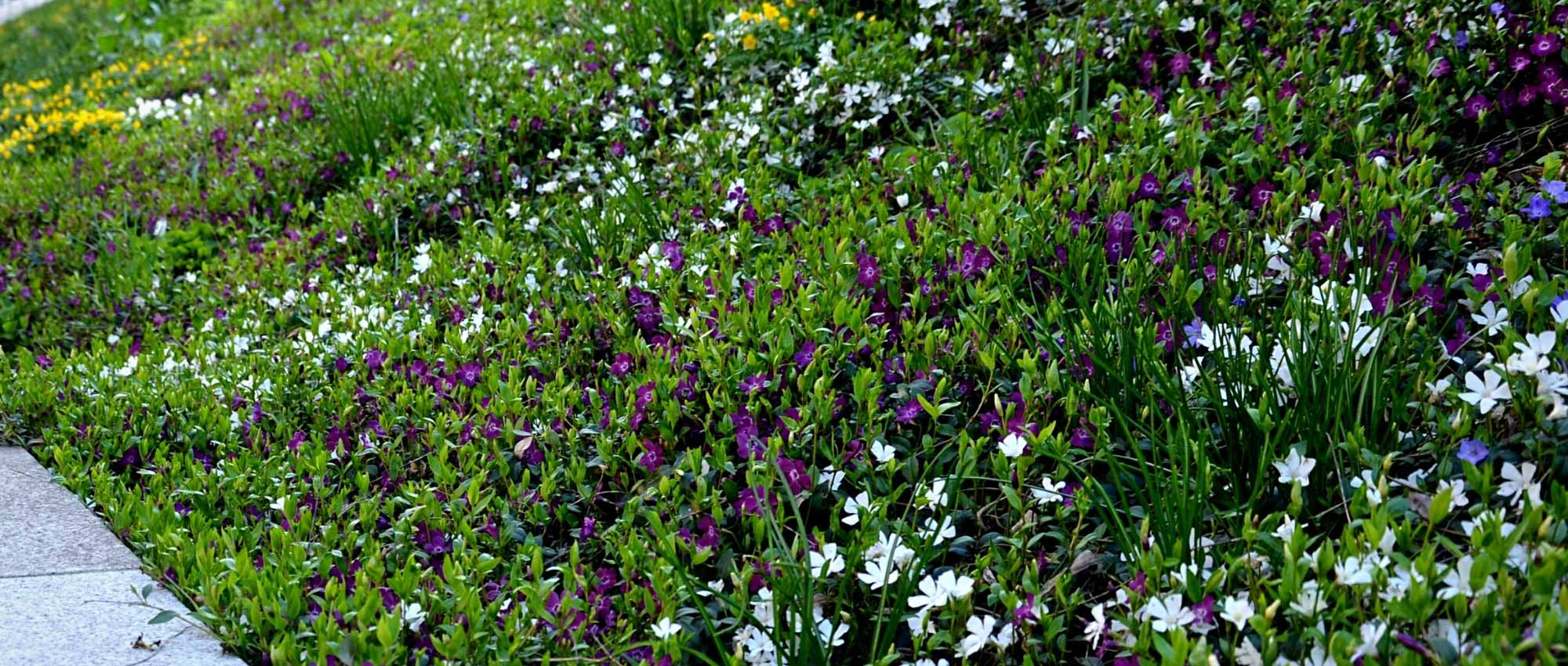
Periwinkle or Vinca is another groundcover plant known for its vigour and adaptability to various environments. It forms long creeping stems and grows quickly, making it easy to cover a slope. It features dark green evergreen foliage or variegated in some varieties, and produces delicate blue flowers in spring. There are also varieties with white or purple flowers. The small periwinkles (Vinca minor) do not exceed 15 cm in height, while the large periwinkles (Vinca major) can reach up to 30 cm tall. Periwinkles are ideal for dressing shaded slopes. You can pair it with evergreen ferns, variegated ivy, hostas, brunneras, and Solomon’s seals to create a very natural atmosphere.
Feel free to check our complete guide on growing periwinkle.
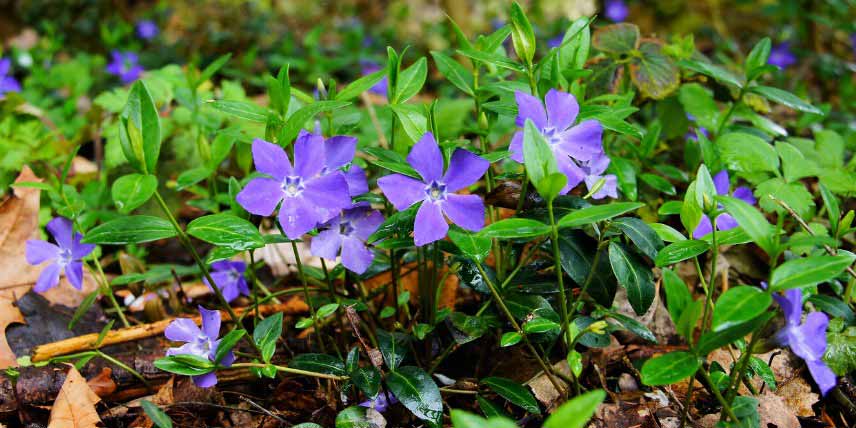
Small periwinkle, Vinca minor
The Eyelet Dianthus deltoides
Dianthus deltoides or delta pink is a charming little perennial that offers generous flowering from May to June, and sometimes until August if the soil is not too dry. Its star-shaped, bright pink flowers are ideal for adding a splash of colour to a bank. Very delicate, they consist of five fringed petals and are marked with a dark pink eye at the centre. This pink does not exceed 20 cm in height and bears medium green, soft, linear, evergreen leaves. Very hardy, it requires little maintenance and enjoys well-drained soils. Feel free to pair it with lavenders, santolines, and helianthemums.
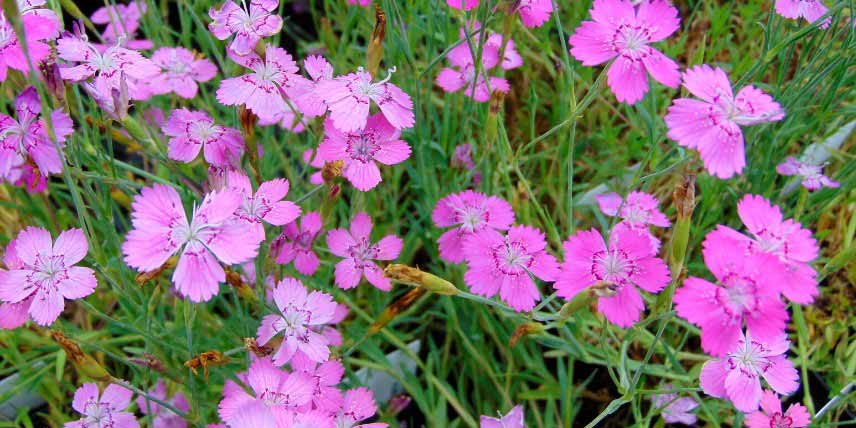
Delta pink Dianthus deltoides ‘Rosea’
Geranium macrorrhizum
The Geranium macrorrhizum is an excellent groundcover that features beautiful, palmately lobed, green and fuzzy leaves. It unfolds in spring above these delightful pink or white flowers depending on the variety. They consist of five petals and measure about 1.5 cm in diameter. It typically blooms from April to June, and may then sporadically re-bloom in summer if the soil is not too dry. This perennial geranium reaches a height of 30 to 40 cm when in flower. Its leaves take on red and bronze hues in autumn. Very resilient, it adapts to challenging conditions and grows well in dry shade. It gradually spreads through its long rootstocks, forming a dense groundcover that effectively suppresses weeds. Pair it with stachys, as well as heucheras and carex, to create lovely contrasts in foliage.
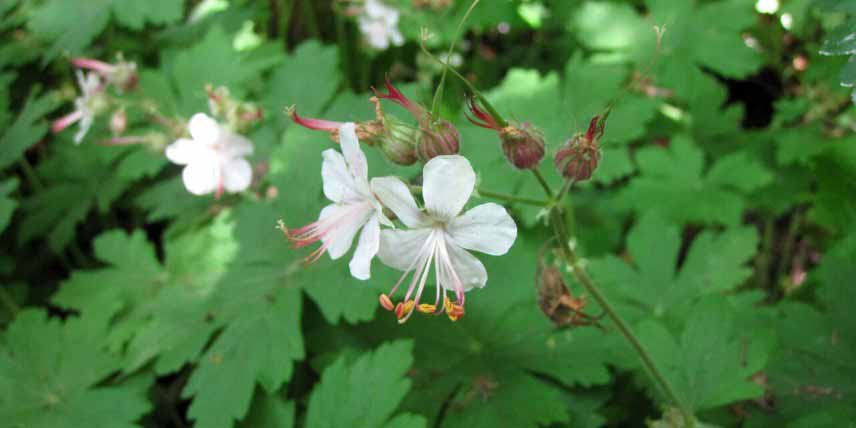
The Geranium macrorrhizum ‘Spessart’
Cerastium tomentosum
Cerastium or Mouse Ear forms delightful carpets of silvery, downy foliage, dense and evergreen. From May to July, it is covered in countless small white flowers. It typically measures between 10 and 20 cm in height. This vigorous plant, capable of quickly covering a slope, is also drought-resistant. It thrives in full sun, in any well-drained soil, even poor and calcareous. Cerastium will pair wonderfully with cistus, aubrietes, red valerian, and lavender.
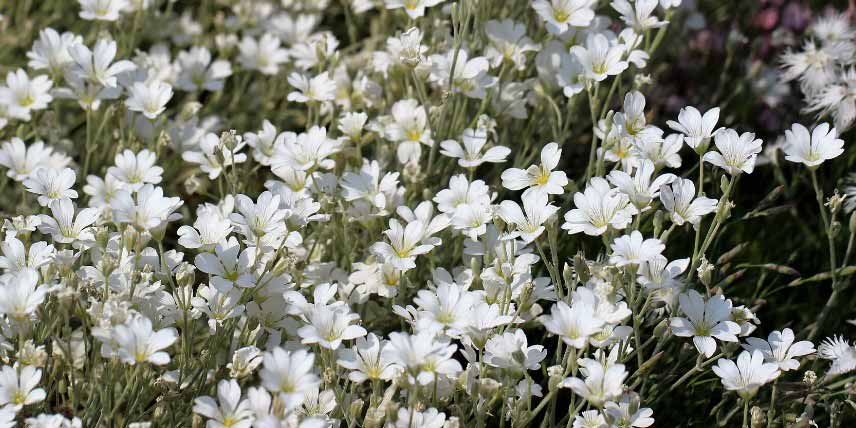
Cerastium tomentosum offers a multitude of star-shaped white flowers
And also...
Many other perennials can easily be used to cover a bank: you can choose creeping bugles (Ajuga reptans), Turkish bindweed (Convolvulus cneorum), daylilies hémérocalles, iberis, Euphorbia characias, helianthemums, delosperma, erigerons, wall campanulas (Campanula portenschlagiana), stachys, gauras, or grasses such as Stipa tenuifolia.
- Subscribe!
- Contents

Comments