





























Pairing ideas with convolvulus
6 companion planting ideas for this bindweed
Contents
The convolvulus, known for its long flowering period from May to October, is a tender plant, perennial or annual depending on the species. The Convolvulus cneorum or Turkish bindweed is hardier than some species. This silver bindweed with trumpet-shaped flowers reminiscent of petunias or ipomoeas can be grown in the ground in our regions with a mild climate. In contrast, the Mauritanian bindweed (Convolvulus sabatius) and the morning glory (Convolvulus tricolor) are generally used as annual plants. The convolvulus originates from the Mediterranean region. It grows easily in sunny exposure, in well-drained, stony or sandy soil. It is perfect for dry gardens, rockeries, and Mediterranean-style gardens, but also finds its place in a naturalistic garden, on a wall, or even in a pot on the terrace. Discover our most beautiful ideas and inspirations for incorporating it into your garden.
⇒ Also check out our guide to learn everything about Convolvulus, Turkish bindweed: sowing, planting, and care

In a romantic garden
The soft hues of convolvulus are ideal for a romantic plant display. For instance, you can choose creeping species to place in the foreground: Convolvulus althaeoides with light pink flowers or Convolvulus sabatius with mauve flowers. More bushy, the Convolvulus cneorum with white flowers and silver foliage can be placed further back. For a lovely light effect, consider the airy flowering of gypsophila (Gypsophila (x) paniculata ‘Festival Pink’, Gypsophila (x) paniculata ‘Rosenschleier’).
Roses are essential in this style of garden. Opt for fragrant roses such as the old rose ‘Roseraie de l’Haÿ’ with a sweet scent of honey and clove, the David Austin English rose ‘Boscobel’ with a powerful floral and fruity fragrance, or the modern Generosa rose ‘Chantal Mérieux’ with notes of rose, raspberry, myrrh, anise, and cider.
At the heart of the bed, the rose hyssop mingles with pennisetum ‘Karley Rose’ featuring silky purple-pink inflorescences. Reminiscent of gaura, the fraxinelle beautifully complements the upright green-blue and cream stems of Euphorbia characias ‘Glacier Blue’. For a touch of originality, plant a white lavender (Lavandula intermedia ‘Edelweiss’) whose white spikes brighten the display. Also consider the garden iris which is drought-resistant and comes in a wide range of colours. The large variety ‘Carl and Sissy’ for example reveals beautiful bicoloured flowers. Finally, when it comes to shrubs, some varieties of hibiscus display stunning double or semi-double flowers in summer: Hibiscus syriacus ‘Pink Chiffon’, Hibiscus syriacus ‘Purple Ruffles’, or Hibiscus syriacus ‘Lady Stanley’. You can pair them with Siberian sage ‘Blue Spire’ with its aromatic greyish foliage and lavender-blue inflorescences.
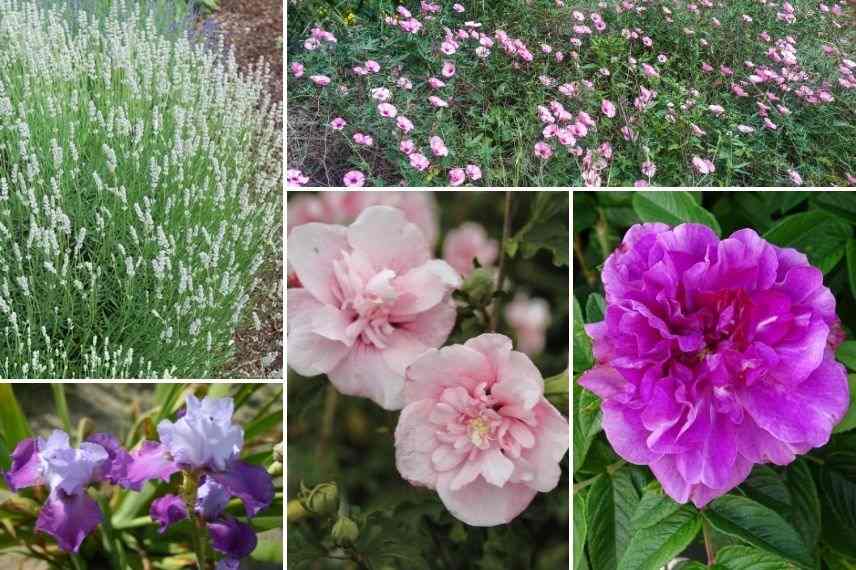
Lavandula angustifolia ‘Edelweiss’, Convolvulus althaeoides, Iris ‘Carl and Sissy’, Hibiscus syriacus ‘Pink Chiffon’ and Rose ‘Roseraie de l’Haÿ’
In a Mediterranean garden
Appreciating rather arid environments, convolvulus finds its perfect place in a Mediterranean-style garden. This bindweed grows effortlessly in well-drained, sandy soils. In full sun, the pastel blue flowers of the Convolvulus sabatius ‘Morrocan Beauty’ add brightness to this dry setting. Reaching no more than 30 cm in height and 60 cm in spread, plant it at the edge of a border so it isn’t hidden by other plants. A hardy ice plant can be placed alongside it. Pair the Mauritanian bindweed ‘Morrocan Beauty’ with fragrant plants, such as thyme, lavender, or nepeta. Their blooms in shades of pink to mauve can create a beautiful contrast with the yellow inflorescences of the rosemary-leaved santolina or the everlasting flower from Italy (the variety ‘Korma’, for example). These are very drought-resistant aromatic plants.
Consider upright plants that add verticality such as Sea Holly (Eryngium maritimum) or agapanthus. Don’t forget the shrubs and climbing plants typical of the Mediterranean coast: cistus, oleander, strawberry tree, and bougainvillea. For a touch of exoticism, opt for palms, such as the famous Chamaerops humilis or succulent plants, like agaves (the very large and graphic Agave americana ‘Variegata’ in green and yellow for the background) or prickly opuntias (for example, the small Opuntia microdasys with its numerous pads).
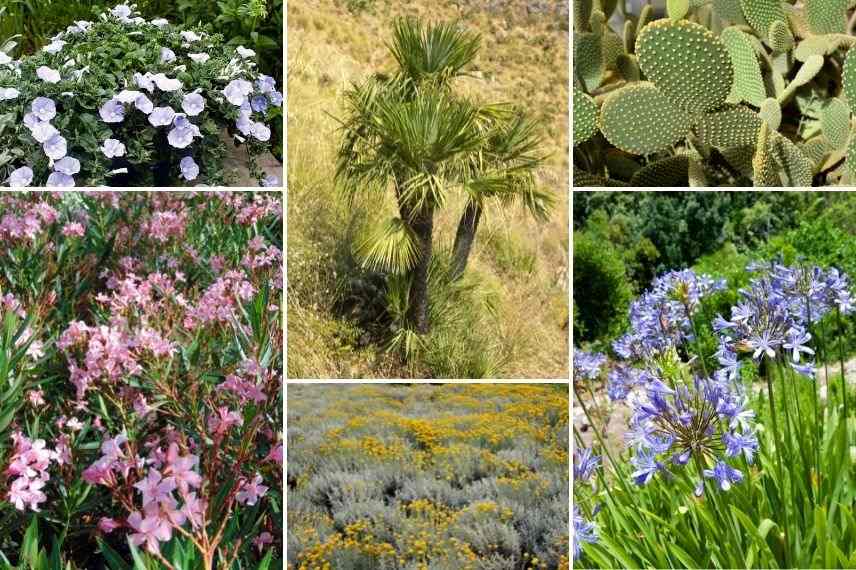
Convolvulus ‘Morrocan Beauty’, Chamaerops humilis, Opuntia microdasys, Nerium oleander ‘Emilie’, Helichrysum italicum, and blue-flowered agapanthus
Discover other Convolvulus
View all →
Available in 1 sizes
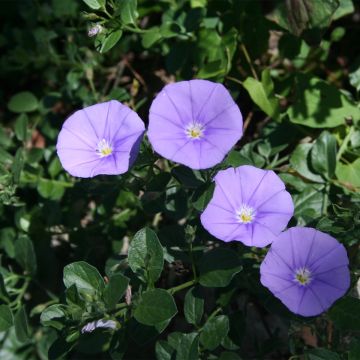
Available in 1 sizes
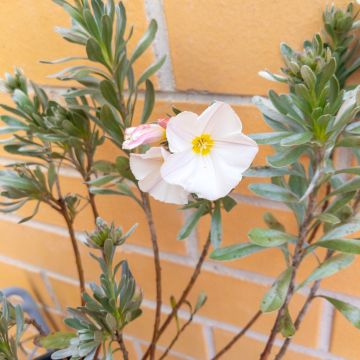
Available in 3 sizes
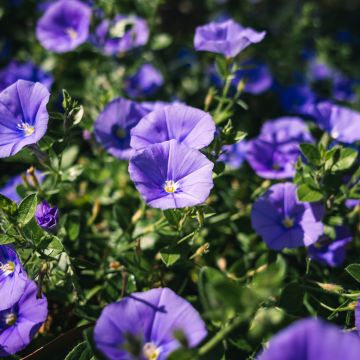
Available in 1 sizes
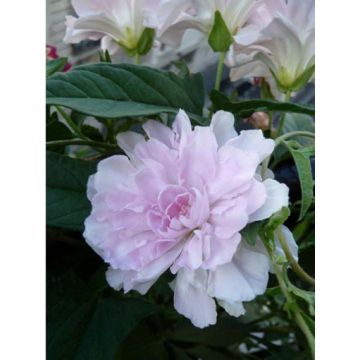
Available in 1 sizes
Available in 1 sizes
In a naturalistic garden with colourful flowering
Thanks to its shrubby habit, Convolvulus cneorum, also known as Silver Bindweed, easily integrates into a natural scene. At the front of the scene, the Erigeron leiomerus with its creeping habit spreads to border the bed alongside our silver bindweed. To highlight its white trumpet-shaped flowering, pair it with sun-loving, drought-resistant plants that require little maintenance.
The sage Salvia nemorosa ‘Caradonna’, showcasing magnificent purple flower spikes, is very resilient. In this cottage garden, plant warm-hued yarrow: Achillea millefolium ‘Walter Funcke’ with its reddish-orange flower clusters and Achillea millefolium ‘Terracotta’ with its yellow-orange corymbs. These can be accompanied by catananche, which offers summer flowering in lavender-blue capitula and self-seeds naturally for the delight of gardeners. At the back of the garden, the hybrid penstemon ‘Raven’ sends up its flower spikes tinted with an intense purple hue alongside the airy Buenos Aires verbena. Incorporate some grasses, such as Calamagrostis acutiflora ‘Waldenbuch’ or Stipa ichu, whose light foliage and feathery inflorescences will undulate in the wind. Much smaller, the summer spikelets of the wild but charming Briza media are also welcome in this natural setting.
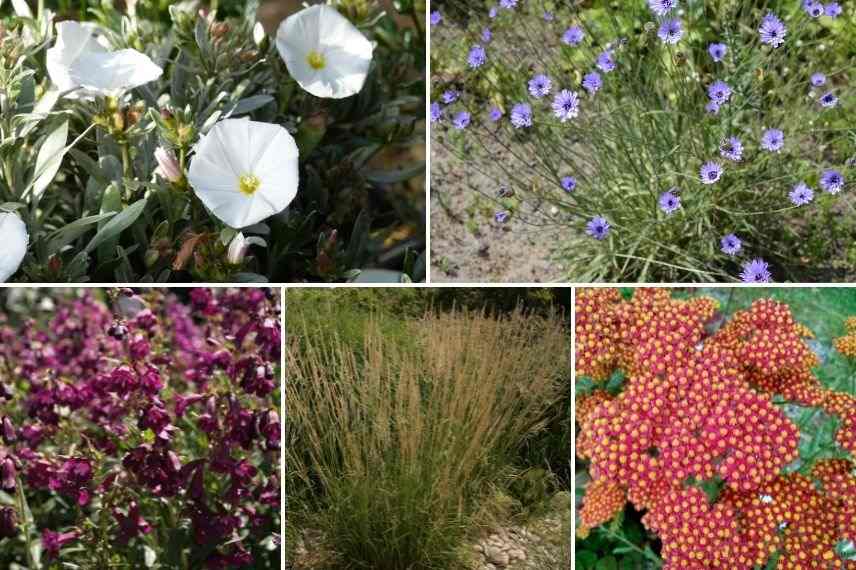
Convolvulus cneorum, Catananche caerulea, Penstemon ‘Raven’, Calamagrostis acutiflora ‘Waldenbuch’ and Achillea millefolium ‘Walter Funcke’
Read also
5 perennials for dry groundIn a dry rockery
You can integrate convolvulus into a sunny rockery or mineral garden. For example, combine the Mauritanian bindweed (Convolvulus sabatius) which thrives in poor, dry, and stony soils with flowering perennials that flourish effortlessly in such environments, like iberis, moss phlox, and carnation. For instance, Phlox subulata ‘Candy Stripes’ blooms from April to June. This small cushion is then topped with a multitude of bicoloured candy-pink flowers edged in white. Next, the rare Dianthus knappii bears delicate light yellow flowers all summer long. The helianthemum is also a good companion for this dry soil arrangement. Meaning “sun flower”, this perennial forms a very floriferous dwarf bush whose flower colours blend well with our mauve bindweed.
Incorporate some small creeping succulents, such as sedums and houseleeks that colonise the crevices of rocks. Less hardy, the prostrate antimima and Crassula exilis ssp Sedifolia are excellent groundcovers, but should be reserved for gardens in mild climates. Finally, small grasses add volume to the overall arrangement with their tuft of linear foliage: Stipa tenuifolia (or “angel’s hair”) with its fine leaves, blue oat grass, or a carex with variegated foliage.
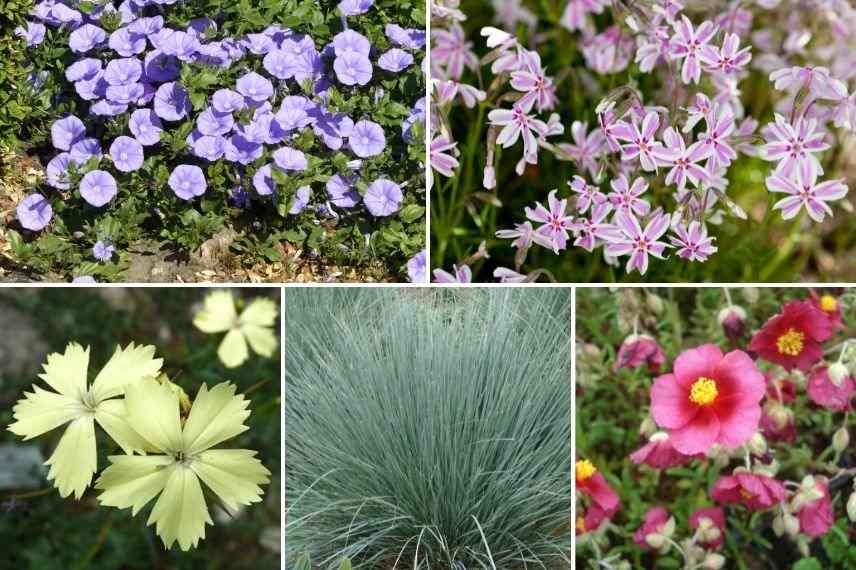
Convolvulus sabatius, Phlox subulata ‘Candy Stripes’, Dianthus knappii, Helictotrichon sempervirens (photo Declangi) and Helianthemum ‘Hartswood Ruby’
To dress a wall
Convolvulus is perfect for flowering a wall in a sunny position. The Mauritanian bindweed is naturally wider than it is tall, allowing it to form dense, flowering cushions that cascade down. Plant it at the top of a wall alongside sun-loving perennials. Arabis, aubrieta, and campanula are excellent for covering a wall. Indeed, they form dense and very floriferous carpets, producing flowers in mauve, pink, or white shades in spring or summer. You can accompany your bindweed with a plant featuring silvery-grey foliage, such as Artemisia schmidtiana ‘Nana’ or Cerastium tomentosum ‘Yo Yo’ (or mouse ear), both not fearing poor soils and drought. In a sunny, dry setting, Erinus alpinus ‘Dr Hähnle’ fills empty spaces by producing a compact, low tuft covered in small, single pink flowers from June to July. A hardy geranium can also adorn the wall while withstanding summer drought.
If space allows, you can plant larger plants in the ground at the back of your wall: garden valerian, daisy (Leucanthemum), rosemary, or the creeping ceanothus Ceanothus griseus var. horizontalis ‘Yankee Point’. For winter flowering, choose winter jasmine, which is adorned with numerous lemon-yellow flowers from December to March.
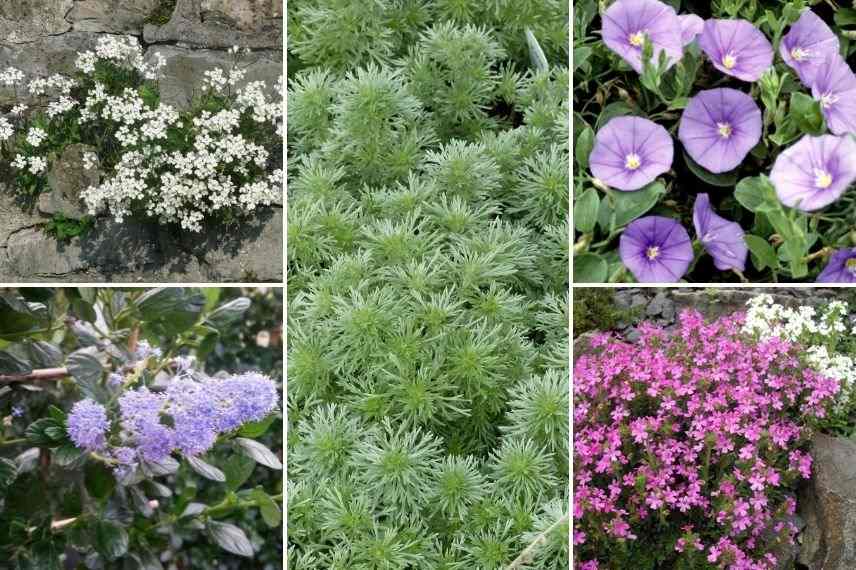
Arabis ‘Bakkely’ (photo nociveglia), Artemisia schmidtiana ‘Nana’, Convolvulus sabatius, Ceanothus griseus var. horizontalis ‘Yankee Point’ and Erinus alpinus ‘Dr Hähnle’
In a pot with annuals
Convolvulus is also suitable for pot planting, paired with other annual plants. Stunning in a flowering pot, Convolvulus tricolor ‘Royal Ensign’ is an annual variety that offers indigo blue flowering, with a white and yellow centre. You can grow this beautiful morning glory in a large planter placed on a windowsill, in a hanging basket, a trough, or a bowl. Plant the trailing varieties near the edge to create a lovely floral carpet cascading from the container. For colours, the simplest solution is to opt for a colour scheme. The blue bindweed can be paired with the small daisies of Felicia amelloides ‘Forever Blue’, the abundant flowering of lobelia ‘Hot Water Blue’, and the white pom-poms of alyssum ‘Snow Crystals’ that lighten the arrangement.
More substantial, the perennial Convolvulus cneorum can also be grown in containers. For this, choose a large trough, as it can reach 40 to 50 cm in height and 80 cm in spread. You might pair it with the pink flowers of Argyranthemum Grandaisy ‘Pink Tourmaline’ and the pink bouquets of garden verbena Verbena hybrida ‘Endurascape Pink Bicolour’.
Finally, complete your floral arrangement with beautiful foliage, such as Dichondra argentea ‘Silver Falls’, Helichrysum petiolare ‘Silver’, or a low-growing ivy like Hedera helix ‘Jake’.
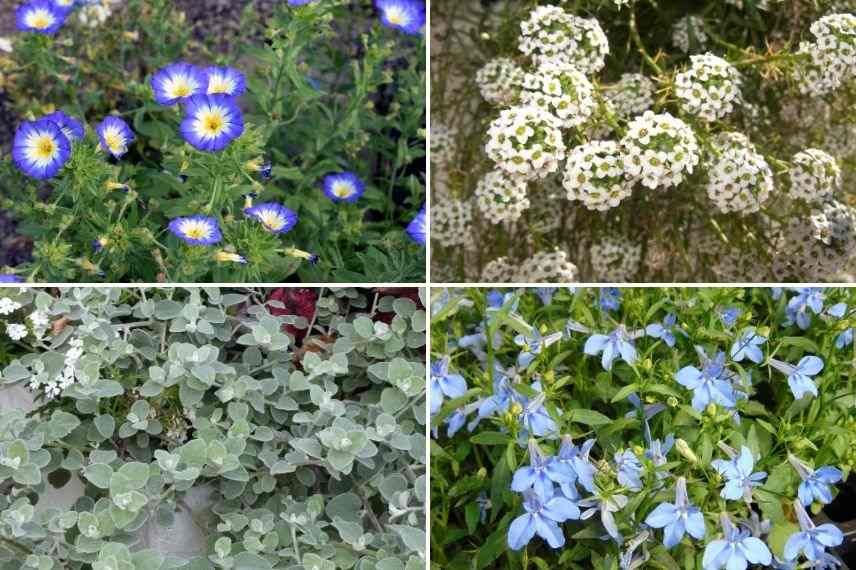
Convolvulus tricolor ‘Royal Ensign‘, Lobularia maritima ‘Snow Crystals’, Helichrysum petiolare ‘Silver’ and Lobelia ‘Hot Water Blue’
- Subscribe!
- Contents
Comments