





























Pairing ideas with Darmera
5 ideas for cool and damp soil
Contents
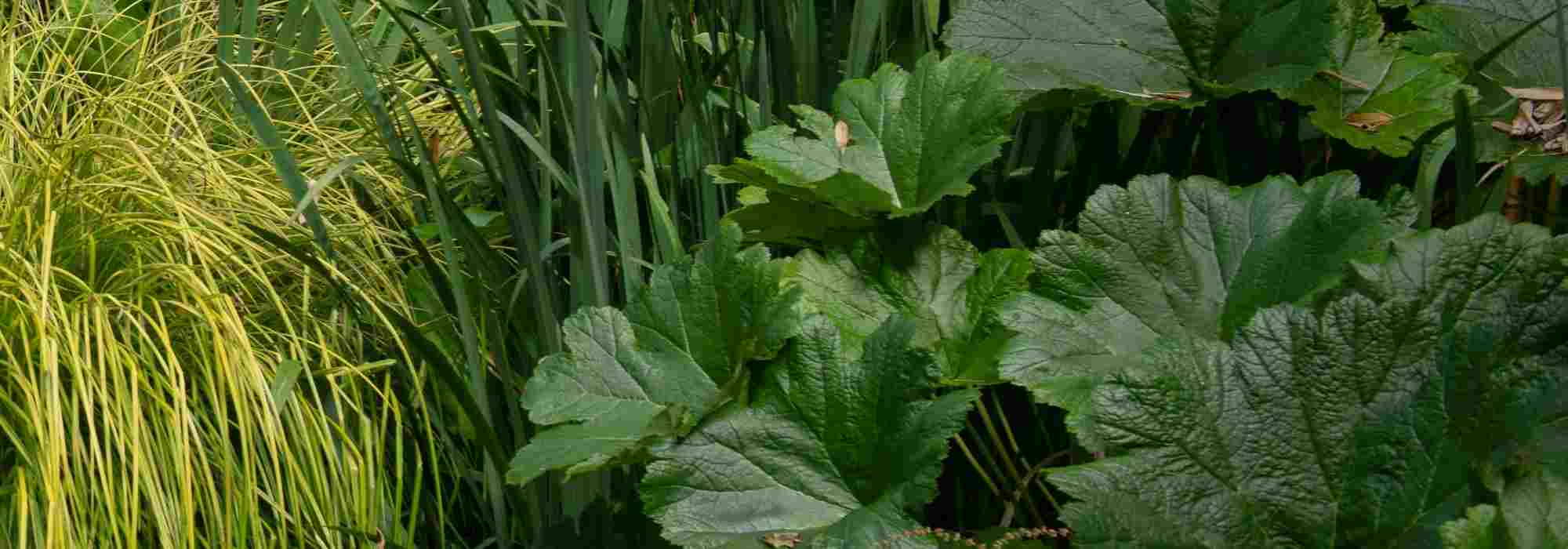
The Darmera peltata is a large, opulent perennial for wet ground. Vigorous and imposing, it forms beautiful clumps that can reach 2 m in height when in flower, composed of large, round leaves measuring up to 60 cm in diameter. A rich green in the growing season, this ample and majestic foliage turns crimson in autumn before disappearing. In spring, it is topped with tall umbels of pale pink to white flowers.
Both lush and elegant, the Darmera brings a lot of exuberance when planted near a pond, in a moist flowerbed, or a cool border.
It thrives in full sun or partial shade alongside its companions in cool ground with similar requirements, allowing for numerous combinations. Discover our 5 inspirations!

To flower a cool corner
Appreciating shaded environments and humus-bearing soil, the Darmera peltata is stunning in the dappled light of a woodland where it will find the constant coolness and moisture it needs. This is a rhizomatous perennial that can become quite imposing in a forest setting. It is in this familiar environment that it will produce the largest leaves. However, be cautious, as under too dense a shade, the flowering may be minimal. Feel free to play with the shapes and colours of the foliage to inject dynamism into the scene, mixing the peltate leaves of the Darmera with broad foliage like that of Hostas, which you can use generously, such as Hosta ‘Sun Power’. Add the graphic leaves of evergreen ferns like Polystichum polyblepharum or enchanting ferns like Matteuccia pensylvanica.
To accompany its flowering, consider Bergenia ‘Jelle’, epimediums, and periwinkles. The Filipendula palmata with its feathery pink flowers and tall stems will also be stunning in this woodland atmosphere, taking over the flowering duties. A groundcover carpet formed of tiarella and heucheras, ‘Asarums and Pachysandra terminalis will enhance this contrasting mix of foliage, habits, and colours.
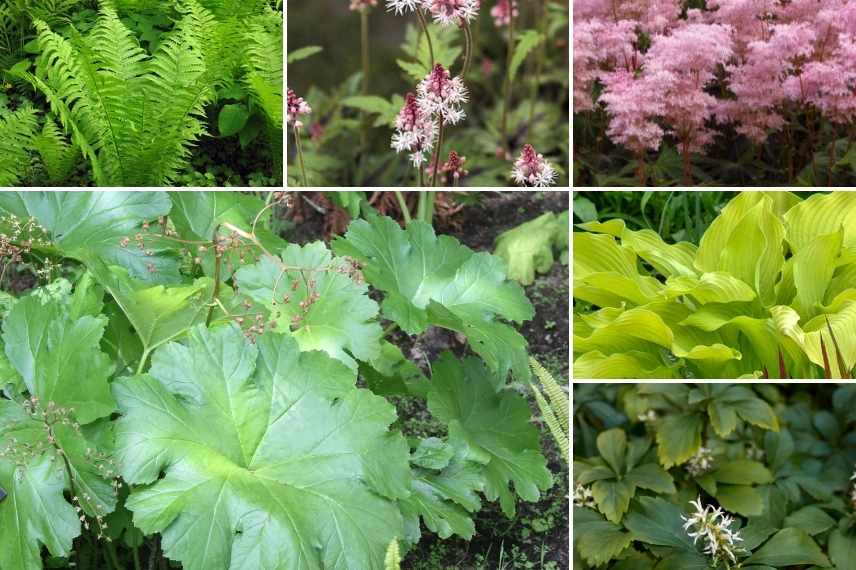
Darmera peltata surrounded by Matteucia pensylvanica, Tiarella ‘Sugar and Spice’, Filipendula palmata, Hosta ‘Sun Power’, and Pachysandra terminalis
Read also
12 perennials for heavy, wet soilOn the edges of a pond
Swamp-dwelling plant, Darmera peltata requires a humid environment and consistently moist soil to thrive. Dreading particularly dry summers, it is especially suited for a water garden. This is why, thanks to its rhizomatous stump, it naturally finds its place on the banks of a stream, pond, or near a basin or marsh. With its lush foliage, it enhances a very wet area of the garden. Create a fresh and lush atmosphere by pairing it with other perennials for wet banks, with an architectural and bushy habit such as Gunnera with its XXL leaves, a Beard of Goat ‘Misty Lace’, and Rodgersias chosen for their beautiful autumn hues like Rodgersia pinnata ‘Elegans’. The giant Japanese butterbur, which develops very large leaves, will also be a great companion for creating an exuberant decor by the water.
The Astilbe simplicifolia ‘Hennie Graafland’ with its lovely pastel pink flowers, or the smaller Astilbe crispa ‘Perkeo’ (25 cm in all directions), the Chinese loosestrifes, such as Lysimachia atropurpurea ‘Beaujolais’ with its wine-coloured flower spikes on foliage turning purple at ripeness will echo the flowering of Darmera by succeeding it.
It can also be paired with Marsh Irises (Iris pseudoacorus), Purple Joe-Pye Weed, and Persicaria ‘Pink Elephant’ planted in groups for beautiful splashes of colour in summer.
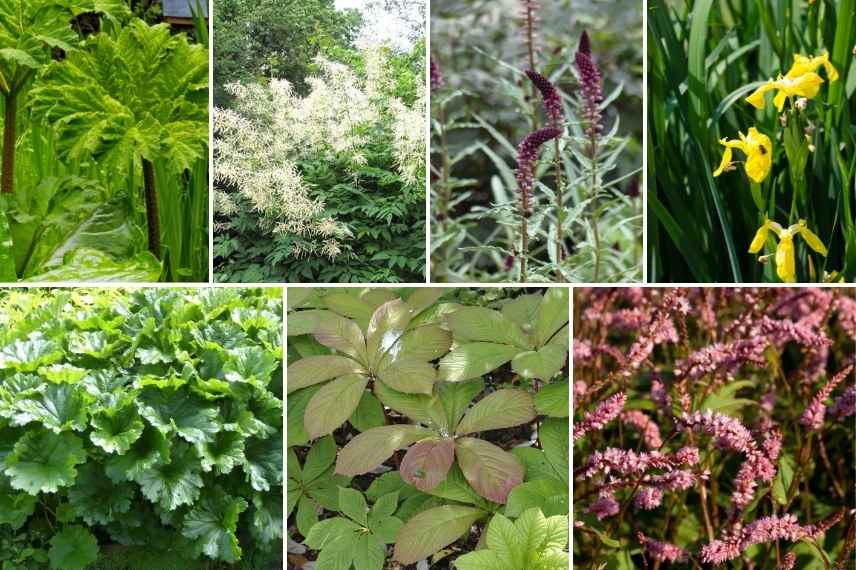
Lush mass of Darmera peltata (bottom left) in association with a Gunnera manicata, a Beard of Goat ‘Misty Lace’, Lysimachia atropurpurea ‘Beaujolais’, Marsh Irises, a Rodgersia pinnata, and some ‘Pink Elephant’ persicarias.
To add depth to a wet flower bed
The Darmera peltata also integrates very well into a mixed border in shaded conditions, formed of perennials that, like it, enjoy cool soils. It is a highly structural perennial, forming clumps of 60 cm in width at ripeness, much more if it thrives. It easily associates with the flowering of many other perennials suited to moist ground. To enhance this cool setting, choose compact varieties of Filipendula (‘Nana’, F. vulgaris ‘Kahome’), which reach no more than 40 cm in height, Japanese primroses ‘Apple Blossom’ flowering from May to July, Libertia grandiflora, with its delicately white flowers in May-June, and a hardy geranium phaeum ‘Margaret Wilson’ with abundant spring flowering. This will create expressive, colourful, and flowering masses. The Lythrum salicaria ‘Blush’, with its soft pink flowers, will bring elegance to the composition and a more elongated visual effect.
Some Hostas (such as Hosta fortunei var hyacinthina), small Petasites with large leaves, and certain grasses for moist soil planted in masses, such as Carex nigra, with its graphic foliage, will help to highlight and soften the layout.
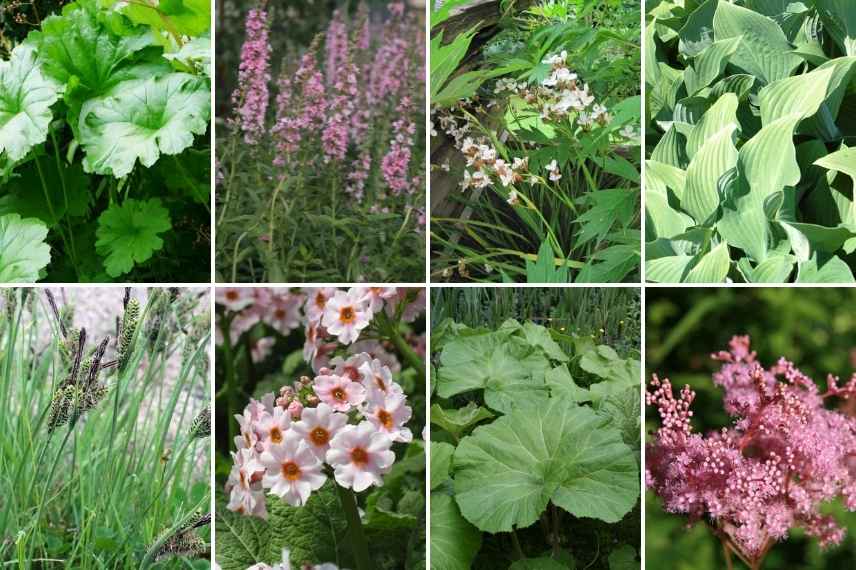
Darmera peltata, Lythrum salicaria ‘Blush’, Libertia grandiflora (© L. Enking), Hosta fortunei var. Hyacinthina, Carex nigra, Primula japonica ‘Apple Blossom’, Petasites japonicus ‘Giganteus’ and Filipendula ‘Nana’
Read also
7 grasses for wet soilIn a cool border
In partial shade or in non-burning sunlight, in a wild and cool garden where free forms, light flowering, natural colours, and large, well-developed leaves are prioritised, Darmera peltata asserts its presence for many months. Once again, to accompany it, focus on other perennials for moist soils. Pair it with other perennials featuring generous foliage such as Acanthus Mollis. Dress the back of the border with Aruncus dioicus, a spectacular perennial that enjoys cool ground. An Arundo donax with its large leaves will create a permanent backdrop in mild climates. Complete with other feathery blooms such as those of Astilbes (‘Professor van der Wielen’, ‘Straussenfeder’), the Meadow Rue, and Queen of the Meadows (Filipendula ulmaria ‘Variegata’). Dot with the river thistle ‘Atropurpureum’ reaching up to 1.20 m high, which will add a bit of spice. The Solomon’s Seal, Dicentra spectabilis, Japanese anemones, and ferns will complete this beautiful alliance of lushness and lightness.
Don’t forget tall grasses for cool soils that will punctuate this elegant and flowering scene; the Molinia caerulea ‘Heidebraut’, whose foliage turns orange at the end of summer, or False Reed Canary Grass.
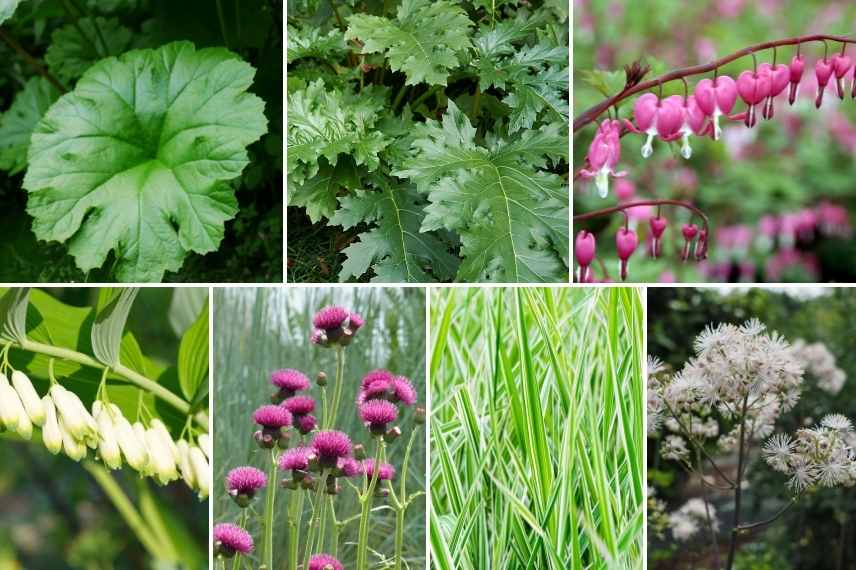
Darmera peltata, Acanthus mollis, bleeding heart, Solomon’s Seal, Cirsium rivulare ‘Atropurpurea’, Phalaris arundinacea, and Thalictrum aquilegifolium
In an exotic scene
With its large, round green leaves adorned with stunning autumn colours, Darmera peltata is also well-suited to decidedly exotic scenes. If you have space in your garden, you can create a large bed with a “jungle” spirit. For a successful display, choose plants with strong personalities, majestic and graphic. Consider the monumental Gunnera manicata with its oversized foliage, ideal for structuring the composition. Surround them with palms that thrive in cool soils, such as Sabals (for example, Sabal minor). The tree fern (Dicksonia antartica) and the giant ‘Lakeside Maverick’ Hosta will also be welcome in this type of bed, bringing interesting contrasts of foliage.
Incorporate some blooms in warm colours, such as that of an Astilbe arendsii ‘Fanal’ with its incandescent red spikes or that of a Ligularia ‘Osiris Fantaisie’.
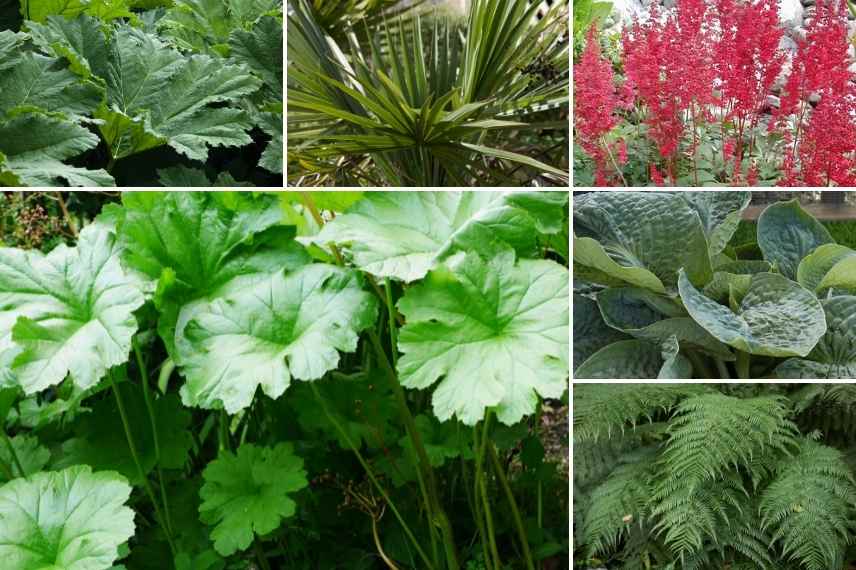
Darmera peltata in a lush exotic bed: Gunnera manicata, Sabal minor, Astilbe arendsii ‘Fanal’, Hosta ‘Lakeside Maverick’ and Dicksonia antartica
- Subscribe!
- Contents
![[plantes_associees plante="Darmera"]Ideas for pairing {glossary}Darmera{/glossary} in the garden.](https://en.promessedefleurs.eu/blogwp/wp-content/uploads/2022/08/Associer-le-darmera.jpg "Associate the darmera")
Comments