





























Associating herbaceous clematis
Our ideas for inviting them to the garden
Contents
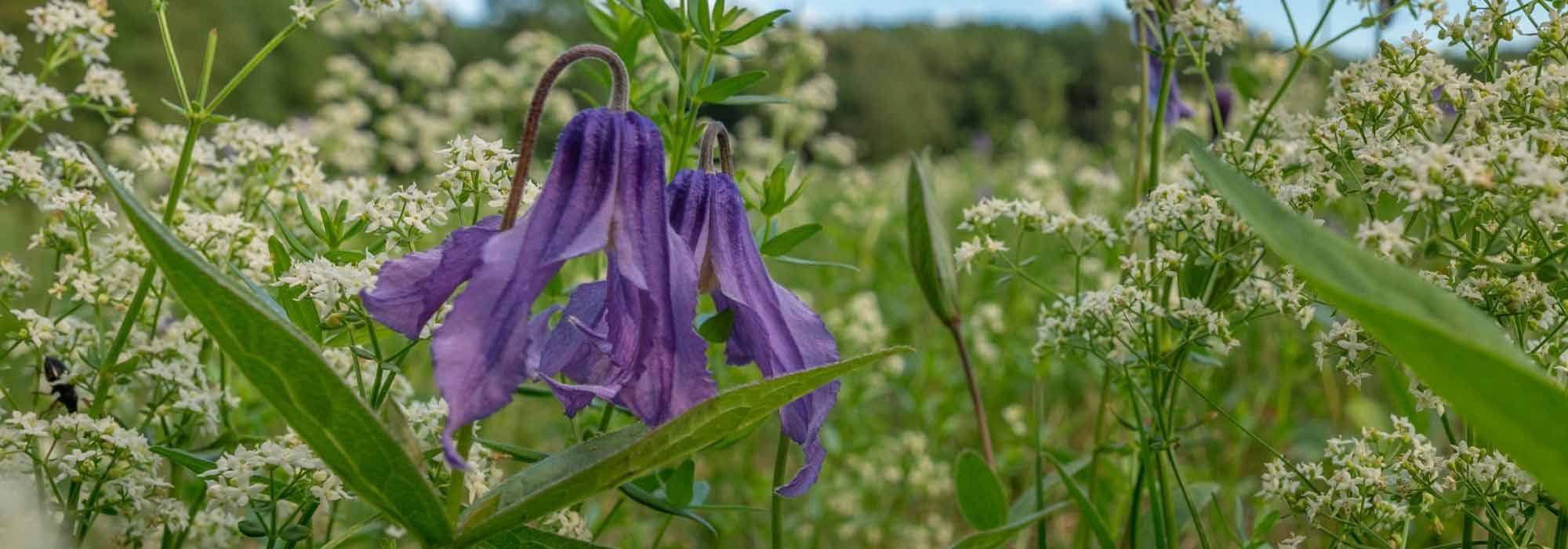
Perennial plants that are interesting yet often overlooked, herbaceous clematis develop dense, leafy stems each year during the beautiful season, bearing flowers often shaped like bells and sometimes like stars. Non-climbing or slightly climbing, they bring vibrancy to gardens and terraces throughout the entire season. Their colour range spans from white to purple, including pink: thus, you will find the variety that suits your landscape displays for any occasion. Easy to cultivate and low-maintenance, they naturally find their place and are accessible even for novice gardeners.
All these qualities make them excellent candidates for introducing into your flower beds by pairing them with other plants: they allow for the creation of naturalistic and romantic compositions, in full sun or partial shade. Discover our most beautiful ideas and inspirations for pairing them in the garden.

In a contemporary display
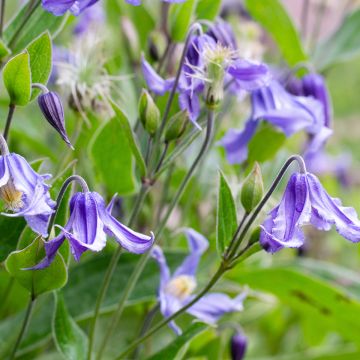
Easy to grow and easily adaptable to different growing conditions, Clematis integrifolia is a perennial forming a herbaceous clump of about 1 m in all directions. It re-emerges each year in the beautiful season to create a mass of lush foliage, composed of deep green ovate leaves. Then, from June to September, it offers a generous and graceful flowering, with a multitude of intense blue bell-shaped flowers, pleasantly fragrant. Afterwards, small decorative silver plumes take over at the end of the season. Very hardy, this herbaceous clematis will thrive in rich, cool soil, alongside plants that require the same growing conditions.
A Miscanthus sinensis ‘Variegatus’ or Variegated Chinese Reed will provide a graceful and graphic backdrop for the perennials placed in the foreground. Its long, narrow foliage is edged with cream-white and pale green bands, making it a bright subject capable of illuminating the somewhat dreary spots in the garden. At the end of summer, inflorescences in orange-pink plumes, turning white at maturity, appear. Just as graphic, but in a different style, the sea holly Eryngium planum, or Blue Sea Holly, bears numerous azure blue head flowers in summer, matching the colour of the clematis. Its tough, dentate leaves, often evergreen, are arranged in rosettes. Ensure it has well-draining soil conditions and place it in the sunniest area of your border. Finally, on a lovely support such as a trellis, pillar, or pergola, plant the Clematis ‘Couronne Royale’ (= ‘Haku Ookan’) as a reminder: a beautiful variety that produces multiple large star-shaped flowers of intense violet, adorned with a bouquet of pale stamens. These flowers are semi-double in May-June, then single in summer. This magnificent liana, reaching about 3.50 m in height, will make a statement!
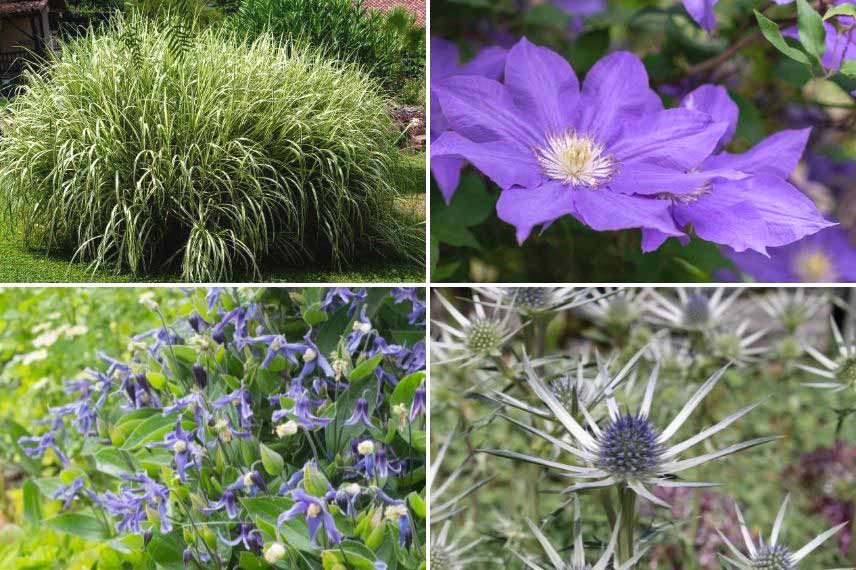 Miscanthus sinensis ‘Variegatus’, Clematis ‘Couronne Royale’, Clematis integrifolia and Eryngium planum
Read also
Clematis: planting, pruning and careIn a refined garden
With their lovely star-shaped flowers, Clematis are timeless classics in romantic and refined arrangements. In this role, the place of Clematis integrifolia Saphyra ‘Duo Rose’ is perfectly suited. It is a charming little herbaceous clematis, forming a bush 1.50 m tall with dense deciduous foliage. Its large pink star-shaped flowers with a midrib and bright pink stamens bloom abundantly in June, and then again more timidly in September. Its compact size and generous flowering make this lovely clematis an ideal variety for perennial and flowering bush beds, or sunny slopes.
At the back, plant a Loropetalum chinense ‘Ming Dynasty’, which stands out for its young foliage in purple and bronze pink hues. Its early flowering will be wonderful from March to May, and it will form a compact shrub with a rounded habit that will turn dark green at maturity. Its numerous intense pink flowers have finely cut petals, and it will happily take its place in a semi-shaded bed, reaching about 2 m in all directions at maturity. Additionally, plant the white Valerian, Centranthus ruber ‘Albus’, which is easy to care for and has an exceptional flowering duration, as well as the Daylily ‘Neyron Rose’ for the refined touch of its bright raspberry pink flowers enhanced by a white midrib on each petal. This old variety forms a beautiful rounded clump and blooms in June-July. Finally, take the opportunity to pair them with an old rose, such as the ‘Ballerina’: this elegant and vigorous shrub rose will offer you a magnificent display of very abundant simple flower bouquets.
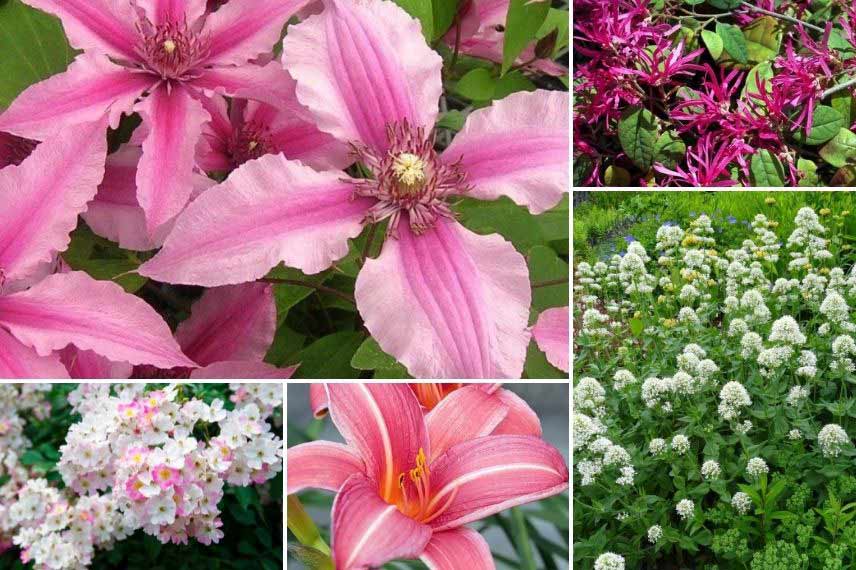
Clematis integrifolia Saphyra ‘Duo Rose’, Loropetalum chinense ‘Ming Dynasty’, Centranthus ruber ‘Albus’, Hemerocallis ‘Neyron Rose’ and Rose ‘Ballerina’
Discover other Herbaceous Clematis
View all →
Available in 1 sizes
Available in 1 sizes
Available in 1 sizes
Available in 1 sizes
Available in 1 sizes
Available in 2 sizes
Available in 1 sizes
Available in 1 sizes
Available in 2 sizes
Available in 1 sizes
In a bed of spicy hues
Th Clematis recta ‘Purpurea’ is a beautiful perennial with purple-tinted foliage, reaching a height of 1,50 m with a width of 70 cm. The colour of its foliage beautifully highlights its numerous small fragrant star-shaped flowers that bloom in June-July.
This colour allows it to be inserted into a very trendy display, based on “Terracotta” colours, warm and spicy. For a season start with bold colours, plant alongside it the Triumph Tulip ‘Black Jack’, which offers lovely flowers in a deep purple-black, ideal for cutting. As a spring complement, awaken the display with the presence of Garden Iris germanica ‘Grand Canari’. Highly floriferous, they produce numerous flowers on each stem, blooming in a bright yellow, adorned with an orange beard. Of considerable size, ‘Grand Canari’ beautifully concludes the iris season, from May to June. The persistent presence will be provided by clumps of purple New Zealand Flax, Phormium tenax ‘Evening Glow’. Finally, the ‘Alchemilla mollis ‘Thriller’ will bring lightness and brightness with its sulphur-yellow flowers and soft light green leaves.
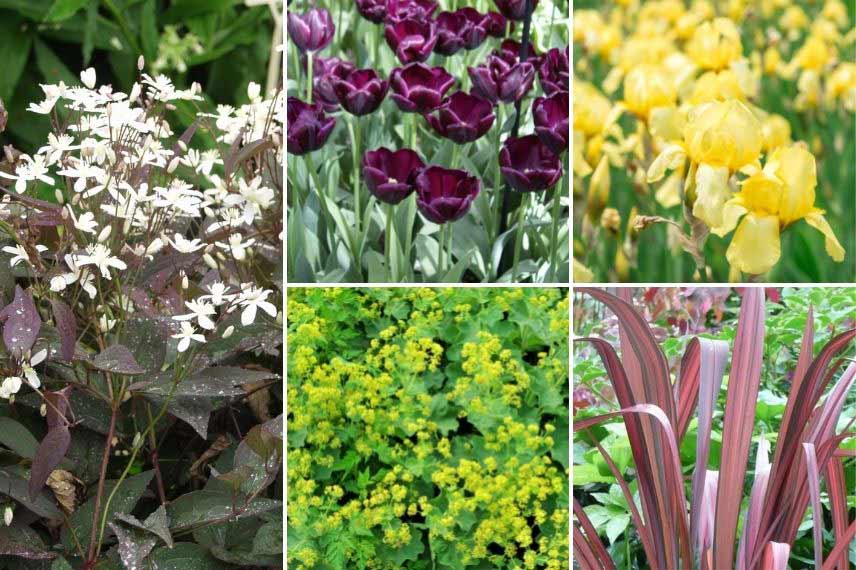 Clematis recta ‘Purpurea’, Triumph Tulip ‘Black Jack’, Garden Iris ‘Grand Canari’, Phormium tenax ‘Evening Glow’ and Alchemilla mollis ‘Thriller'[/caption>
Read also
How to prune and care for clematis?In a mauve and white flowerbed
Always beautiful in the garden, this colour combination appeals to many gardeners. It consists here of easy-to-grow plants, accessible to beginners, ensuring a stunning result! The charming little herbaceous clematis, Clematis integrifolia ‘Blue River’, offers delightful flowers in a magnificent mauve blue that open star-like on a bouquet of cream-yellow stamens. It blooms from June to September and completely disappears in winter, only to re-emerge each spring.
An excellent perennial for sunny borders and beds, it beautifully highlights the Veronica longifolia ‘Lila Karina’, an elegant perennial with an upright habit that produces long spikes of small pale blue flowers throughout the summer above ash-green foliage. To continue the display of mauve blooms, plant a butterfly tree at the back, such as Buddleja ‘Flutterby Peace’. This compact and sterile variety is exceptionally floriferous! This deciduous bush forms a small shrub of 1.5 m in all directions with dark green foliage and produces highly melliferous violet-mauve flowers from May to November. To soften these strong tones, plant a grey, fluffy groundcover of Mouse Ears Cerastium biebersteinii, which will be adorned with countless small white flowers from May to July. Additionally, clumps of Tulbaghia violacea ‘Pearl’ will stand out with their white flowers.
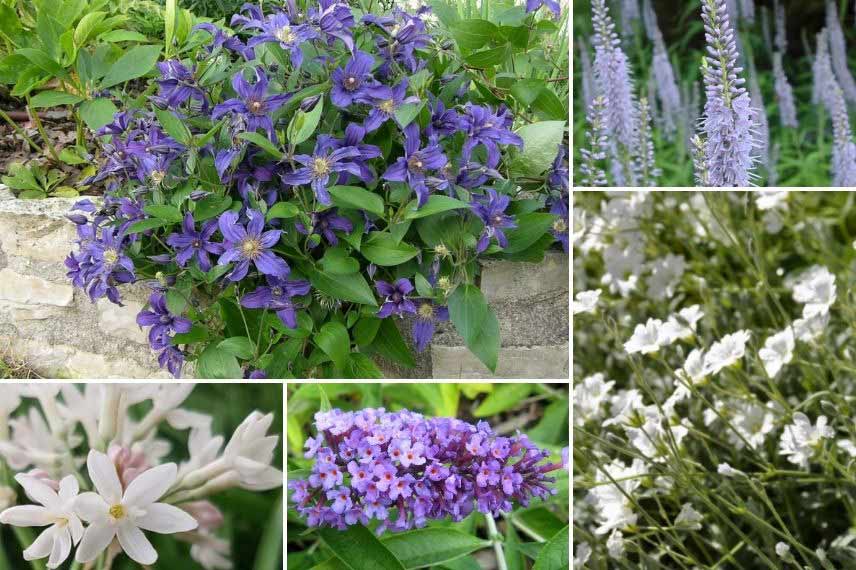
Clematis integrifolia ‘Blue River’, Veronica longifolia ‘Lila Karina’, Cerastium biebersteinii, Buddleja ‘Flutterby Peace’ (Wikimedia Commons) and Tulbaghia violacea ‘Pearl’
In a bed of rare plants with bold hues
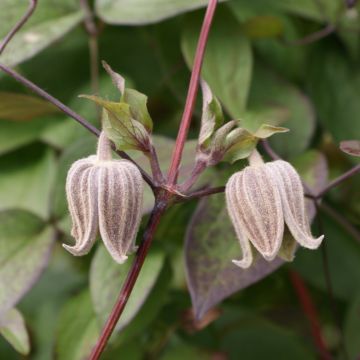
Rare and surprising botanical clematis, Clematis fusca is an herbaceous species of Asian origin with summer flowers shaped like small pendulous bells. Covered in silky hairs, they are of a soft brown hue with a hint of purple. To be planted in partial shade, either trained or spreading freely on the ground, it will produce new shoots each spring and quickly reach a height of 1.5 to 2 metres, with a spread of about 1 metre.
Set the base of this original partial shade composition with a beautiful purple Japanese Maple, or Acer palmatum ‘Atropurpureum’, with its magnificent purple foliage all year round turning to bright red in autumn and one or two Leucothoe keiskei ‘Burning Love’. These small evergreen bushes have a compact and spreading habit, and bear leaves that change colour throughout the seasons: bright red on young stems, purple-orange in winter, and bronze and green hues in summer. Their spring white flowering is simply delightful! Enhance the precious colours with Fuchsia regia ‘Reitzii’, one of the hardiest varieties, resistant to -10/-12 °C. Its long bicolour flowering in red and violet followed by small edible black-purple berries is also a marvel, beautifully complemented by the generous foliage of the evergreen fern Polystichum munitum. Quite imposing, it produces an abundance of large fronds of bright green, bringing a welcome freshness to the composition.
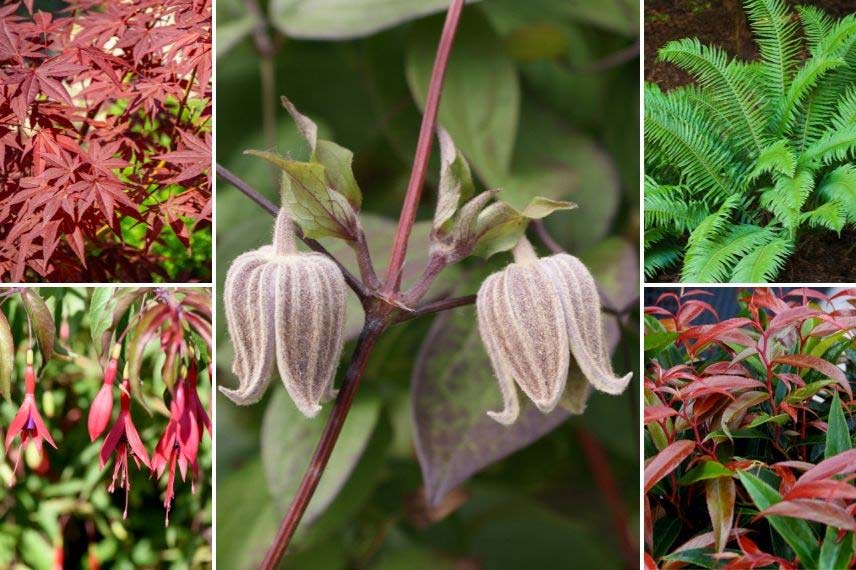
Acer palmatum ‘Atropurpureum’, Fuchsia regia ‘Reitzii’, Clematis fusca, Polystichum munitum and Leucothoe keiskei ‘Burning Love’
In a white garden
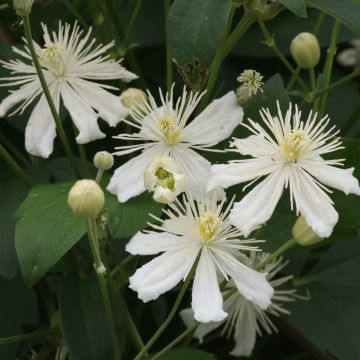
Clematis are classics of white gardens as many varieties offer immaculate flowerings. Among the herbaceous clematis, Clematis flammula mandshurica is a ground-covering rather than climbing variety that produces a cloud of small, deliciously fragrant white stars each summer, generously covering the long stems that colonise the surroundings and stand out beautifully against its dark green foliage. It will brighten sunny or partially shaded areas of the garden in fresh, neutral, or slightly acidic soil.
It can take on the Silver Bell Tree Halesia carolina, a large, highly decorative shrub with its multiple small white bells. To enhance the pure flowerings, pair it with a David Austin Rose ‘Kew Gardens’, regarded by knowledgeable gardeners as one of the best roses. Its beautiful pure white blooms, accented by a very soft lemon-yellow centre, make this upright shrub rose completely thornless. At the base of this composition, plant masses of variegated Hostas, with their always generous foliage.
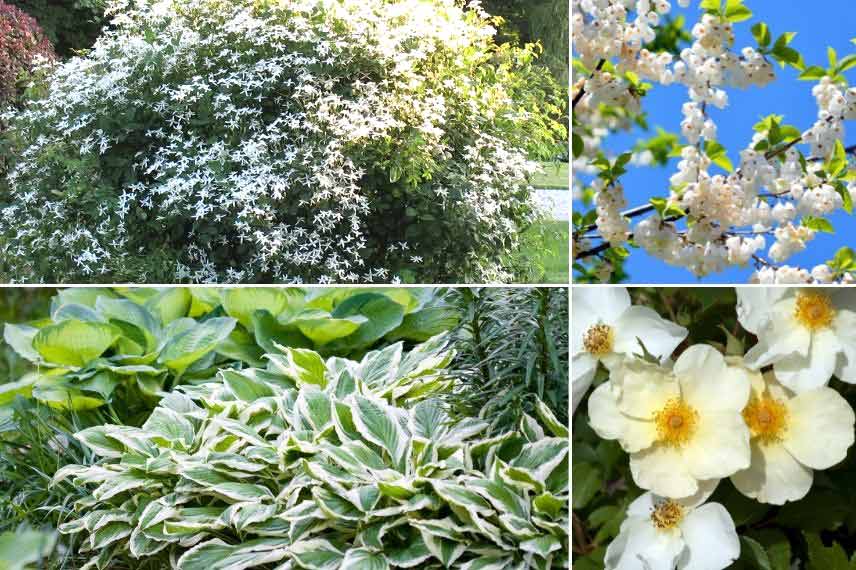
Clematis mandshurica, Halesia carolina, David Austin Rose ‘Kew Gardens’ and variegated Hostas
On a a yellow and blue slope in partial shade.
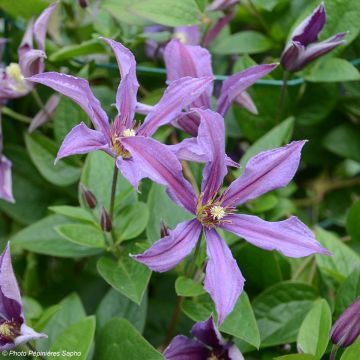
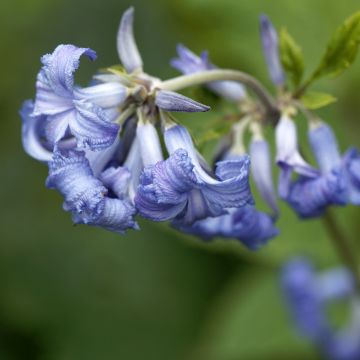
With their compact size and flexible stems, some herbaceous clematis are perfect for greening a bank. For a long summer flowering period and generous foliage, plant masses of Clematis (x) heracleifolia ‘New Love’. This herbaceous clematis is rather rare and produces flowers with long, curved petals gathered in bouquets, in a deep blue colour. The large, velvety green leaves of this hybrid of Clematis heracleifolia do not completely disappear in winter and take on a greyish hue.
Stunning on a bank with its spreading habit, pair it with St John’s Wort Hypericum (x) moserianum ‘Little Misstery’ which offers bright green foliage variegated with golden yellow, a colour reflected in its abundant flowering that occurs continuously from July to September. Very comfortable in the sun, it also enjoys partial shade. The Heuchera ‘Happy Flames’ is also a beautiful evergreen perennial perfect for banks. Its golden foliage with bronze highlights is stunning, and it produces delicate white bells in summer. Finally, complete this landscape display with wide carpets of sweet violets ‘Königin Charlotte’ : these lovely plants bloom from March to July if the soil remains cool. Their simple bluish-purple flowers are delightfully fragrant and they make an excellent groundcover.
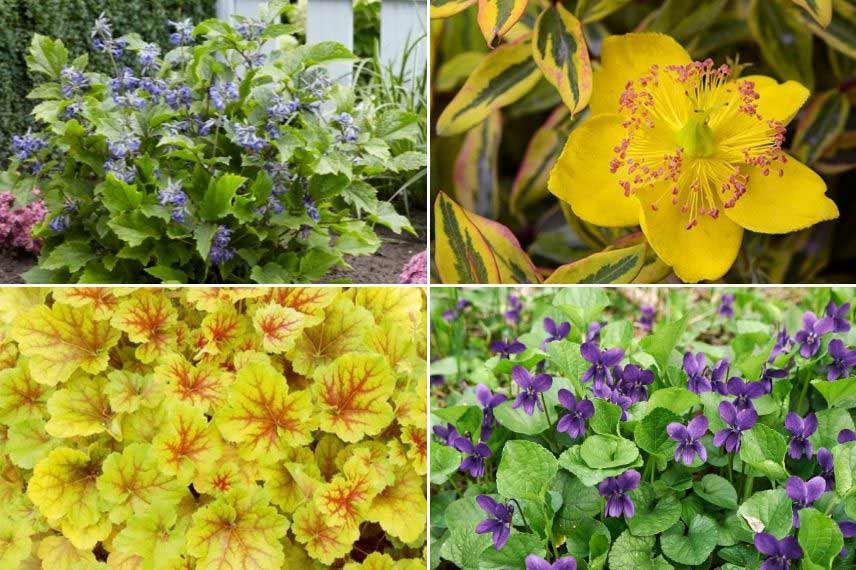
Clematis ‘New Love’, Hypericum (x) moserianum ‘Little Misstery’, Viola odorata ‘Königin Charlotte’ and Heuchera ‘Happy Flames’

- Subscribe!
- Contents
Comments