






























Honey and orange inspiration for a vibrant, enchanting garden
5 landscaping ideas for a warm, colourful garden all year round
Contents
The colour orange in the garden flirts with cinnamon and tawny hues and blends with very soft yellows to create enchanting atmospheres. This fusion of warm tones, in the blooms, the foliage or the bark, instantly warms borders and pots placed on a balcony or terrace. Follow our advice to make the most of the energy of burnt orange and the softness of honey‑golden colours in your plantings. The result is full of promise for achieving a vibrant and utterly harmonious garden!
→ Find our colour inspiration on pages 32–33 of the 2023 Autumn Winter catalogue.

In spring
In the first months of the year, the colour palette playing with rust-tinged orange and pale to golden yellows is mainly found in the flowering. They spread from March and finish beautifully in June, and are found both in the charming bulbs that brighten the start of the season, in the bushes and perennials.
A sunny or semi-shaded border in our example hosts a handsome paperbush, the Edgeworthia ‘Red Dragon’ with curious spherical inflorescences of deep orange, ensuring the transition between winter and spring. A Japanese quince in an orange shade such as the Chaenomeles ‘Mango Storm’ will take over, with some early tulips and botanical tulips.
For late spring, bet on the subtle coppery young foliage of the Abelia ‘Caramel Charm’, apricot azaleas for a refreshing tonal range, or vanilla-toned flowers like the Rhododendron ‘Horizon Monarch’ and the Iris Germanica ‘Comes the Dawn’ or the Iris ‘Ambertine‘. Finally, a small bush with evolving colours such as the Diervilla ‘Kodiak Red’ will also naturally find its place. Many other equally delightful plants can take up this border: wallflowers such as ‘Apricot Twist’ or ‘Winter Passion, a clump of daffodils with single or double flowers for elegance, foxtail lilies such as ‘Cleopatra’, a Berberis ‘Orange King’ with handsome purple foliage…
Once the spring bulbs have finished flowering, you can insert in their place some summer bulbs in the same shades, for example crocosmias and lilies.
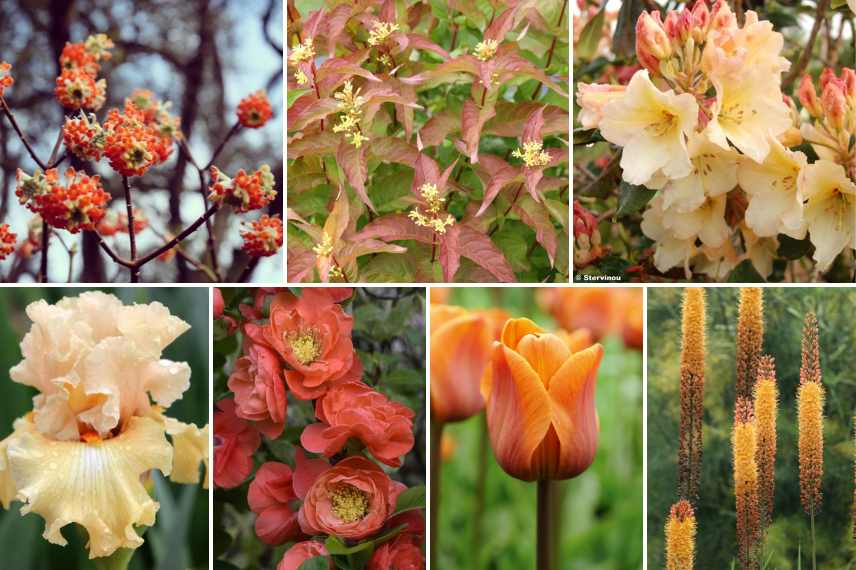
Edgeworthia chrysantha ‘Red Dragon’, Diervilla ‘Kojak’, Rhododendron ‘Horizon Monarch, Iris ‘Comes the Dawn’, Chaenomeles ‘Mango Storm’, Tulip ‘Triomphe Cairo’ and Eremurus ‘Cleopatra’
Read also
Pairing ideas with orange flowersIn summer
The summer season craves warm tones and the choice is then almost endless for composing a yellow‑orange scene, fiery yet tempered by some honey‑coloured blooms.
Include flowers of varied shapes, and don’t forget a few coppery foliage accents to support the whole. This border will glow in full sun, and can also invite a few spring and autumn plants borrowed from the displays shown here, to prolong the enchantment.
Place near a Carex testacea ‘Prairie Fire’, a superb coppery “grass”, some achilleas ‘Terracotta’ and Alstroemeria aurantiaca, dazzling, for a zesty touch. At the back of the border, a Buddelia globosa or a Buddleia x weyeriana ‘Sungold’ will bring a note of originality with its small orange, ball‑shaped inflorescences, while Californian poppies in the foreground will form a very colourful, long‑flowering mass. A large‑flowered rose such as ‘Terracotta‘, with a deeper tone, will be useful to create contrast within the orange wave.
Again, it is useful to mix in some lighter flowers, apricot‑coloured or straw‑yellow, so as not to weigh down the display and to create a graduated range of colours. Daylilies such as ‘Femme Osage’, iridescent yellow, small elegant flowers like those of the avens and the potentillas wonderfully soften the whole.
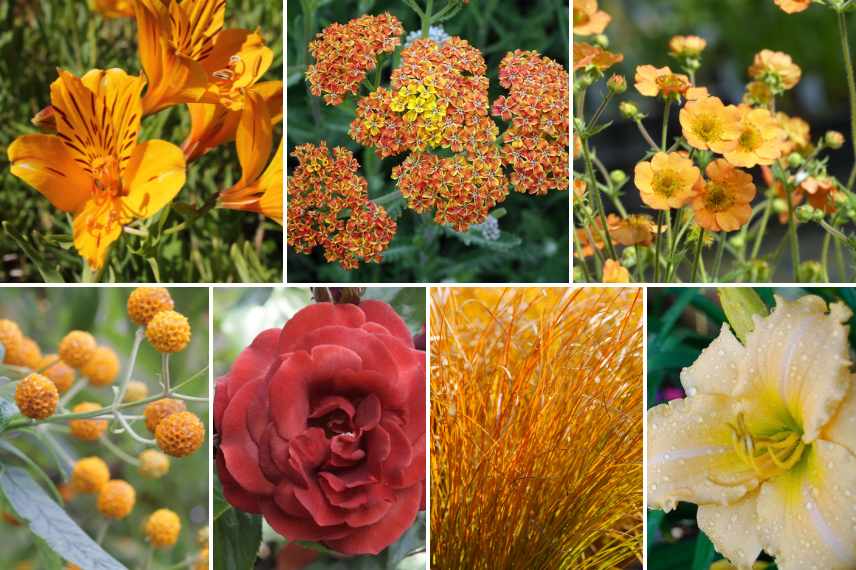
Alstroemeria aurantiaca, Achillea millefolium ‘Terracotta’, Geum ‘Totally Tangerine’, Buddleia globosa, rose ‘Terracotta’, Carex testacea ‘Prairie Fire’, and Daylily ‘Femme Osage’
In autumn
It may be in autumn that the changing colours offer the most possibilities and subtlety on our bed with its spicy and vanilla shades. Les Japanese maples at the head are an ode to our late-season colour palette. They are almost indispensable in a yellow–orange scheme, and choosing will be difficult! Why not an Acer palmatum dissectum ‘Orangeola’, one of the wonderful maples with colourful bark, or in a shrub border, a larger maple, the Acer triflorum with its exceptional foliage? In a semi-shaded spot, their blaze will be tempered by the honey and cinnamon notes of certain foliage.
On les associera à des caramel-coloured heucheras, a few marbled-leaf Epimediums, and ferns such as Dryopteris erythrosora, bronzed in autumn. Another fine bush completes a coppery scene here: the caramel tree or Cercidyphillum japonicum.
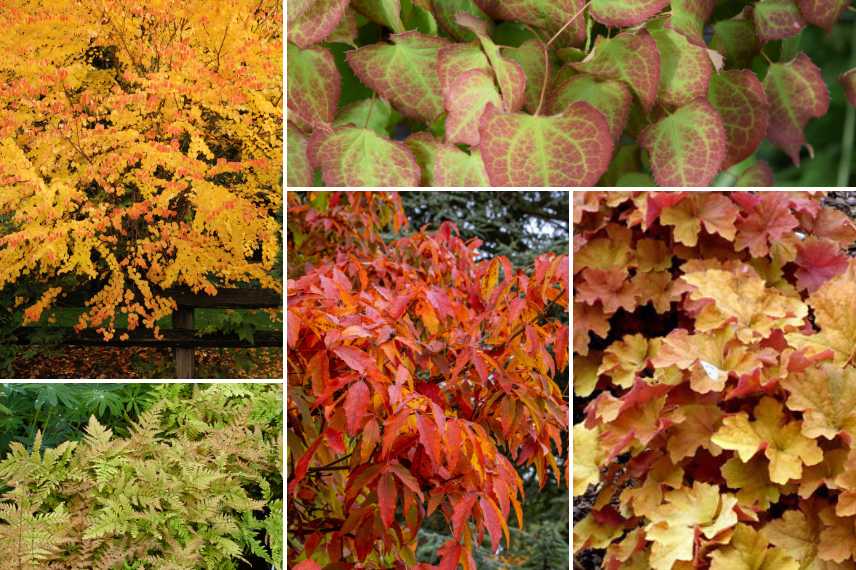
Cercidiphyllum japonicum, Epimedium, Driopterys erythrosora, Acer trifolium and heuchera ‘Sweet Caramel’
In a large, sunnier bed, make way for a symphony of warm and soft colours at once: from straw and saffron yellows to rust and papaya tones. The straw-coloured culms of Miscanthus nepalensis lend great softness, while Miscanthus sinensis ‘Sarabande’ unfurls its spikes, first coppery then golden. Some chrysanthemums provide a beautiful orange note and an Osmanthus aurantiacus planted at the back of the bed flowers at the same time with its small, very fragrant yellow–orange blooms.
The dogwoods with decorative wood will bridge into winter with their foliage, before revealing their golden (Cornus stolonifera ‘Flaviramea’) or orange (Cornus sanguinea ‘Magic Flame’) stems. A Mahonia confusa ‘Soft Caress’ with yellow flowers and very divided foliage will be the perfect companion to a Schizachyrium scoparium and Dahlias still in bloom in early autumn (below the Dahlia ‘Crazy Legs’).
In a mild climate, a fine Euryops pectinatus will illuminate the bed year-round with its yellow tones. A Berberis ‘Orange Ice’ will, for its part, bring the ultimate flamboyant touch from spring through to autumn, in its foliage, flowering and fruit!
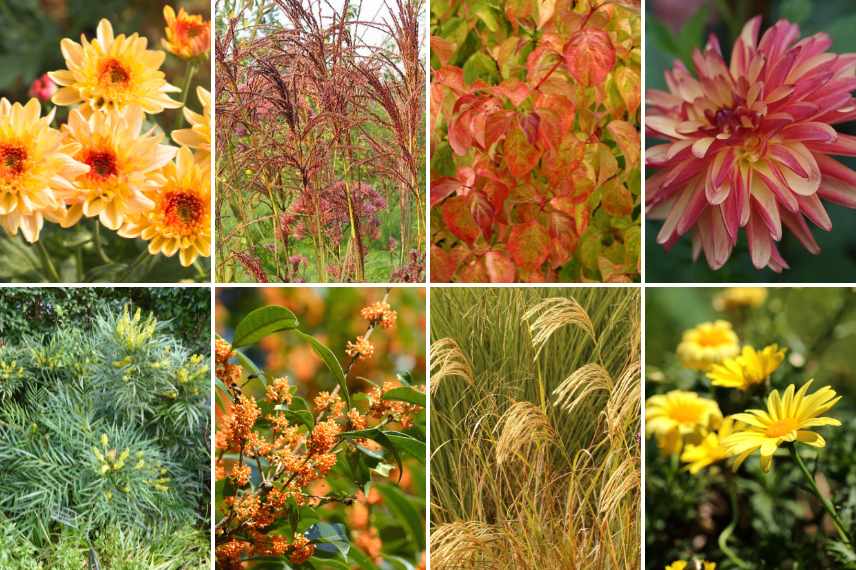
Chrysanthemum, Miscanthus nepalensis ‘Sarabande’, Cornus sanguinea ‘Magic Flame’, ornamental Dahlia ‘Crazy Legs’, Mahonia ‘Soft Caress’ (© Gwenaëlle David Authier), Osmanthus fragrans var. Aurantiacus, Miscanthus nepalensis and Euryops.
In winter
Winter is coming, bringing cold and gloom… To counter the bad weather, a scene in shades of amber and cinnamon will act as a comforting balm.
This season, the spotlight is on the orange bark of certain trees! : the Acer griseum for its extraordinary cinnamon-coloured exfoliating bark, an Arbutus andrachne even more vivid, or a Prunus maackii ‘Amber Beauty’ for its unique, glossy, amber bark. Around these trees, plant a few winter blooms notable for their delicacy and the softness of their honeyed tones: an essential Hamamelis x intermedia ‘Diane’ or ‘Orange Beauty’, admired for their splendid orange autumn foliage, a Stachyurus praecox with its spreading silhouette and graceful blonde clusters, or a Chimonanthus praecox with graceful bicoloured flowers. The aments of a hazel will also make a fine display in this setting, as will the pale yellow, highly fragrant bloom of a winter honeysuckle (Lonicera fragrantissima).
At the foot of these winter beauties, add some Cornus sanguinea with their coloured wood, a few fine golden heucheras, and plants of the yellow hybrid hellebore ‘Guttatus’ that will further enliven the scene and banish the gloom as if by magic. A clump of Iris foetidissima, taking its time to settle in, will also be highly attractive with its red‑orange fruits in place throughout the winter.
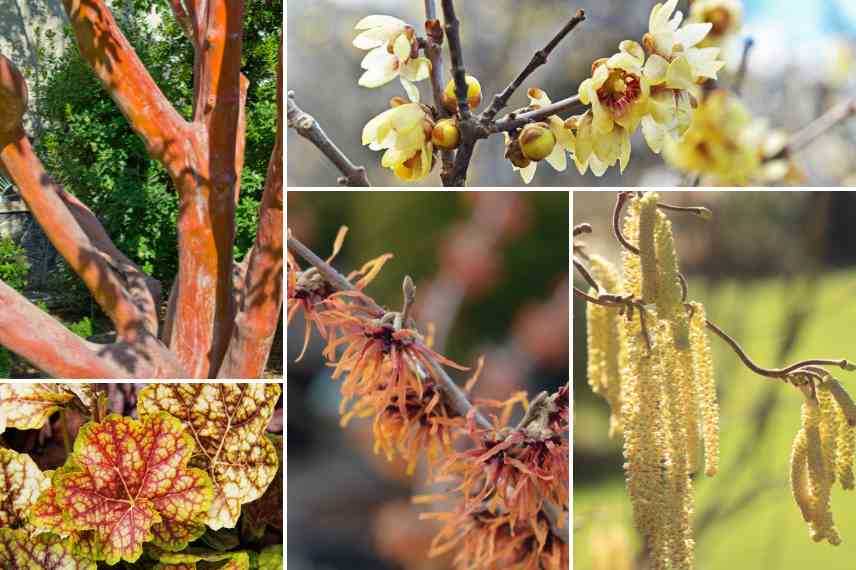
Arbutus andrachne, Chimonanthus praecox, Heuchera, Hamamelis ‘Diane’ and aments of a hazel
In a warm-climate garden
Regions of warm climate are the perfect setting to indulge our craving for orange in the garden. Adorned with soft yellows and russet, gingerbread-toned hues, the Mediterranean garden will be best suited to showcase beautiful combinations with imposing plants.
For example, you could plant a magnificent Cape Acacia (Paraserianthes lopantha) as the main specimen: its yellow, bottlebrush-like flowers in mid-winter will echo those of Pyrostegia venusta, an exceptional climbing plant that can be grown in this region. Later in the season, the scene will be coloured by an orange bougainvillea, pale yellow Cannas (such as Canna ‘Louis Cottin’), lantana flowering for many months, Leonitis leonurus, and why not a buddleia globosa?
For foliage, complement the scene with honey, golden and bronze tones: Uncinia rubra or Libertia, and a Phormium ‘Jester’ or ‘Rainbow Maiden’ for volume.
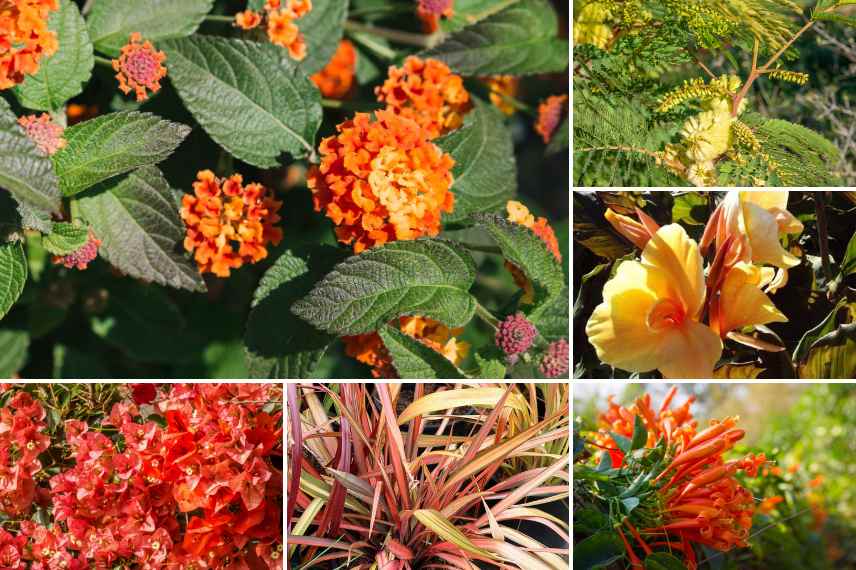
Lantana, Canna Cottin, Phormium ‘Jester’ (© cultivar 413)
- Subscribe!
- Contents
Comments