


How to create the illusion of water with plants?
Choose suitable plants, arrange them well, and complement with a few decorative elements
Contents
Symbolising water in the garden creates a zen, refreshing, meditative atmosphere, inspired by Japanese gardens. However, it is not always necessary to install a basin, pond, water feature, or waterfall for this. Not all gardens have the space for these installations, which also require maintenance and effective drainage management.
Easily create a play of illusions by simply using plants chosen according to your specific growing conditions (sunlight, soil type, winter severity…), as well as decorative elements. This will give a completely different charm and style to your garden. Let’s see how to proceed.

Choosing colours associated with water
To evoke water, choose plants in shades of blue, grey-green, aquamarine, silver, and white. By mixing these hues in foliage or flowers, you will create the illusion of a water feature.
Blue oat grass
The blue oat grass is a grass with beautiful metallic blue evergreen foliage.
Small in size, it measures about 50 cm in all directions, making it suitable for many gardens or even in pots. It thrives in full sun, in well-drained soil, tolerates heat, and is quite hardy (down to -15°C).
Leymus arenarius
This herbaceous perennial features bright linear silver-blue foliage. It grows to less than 1 metre in height, enjoys full sun, and thrives in dry, light, even poor soil. It is also very hardy, suitable for most of our regions.
The variety ‘Blue Dune’ offers even brighter foliage, a steel blue accompanied by blue-grey flower spikes.
Note that this is a vigorous plant, which can become invasive due to its running stump.
Brunneras
The Brunneras are perennial plants for partial shade, which reveal a myriad of blue flowers in spring, creating a true coloured mist. The round and lush foliage is equally interesting, as it resembles certain aquatic plants.
Consider for example ‘Jack of Diamonds’, with its large leaves reaching up to 25 cm long, which are almost covered in silver frost.
Hardy and easy to care for, these perennials prefer cool, rich organic soils.
Succulents
These non-hardy plants can be grown in pots and brought indoors during winter to protect them from frost. Thanks to the shades of their leathery foliage, these succulents will evoke the reflections of water.
- The Cotyledon orbiculata ‘Gray’ offers foliage blending grey, silver, and blue hues.
- The Echeveria lilacina produces very light blue foliage tinged with silver, while the Echeveria elegans ‘Rose’ prefers aquamarine leaves.
- The Senecio serpens ‘Blue Chalk’ is a groundcover with long, slender blue leaves.
- The Senecio mandraliscae, on the other hand, features striking blue-silver foliage with an almost tentacle-like appearance, creating an underwater atmosphere.
Provide them with a warm, sunny location in a light, well-draining substrate to avoid any stagnant moisture.
Ipomoea ‘Light Blue Star’
This fast-growing climbing plant will form a large cascading display in just a few weeks, amidst which large pale blue flowers bloom all summer long. Its imposing silhouette (up to 2 metres) and the colour of its flowers will enhance the impression of water in the garden. ‘Light Blue Star’ can be placed near a support that its twining stems will climb, or used as groundcover.
Not very hardy, it is generally grown as an annual outside regions with short, mild frosts. It thrives in full sun or partial shade, in cool, fairly rich but light soil.
Other blue flowering plants
Add blue-flowering plants, such as agapanthus, creeping bugle, muscari, as well as asters, campanulas, delphiniums, irises, ceanothus, or hardy geraniums.
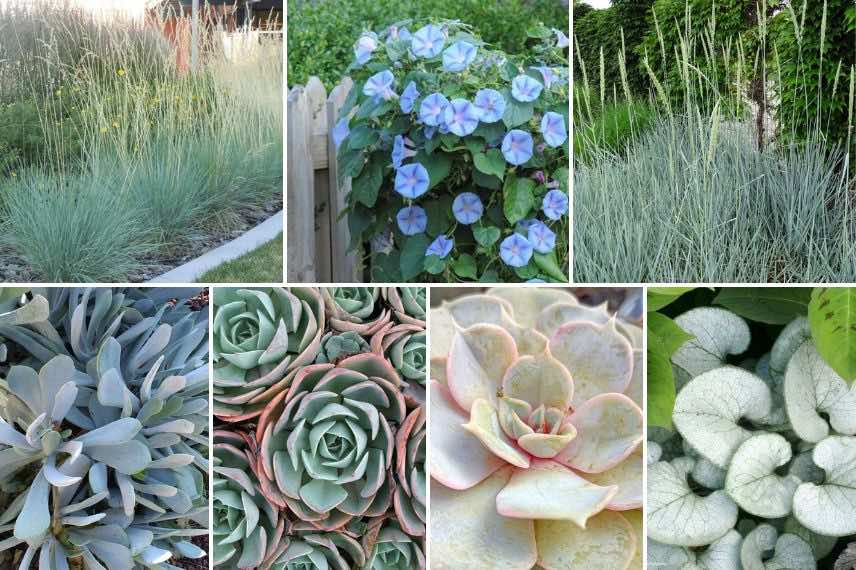
Clockwise from top: Blue oat grass, Ipomoea ‘Light Blue Star’, Leymus arenarius ‘Blue Dune’, Brunnera ‘Looking Glass’, Echeveria lilacina, Echeveria elegans ‘Rose’, Cotyledon orbiculata ‘Gray’
Play with shapes and textures
The aim is to use plants that evoke wetland areas, as well as textured foliage, appearing as if covered in water or frost. Some may even resemble the skeleton of corals, further enhancing the aquatic references.
Centaurea pulcherrima
This perennial found around the Mediterranean forms a beautiful bushy clump, composed of highly dissected ornamental foliage. It is covered in a light grey down that gives it texture and light.
It reaches 60 cm in height and 40 cm in spread, enjoys full sun, and tolerates poor, even dry soils. It is hardy down to -10 to -12°C.
Ferns
Essential plants for cool, moist, and shaded areas, the fronds of ferns easily add volume and texture.
Opt for evergreen varieties that will retain their foliage in all seasons. Among deciduous varieties, choose the silver-reflected fronds of Athyrium niponicum ‘Pewter Lace’ (40 cm in all directions) or ‘Pictum’ (30 cm in all directions).
Wooly Thyme
The wooly thyme is a groundcover (5 cm in height and 60 cm in spread) with grey, textured foliage, as if constantly covered in morning dew drops.
Quite hardy, this plant will thrive in full sun in well-drained soils, even dry or calcareous ones.
Weeping mulberry
If you have space, this weeping white mulberry (4 metres in all directions) will replace the weeping willow, a tree accustomed to waterside locations. It also has long, lush, flexible branches, creating a true vegetative cascade around the trunk.
Plant it in full sun or partial shade, in rich, well-drained soil.
Other interesting foliage
Also consider Stachys byzantina ‘Big Ears’ with its large, fuzzy grey-green leaves, or Senecio ‘Angel Wings’ with its blue-silver velvety foliage, and the silver dust cineraria with its dissected leaves resembling coral, as well as wormwoods, etc.
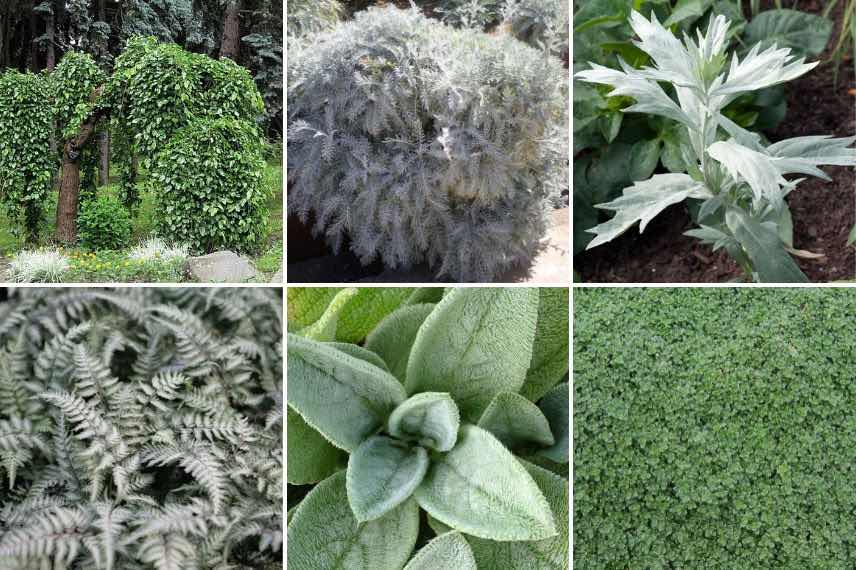
Morus alba ‘Pendula’, Centaurea pulcherrima, Artemisia ludoviciana ‘Valerie Finnis’, Wooly thyme, Stachys byzantina ‘Big Ears’, Athyrium niponicum ‘Pewter Lace’
Bring movement to evoke natural waves and waterways
Grasses ornamental grasses easily create that effect of movement reminiscent of water’s oscillation. Under the influence of the wind, these graceful and light plants sway in beautiful synchronisation, evoking the sea or ocean. Some foliage is also chosen for its resemblance to that of aquatic plants.
Chinese reeds
The Chinese reeds, with their supple foliage and cascading flowering of silver spikes, will enhance the illusion of water.
They thrive in sunny locations, in any type of rather rich and consistently moist (slightly damp) soil. They are quite hardy, surviving temperatures below -20°C.
The Miscanthus sinensis ‘Etincelle’ (1.10 metres tall with a spread of 80 cm) features fine foliage, speckled with golden markings that shine in the sun and can give the impression of dew or water droplets.
Plant them in groups (at least 3 plants) and position them in a breezy location to fully enjoy the natural swaying movement offered by their silhouettes.
Stipa
Highly ornamental, Stipa grasses are perfect for sunny, windy, and dry areas of the garden. These conditions will allow their fine foliage and delicate inflorescences to sway in a wave-like motion.
The small Stipa capillata (60 cm in all directions) will wave its silver tufts in summer, creating light effects reminiscent of water reflections. The Stipa tenuissima ‘Pony Tails’ (45 cm in all directions) forms a true little plant cascade, with its undulating hair. On the side of the Stipa pennata, it is the silver seed spikes at the end of summer that bring a lot of movement. They are equipped with long silky threads that sway at the slightest breeze, creating light effects under the sun.
These plants are quite hardy (-12 to -15°C approximately) and thrive in even poor, well-drained soil.
Pennisetum
These grasses with their brush-like flowers produce cylindrical and feathery blooms, exuding great lightness. These plants also offer a graceful arching silhouette reminiscent of cascading water.
The Pennisetum alopecuroides ‘Gelbstiel’ (approximately 60 cm in all directions) produces flowers borne on golden floral stems, almost shimmering in the sun. Its fine foliage cascades beautifully, complementing the sparkling blooms.
These grasses are grown in sunny locations, in rich, well-draining soil. Their hardiness varies depending on the species.
Other Plants to Add Movement
Also try the diamond grass (1 metre tall with a spread of 50 cm). Its nickname refers to the light reflections observable on the flowers after rain or morning dew.
The love grass (approximately 80 cm in all directions) will transform in summer into a true mist of spikelets.
The Briza maxima (50 cm in all directions) will reward us with undulating foliage and spikelets that can resemble large inverted and trailing droplets.
Finally, some molinies will provide an impression of mist in summer thanks to their airy floral spikes.
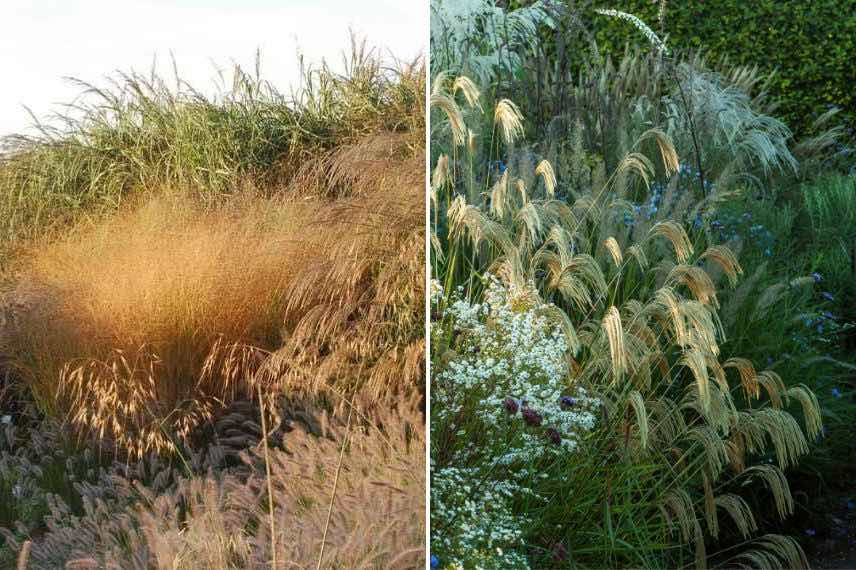
Grasses beautifully illustrate the movements of water
Arranging plants to enhance the evocation of water
Once the plants are chosen, they will be installed to enhance the impression of movement and fluidity. To achieve this, avoid straight lines and flat surfaces, which appear less natural. Install the plants in masses to create volume and prefer a curved arrangement that meanders.
A bank or an artificial mound can also give the impression of an island. By using mineral elements and drawing inspiration from Japanese gardens, create a rockery. It can even be adorned with a groundcover or a climbing plant.
Between the plants, create winding paths reminiscent of a river or any other watercourse. Use pebbles, flat stones, gravel, or small rocks to outline these undulations symbolising water.
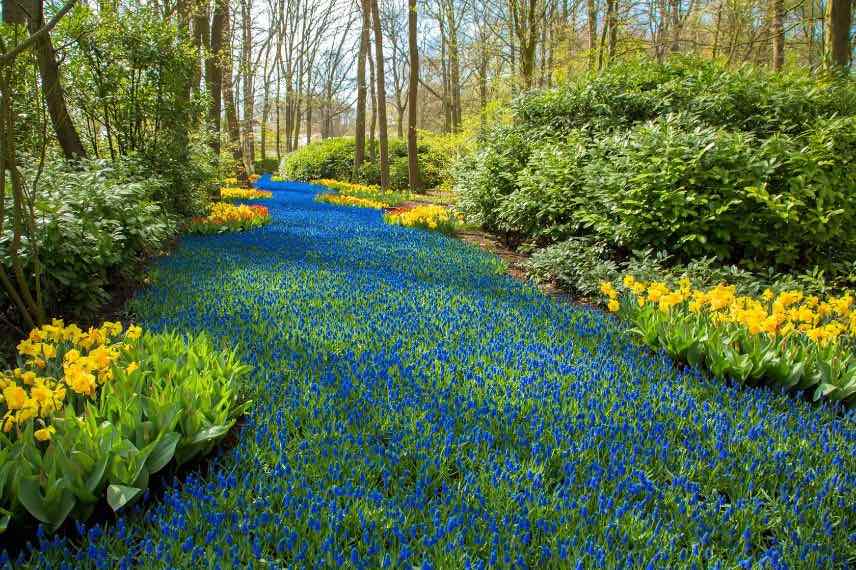
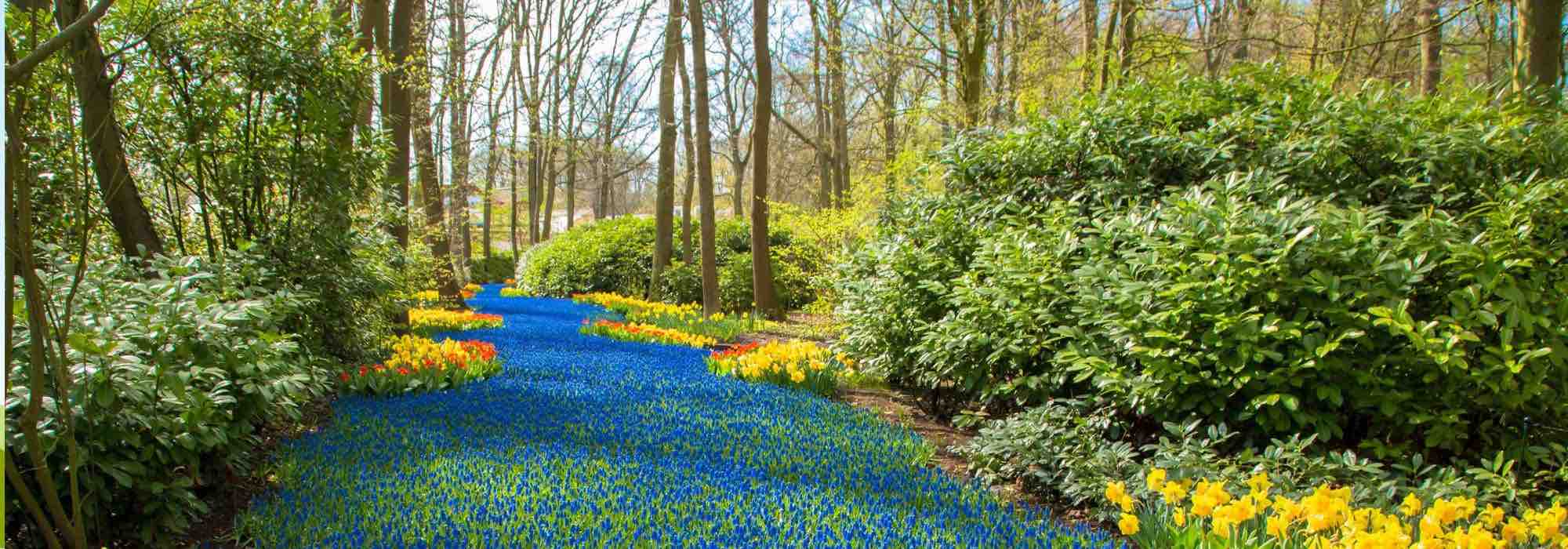
On a large scale, in the forest, a river of muscaris meanders
Add decorative elements to enhance the aquatic effect
You can incorporate various complementary elements alongside your plants that will also reference water.
- Install large pots, basins, or ceramic jars in shades of blue or aquamarine.
- Create decorations using clear resin reminiscent of water, such as a vase in which dried stems, bamboo, etc., can be arranged.
- Add decorative elements related to water: bridge, walkway, boat, mill, well, marine or aquatic animals (frogs, dragonflies, fish, turtles, birds…).
- Incorporate decorations made of driftwood, shells, etc.
- Use glass to play with transparency and light effects evoking water. For example, place ornamental saucers filled with marbles.
- To delineate spaces, rake sandy or gravel areas to create an impression of movement and waves.
- Install a dry riverbed or dry stream. These excavated areas allow for a winding path, sometimes sloping, reminiscent of a natural watercourse. They consist of large stones, pebbles, and/or sand.
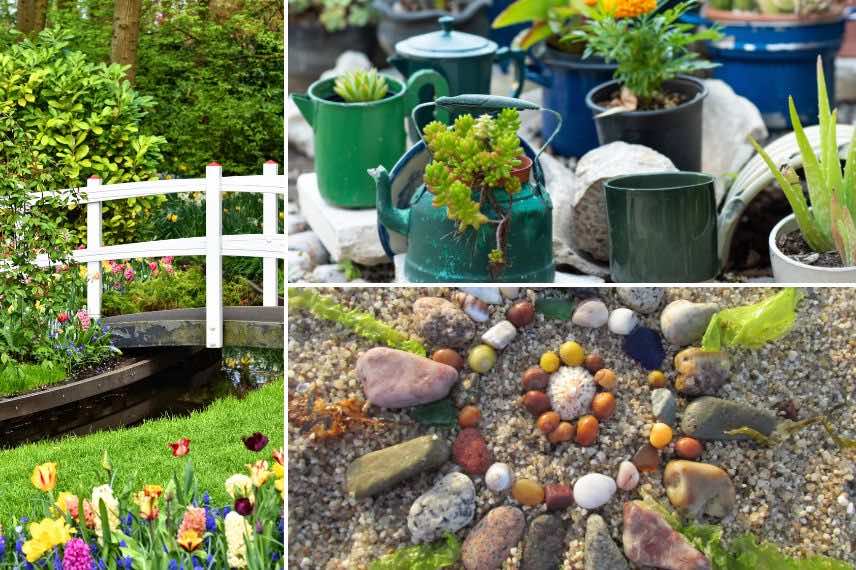
Add decorative elements evocative of water: pots in shades of blue and green, white stones, sand, shells, and pebbles, and even a bridge or walkway
- Subscribe!
- Contents
Comments