


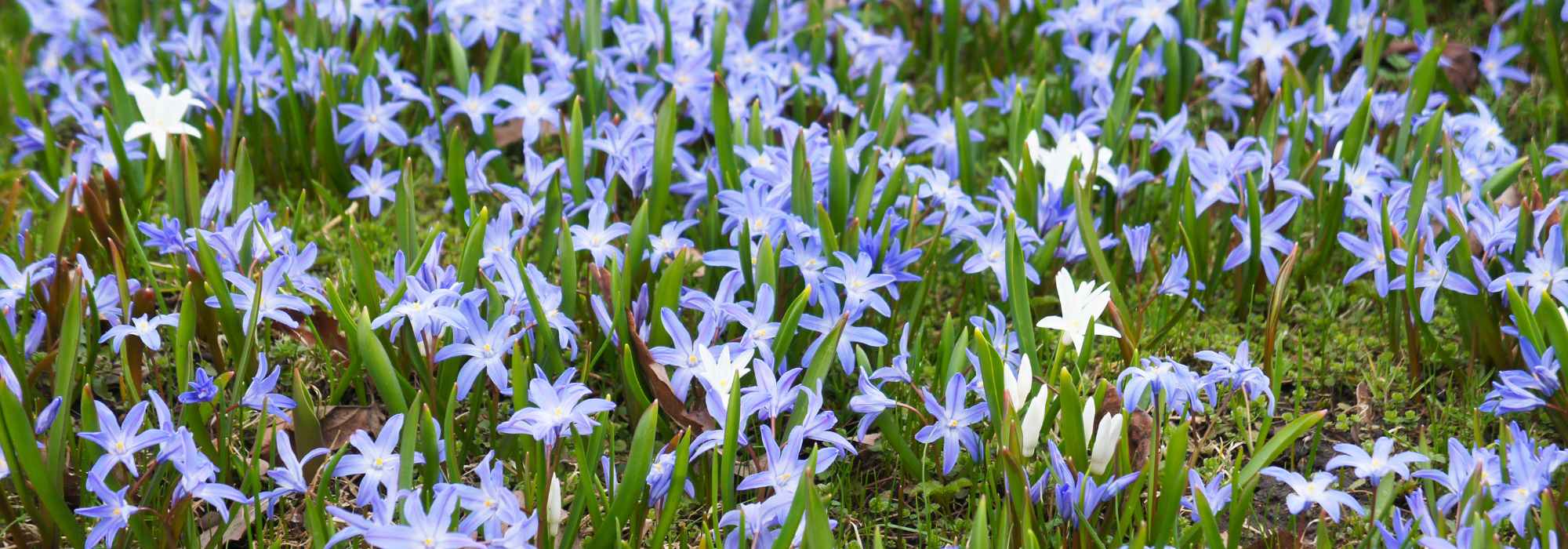
Mass planting of bulbs: why and how?
A single, economical and durable method!
Contents
Spring bulbs or summer bulbs mass planting is a common technique for delivering a strong visual impact across expansive lawns or large borders. Particularly suited to naturalistic gardens and woodland-style settings for spring or autumn bulbs, or lush borders in midsummer, the profusion of flowers produced is a feast for the eyes. Although planting time is inevitably a little longer in the first year, the spectacular and renewed result will delight all gardeners.
How to plant in mass and which bulbs to favour? We cover everything in this guide!
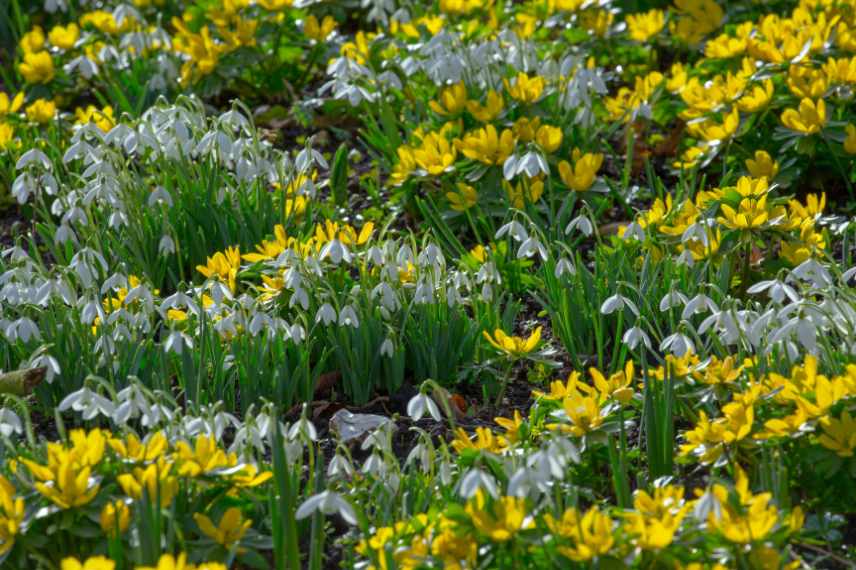
Snowdrops and Eranthis planted in mass, the effect is dazzling

The benefits of mass planting
Aside from the magical and striking sight of hundreds of flowers blooming all at once in the garden, mass-planted bulbs are also economical. A bulk purchase of bulbs always costs less than buying them individually at the per-bulb price.
The other visible benefit of mass-planting small bulbs is their durability in the garden: they return faithfully year after year, as perennial plants do, thickening up and spreading in most cases. This is then referred to as naturalisation for botanical bulbs such as crocus, some narcissi and guinea-fowl fritillaries, or cyclamens, among others. For example, a Chionodoxa produces two bulbs in year 2, then five in year 3, etc. Economical and durable, it’s something we’d welcome more of!
Finally, this mode of cultivation saves time in the long run, because although the initial planting is lengthy, the bulbs won’t need to be wintered and dug up: one planting once and for all, and that’s that.
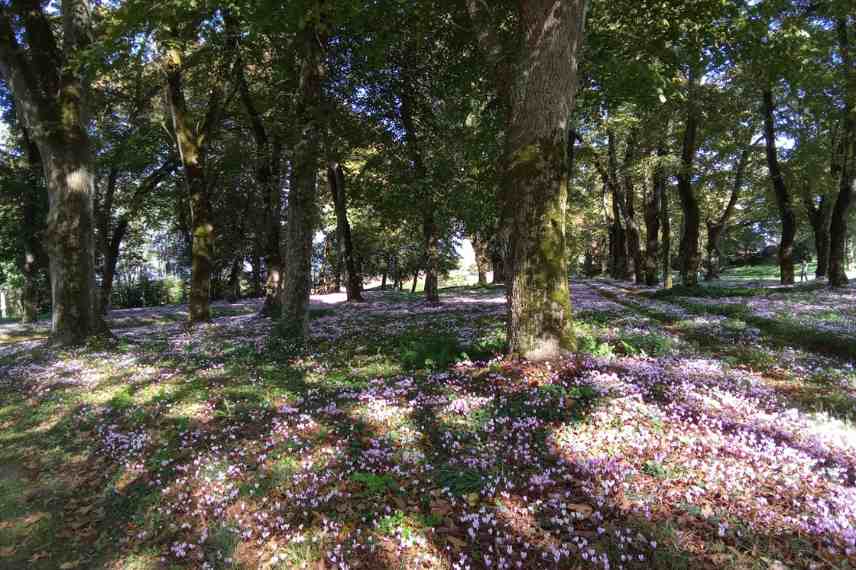
Cyclamens as far as the eye can see in the woodland at Jarzé Castle, (Maine-et-Loire) in France (© Gwenaëlle David Authier)
How many bulbs should you plant, and what planting density should you plan for?
When we talk about mass planting, we mean large quantities… but it all depends on the bulb size, hence the size of the flower. The smallest spring flowers such as snowdrops or cyclamen, for example, are particularly suited for achieving a carpet of colour. Narcissi or tulips create patches of colour that are more intense, and can also be planted in mass.
Mass plantings in hundreds of bulbs are therefore mainly considered for small spring or autumn bulbs, which stay small in size and often low-growing, and which, hardy, can remain in the ground year-round. They benefit greatly from being showcased in this way.
We will also take into account the size of the garden : a park or a small city garden will not require the same number of bulbs to dress a border or the lawn. Obviously one can reproduce a spectacular display in a more limited space.
Concretely :
– Small bulbs (size 4 to 10) are planted in clumps of 3 to 5 per hole. This yields a natural effect of the wildflower meadow type. Count between 75 and 150 bulbs to cover 1 m², depending on bulb size.
⇒ The following are suitable : the Chionodoxa, Cyclamen coum, botanical tulips, scilla, Ipheion, Spanish Hyacinth, snake’s-head fritillary, Autumn Colchicum and Sternbergia, Cyclamen hederifolium, etc. NB. : l’Iris reticulata et l’anémone blanda, bien que petits, requièrent de 15 à 30 bulbes au m2.
– Larger sizes (bulb sizes 10 to 16) are planted individually, but must be planted every 5 cm to obtain a colourful mass. Count a minimum of 50 bulbs to cover 1 m².
⇒ The following are suitable : the tulips, the narcissi, the hyacinths, etc.
– Finally, the large calibres such as the Imperial fritillaries, Scilla peruviana, the “giant” Alliums, Galtonias or Eremurus demandent un trou de plantation important en diamètre et profondeur ainsi qu’un espacement plus important aussi, car ils produisent de grandes fleurs et sont un excellent point focal au jardin. Généralement, vous en planterez 5 ou 6 per m², avec un espacement d’au moins 10 cm.
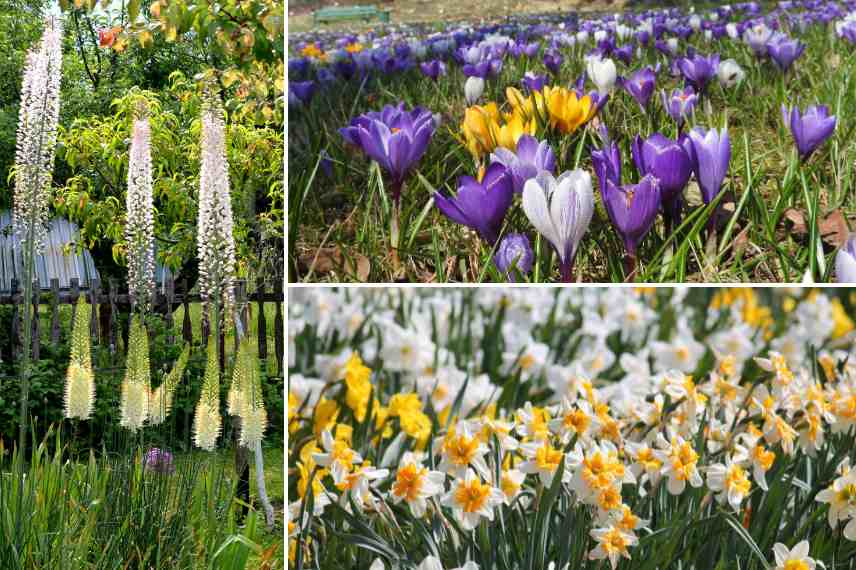
Density of planting varies with bulb size: here Eremurus, crocus and narcissi
→ Also read: Planting density, everything you need to know.
Practical tips for planting bulbs in bulk
Mass planting requires a method and a few specific care steps to work efficiently:
- Soil preparation : the essential criterion, as always, but even more so for our mass planting, because we are planting bulbs that will stay in the ground for good. The soil must be well-drained for all the bulbs, so they do not suffer excessive moisture in winter, which would cause them to rot prematurely. If your soil retains water, add sand to the planting hole to drain and thus prevent rot.
- Planting depth : one always plants at a depth equal to twice the height of the bulb, slightly deeper in sandy soil. Note that uneven depth can sometimes cause irregular flowering and may spoil the mass effect.
- Spacing : the smaller the bulbs, the closer the planting will be. Mass planting requires a higher density than traditional planting. Refer to the planting guidance on the bulb pack, reducing it: for example for guinea-fowl fritillaries, instead of 75 bulbs per m², plan for 90 bulbs, and plant at 5 cm apart instead of 10 cm.
- Method : on a lawn or in the grass, one often advises to scatter the bulbs randomly for a natural look. This is ideal for bulbs that will naturalise. Plant the bulbs where they fell. Do the same for a woodland area. However, in a border, we tend to create “spots”, and there you can plant the bulbs in groups of about thirty, which usually results in beautiful colour spots.
For tools, a bulb planter or bulb dibber with a handle is ideal, often more practical than the bulb trowel, which does not adapt to hard soils.
Insert the bulbs into the planting hole, upright, taking care of the planting orientation. Do not compact the soil too much. Crumble the soil removed over the bulbs and gently firm with your foot. - Time to devote : hard to give an average here, as small bulbs are planted more quickly due to the shallower and smaller hole. But allow about three minutes per hole, when your soil is loose and easy to work. By excavating the planting area to a depth of 20 cm, you move ahead more quickly; this suits well for creating colour spots on the woodland edge or in a border, for example.
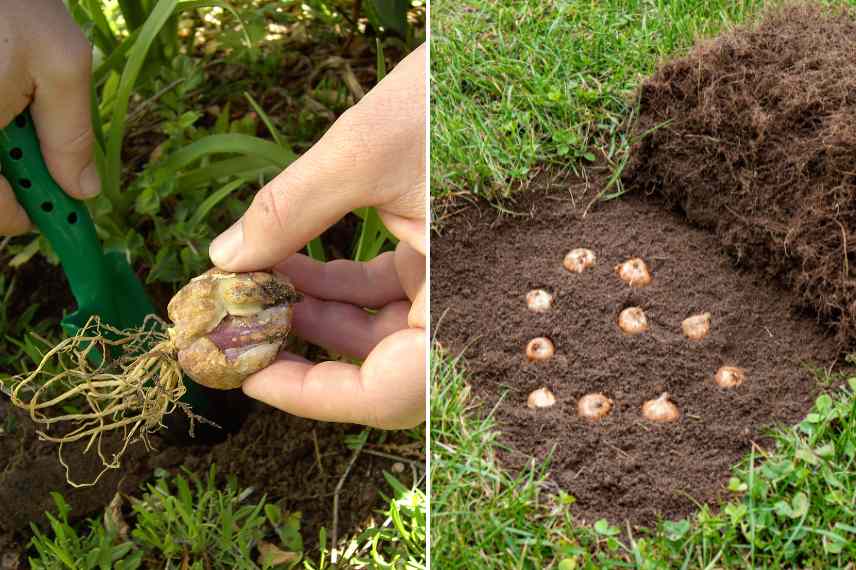
Bulb-by-bulb or grouped, depends on the area you have to plant
Tips for caring for and prolonging flowering
The bulb is an underground storage organ that allows the plant to regenerate. The foliage, which emerges after the flowering period, plays a key role in helping to replenish the reserves stored in the bulb. If bulbs are planted in a lawn, you should not mow immediately after flowering, to allow the plant time to replenish its reserves. About six weeks after flowering, mowing should take place. This typically coincides with the first mowing in April, when early-winter bulbs have been planted—the earliest of them.
When planted in a border, bulbs are traditionally mixed with perennial plants, a deciduous groundcover, or other later bulbs that will take over once flowering has finished.
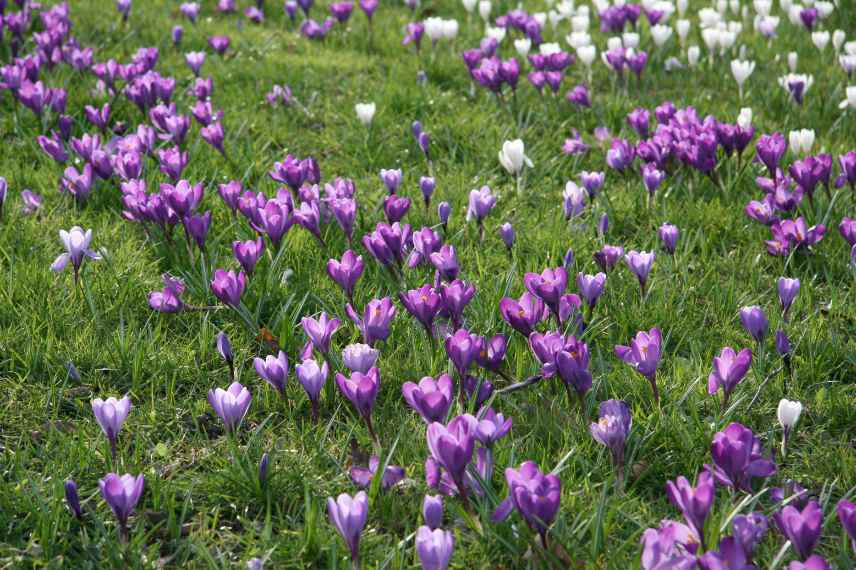
When bulbs carpet a lawn, you’ll need to be patient for the first mowing!
- Subscribe!
- Contents
Comments