





























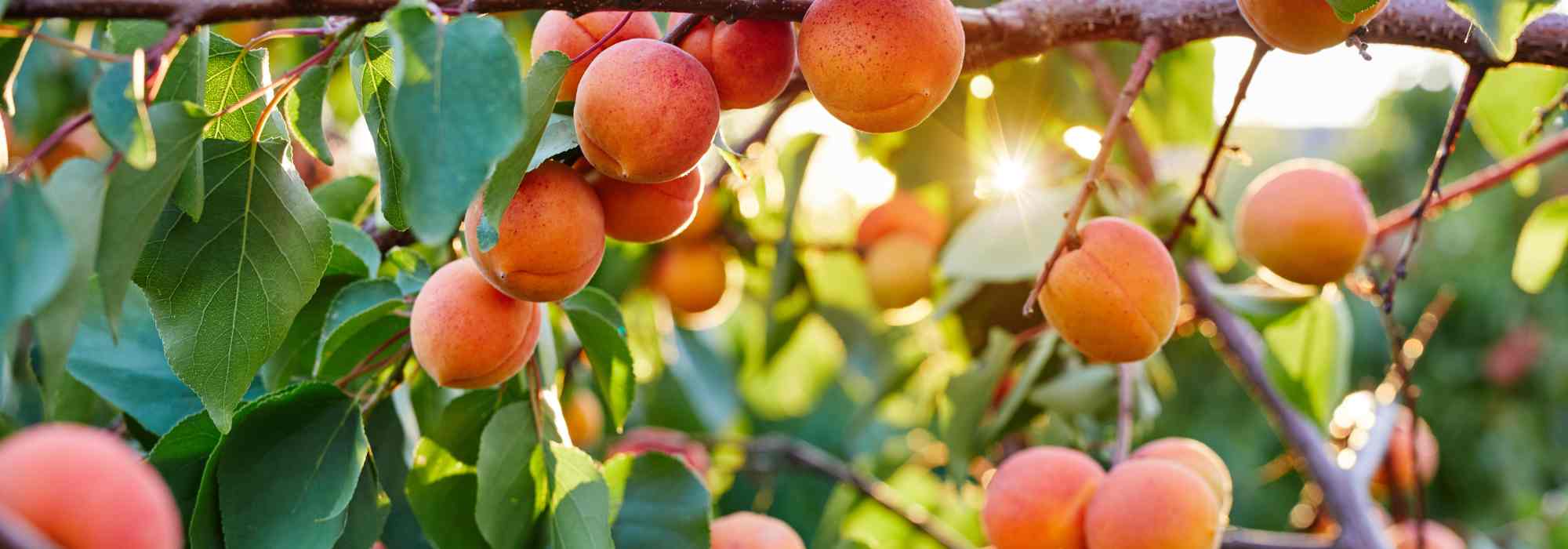
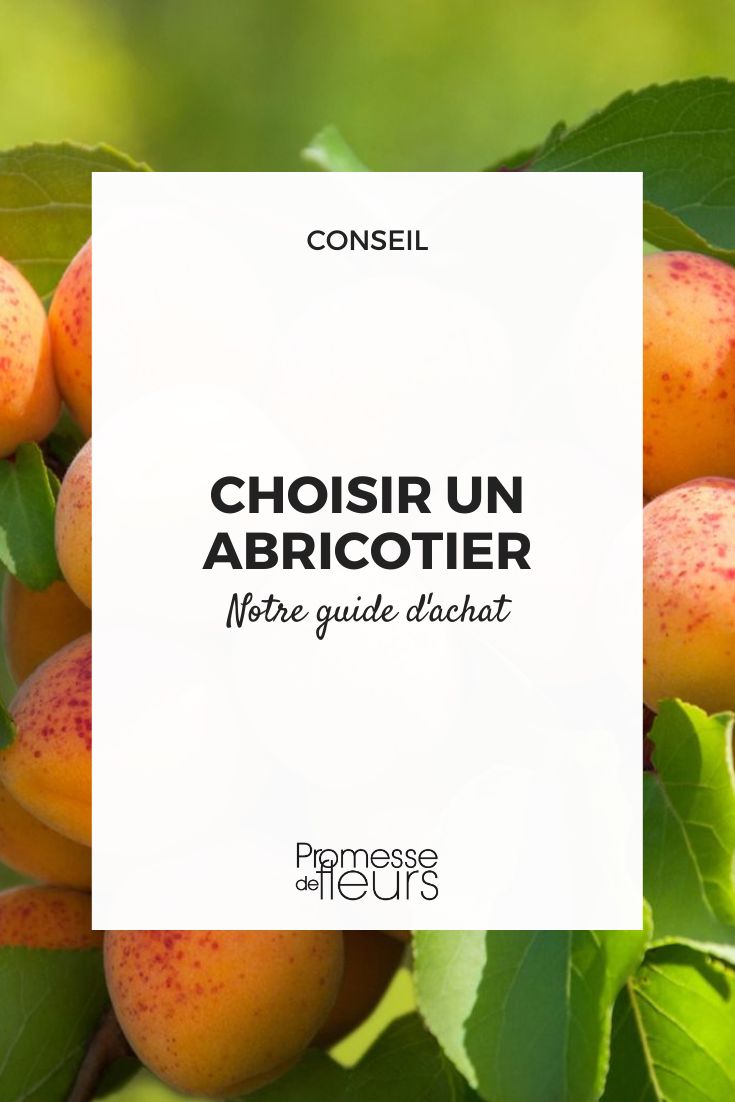
Choosing an apricot tree: the ultimate guide
All our tips for selecting the apricot tree variety that best suits your criteria
Contents
Because of its warmth and sun requirements, the apricot tree (Prunus armeniaca) is undeniably a quintessential fruit tree in southern France. Notably, it tolerates drought and is particularly sensitive to humidity. And, at the same time, its early flowering, which occurs just after the almond tree’s flowering, can be damaged by late-spring frosts. Nevertheless, some apricot varieties can be planted further north in the country, provided they have a very sunny position and, above all, are well sheltered from cold winds. A wall planting is ideal; you can espalier it to maximise its chances.
Thrives in all soil types, except overly damp or clayey soils, and can be planted in a garden or an orchard, or on a balcony or terrace for dwarf varieties. However, it takes 3 to 4 years to bear fruit, and, above all, to achieve a good yield.
If you would like to plant an apricot tree in your garden, discover our tips for choosing the best variety for your region, your garden, or your fruit preferences.
For more information: Apricot tree: planting, pruning and care.

Depending on the growing region
The apricot tree is a fruit tree with excellent hardiness (down to -20°C). It also requires a cold period below 7°C lasting 400 to 600 hours per year. Nevertheless, it is more of a southern-climate tree, as its pretty white or pink flowers, particularly delicate, appear as early as March for some varieties. Spring frosts can be detrimental to fruiting. In southern France, early-flowering varieties will therefore be preferred such as ‘Muscat de Nancy’, a variety that yields apricots with Muscat flavour, with orange skin speckled with red, and with a fine, melting flesh, slightly musky. It is moreover one of the earliest varieties.
The apricot tree ‘Rouge du Roussillon’ is also particularly suited to regions with mild winters: its fruits to be harvested mid-July are perfect for jams and tarts. As for the variety ‘Bulida’, it produces large-fruited, juicy and sweet apricots from the beginning of June.
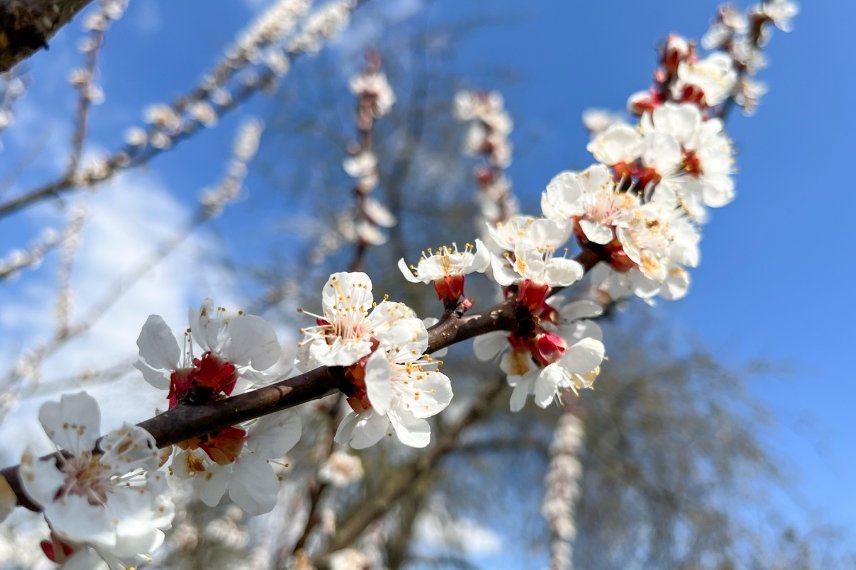
Apricot tree flowers are early, hence susceptible to frost. That is why, in half the country, it is preferable to plant late-flowering varieties such as ‘Tardif de Tain’ or ‘Rouge Tardif’
If you live in the northern half of the country, you can perfectly enjoy picking beautiful apricots, firm and sweet. Provided you choose late-flowering varieties. Thus, spring frost risks will be less to fear. Likewise, you should plant this apricot tree due south to maximise heat, and above all in a very sheltered position, for example protected by the house façade. Among the least sensitive to spring frost, the variety ‘Tardif de Tain’ stands out. Flowering occurs in April and the fruit harvest runs from late July to August. ‘Doucœur’ and ‘Rustique des Pyrénées’ also flower quite late and bear fruit in mid-August. Their apricots are not very large but delicious with a soft, fragrant flesh.
The apricot tree ‘Rouge Tardif Delbard’ also flowers late, at the end of March, with fruit maturity in August. The variety ‘Luizet’, created in 1839 in Écully in the Rhône, is particularly suited to continental climates to such an extent that its production is lower in regions with mild climates. ‘Orange Summer’ is certainly one of the latest varieties, as large-fruited apricots are harvested from late August to early September. Luizet (requires winter cold). Finally, the well-known ‘Bergeron’, widely grown in the Rhône valley, is characterised by the resistance of its flowers to late frost. This variety, moreover, does enjoy a little cold. The large fruits with a tangy flavour reach maturity in mid-July.
Read also
Apricot tree: the best varietiesDepending on the size of your garden
The apricot tree forms a ramified silhouette and a rounded habit that spreads with time. It is also of great elegance thanks to the reddish colour of its bark, very ornamental with its lenticels running across it. At maturity, an apricot tree hardly exceeds 6 m in height with a spread of about 3 m. That said, it is easy to fit into a large garden or an orchard where planting is done every 6 m.
Those with a small garden, or simply a terrace or even a balcony, may opt for dwarf apricot trees. These small trees are also perfectly suited to pot planting. Despite their compact size, they are just as productive. The variety Garden Aprigold is a benchmark in the category. With a height of one metre and a 60 cm spread, it will fit into the smallest spaces. Selected in the United States, this variety produces apricots of excellent flavour, with golden-yellow skin and orange flesh, about 5 cm in diameter.
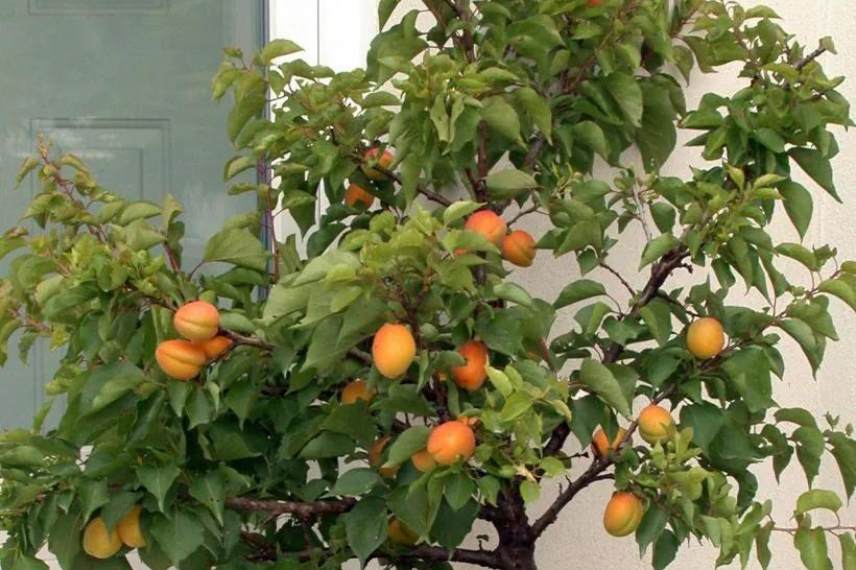
The Garden Aprigold variety grows perfectly well in a pot on a balcony or terrace
In the recent Breton range Fruit me®, ‘Apricot me’ stands out for fruiting from the first year and its compact dimensions: 2 m tall and 1.50 m wide. Although it is small, this apricot tree offers large red-orange fruits with a firm and juicy texture.
The variety Compacta leaves little doubt as to its morphology. It is a dwarf apricot tree, 2 m tall and 1.50 m wide, which proves very productive. It is easy to grow in a pot and practically requires no pruning. The dwarf form of the common apricot, Nanum or Nana, also tolerates pot planting very well on a large balcony or terrace. At maturity, it reaches 3 m tall with a 2.50 m spread. Its early flowering makes it more suited to regions with mild climates.
Depending on the flavour and how the fruits are used
Biting into a juicy, sweet apricot is a gustatory delight. Thus, the variety ‘Bergeron’ owes its popularity to its large fruits with a slightly tangy taste and firm flesh. This apricot can be enjoyed at table, but also in preserves or pastries. Another apricot tree bears fruit that is slightly tangy. It is the variety ‘Goldrich’, an American creation from 1954. The ‘Goldrich’ apricots are large-fruited, somewhat elongated in shape, very juicy and well suited to cooking.
The apricots of ‘Bulida’ have firm flesh. As with the fruits of the variety ‘Hargrand’ (partially self-fertile, which therefore requires the presence of another pollinating variety) whose orange flesh is firm, sweet and of excellent eating quality.
The flesh of the variety ‘Polonais’ is also notable for its flavour. It is fine and melts in the mouth, juicy and very fragrant. However, it can be somewhat delicate. The apricots of the variety ‘Rouge du Roussillon’ also show a certain fragility, hence a short shelf life. But they compensate for this drawback with their melt-in-the-mouth, fragrant, very aromatic and sweet flesh. These are apricots that allow the making of excellent jams or tarts. For pastries or for eating fresh, one can also choose the variety ‘Précoce de Saumur’ with medium-sized orange fruits, with flesh that is not very juicy but sweet and fragrant.
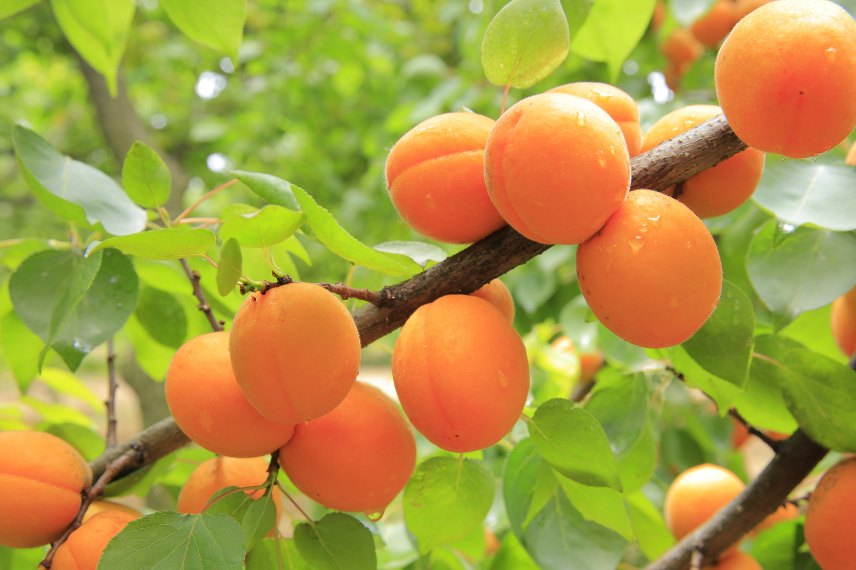
Depending on the variety, apricot flesh can be more or less tart, melt-in-the-mouth or fragrant
To finish this selection, the apricot tree ‘Pêche de Nancy’ comes up trumps. This very old variety produces large oval fruits with orange skin, speckled with carmine-red dots on the sun-facing side. Its flesh, almost yellow, is juicy, sweet, with a muscat flavour, and above all very tender, which makes it easy to detach from the stone.
Read also
Apricot tree: planting, pruning and careAccording to the yield
Polonais and Rouge du Roussillon are particularly productive, as is Royal, derived from Pêche de Nancy and bred in 1808 in the Luxembourg gardens in Paris. This variety was presented to the king in 1825. It bears a plentiful crop of large round fruits, pale yellow speckled with red, with good flavour due to their soft, melt-in-the-mouth flesh. They are perfect apricots for preserves.
In terms of productivity, the Spanish-origin variety Canino can also be mentioned, offering large oblong fruits, 4.5 to 5.5 cm in diameter, with a lovely yellow-orange colour. Their flesh is sweet, juicy and perfumed.
Adapted to regions with mild winters, the ‘Rouge du Roussillon’ variety is particularly productive,[/caption]
- Subscribe!
- Contents
Comments