





























Pairing Phormium
5 atmospheres to create with New Zealand Flax
Contents
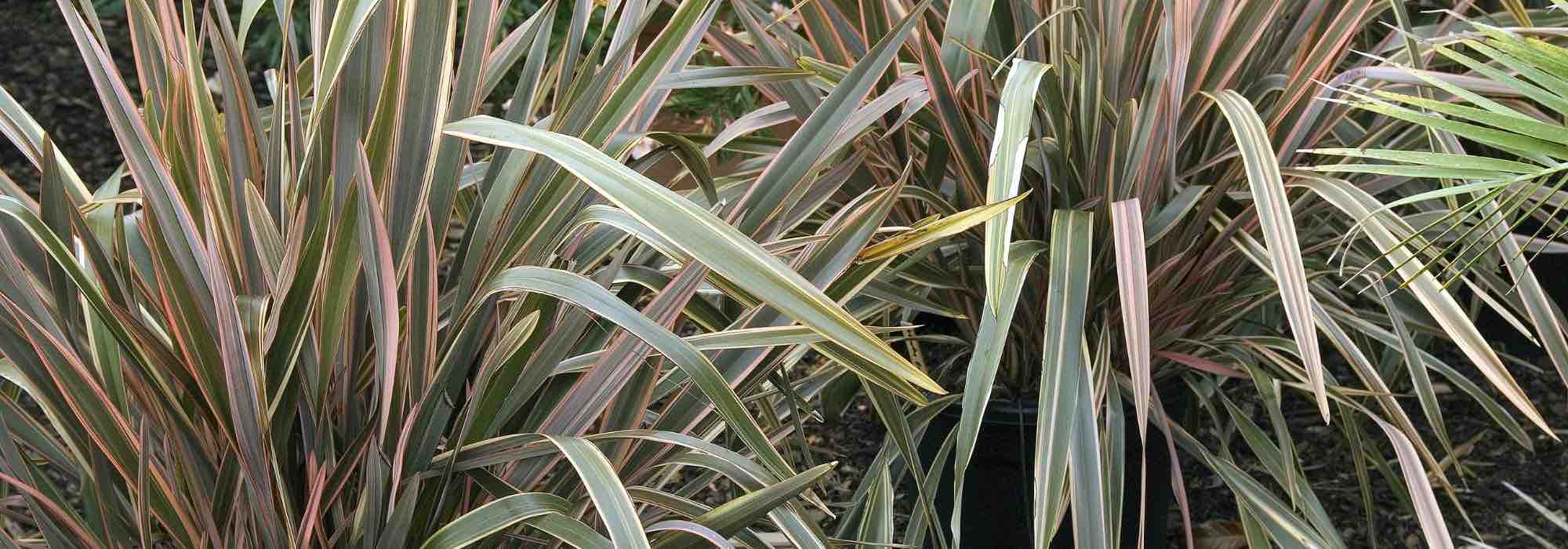
The New Zealand Flax or Phormium are large perennials whose dimensions, behaviour, and habit often lead them to be regarded as true bushes. Featuring evergreen, thick, and fibrous sword-shaped foliage, Phormium tenax typically reaches heights of around 2m to 2.5m in our gardens, while Phormium cookianum and some hybrids are more modest in size. The clump, with its upright then more or less spreading habit, makes a very structural plant with a strong presence, regardless of the season. The unique summer flowering, borne on tall spikes, adds to the ornamental interest of its foliage, which comes in a wide range of colours and shades depending on the varieties. Preferring full sun, thriving in fresh soil but well-suited to drought once established, Phormium is, however, best reserved for relatively mild regions. The plant begins to suffer as soon as temperatures drop below -7°C. It is, on the other hand, an easy-care perennial, wind-resistant, and its graphic form can be utilised in numerous designs: modern and graphic associations with grasses, winter compositions with incredible colours, or soft autumn borders in warm tones, exotic gardens that transport you, or a strong element in a border for a seaside garden. I therefore invite you to discover 5 pairing ideas to showcase your Phormium and welcome it into your garden.

Architectural association with perennials and grasses
One of the qualities of Phormium is their architectural silhouette. Emphasise this graphic quality in a bed dedicated to this theme, which pairs very well with a modern house featuring clean lines. Select one or two Phormium by playing with their size and hues. The typical green-leaved species or a variegated Phormium ‘Variegatum’ can be placed at the back of your bed, while smaller varieties like Phormium ‘Special Red’ or ‘Margaret Jones’ are installed more towards the front. Echo the upright form of New Zealand Flax through grasses whose finer foliage changes with the seasons, adding lightness and movement: Calamagrostis, Panicum, Andropogon or Molinia are perfect for this use. Contrast these upright forms with other grasses that have a more spreading and open habit, such as those offered by Pennisetum, Muhlenbergia rigens or smaller Miscanthus varieties (such as ‘Cute One’ and ‘Gnome’, which are among the shortest). Outline the foreground with Fescues with bristly and evergreen clumps and bring forth some large perennials that will stand out in this arrangement, such as Kniphofia with their cylindrical spikes in warm colours and Eryngium that offer stunning silver-blue hues on striking but spiky foliage.
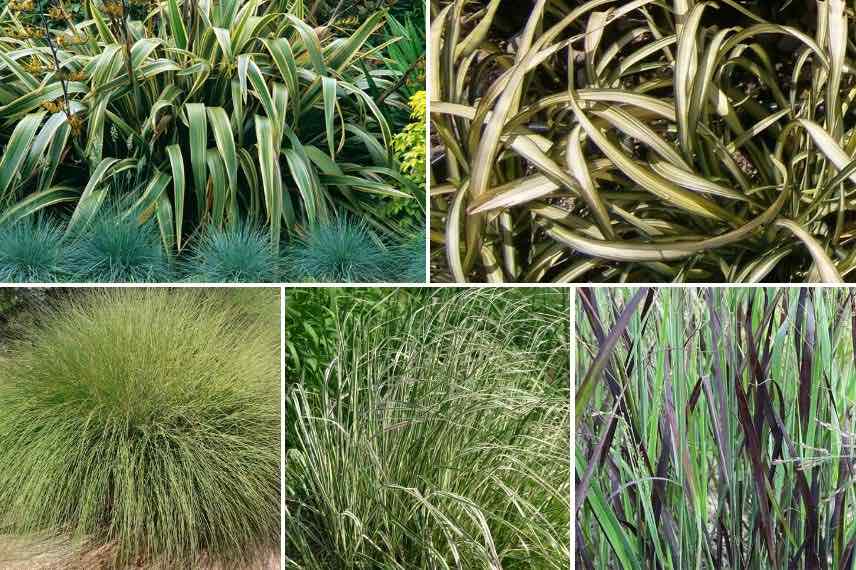
Clockwise: Phormium tenax ‘Variegata’ in front of a bed of Festuca glauca, Phormium cookianum ‘Blondie’, Panicum virgatum ‘Blue Darkness’, Calamagostis acutiflora ‘Overdam’ and Muhlenbergia rigens
A vibrant winter flower bed
Phormium are evergreen perennials and their presence is therefore affirmed all year round, including in winter. Create a very colourful and cheerful border in the “bad” season by planting a variety such as Phormium ‘Jester’ with pink, bronze, and green leaves or ‘Pink Panther’, which has similar hues. Place it alongside a Himalayan Birch with pure white bark and decorative Dogwoods whose vibrant colours provide cheerful bursts, even under the greyest skies: Cornus sanguinea ‘Midwinter Fire’ for bright orange stems that are almost fluorescent, Cornus sericea ‘Flaviramea’ for a bright yellow, and Cornus alba ‘Bâton Rouge’ for an intense red. Complete with some evergreen plants with decorative foliage, such as Nandina domestica ‘Fire Power’ with a fairly regular rounded habit and bright red foliage in cold weather, a Pittosporum tenuifolium ‘Tom Thumb’ with dark purplish hues (best suited for mild climates), and a Ligustrum ovalifolium ‘Lemon and Lime’ with small golden yellow foliage that is semi-evergreen depending on winter severity. You can also opt for dwarf conifers whose foliage can come in various shades of green as well as blue, silver, yellow, or variegated. Finish with a few Hellebores for generous flowering and some grasses whose culms often take on straw-like tones in this season, harmonising with all their neighbours (Pennisetum, Miscanthus, Panicum).
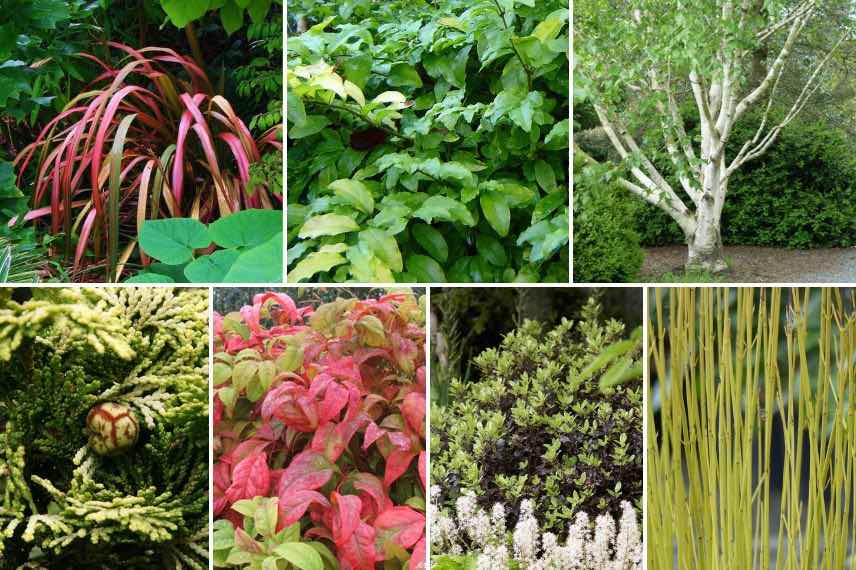
Clockwise from top: Phormium ‘Jester’, Ligustrum ‘Lemon and Lime’, Betula utilis var. jacquemontii, Cornus sericea ‘Flaviramea’, Pittosporum tenuifolium ‘Tom Thumb’, Nandina domestica ‘Fire Power’, a dwarf Chamaecyparis with golden foliage
Discover other Phormium
View all →
Available in 0 sizes
Available in 1 sizes
Available in 2 sizes

Available in 1 sizes
Available in 1 sizes
Available in 2 sizes
Available in 2 sizes
Available in 3 sizes
Available in 2 sizes
Available in 2 sizes
Autumn blend in warm tones
Persisting, Phormium lends itself to displays for all seasons. The foliage of many deciduous trees and bushes ignites in autumn. You can choose to follow this trend with varieties like Phormium ‘Flamingo’, with green and pink foliage, or ‘Rainbow Sunrise’, which blends pink, olive green, and bronze green, or conversely play on contrasts with the dark, almost black foliage of Phormium ‘Black Adder’ or that of a bronze-purple Phormium like ‘Purpureum’, whose silhouettes stand out boldly against the autumnal red, yellow, or orange adornments of their neighbours. Regarding flaming foliage in late season, the choice is vast! Among the small-growing subjects, suitable for small city gardens, we can mention the Dwarf Winged Spindle, pink-red and dome-shaped, numerous Dogwoods whose tones vary according to species and varieties, the essential Japanese Maples (in rather acidic soil), or even Viburnums. If you are fortunate enough to have more space, consider Liquidambar, the Tulip Tree, Nyssa (in cool soil), or even large maples like Acer freemanii ‘Autumn Blaze’. Some grasses stand out, both for their silhouettes and their late-season colours or their ability to dance elegantly in the wind. Also essential, late-flowering perennials such as Asters, Sedums, Eupatoriums, Japanese Anemones, or Liriopes. Among the bulbous plants, be surprised by Sternbergia, Colchicums, and Naples Cyclamen.
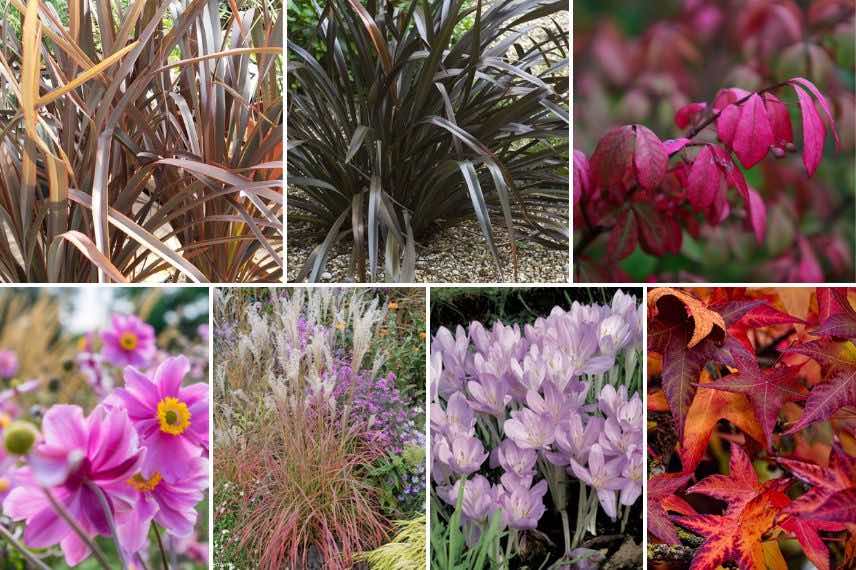
Clockwise: Phormium tenax ‘Purpureum’, Phormium cookianum ‘Black Adder’, Euonymus alatus ‘Compactus’, Liquidambar styraciflua ‘Palo Alto’, Colchicum cilicium, Miscanthus ‘Little Miss’, and Asters, Anemone tomentosa ‘Serenade’
An exotic bed to escape
Due to its New Zealand origins, Phormium naturally lends itself to the composition of exotic-inspired displays. In this regard, pair it for example with a Chinese Windmill Palm, one of the hardiest in the genus. Bamboos with colourful canes can serve as a backdrop, and you need not worry about losing control if you opt for non-running varieties. Featuring strap-like foliage, Beschorneria develops a long flower spike in late spring, just before the equally unique flowering of Phormium. Extend the presence of colour with Canna. Some varieties are just as interesting for their foliage as for their flowering. To integrate diversity in leaf shape, and if your soil is sufficiently cool, opt for a Tetrapanax papyrifera ‘Rex’ with its immense palmate leaves or a false aralia (the bright foliage of Fatsia japonica ‘Spider’s Web’ is widely splashed with cream). Evoking distant lands, Hedychium are “wild gingers” with beautiful summer to autumn flowering in fragrant clusters of warm hues. To dress the base of these structural plants, install Heucheras that offer an incredible palette of colours, from Hakonechloa with a graceful habit (in consistently cool soil) to Ophiopogon whose certain varieties, like Ophiopogon planiscapus ‘Nigrescens’, slowly form a carpet of intensely black leaves.
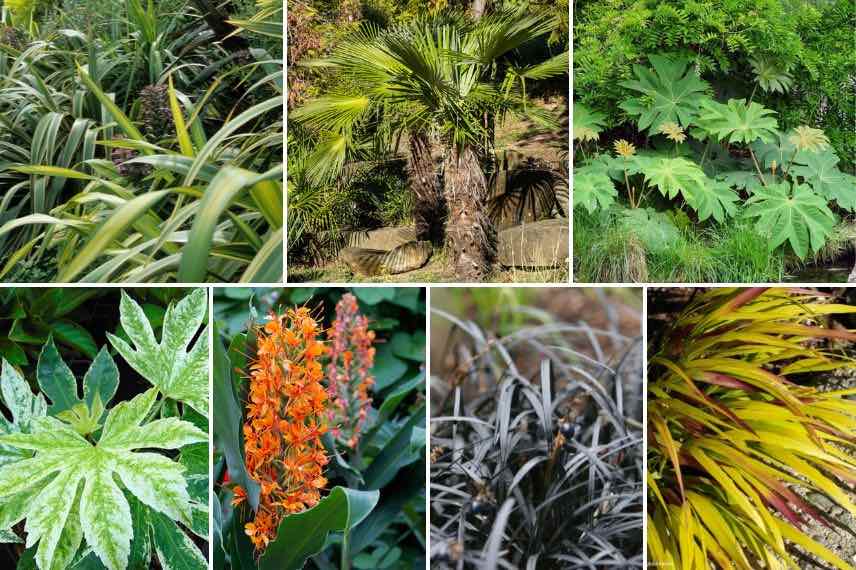
Clockwise from top: Phormium, Trachycarpus fortunei, Tetrapanax papyrifera Rex, Hakonechloa macra ‘Sunflare’, Ophiopogon planiscapus ‘Nigrescens’, Hedychium coccineum Tara, Fatsia japonica ‘Spider’s Web’
In a coastal garden with a holiday vibe
Coastal gardens are exposed to wind and spray, conditions that can be challenging for plants but are well tolerated by Phormium, especially since they appreciate the mildness and good humidity that are generally present in these regions. Imagine a group of three New Zealand Flaxes arranged in a triangle, selected for their remarkable hues: Phormium ‘Sundowner’ for its bronze-green leaves edged with salmon pink, ‘Alison Blackman’ with its lovely olive green adorned with cream and pink bands, and ‘Apricot Queen’ showcasing its dominant green streaked with bronze, red, and apricot. In the background, create a backdrop using a Palm (Trachycarpus fortunei or Phoenix canariensis for example), a Banana Plant, a Cordyline, and a large Callistemon with its curious bottlebrush flowers. In the midst of your New Zealand Flaxes, interspace a few clumps of Agapanthus, Crocosmias, Kniphofia, and Canna, mixed with grasses such as Angel Hair, Sand Reed, and Chinese fountain grass. In the foreground, set your display against a border where the blood-red foliage of Imperata cylindrica ‘Red Baron’ can mingle with the fine bronze foliage of a Carex bronze, the blue to violet flowers of Calaminthes, and a few clumps of Erigeron that are always in bloom.
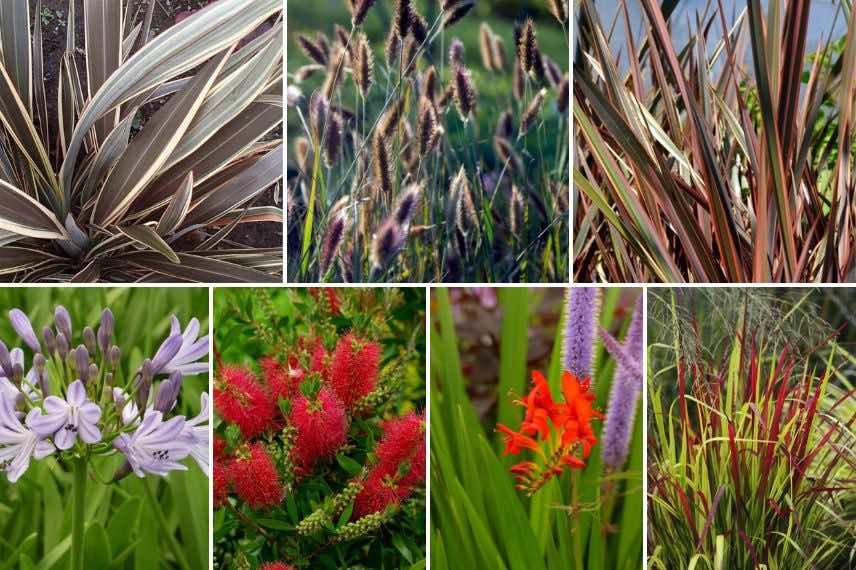
Clockwise from top: Phormium ‘Alison Blackman’, Pennisetum ‘Red Bunny Tails’, Phormium ‘Sundowner’, Imperata cylindrica ‘Red Baron’, Crocosmia ‘Lucifer’, Callistemon laevis, Agapanthus ‘Megan’s Mauve’
For further reading...
→ Discover our wide range of Phormium in our online nursery!
→ Everything you need to know about Phormium: planting, growing, and maintaining it.
→ Choosing a Phormium according to your region, all our tips.
- Subscribe!
- Contents
Comments