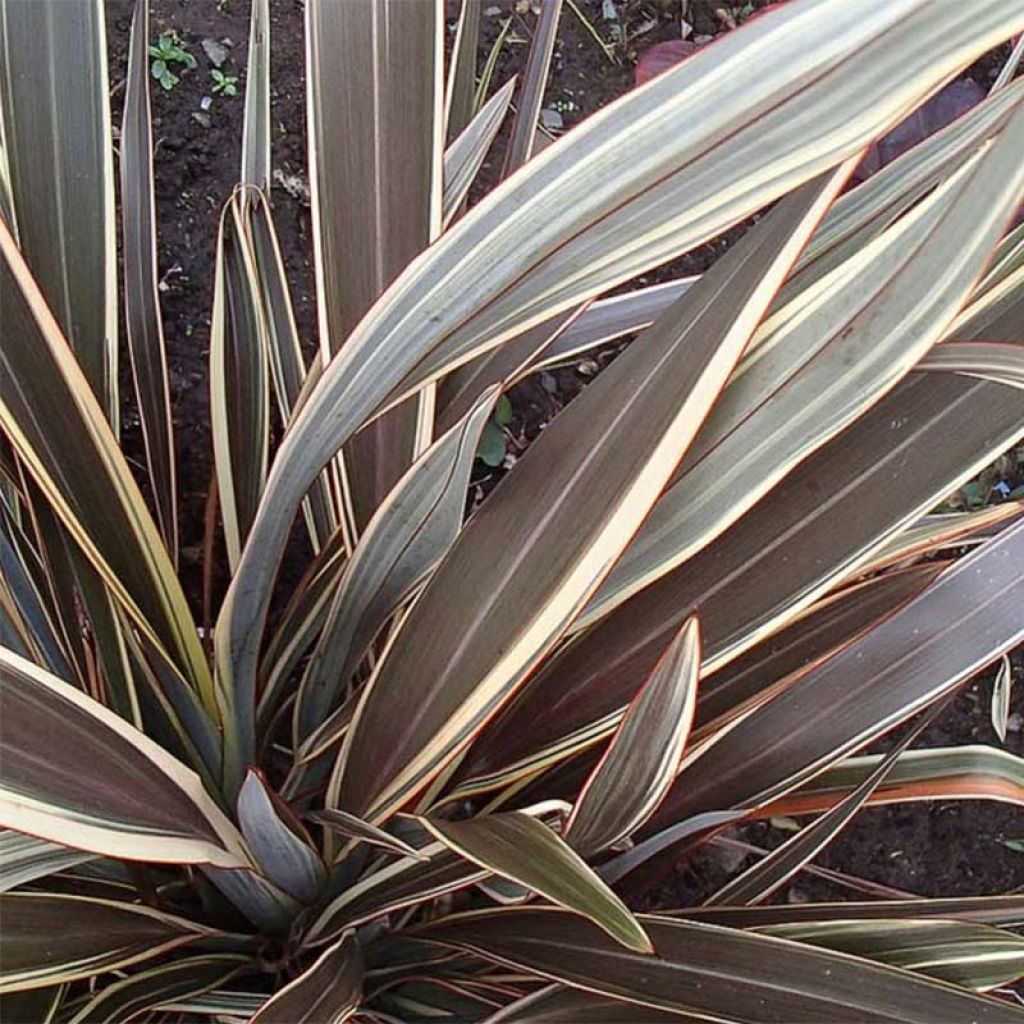
Phormium tenax Alison Blackman - New Zealand Flax
Phormium tenax Alison Blackman - New Zealand Flax
Phormium x tenax Alison Blackman®
New Zealand Flax, Flax Lily
Label indicating the received colour is green and yellow, of good quality.
Jean-Pierre L., 20/07/2018
Back-to-school special offer!
Get €10 off for every €50 you spend! And get up to €40 off on a single order.
How does it work?
1. Shop your favourites
Add your favourite plants to your basket. For every €50 you spend (excluding delivery charges, store credit and the plastic-free option), you’ll receive a €10 voucher.
€50 spent = €10 voucher
€100 spent = €20 voucher
€150 spent = €30 voucher
€200 spent = €40 voucher
2. Place your order
Once your basket reaches one of the spending thresholds, place your order. You can even choose your delivery date!
3. Receive your voucher
As soon as your order has been shipped, you’ll receive an email containing your personal voucher code and its value.
4. Use it on your next order
Your voucher is valid for 90 days from the date you receive it. It can be used once only, on a new order worth at least the value of the voucher, excluding delivery charges.
Please note: Vouchers can be combined with other offers, but cannot be split or refunded.
Home or relay delivery (depending on size and destination)
Important: You may be charged customs duties by your country’s customs authorities upon delivery.
Schedule delivery date,
and select date in basket
This plant carries a 12 months recovery warranty
More information
We guarantee the quality of our plants for a full growing cycle, and will replace at our expense any plant that fails to recover under normal climatic and planting conditions.

Would this plant suit my garden?
Set up your Plantfit profile →
Description
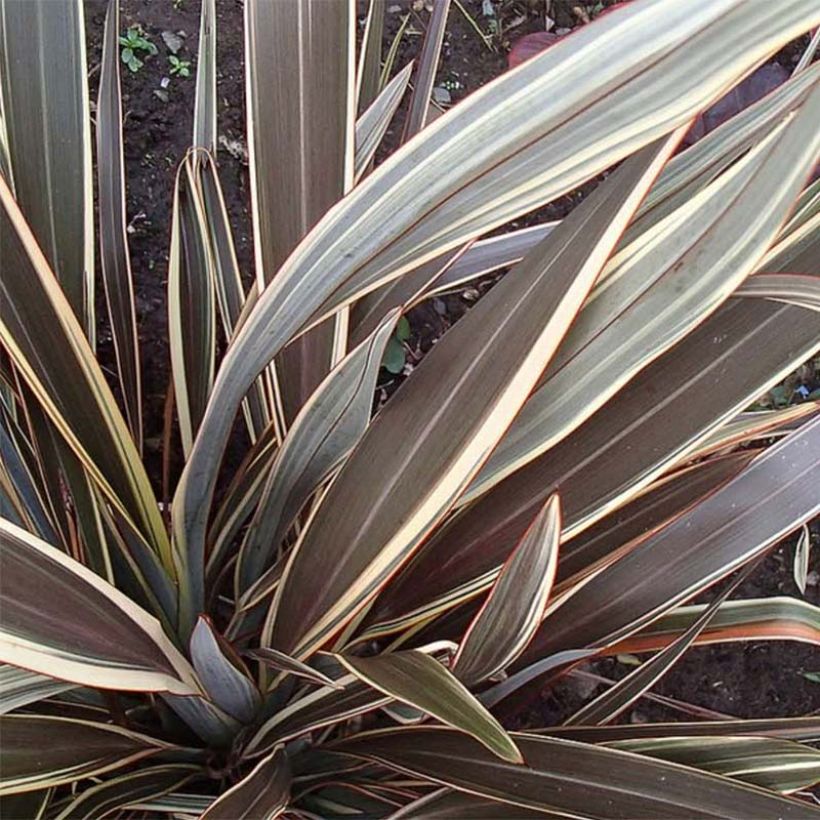
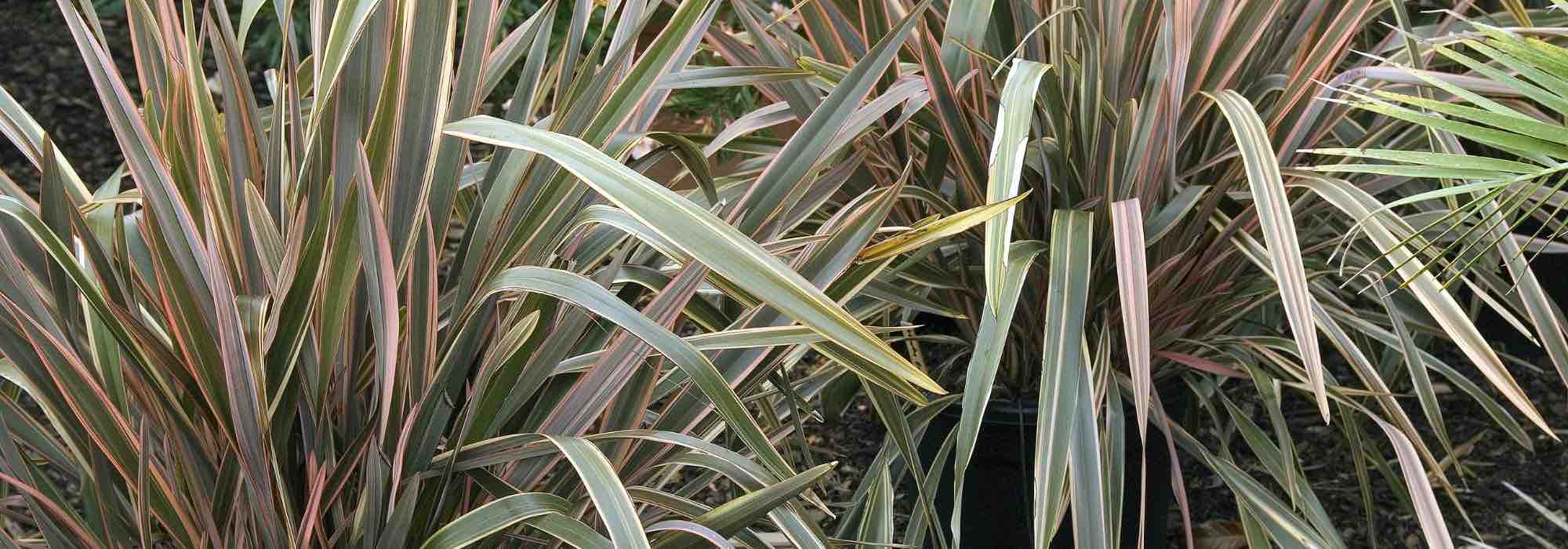
The Phormium 'Alison Blackman' is a recent variety of New Zealand Flax with an unprecedented color that will turn many heads. Tall, with a play of light and shadow, exotic in appearance yet adorned with subtle shades, this large evergreen perennial consists of long narrow leaves that blend different dark and pastel tones, creating a more nostalgic than sad symphony of colours, combining bronze-green, brown, gold, and rose-tinted apricot. Phormiums are splendid perennials for mild climates, unfortunately not very hardy. Whether planted individually or in mass, this very graphic plant is ideal for coastal regions. It will also thrive in a large container, to be overwintered in a cool climate.
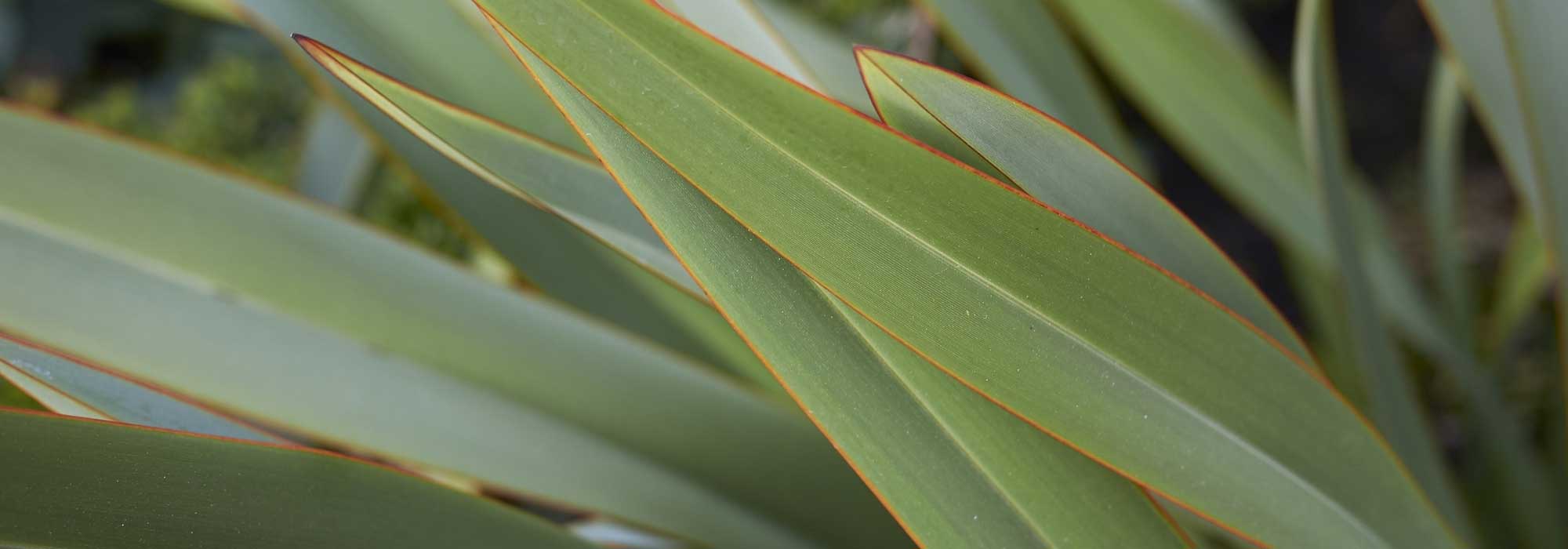
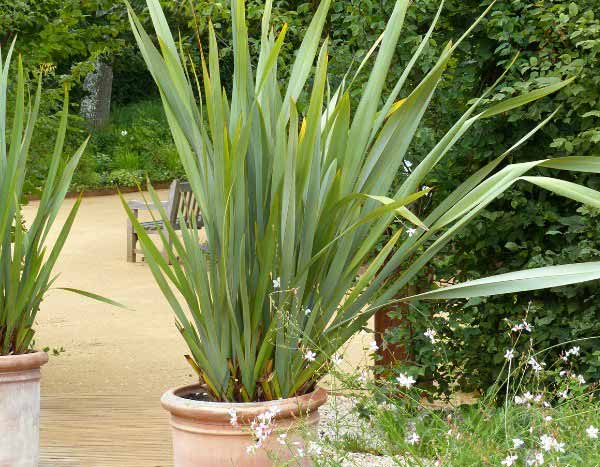
The New Zealand Flax 'Alison Blackman' belongs to the agave family. It is a recent horticultural creation resulting, among others, from the Phormium tenax, the larger of the two New Zealand species. This superb rhizomatous perennial develops into a wide non-spreading clump. With an upright and arching habit, it reaches approximately 1.20m (4ft) in all directions, depending on the growing conditions. The leaves are rather narrow (less than 5cm (2in)), slightly arched, very long, somewhat rigid, arched and pointed at their tips, remarkably variegated, ranging from olive green to randomly streaked yellow and cream, with fine borders of pink-red. While the foliage is the main asset of this perennial, its flowering, when it occurs, is not to be ignored. Tall floral stems of at least 1.50m (5ft) appear from May to July, depending on the climate, towering above the clump of foliage. They are green tinged with purple, in the form of curved tube-like flower spikes, which turn varying shades of bright red when mature. This flowering attracts certain birds and numerous pollinating insects.
This Phormium is a plant of great ornamental value, suitable for large beds or rockeries in mild climates. Whether used individually or in groups, it structures the space and adds a very exotic charm to the garden. Like tall grasses, it is also a wonderful perennial for a modern garden with clean lines. In colder regions, it can be planted in a very large pot on the terrace or balcony, and overwintered frost-free in a cold greenhouse or a slightly heated conservatory. In an urban garden, it softens concrete structures. For an exotic and contrasting atmosphere, it can be paired, for example, with Leptospermum scoparium, a pink to red ball-shaped flower in summer, Helichrysum rosmarinifolium 'Silver Jubilee', Pittosporum tenuifolium Tom Thumb, or even Olearia macrodonta 'Major', plants also from Oceania, perfect for coastal areas.
The Maoris use Phormiums as we use flax, for their fibres which are exploited in the textile industry. This ability probably gave them the vernacular name 'New Zealand Flax'.
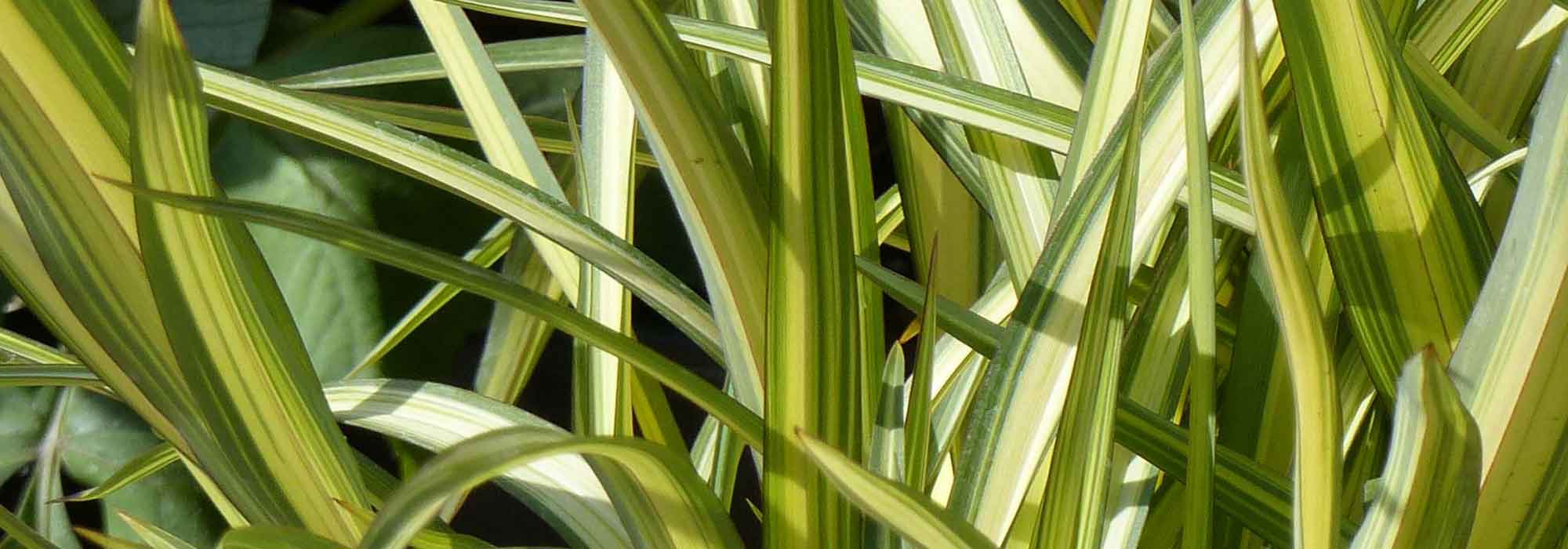
Phormium tenax Alison Blackman - New Zealand Flax in pictures
Flowering
Foliage
Plant habit
Botanical data
Phormium
x tenax
Alison Blackman®
Asphodelaceae
New Zealand Flax, Flax Lily
Cultivar or hybrid
Planting and care
The Phormium tenax 'Alison Blackman' is a hardy plant that will be grown in open ground mainly in regions where frosts do not drop below -7°C (19.4°F). Everywhere else, pot cultivation is more suitable, which will allow wintering sheltered from frost, in a cool and bright room.
Plant your Phormium in a container or a large pot with the bottom filled with gravel, pottery shards or clay balls. The mixture it receives should be fertile and well-draining (1/3 leaf compost, 1/3 compost, and 1/3 ordinary garden soil).
Place the plant in full sun. Water abundantly during the growing season so that the soil never completely dries out. Feed the plant with fertilizer once a month. In winter, reduce water and fertilizer inputs, and let the soil dry superficially between waterings.
In regions with a mild climate and light frosts, plant the Phormium in open ground, in the sun, in a well-drained and fertile soil.
In summer, make sure the plant does not lack water. In winter, it will rely on rainwater.
In case of severe frost forecasted, install a thick mulch at the base of the plant and cover it with a winter veil.
In the coldest regions, a thick mulch will help protect the roots from frost in winter.
Planting period
Intended location
Care
Planting & care advice
-
-
-
-

-
-
-
-
-
, onOrder confirmed
Reply from on Promesse de fleurs
Recently viewed products
Haven't found what you were looking for?
Hardiness is the lowest winter temperature a plant can endure without suffering serious damage or even dying. However, hardiness is affected by location (a sheltered area, such as a patio), protection (winter cover) and soil type (hardiness is improved by well-drained soil).

The flowering period indicated on our website applies to countries and regions located in USDA zone 8 (France, the United Kingdom, Ireland, the Netherlands, etc.)
It will vary according to where you live:- In zones 9 to 10 (Italy, Spain, Greece, etc.), flowering will occur about 2 to 4 weeks earlier.
- In zones 6 to 7 (Germany, Poland, Slovenia, and lower mountainous regions), flowering will be delayed by 2 to 3 weeks.
- In zone 5 (Central Europe, Scandinavia), blooming will be delayed by 3 to 5 weeks.
In temperate climates, pruning of spring-flowering shrubs (forsythia, spireas, etc.) should be done just after flowering.
Pruning of summer-flowering shrubs (Indian Lilac, Perovskia, etc.) can be done in winter or spring.
In cold regions as well as with frost-sensitive plants, avoid pruning too early when severe frosts may still occur.
The planting period indicated on our website applies to countries and regions located in USDA zone 8 (France, United Kingdom, Ireland, Netherlands).
It will vary according to where you live:
- In Mediterranean zones (Marseille, Madrid, Milan, etc.), autumn and winter are the best planting periods.
- In continental zones (Strasbourg, Munich, Vienna, etc.), delay planting by 2 to 3 weeks in spring and bring it forward by 2 to 4 weeks in autumn.
- In mountainous regions (the Alps, Pyrenees, Carpathians, etc.), it is best to plant in late spring (May-June) or late summer (August-September).
The harvesting period indicated on our website applies to countries and regions in USDA zone 8 (France, England, Ireland, the Netherlands).
In colder areas (Scandinavia, Poland, Austria...) fruit and vegetable harvests are likely to be delayed by 3-4 weeks.
In warmer areas (Italy, Spain, Greece, etc.), harvesting will probably take place earlier, depending on weather conditions.
The sowing periods indicated on our website apply to countries and regions within USDA Zone 8 (France, UK, Ireland, Netherlands).
In colder areas (Scandinavia, Poland, Austria...), delay any outdoor sowing by 3-4 weeks, or sow under glass.
In warmer climes (Italy, Spain, Greece, etc.), bring outdoor sowing forward by a few weeks.
Shipping country and language
Your country of residence may be:
Your country of residence is:
For a better user experience on our website, you can select:
Your shipping country:
-
 Austria
-
 Belgium
-
 Bosnia & Herzegovina
-
 Bulgaria
-
 Croatia
-
 Cyprus
-
 Czechia
-
 Denmark
-
 Estonia
-
 Finland
-
 France
-
 Germany
-
 Greece
-
 Hungary
-
 Iceland
-
 Ireland
-
 Italy
Italy
-
 Latvia
-
 Liechtenstein
-
 Lithuania
-
 Luxembourg
-
 Malta
Malta
-
 Netherlands
-
 Poland
-
 Portugal
-
 Romania
-
 Serbia
-
 Slovakia
-
 Slovenia
-
 Spain
Spain
-
 Sweden
-
 Switzerland
Language:
-
French
-
 English
-
Spanish
-
Italian
-
German
-
Portuguese
-
Dutch
-
Finnish
My Account
Hello
My wish lists
My cart
Log in / Register
Existing customer?
This form is protected by reCAPTCHA - the Google Privacy Policy and Terms of Service apply.
New customer?
Create an account to track your orders, access our customer service and, if you wish, make the most of our upcoming offers.