





























Pairing ideas with shrubby Salvias
7 ideas to invite shrubby sage into the ornamental garden
Contents
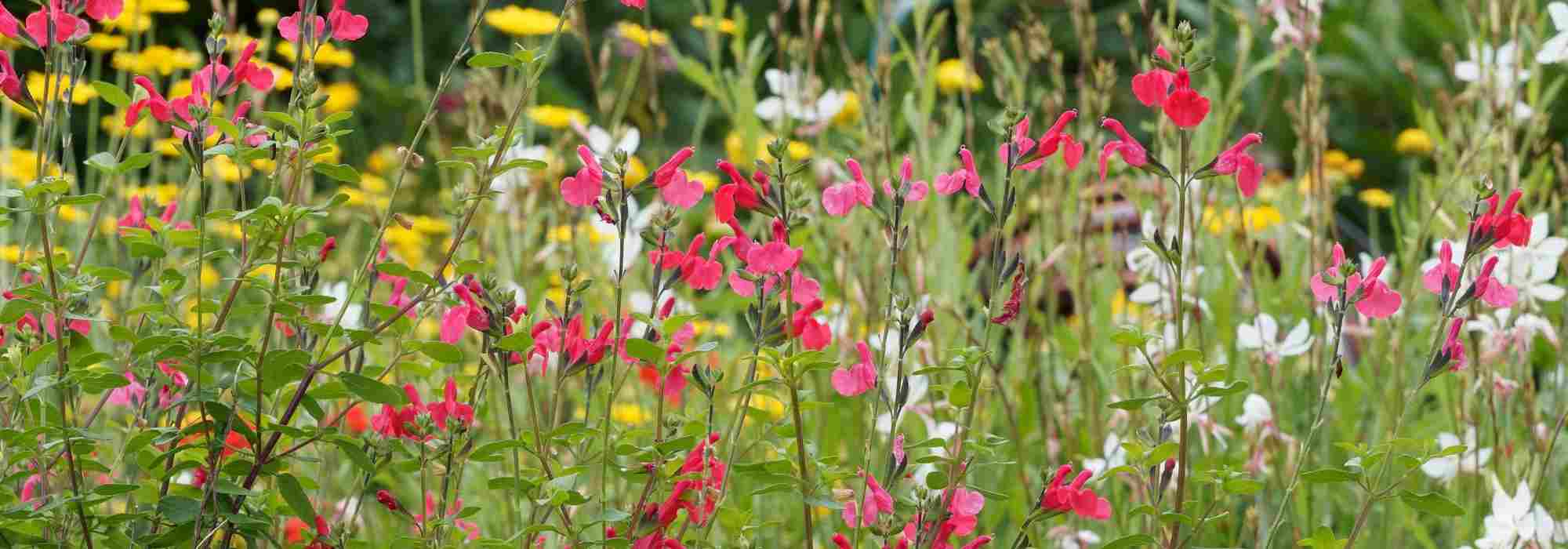
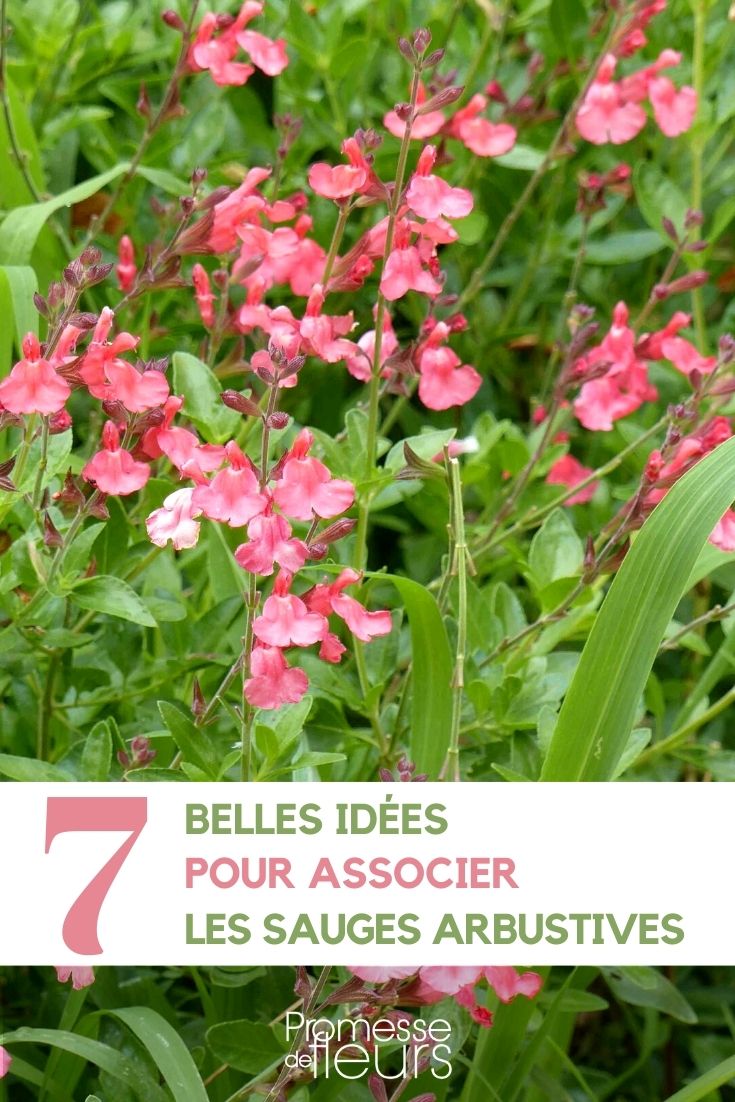
With its long summer flowering, the bushy sage is one of the stars of the garden from late spring to frost. The wide variety of cultivars allows this robust, carefree young plant to be combined in warm or pastel scenes depending on its colour, in large spaces or more intimate areas of the garden.
Have you fallen for a bushy sage, a Salvia microphylla, Salvia greigii, or Salvia grahamii and are unsure what other plant to pair it with? There is definitely a place for it in a border or on the terrace, especially as its bushy and airy habit thrives wherever it receives sun and warmth.
Here are some ideas to inspire you!

In a dry garden
Shrubby sage, whether you choose to plant a Salvia microphylla or a Salvia grahamii, loves the sun. As it also requires well-drained soil to thrive, and especially to avoid suffering in winter, it is perfectly suited to join a few plants in a dry garden. This could be a sunny rockery, a scree garden, or even beds covered with mineral mulch.
For this use in a mineral garden, play with blue and cream or yellow tones, along with some blue-tinged foliage: the jamensis ‘Lemon Light’ shrubby sage will mingle with Eryngiums or Echinops ritro, a ruta graveolens, Anthemis tinctoria, and a Miscanthus sinensis ‘Yaku Jima’ for a large dry garden. A few clumps of Festuca mairei with evergreen foliage will enhance the impression of a dry garden. To keep this dry garden visually appealing in spring and autumn, add some staggered flowering plants like Eremerus ‘Pinokkio’ in orange, which will provide beautiful verticality in spring, and for autumn, blue touches with Asters amellus ‘King George’ and the golden yellow of Ajania pacifica. In many regions, you can also incorporate a beautiful small agave, such as the Agave havardiana.
You can also combine it with the beautiful and undemanding desert sage (Salvia pachyphylla) in a garden with pink and blue tones. This shrubby sage will also be an ideal choice in a no-water garden.
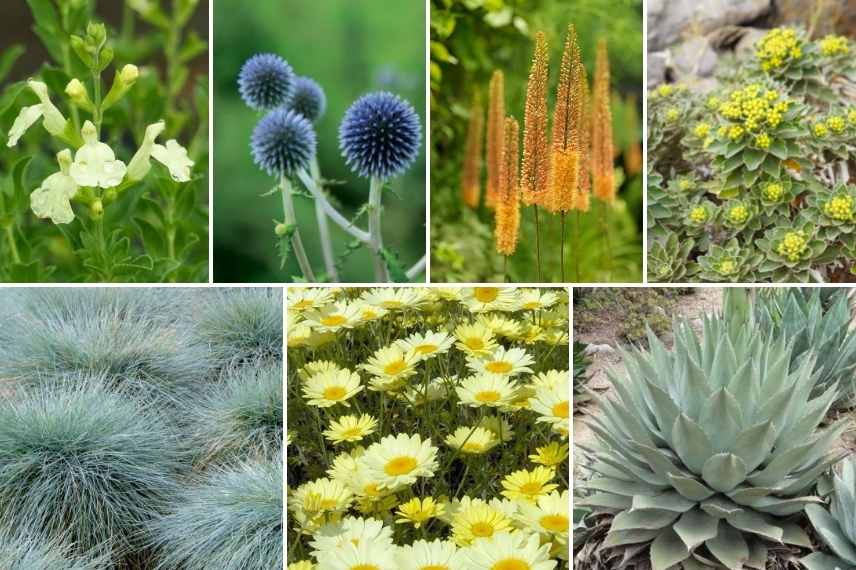
Salvia jamensis ‘Lemon Light’, Echinops ritro, Eremurus ‘Pinokkio’, Ajania pacifica, blue fescues, Anthemis tinctoria, and Agave havardiana
Read also
Shrubby sages: planting and care tipsIn an English mixed border
In a large garden where there is the opportunity to insert some beautiful mixed borders of the English type, bush salvias create colourful masses with a palette that allows for all sorts of creativity. These salvias will always blend well within a wide flowerbed with perennials, groundcovers, and a few taller bushes.
A bush salvia with soft, salmon tones like the magical ‘Ribambelle’ or the salvia jamensis ‘Melen’ works wonders in a mixed border that plays with pastel shades, while more vibrant red and purple salvias like ‘Royal Bumble’ will thrive in a lively summer display.
In our example, Salvia microphylla ‘Ribambelle’ gracefully accompanies tall Sidalcea malviflora and Geranium ‘Rozanne’, which bloom as long as it does. Insert some tall plants like grasses, such as Miscanthus nepalensis with its stunning broom-like spikes. In spring, a Rosa gallica officinalis will unfurl its myriad of carmine roses. In summer, lupins or delphiniums will take over in an explosion of blues, whites, and pinks.
Enhance the blurred aspect of this composition with the fresh, spring-like flowering of Alchemilla, which will provide its beautiful foliage throughout the summer.
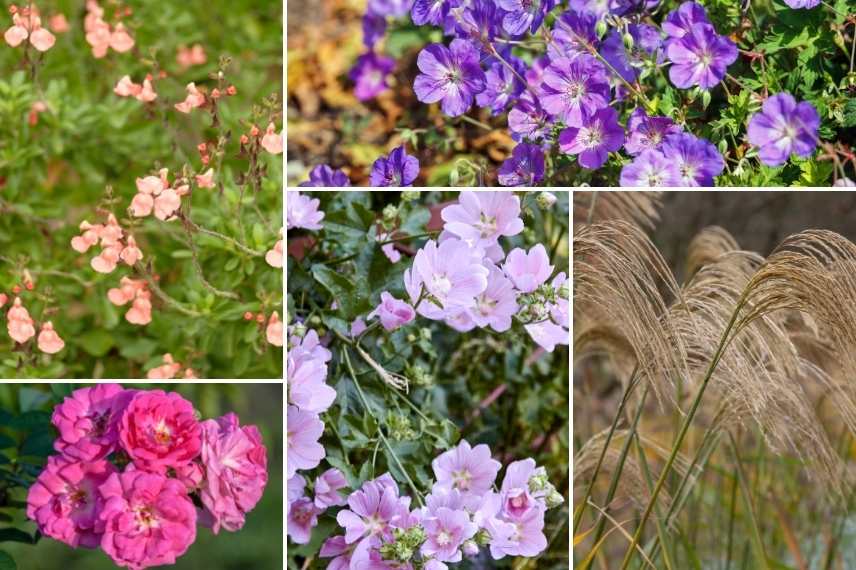
Salvia ‘Ribambelle’, Hardy Geranium ‘Rozanne’, Rosa gallica officinalis, Sidalcea malviflora, and Miscanthus nepalensis
Discover other Salvia - Bushy Sage
View all →
Available in 3 sizes
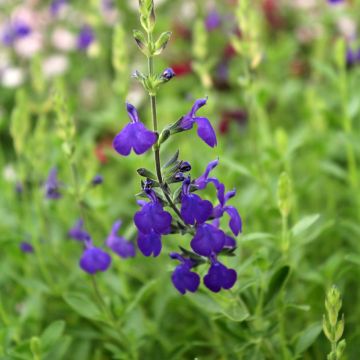
Available in 2 sizes
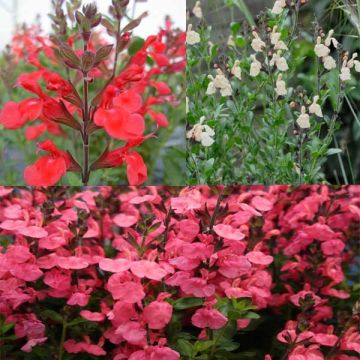
Available in 0 sizes
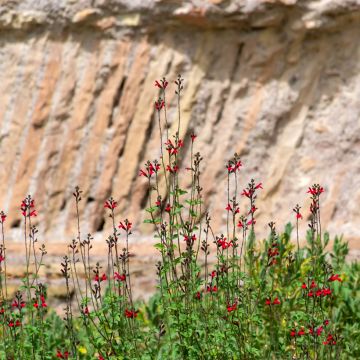
Available in 3 sizes
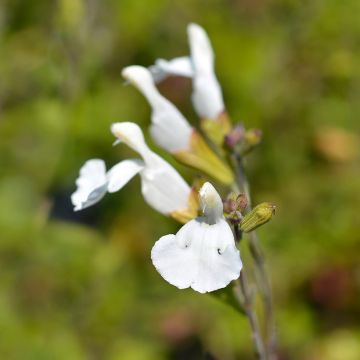
Available in 2 sizes
Available in 3 sizes
Available in 2 sizes
Available in 3 sizes
Available in 2 sizes
Available in 3 sizes
In a misty duo
Light and airy by nature, with its inflorescences emerging along the stems, the shrub sage is very graceful when paired with feathery inflorescences such as the silky spikes of certain grasses. The contrast between the small, brightly coloured flowers of a sage in vivid shades like cherry pink in the ‘Cerro Potosi’ shrub sage or the bicolour red of a ‘Hot Lips’ sage is striking against Chinese fountain grasses alopecuroides or Pennisetum orientale: the long, creamy, fluffy plumes highlight the sages against a very soft straw-coloured background.
One can create a duo with a single grass or combine two grasses (Pennisetum villosum and Stipa, for example, to bring a lot of movement and delicacy, or with a Deschampsia cespitosa and its fluffy spikes). The idea is to choose grasses of a height roughly similar to the sage to form homogeneous cushions and create a very natural-looking space.
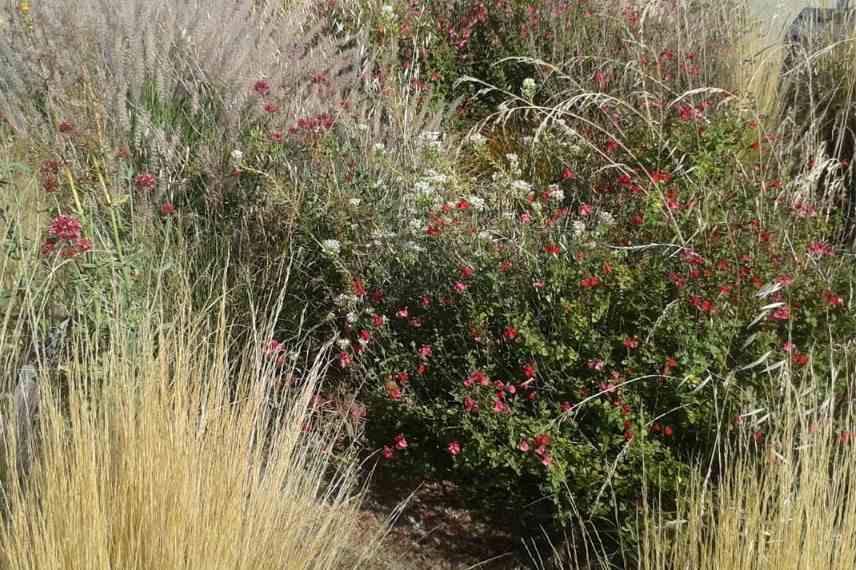
A medley of shrub sages and grasses (Gwenaëlle David)
In a naturalistic border
Many shrubby sages will thrive in a wild area, where their light habit will shine alongside plants with similar needs: well-drained soil and plenty of sunlight.
You have a plethora of perennials and grasses to create a long-lasting floral scene, favouring some melliferous species for this garden with a meadow-like appearance: Cephalaria, Molinia, Sedum, Salvia sclarea, Achillea filipendulina, Verbena bonariensis, Echinaceas, Rudbeckia subtomentosa, etc. You can truly mix vibrant inflorescence colours in this space or opt for soft shades of yellow and blue, as seen in our example of the ‘Blue Note’ sages: they pair beautifully in a bicolour scheme or with orange, bright pink, and white tones. To tie this natural medley together, consider incorporating grasses of varying volume and height: Molinia and Miscanthus in clumps, Panicum and Calamagrostis that are narrower…
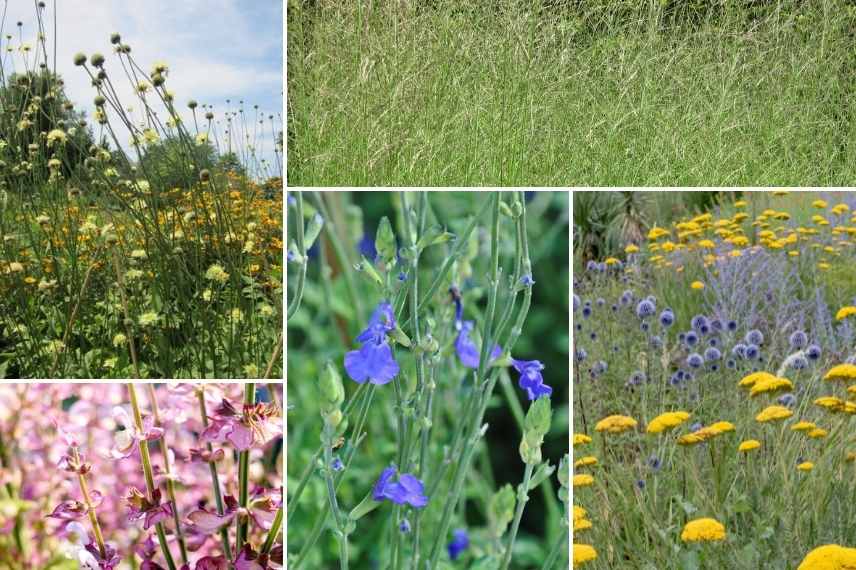
At the bottom centre, the shrubby sage ‘Blue Note’, here associated with giant Cephalaria, some Molinia caerulea arundinacea ‘Skyracer’, Salvia sclarea, Achillea filipendulina, and blue thistles.
In a holiday garden
Worry-free plant, flowering for nearly 6 months a year, the shrubby sage truly deserves its place in the garden of a summer home, whether it’s a country house, a seaside retreat, or in the foothills. In these gardens where one cannot dedicate as much time as in a primary residence garden, shrubby sages prove indispensable, both for the little maintenance they require and for their long flowering and ease of establishment.
- In the countryside, gather together a few simple beauties that are incredibly effective in their charm and soft colours, such as Alcalthaea ‘Parkallee’, a shrubby peony, and a rose ‘Pierre de Ronsard’ around a Salvia microphylla ‘Hot Lips’. Add evergreen foliage such as the greyish leaves of lamb’s ears (Stachys byzantina) or Sporobolus heterolepis, a low, silky semi-evergreen grass.
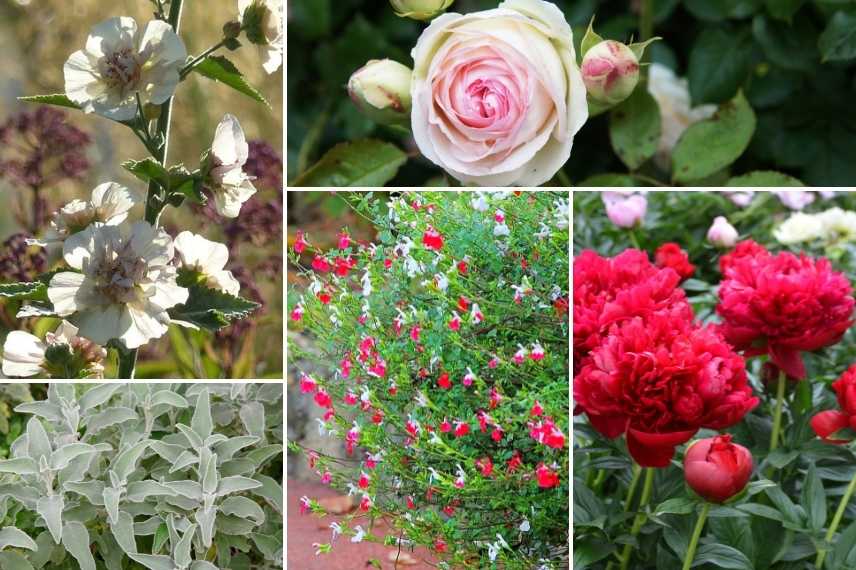 In the centre, a beautiful Salvia microphylla ‘Hot Lips’, accompanied by an Alcalthaea ‘Parkallee’, a rose ‘Pierre de Ronsard’, Stachys byzantina, and the vibrant red of a Paeonia lactiflora ‘Henry Bockstoce’
- By the sea, a greggii shrubby sage ‘Alba’ or a pink-toned Salvia microphylla will subtly blend its flowers with exotic or bold plants like a Phormium tenax, blue Agapanthus, and the blue-violet of a Vitex agnus castus ‘Latifolia’ or a shrubby Veronica with spike flowers, and evergreen. A compact, glossy green Pittosporum tobira ‘Nanum’ will add a fragrant touch in late spring, along with a few small trees reminiscent of the seaside, such as an Albizia or a umbrella pine (Pinus pinea) to complete this maritime atmosphere.
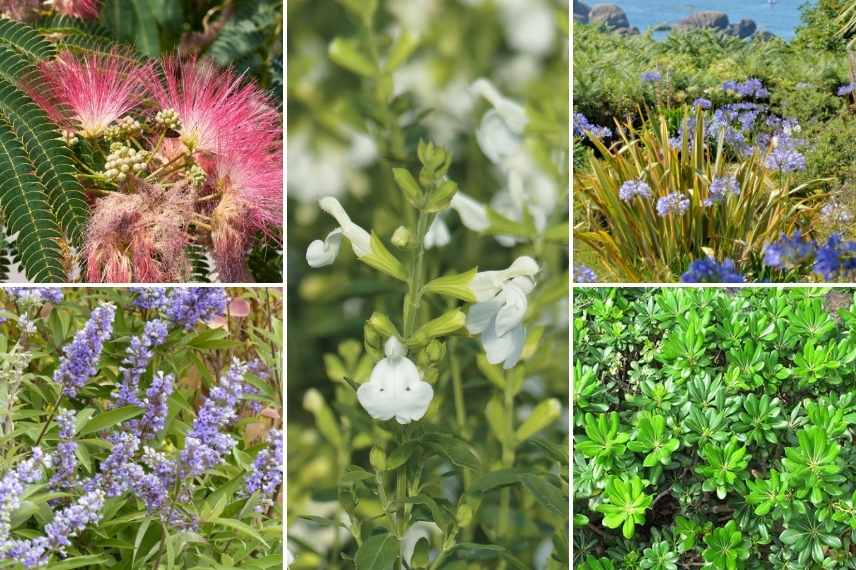 In the centre, Salvia greggii ‘Alba’ is alongside an Albizia julibrissin, Agapanthus, Phormium, Vitex agnus castus ‘Latifolia’, and Pittosporum tobira
- In the foothills, prefer a hardy sage like Salvia greggii ‘Arctic Blaze Purple Novasalpur’ with violet flowers, and plant it in a bed with plants that offer excellent cold resistance: a ‘Lovely Pink’ cinquefoil or a rugosa rose ‘Frau Dagmar Hastrup’ with soft pink hues, as groundcover, crumpled Oriental poppies or orange nudicaule poppies, and a Deutzia compacta ‘Lavender Time’ to dress the space in spring, along with a few centauries and Asters alpinus. A dwarf conifer will provide an interesting textural contrast and evergreen foliage.
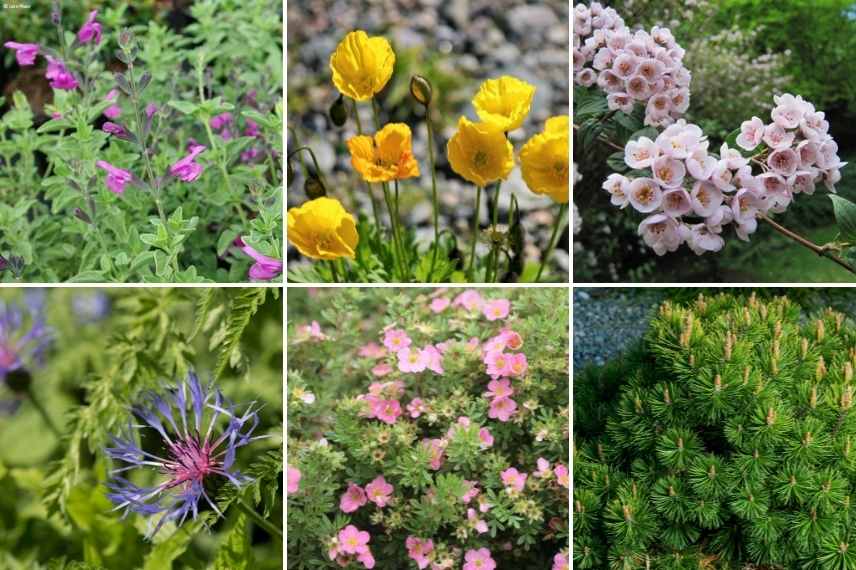 Salvia ‘Arctic Blaze Purple’, Papaver nudicaule, Deutzia compacta ‘Lavender Time’, Centaurea montana, Potentilla ‘Lovely Pink’, and Pinus mugo
In a low hedge
A low hedge or border along a path can easily incorporate some shrub salvias: remaining low, flowering for no less than 5 months, and semi-evergreen in mild climate regions, they prove to be a beautiful option, alternating with another perennial or small evergreen shrub. This could be a medium-sized lavender like the remarkable Lavender ‘Munstead’ (to pair with a butterfly lavender for an early flowering starting in May), or, for more texture contrast, a Stipa tenuissima that is light and airy, or alternatively, mini boxwoods trimmed into balls (Euonymus japonicus ‘Suzanne’ or Euonymus microphyllus ‘Albovariegatus’). You can also consider this low hedge for a purely summer configuration by cohabiting our shrub salvia with Nepeta racemosa. Opt for an interesting variety for its compact habit, such as the lovely Salvia greggi ‘Mirage Salmon’ with its countless bright salmon-pink flowers.
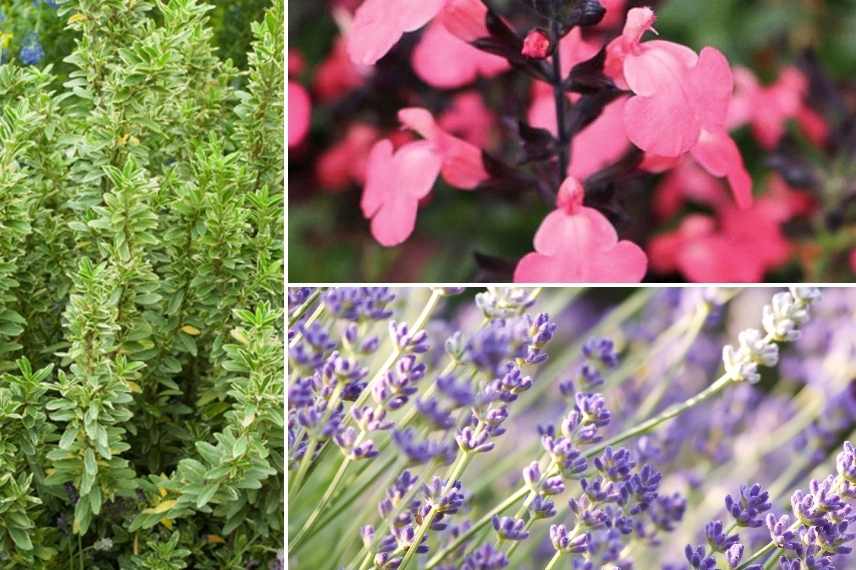
Euonymus japonicus ‘Albovariegatus’, Salvia greggi ‘Mirage Salmon’ and Lavandula angustifolia ‘Munstead’
In an urban garden
Adaptable, the shrubby sage thrives even when planted in a sufficiently large container, allowing it to express itself. If you only have a small, reasonably sunny terrace, even in the city, it quickly settles in and enchants the space for many months. Pair it with contrasting foliage, even trimmed for a beautiful alchemy, and spike inflorescences to bring verticality: Pittosporum tenuifolium ‘Silver Ball’, Liatris spicata or lavender, and why not an Agave in the milder regions. Also, install nearby the dwarf version of Buenos Aires verbena (‘Lollipop’) to ensure a long flowering period until frost and a radiant white lavender!
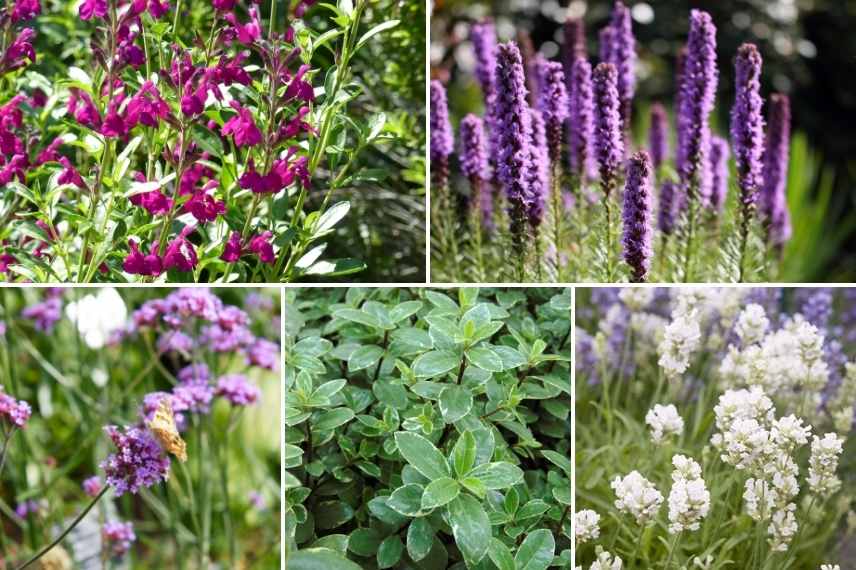
Salvia jamensis ‘Raspberry Royal’, Liatris spicata, Buenos Aires verbena ‘Lollipop’, Pittosporum tenuifolium ‘Silver Ball’ and Lavandula angustifolia ‘Arctic Snow’
→ Learn more about growing shrubby sage in a pot in our article!
- Subscribe!
- Contents
Comments