





























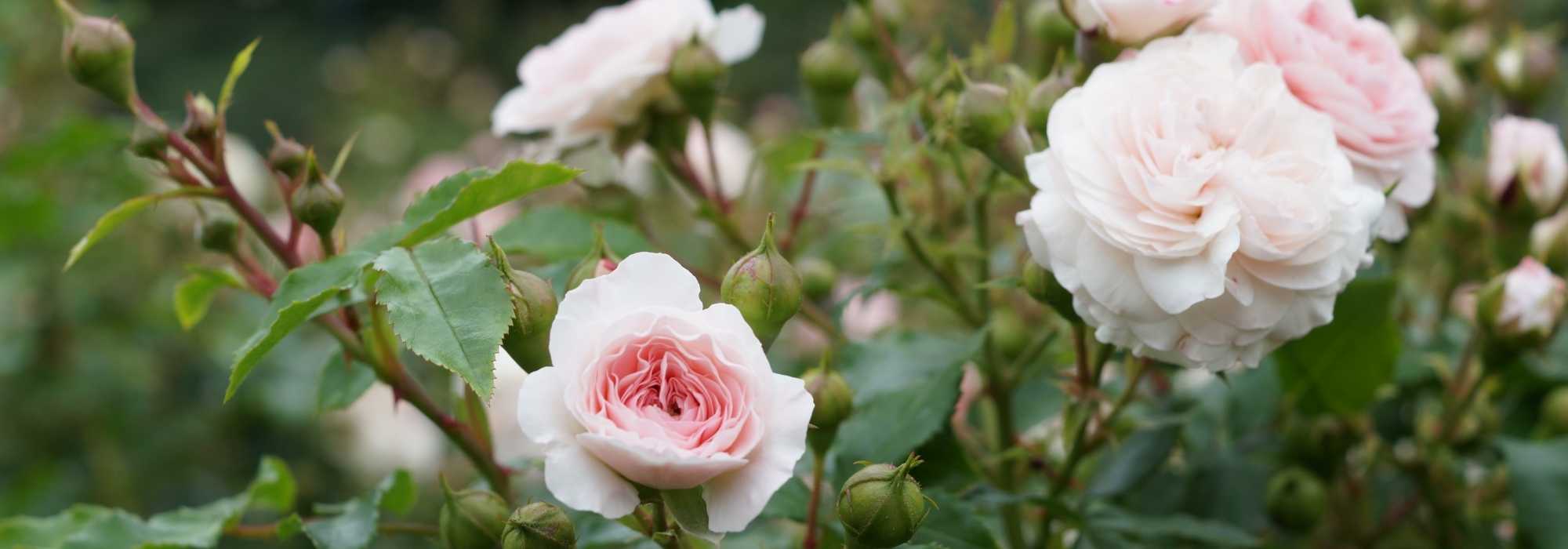
What to put at the base of roses?
Our tips and ideas to showcase your roses
Contents
Roses are resplendent from late spring to mid-summer, but we often forget to plant companion plants at their feet that will accompany them throughout the beautiful season. However, nothing is less glamorous than one or more roses planted in a bed, leaving the soil – or at best the mulch – clearly visible all around… especially when it comes to non-repeat flowering roses. The charm factor is then not really present…
Do you want to enhance the base of your roses but don’t know how to go about it or which plants to choose? Depending on the type of rose, its colour, and the style of your garden, we are here to help by offering you some simple ideas to create charming and whimsical combinations!
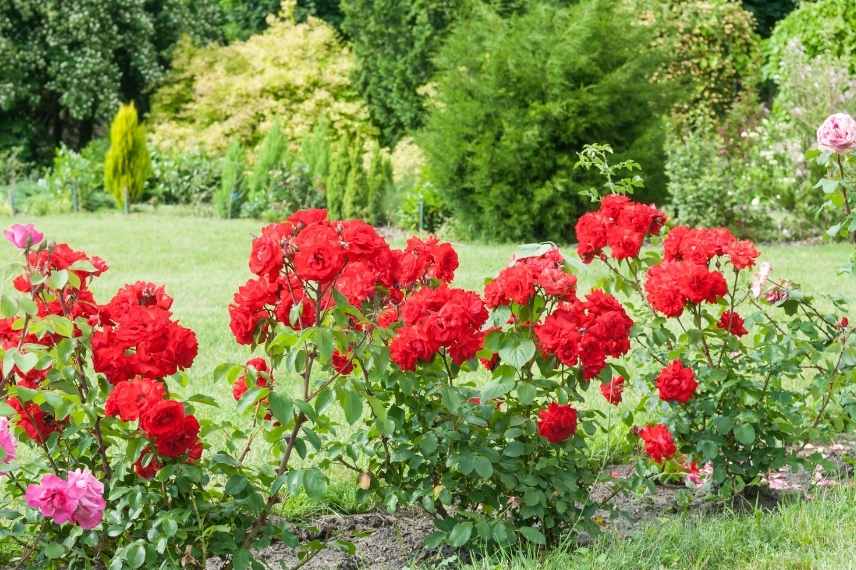 A bed of bush roses without dressing… we can do better!

Why dressing the base of rose bushes?
Don’t neglect the base of your roses! While they will develop and showcase their beauty as soon as they are covered in buds and then flowers, this allows for:
- dressing their sometimes bare base. Indeed, saying that roses are the poor relatives in the off-season is an understatement… their foliage or thorny habit when bare is not the most attractive, so it’s always good to disguise this unflattering silhouette with small bushes or perennials;
- creating beautiful combinations of shapes and colours;
- filling in for non-repeat flowering roses (those that only bloom once). Additionally, one or two long-flowering perennials can help bridge the gap during the absence of blooms from repeat flowering roses when, once pruned, they will take a few weeks to produce their roses again;
- groundcovers planted at the base of roses contribute to maintaining soil moisture and limiting the growth of adventive plants.
However, you will gladly forgo this dressing for standard roses, as they truly benefit from having their trunk left free of competition to highlight them. In fact, they are often planted in isolation.
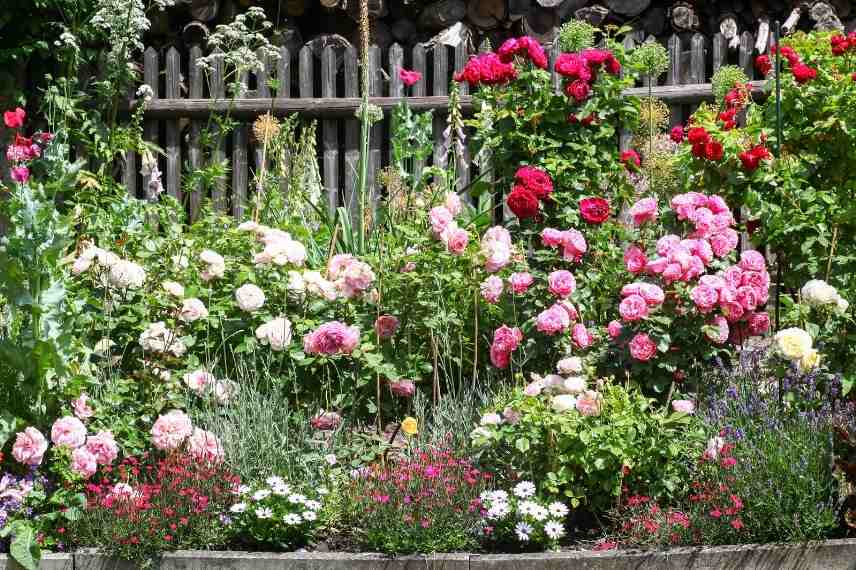
Installing perennials at the base of roses helps to enhance your flower beds, play with colour combinations, and provide welcome protective foliage in the height of summer.
What type of plants?
Unless you are creating a rose garden at home, where the focus is on roses planted en masse without generally associating them with other plants, most roses in our gardens deserve a lovely dressing!
There are several options, in fact, depending on the type of rose, its colour, and, another fundamental aspect, the style of your garden.
The chosen plants must meet certain criteria. They should not overshadow the roses, while enhancing them:
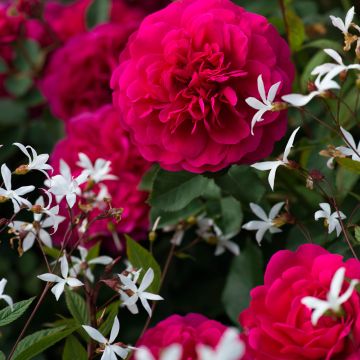
- They should be light or airy in their flowering or foliage to bring the necessary delicacy and complement the charm of the roses: Gypsophila, Thalictrum, Calamintha nepeta, Alchemilla, Oriental poppies, Penstemons, Artemisia, Amsonia hubrichtii, numerous Pennisetum orientale such as ‘Karley Rose’, etc.
- They should be low or medium height according to the size of the rosebush, to sit at its base without overwhelming it in height, where the rose inflorescences begin: hardy geraniums, essential, but also sages, phlox, Oriental poppies, campanulas, avens, Irises, or Liriope for the shorter roses.
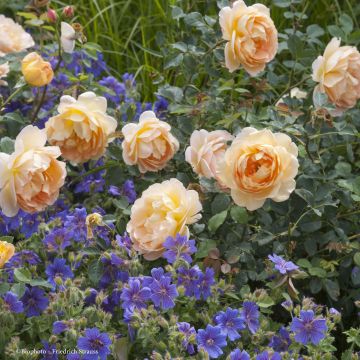
- Pastel and soft colours will accompany pink roses, complementary colours like blue will harmonise well with yellow or orange roses, while white roses can accommodate all colours… avoiding white except in a white garden, of course.
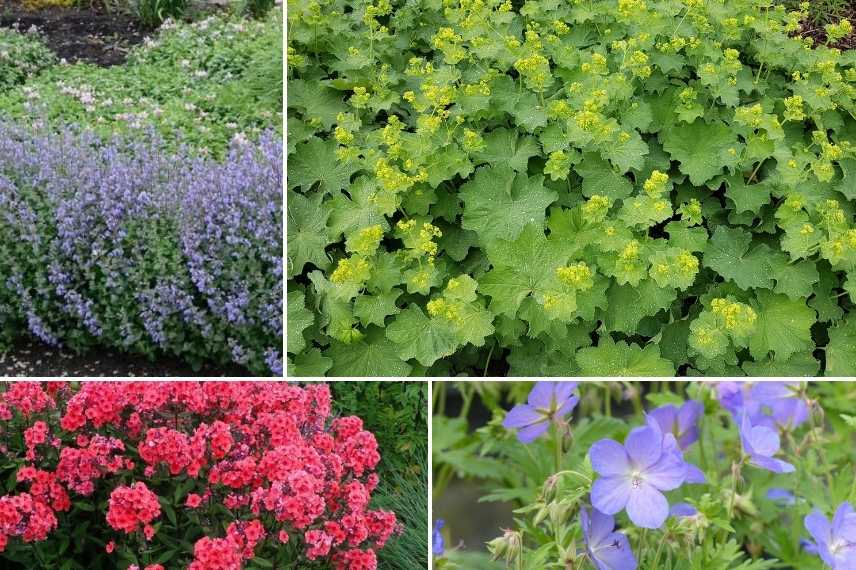
Among the foolproof and harmonious associations at the base of roses: Nepeta, Alchemilla, Phlox, and hardy geraniums
Discover other Perennials Roses
View all →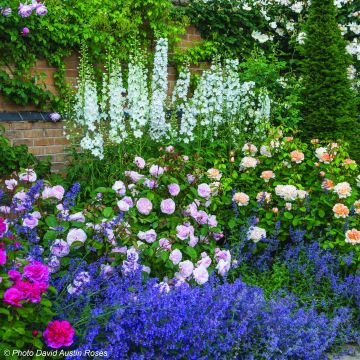
Available in 0 sizes
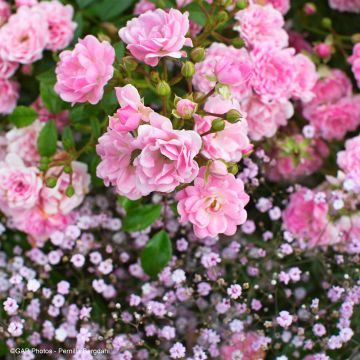
Available in 0 sizes
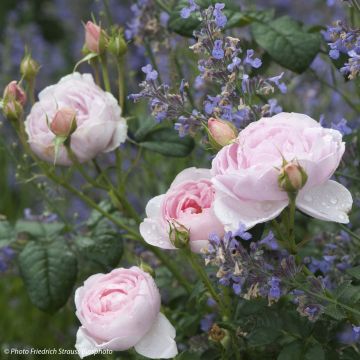
Available in 0 sizes
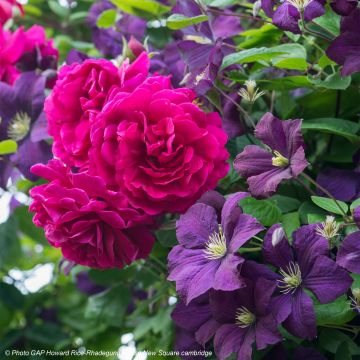
Available in 0 sizes
Available in 0 sizes
Available in 0 sizes
Available in 0 sizes
Available in 0 sizes
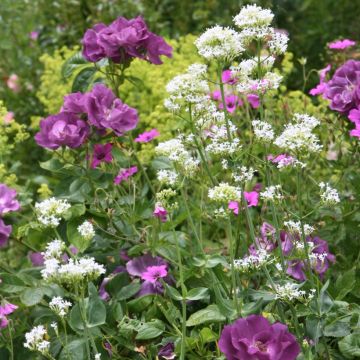
Available in 0 sizes
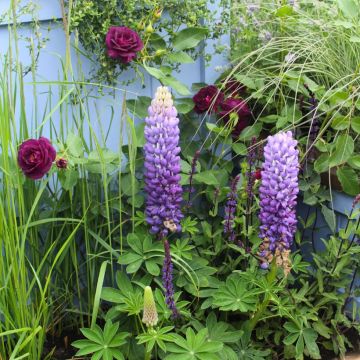
Some examples to dress the base of your roses
Simple dressing: a single magical perennial!
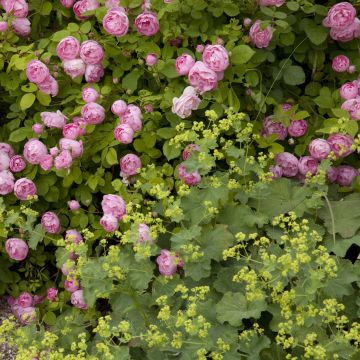
One generous plant or planted in groups of 2 or 3 at the base of your roses will ensure a stunning effect, simple and magical: Alchemilla mollis with its chartreuse flowers, long flowering period, and remarkable aniseed leaves, thriving in all soils, is the perennial often chosen. Its yellowish hue complements all rose colours, making it an effective and very romantic dressing. It delicately adorns the low stems of old roses whose wood is less ornamental. Salvias, with their long-lasting blooms and blue, mauve, or purple hues, also make good companions, just like Gypsophila, chosen for its lightness and white flowers.
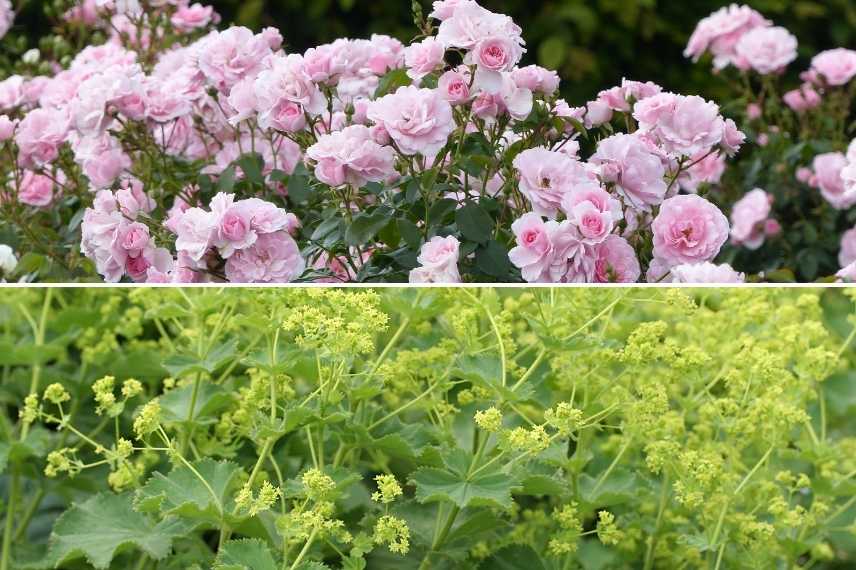
Alchemilla at the base of roses (here shrub rose ‘Bonica’): a classic full of freshness!
Dressing with flowers and foliage
You can also create a happy mix at the base of the roses by combining foliage and flowers in a groundcover use that also helps to avoid weeding around thorny roses: Stachys byzantina in grey, a multitude of hardy geraniums, Salvia nemorosa with its more upright violet inflorescences for a lovely contrast… Don’t multiply the perennials; two or three in pastel or contrasting shades, as in the example below, are more than enough to accompany your delicate roses.
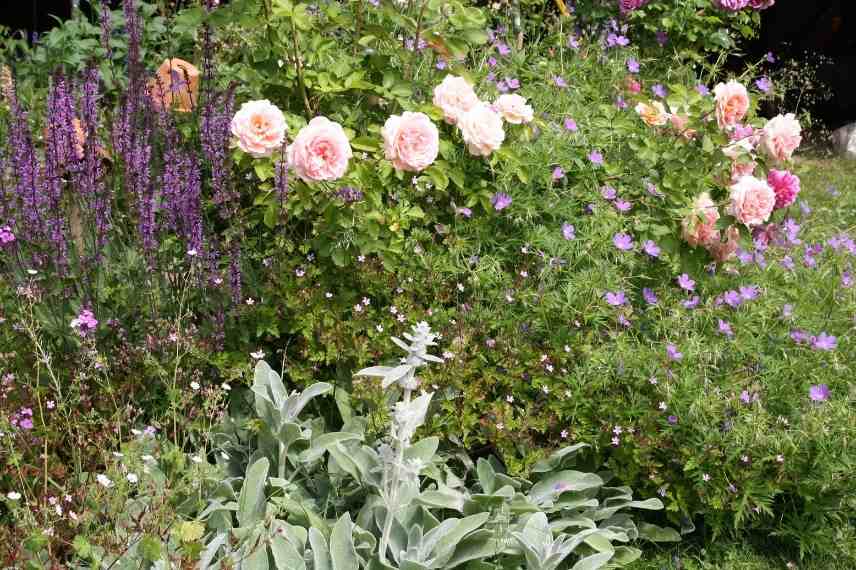
Stachys, salvias, and hardy geraniums naturally accompany a beautiful rose (© Virginie Douce)
Round dressing
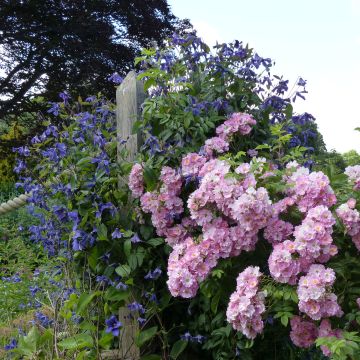
At the base of the roses, but also between them, install soft, bucolic, and romantic perennials for a very natural style: you will choose this configuration with taller roses, even climbing roses. The profusion of plants creates a floral halo around the roses, with the essential hardy geraniums, yarrow in full sun, valerian, and why not a herbaceous clematis that runs at the base of the roses. Some low shrubs are also interesting: spiraeas, Deutzia gracilis ‘Nikko’, etc.
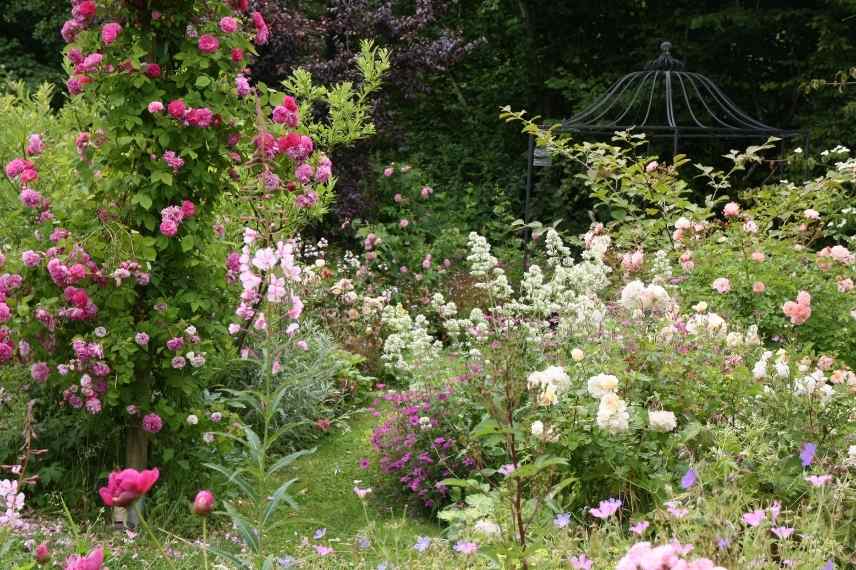
Roses beautifully surrounded! (© Virginie Douce)
Foliage
Play with beautiful foliage to bring contrast: silver foliage as mentioned above, but also purple that enhances pale pink roses even more: Persicaria ‘Red Dragon’, Anthriscus sylvestris ‘Ravenswing’ with its lovely white umbels, Sedum ‘José Aubergine’, and even small shrubs like Cotinus coggygria ‘Lilla’, whose pink cloud-like flowers will enhance your roses.
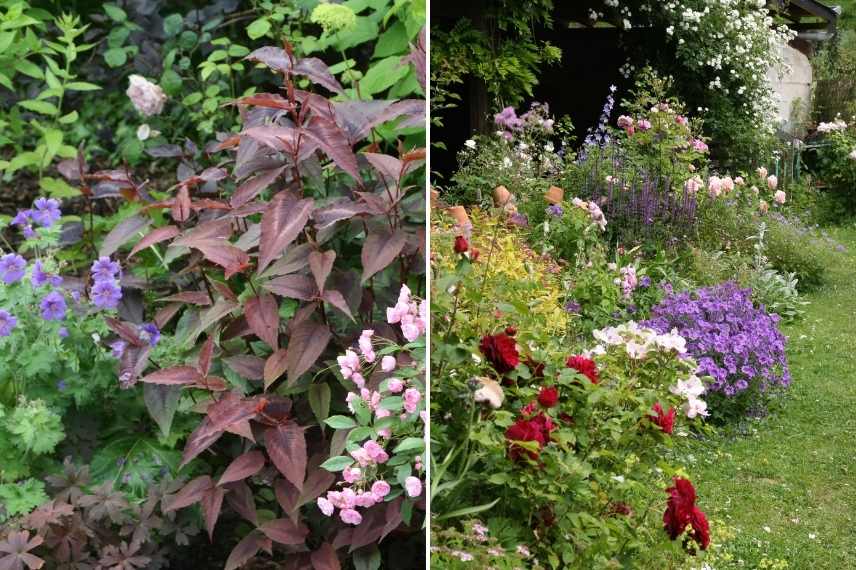
Association of decorative foliage with roses (© Virginie Douce)
A classic dressing
A much more classic option is to surround a group of roses with boxwood. The effect is charming for old-fashioned or cottage gardens, and in subspaces of the garden where you concentrate your roses, for example. They make a beautiful ornament around the roses, and you can, as here, add a carpet of hardy geraniums at their base to avoid leaving the soil bare. If you are hesitant to plant boxwood, opt for mini euonymus (Euonymus japonicus Microphyllus), Ilex crenata, or bush honeysuckles (Lonicera nitida).
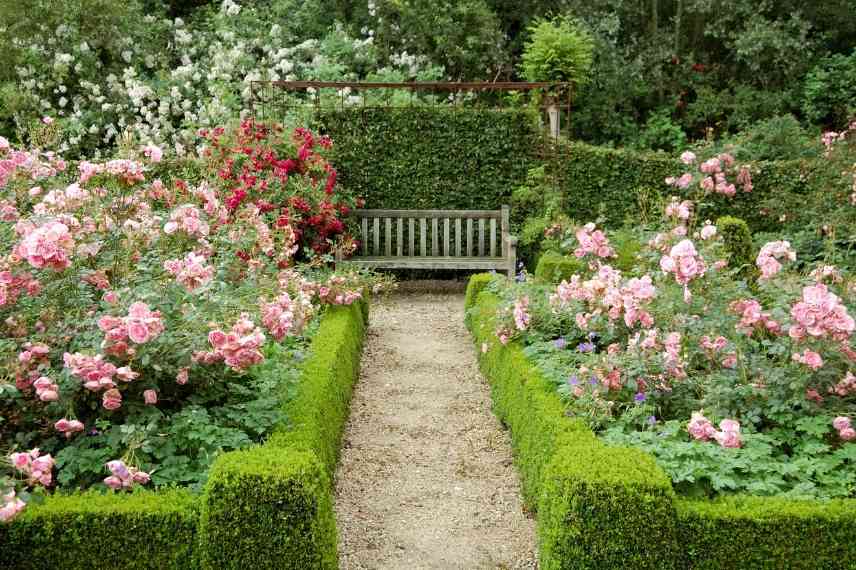 Boxwood borders always look beautiful with roses[/caption>
Gwenaëlle’s advice: growing only roses together… is not very good from a health perspective: they are more likely to attract aphids or downy mildew, or even powdery mildew when planted too closely. Dressing their base is a good remedy, aesthetically pleasing as well, for their little Achilles’ heel!
Don’t forget spring bulbs: Alliums and tulips also make beautiful companions for your roses, even if they won’t serve the same purpose as perennials. They are essential for creating lovely romantic or rustic scenes!
Read also
6 groundcover campanulasChoosing companion plants for roses
It is entirely possible, and often the approach taken with the most disease-prone roses, to install companion plants nearby, preferably at their feet. They will act as auxiliaries, much like a plant in the vegetable garden. Combining the useful with the pleasant is therefore essential to dress up your roses! We mainly rely on perennials with aromatic foliage that serve as natural repellents against insects, particularly aphids, such as chives, which bloom in lovely mauve pom-poms and are effective against black spots and powdery mildew, as well as nepeta, creeping rosemary, wormwood, or sages.
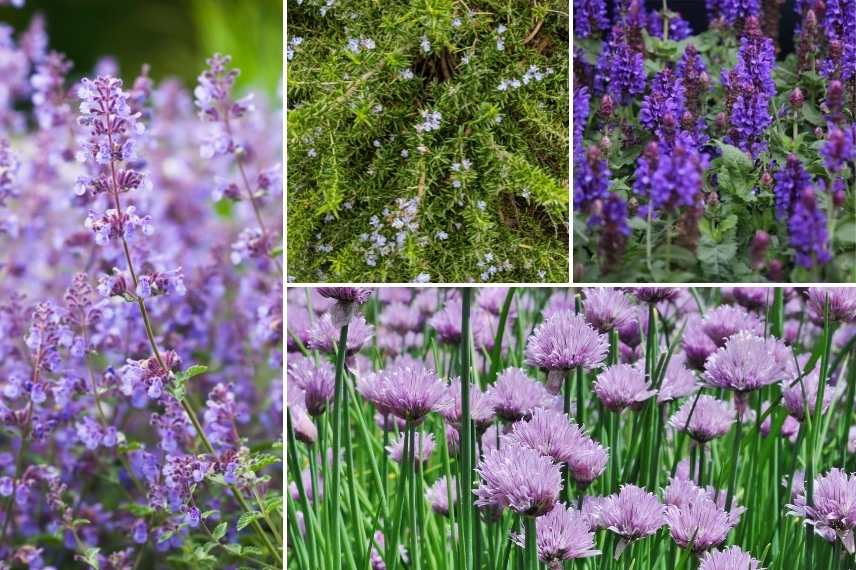
Nepeta racemosa, creeping rosemary, Salvia nemorosa ‘Blue Marvel’, and chives in bloom
Learn more
Discover numerous ideas in the book published on the subject by Ulmer in 2016 “Companions for My Roses, Associations for the Garden,” which Ingrid comments on in our blog and our inspiration: At the Base of My Roses.
- Subscribe!
- Contents
![[plant] mulch such as compost or well-rotted manure is ideal to put at the base of [roses] to help retain moisture, suppress weeds, and provide nutrients.](https://en.promessedefleurs.eu/blogwp/wp-content/uploads/2022/04/que-mettre-au-pied-des-rosiers.jpg "[plant]Mulch[/plant] is an essential element to consider at the base of [plant]roses[/plant].")
Comments