





























6 evergreen shrubs to adopt in a mountain garden
For a green garden all year round, even in the mountains
Contents
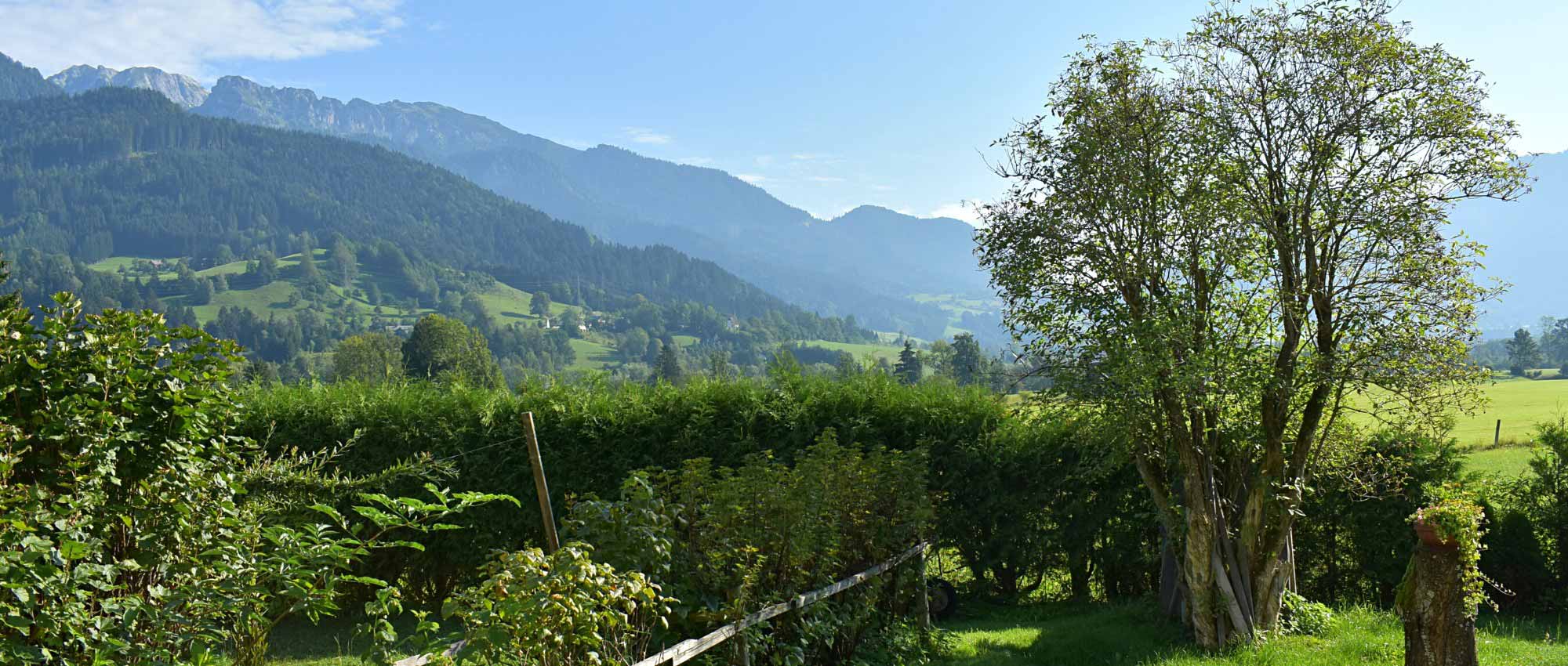
Mountain gardens are subject to unique climatic and geological conditions. The montane climate is characterised by long, cold winters, relatively cool summers, and frequent rainfall. Soils are often poor and rocky, and shallow. Plants must therefore be particularly robust and resilient. Discover our selection of 6 evergreen bushes that adapt well to mountain planting. Whether planted as a hedge, in isolation, or as a backdrop for a perennial bed, they will remain decorative all year round thanks to their evergreen foliage.
And for more options, find our entire range of shrubs for montane climates.

Kalmia latifolia
Also known as Mountain Laurel, the Kalmia latifolia is a beautiful shrub native to North America, and it offers in spring (May-June) clusters of small, cup-shaped flowers. Depending on the varieties, they are available in different shades of pink: from pale pink to purplish-pink, even almost red. Particularly delicate, they appear to be made of porcelain and are adorned with patterns of rare finesse. The flower buds are also very decorative, resembling small meringues. Kalmia grows slowly and reaches a height of 2 to 3 m at ripeness. Its leaves are quite ordinary, glossy green and thick, resembling laurel leaves. The Kalmia latifolia is an acidic soil shrub, thriving in partial shade in acidic soil, sheltered from strong winds. It can also be cultivated in a large pot or container. Perfectly hardy, it withstands temperatures of around -25 to -30 °C. In the garden, you can pair it with rhododendrons, Enkianthus, and heathers.
Discover our complete sheet: “Kalmia latifolia: planting, growing and care”
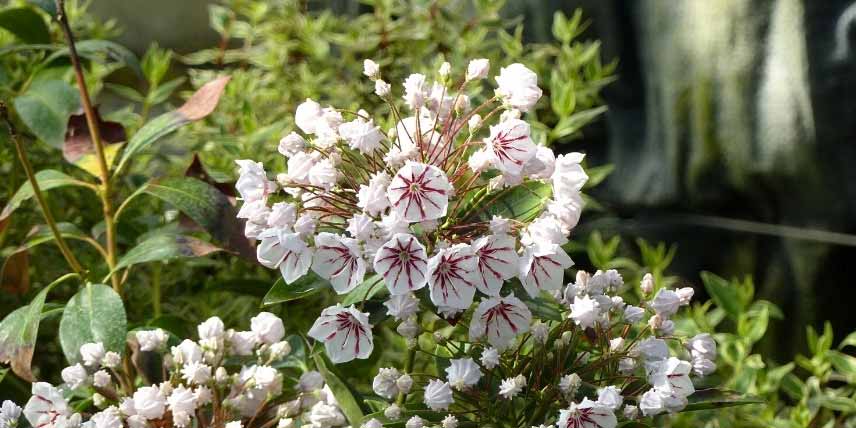
Kalmia latifolia ‘Peppermint’
Rhododendron
Some rhododendrons are particularly suited to montane climate and can withstand temperatures of around -30 °C. The Rhododendron ferrugineum, for example, is a shrub that grows spontaneously in the mountains, at the subalpine zone (between 1,400 and 2,400 m above sea level). It reaches heights of between 30 cm and 1.20 m. It bears dark green leaves, rusty on the underside, and unfolds very beautiful bright pink flowers in spring. Also discover the Rhododendron tsariense, a shrub native to the Himalayas, which has dark green leaves with an astonishingly felted underside, in a tawny to russet hue. It forms a shrub about 1.30 m in all directions and offers pale pink flowers in April. In the garden, you can pair these rhododendrons with junipers, lingonberries, and Kalmia. Also consider Asian primroses, such as Primula japonica ‘Alba’.
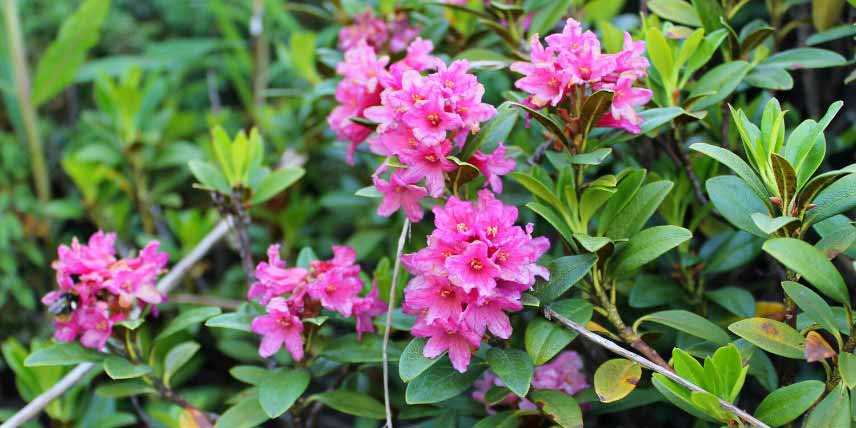
Rhododendron ferrugineum (photo Daniel Ballmer)
Juniper
Common juniper or Juniperus communis is a hardy conifer, tolerating temperatures down to -30 °C. It naturally grows at altitudes of 1,800 – 2,000 m. It bears dark green needle-like leaves measuring 1 to 3 cm long. Its flowering is insignificant, but it is followed by the appearance of globose fruits, initially green and then turning blue-black and pruinose at maturity. Common juniper is available in numerous varieties, distinguished by their habit: prostrate (like the variety ‘Green Carpet’) or conical (for example ‘Sentinel’), as well as by their colour: green, blue or golden. You can also choose the scale-leaved juniper, Juniperus squamata, which is also robust enough to be grown in a mountain garden. It has attractive blue-grey foliage and takes on a prostrate habit.
Junipers have the advantage of adapting to all types of soil, even rocky and shallow, and can withstand drought without issue. They can be pruned into cloud or niwaki shapes, bringing a Japanese ambiance to the garden. They pair beautifully with other small conifers such as mountain pine, Pinus mugo, and Thuja occidentalis ‘Danica Aurea’, which naturally forms a small sphere with golden foliage.
Discover our complete guide: “Juniperus, junipers: planting, pruning and care”
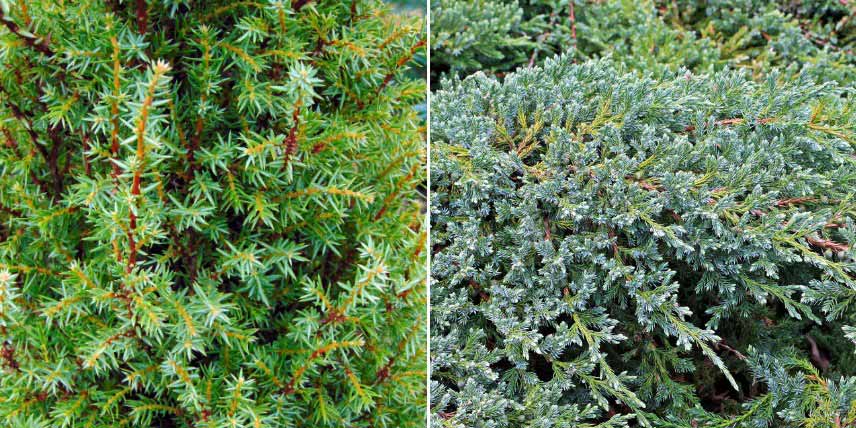
Juniperus communis ‘Compressa’ and Juniperus squamata
Thuja
Thuja is a conifer often used to create dense and opaque single-species hedges, especially since it tolerates pruning very well, but it can also be planted as a specimen. Its leaves consist of small scales, 1 to 3 mm long, imbricate on flattened and ramified branches. The most commonly cultivated is Thuja plicata (hardy down to -20 / -25 °C), but you can also choose the Canadian thuja, Thuja occidentalis (hardy down to -30 °C), which has a slightly more compact habit and brighter, vivid green foliage. There are different varieties, some taking a rounded form like Thuja occidentalis ‘Danica’ or columnar like Thuja ‘Totem Smaragd’. Others stand out for their golden foliage (‘Rheingold’) or bluish foliage (‘Pancake Concesarini’).
Thujas thrive in full sun or partial shade, in any type of soil. They can be pruned once or twice a year, although conical or spherical varieties can do without pruning if they have enough space. With their geometric shapes, these will integrate beautifully into a contemporary and graphic garden, in association with grasses like Pennisetum alopecuroides or Stipa capillata, as well as other conifers with a well-structured habit (for example, Juniperus communis ‘Green Carpet’ or Picea abies ‘Little Gem’).
Discover our complete guide on growing Thuja.
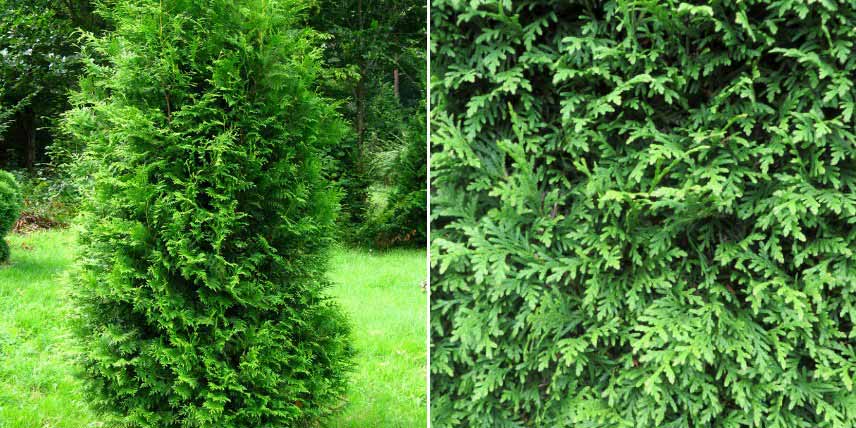
Thuja occidentalis ‘Brabant’
Cotoneaster
Cotoneasters are resilient, low-maintenance shrubs that are easy to grow. Among the evergreen varieties, we particularly recommend the Cotoneaster franchetii or Cotoneaster lacteus. They form bushy, rounded shrubs, reaching 2 to 3 m in all directions at maturity. Their branches are arching and bear small, dark green, matte leaves on top and felted underneath. Cotoneasters produce numerous small white flowers with five petals in spring, which are particularly melliferous. These are followed in autumn by bright red decorative berries that are highly appreciated by birds.
Plant Cotoneaster in full sun or partial shade, in any type of soil, even calcareous or stony, as long as it is well-drained. It is sensitive to excess moisture in winter, which could cause its roots to rot. With its rustic charm, it pairs wonderfully with viburnums (for example, Viburnum dentatum ‘Blue Muffin’, with decorative blue berries), as well as with serviceberries, mountain ashes, and dogwoods.
Discover our guide “Cotoneaster: planting, pruning, maintaining”
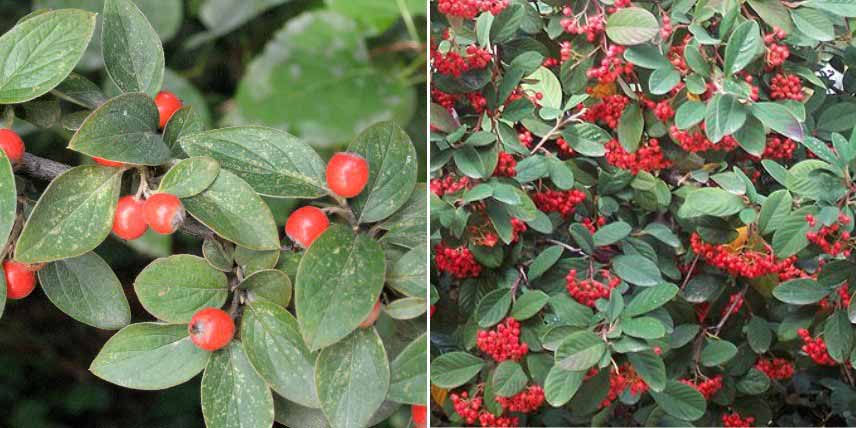
Cotoneaster franchetii (photo: A. Barra) and Cotoneaster lacteus
Holly
Common holly, Ilex aquifolium, is a hardy shrub that naturally grows in undergrowth up to 1500 m in altitude, and even up to 2000 m in the southernmost regions of its distribution area. Its leaves are glossy dark green and leathery. They are polymorphous: the lower leaves are generally beautifully dentate and spiny along the edge of the lamina, while the upper ones are simply undulate. It can reach up to 5 m in height and 2 m in spread at maturity. It is dioecious, meaning there are male and female plants. The latter produce lovely bright red berries in autumn, about 1 cm in diameter, which persist well into winter. They are appreciated by birds. Some varieties are distinguished by their variegated foliage, such as ‘Argenteomarginata’ holly.
Holly is a robust and resilient shrub that thrives in partial shade. It prefers cool, fertile, well-drained soils with an acidic tendency. In the garden, it will easily find its place in a free and rustic hedge, or even as a standalone specimen. It is perfect for accompanying other shrubs with decorative berries, such as hawthorn or snowberry.
Discover our complete guide to everything about holly.
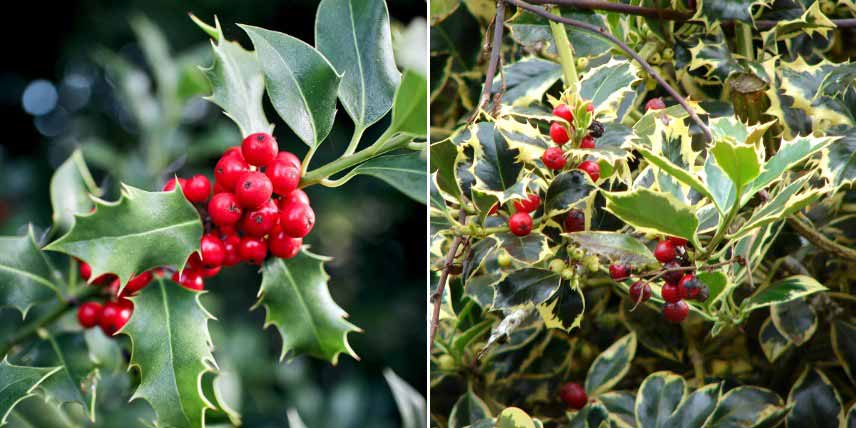
Ilex aquifolium (type species) and Ilex aquifolium ‘Argenteovariegatum’ (photo: Starr Environmental)
- Subscribe!
- Contents

Comments