





























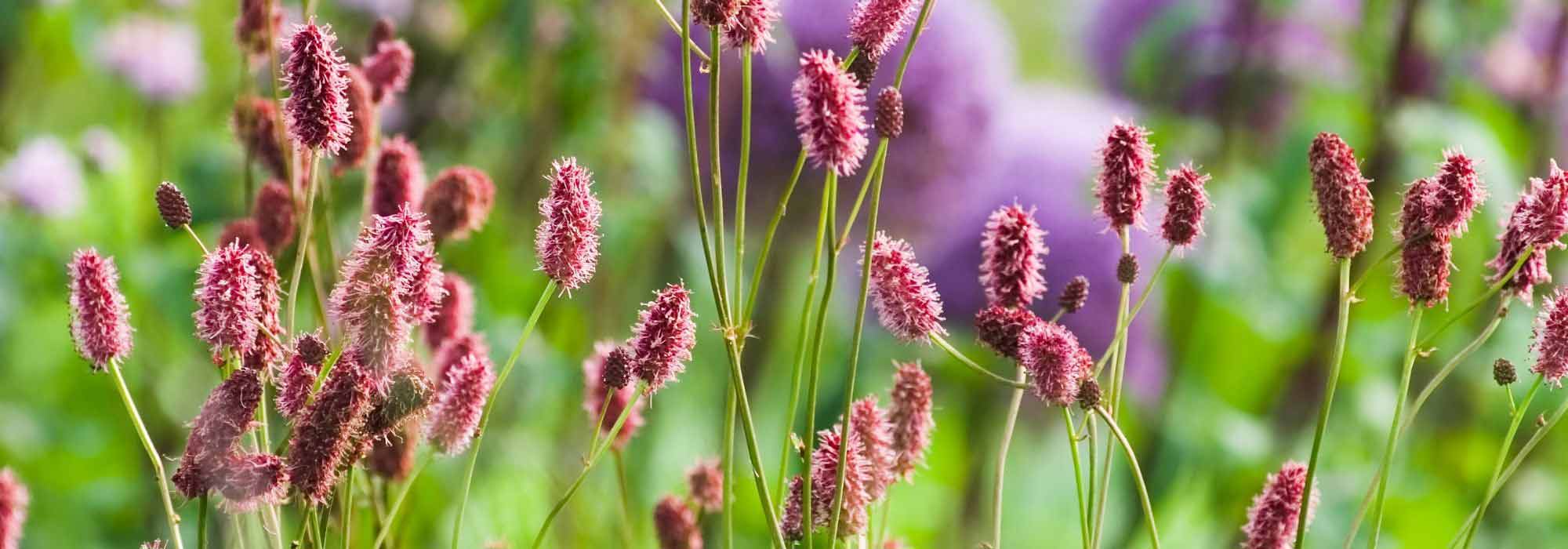
6 ideas for pairing Sanguisorba
6 ideas for creating beautiful combinations with Burnet
Contents
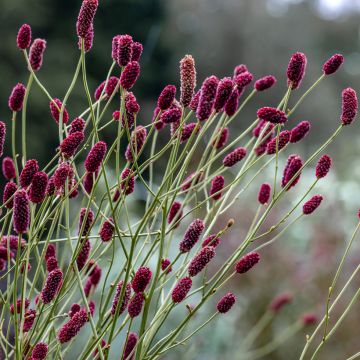
Beautiful rhizomatous perennials, the Sanguisorbas, also known as Burnets, offer an original flowering in spikes, particularly interesting in landscape displays due to their uniqueness. Short and cylindrical in some species and cultivars, feathery and flexible in others, their colour palette ranges from white to deep purple, including soft pink.
Hardy and easy to care for, Sanguisorbas are somewhat underrated and consequently too rarely planted in our gardens. Yet, as long as they are provided with the growing conditions they favour, they require little maintenance and bloom for long weeks during the summer.
If you wish to try Burnet in your garden and showcase it, here are 6 pairing ideas to inspire you.
→ Planting, cultivation and maintenance, follow the guide to grow Burnet like an expert!

In a summer flower bed
The small burnet, Sanguisorba minor, naturally grows in dry lawns and limestone scree and tolerates drought very well. It can therefore be planted in a sunny border, showcasing summer flowers. Alongside this lovely Small Burnet, planted in the foreground, with its green-purple globose spikes flowering in May-June, install clumps of Echinacea purpurea ‘White Swan’ with daisy-like white flowers. The Veronicastrum virginicum ‘Erika’ and Agastaches ‘Black Adder’ will punctuate the display with their delicate pink and blue spikes. A touch of softness and opulence is added by the Phlox paniculata ‘Rosa Pastel’, and the result is delightful: stunning blooms guaranteed for the beautiful season!
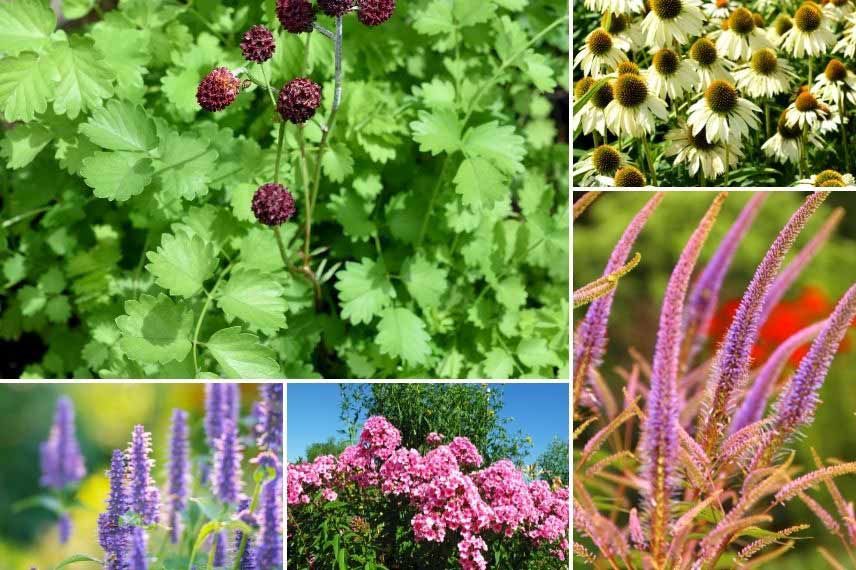
Sanguisorba minor, Echinacea purpurea ‘White Swan’, Veronicastrum virginicum ‘Erika’, Phlox paniculata ‘Rosa Pastel’ and Agastache ‘Black Adder’
In woodland
Sanguisorbas can be combined with woodland perennials, a beneficial area for some of them like Sanguisorba obtusa or Japanese burnet, which is typically found in damp locations: thus, shade, humus-bearing and cool soil will meet all its requirements. For a natural woodland atmosphere, choose plants that thrive in similar situations: ground-covering perennials like Ajuga reptans ‘Sanne’ will complement the pink of its long and soft spikes, while some red Angelicas Angelica gigas will bring a natural grace and a true presence. In this type of space, ferns that prefer cool ground like Matteuccia orientalis will elegantly fill the gaps.
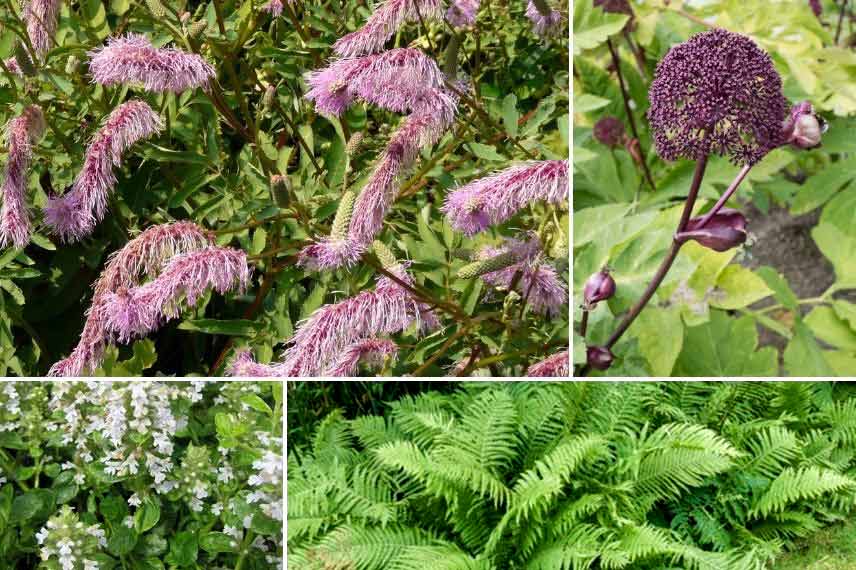 Sanguisorba obtusa, Angelica gigas, Ajuga reptans ‘Sanne’ and Matteuccia orientalis
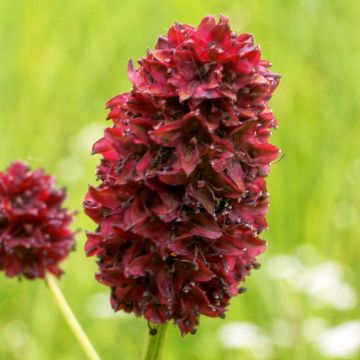
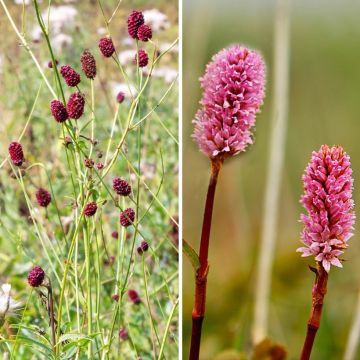
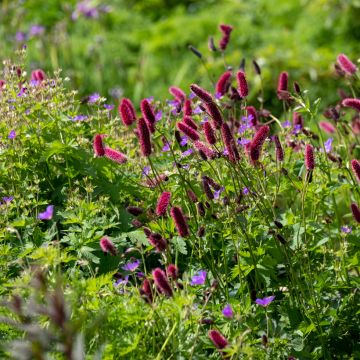
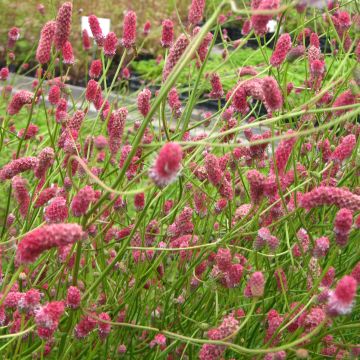
Discover other Sanguisorba
View all →
Available in 1 sizes
Available in 1 sizes
Available in 0 sizes
Available in 1 sizes
Available in 1 sizes
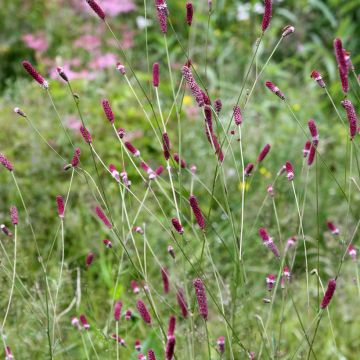
Available in 2 sizes
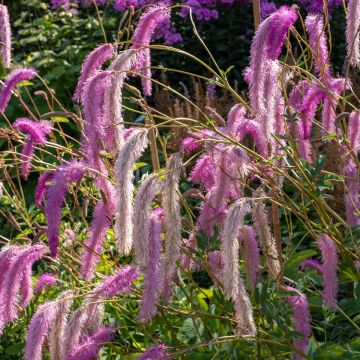
Available in 1 sizes
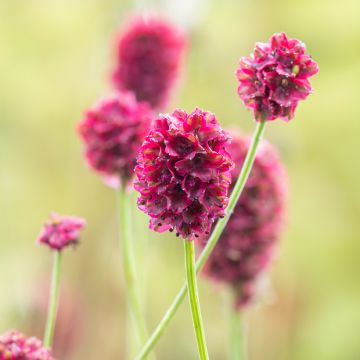
Available in 1 sizes
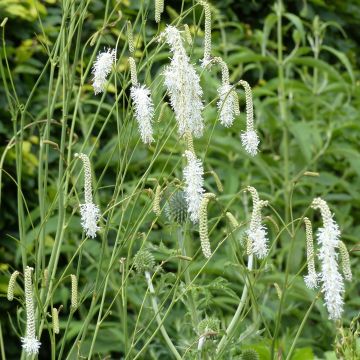
Available in 2 sizes
Available in 1 sizes
In a game of contrasts
Playing with the shapes of plants, the colours of inflorescences and foliage highlights the brightness of the Sanguisorba tenuifolia ‘Pink Elephant’ and vice versa. It will beautifully contrast with the acid green of Euphorbia characias ‘Purple and Gold’. The vertical foliage of Phormiums adds a contrasting play to the foliage, animating the scene with an interesting verticality. A groundcover in the same colour scheme is a great addition for easy maintenance of the bed: consider hardy geranium ‘Bob’s Blunder’ with its purple foliage and soft pink flowers. Finally, the clumps of Hostas ‘Almost’ with their vibrant, shiny green leaves supported by a purplish-red petiole will bring a welcome brightness and generosity.
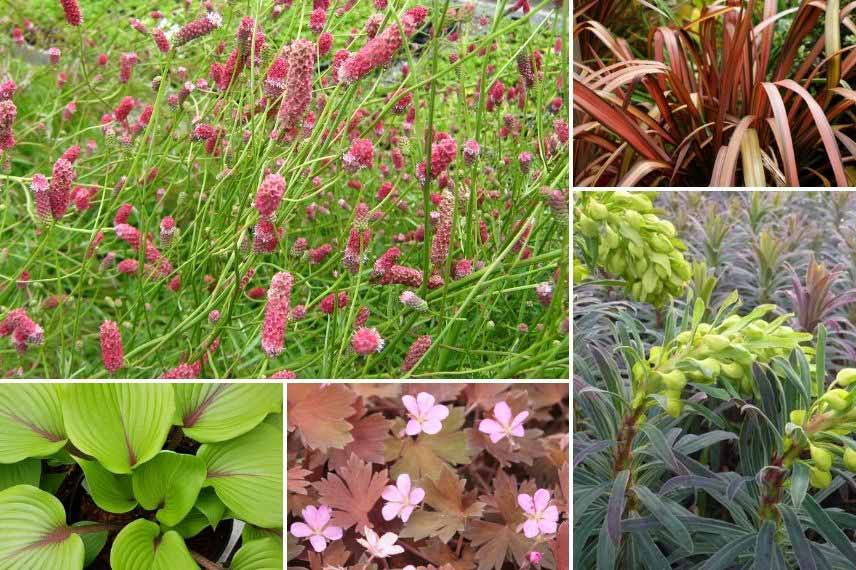
Sanguisorba tenuifolia ‘Pink Elephant’, Phormium, Euphorbia characias ‘Purple and Gold’, hardy geranium ‘Bob’s Blunder’ and Hostas ‘Almost’
In a naturalistic garden
With their wild plant appearance, Sanguisorbas are ideal for naturalistic gardens. They offer a lovely lightness, reminiscent of the short, purple spikes of Sanguisorba menziesii that seem to float and dance with the wind, much like the grasses Chinese fountain grass. Counterbalance this lightness with the ornamental garlic Allium ‘Pinball Wizard’, featuring large spherical mauve-pink umbels on sturdy stems. The repeat flowering rose ‘Peace and Love’, a descendant of the species Rosa persica, has inherited from its ancestor a striking brown-red heart that sits at the centre of a single corolla of light pink petals: a perfect rose for this natural and rustic scene!
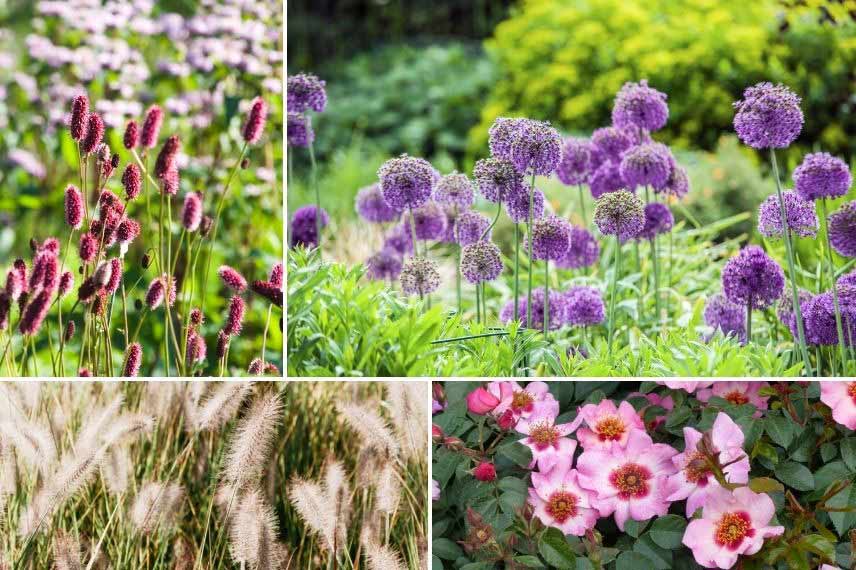
Sanguisorba menziesii, Allium ‘Pinball Wizard’ and Rosa ‘Peace and Love’
In a Punk Garden!
Very trendy, the punk garden “is scruffy, lazy, and doesn’t follow the straight path.” Simple in its design and maintenance, low-cost and natural, it is actually an ecological garden where Sanguisorba finds its place. It is a robust and durable perennial that enlivens the garden for many years.
In this slightly wild garden style, you could install for example, Sanguisorba ‘Red Thunder’. This burnet is a sturdy, floriferous, and colourful variety, easy to grow in any cool to moist soil. It blooms from June with lovely upright purple spikes. Pair it with the pretty creeping willow Salix repens, a tiny willow that develops arching branches and bears young greyish foliage, preceded in March-April by a lovely flowering of grey-yellow aments. With this excellent natural and low-maintenance groundcover, plant some Monardas ‘Mohawk’, the lovely purple bergamots and the field rose Rosa arvensis which will produce numerous bouquets of simple ivory-white flowers with a golden heart, pleasantly scented, in June-July. A low-maintenance space, simple, where biodiversity and the gardener can rest in peace!
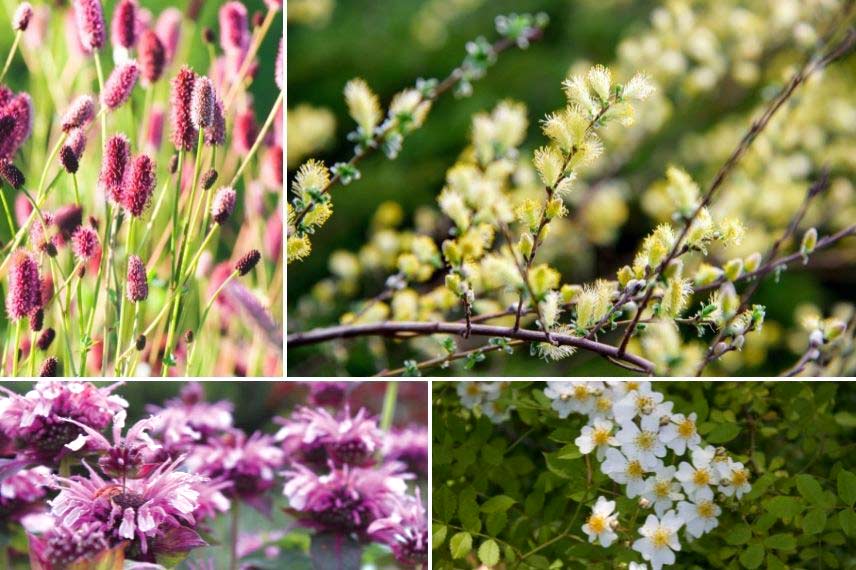
Sanguisorba ‘Red Thunder’, Salix repens, Monarda ‘Mohawk’ and Rosa arvensis
In an aromatic garden
Edible, the leaves of the Small Burnet Sanguisorba minor, rich in vitamin C and possessing antiseptic and healing properties, have a cucumber and green walnut flavour and can be eaten in salads. This remarkable rhizomatous perennial can be planted in an herb garden. Very hardy, it forms a spreading clump 50 cm high, and in June its leafy stems bear rounded terminal spikes composed of small green flowers tinged with purple.
Preferring dry, well-drained soils, it will thrive alongside rosemary, thyme, and lemon balm in a sunny position. In the summer, fill the gaps in this herb garden with, for example, a Purple Basil, Chamomile, and an essential Chives: flavours and colours will be guaranteed!
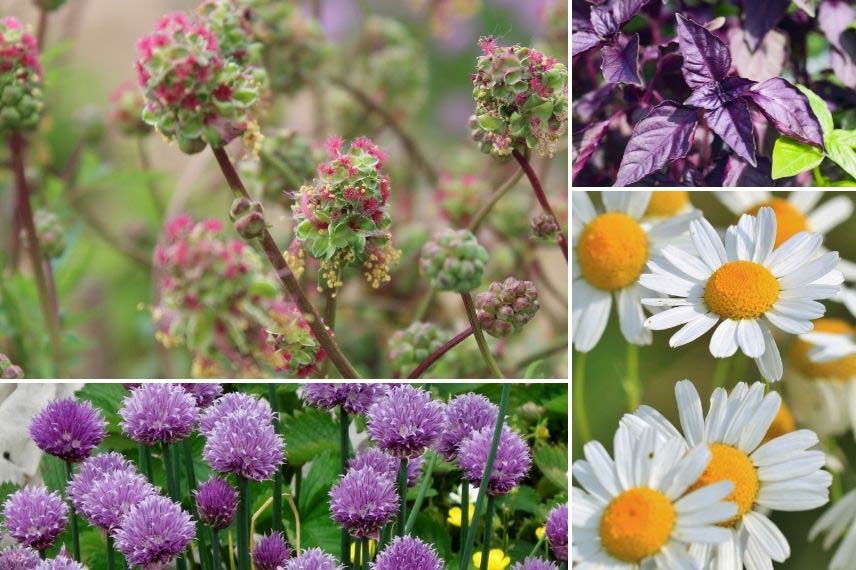
Sanguisorba minor, Purple Basil, Chamomile, and Chives

- Subscribe!
- Contents
Comments