





























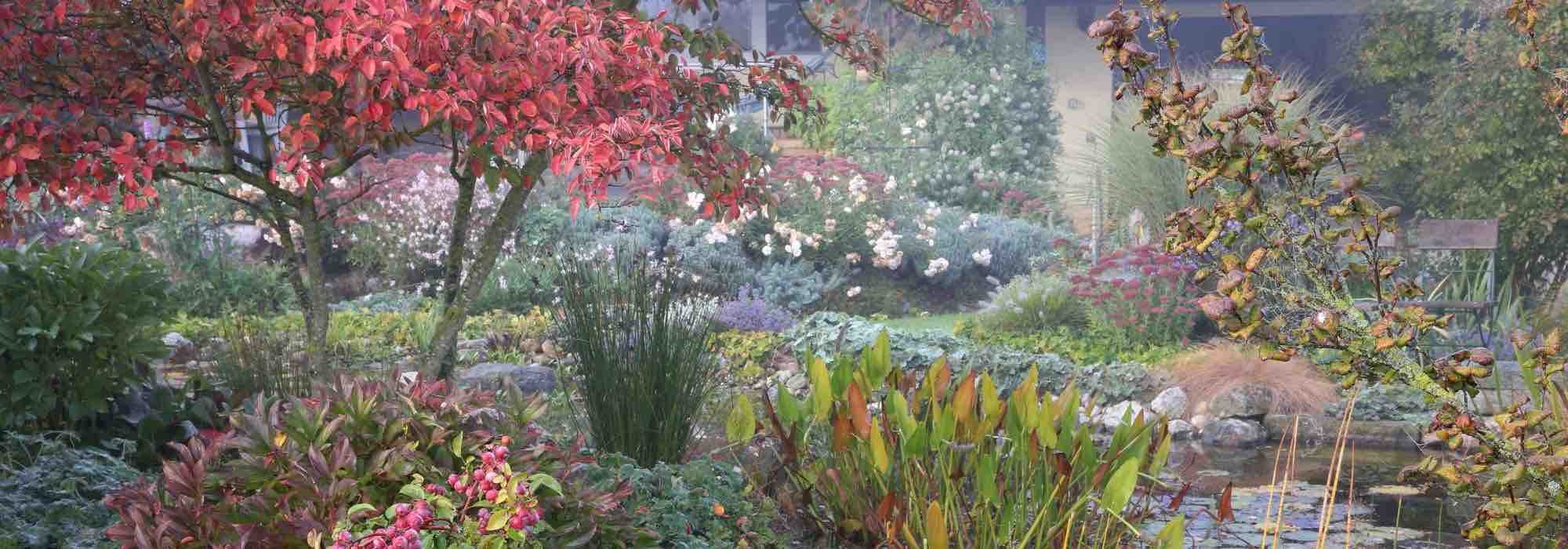
8 shade plants with autumn interest
Focus on a few shade plants for autumn
Contents
Let’s explore the beautiful shade or part-shade plants that are highlighted by autumn for various reasons: stunning, changing foliage, some bulbs peeking through the fallen leaves, charming flowers that continuously brighten a shady spot, vibrant red fruits or a variety of colourful berries, and jewel-like flowering worthy of a collection…
Discover in this article some beautiful plants for shade in autumn: perennial, bush, bulb, and climbing plant to multiply the reasons to love this season in the garden.

Japanese Maples
How can we not start with the stars of autumn: the Japanese Maples with their beautiful variations of warm and vibrant colours this season. The exposure that suits them best is undoubtedly partial shade, although there may be some nuances depending on the species and varieties. Many have stunning autumn displays. Some change colour 3 to 4 times a year. Let’s focus on those that change their attire between summer and autumn, and sometimes twice in autumn. Notably, there is the Acer palmatum ‘Osakazuki’ which turns blood red in autumn, as well as the Acer palmatum ‘Sangokaku’, which changes throughout the year, igniting in red-pink-orange once summer is over, finishing in a golden yellow before the leaves fall. Its naked stems then reveal their coral red colour until the return of the leaves the following spring. The Acer palmatum ‘Seiryu’ with its finely dissected foliage brightens and colours shaded areas all year round, starting its growth in almost fluorescent light green, then settling into orange-yellow and gloriously finishing its season in purplish red. We should also mention the very beautiful Acer aconitifolium with its stunning aconite-shaped leaves, beautifully shaded throughout the year and ruby red in autumn.
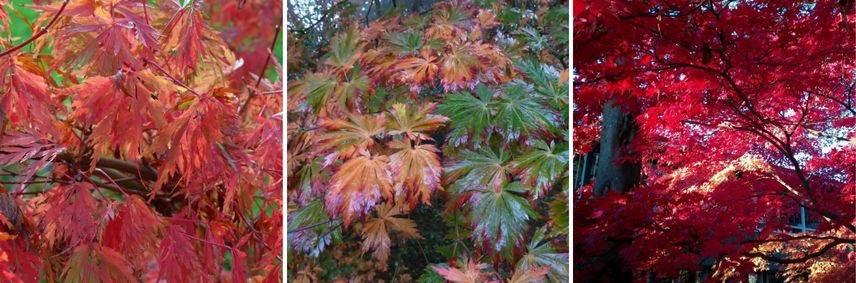
Acer palmatum ‘Seiryu’, Acer aconitifolium, Acer palmatum ‘Osakasuki’
Japanese Anemones
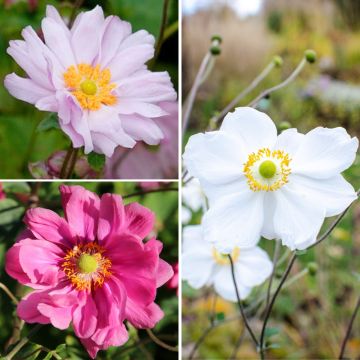
Iconic autumn flowers for light shade and partial shade, the Japanese Anemones are beautiful companions to the Maples mentioned earlier. Blooming for some as early as summer, they thrive for many in September and October in cool soil and shaded conditions, illuminating the garden with white, pale pink, or deep pink flowers, featuring yellow centres. With a rather loose or more compact habit, they self-seed and wander if the ground suits them. Their flowers, a mix of wild and refined, can be single or double, with the paler ones having a pearly sheen, while the darker varieties join the vibrant colour festival of the autumn garden. Notably, some start with very pretty dark purple-burgundy buds, sometimes almost black. Others adorn their petals with a lovely mauve-purple reverse. Here are a few varieties: the Japanese Anemone ‘Robustissima’, very tall, with a pale pink pearly hue. The Anemone japonicum ‘Fantasy Pocahontas’ with its tousled, frizzy petals, a bit unkempt, which adds to its charm. ‘Fall in Love Sweetly’ for a darker variation, also without a comb. ‘Alando Rose’ with its lovely simple cup-shaped flower in a rich pink for October, very minimalist. ‘Hadspen Abundance’ for its pretty dark buds and subtle, pearly autumn flower. ‘Ruffled Swan’ for its white petals with mauve reverses.
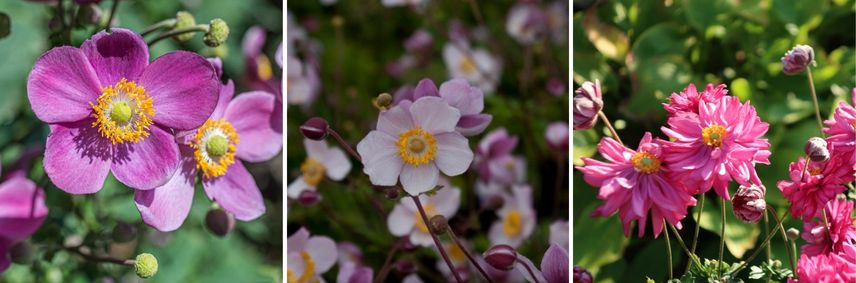
Anemone ‘Alando Rose’, Anemone ‘Hadspen Abundance’, Anemone ‘Fall in Love Sweetly’
Discover other Late flowering perennials
View all →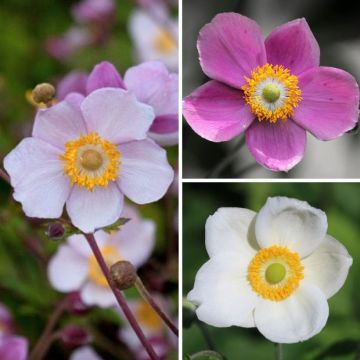
Available in 0 sizes
Available in 0 sizes
Available in 0 sizes
Available in 0 sizes
Available in 0 sizes
Available in 0 sizes
Available in 0 sizes
Available in 0 sizes
Available in 2 sizes
Available in 1 sizes
The lovely autumn bulbs
Less well-known than their spring cousins, there are indeed some lovely bulbs that bloom in autumn among the fallen leaves. The Naples Cyclamens brighten the garden with low, carpet-like displays, in pink or white, fragrant, during September and October. Their small flowers, delicate like butterfly wings, and their attractive triangular foliage marbled with silver-white, create a charming ensemble that should not be overlooked in autumn, even though they are close to the ground. Moreover, their foliage persists throughout the winter. Pink or white, they are planted in summer in dry soil and may only need watering at flowering time if rain is lacking. A cousin, the Cyclamen cilicium, slightly less hardy and rare in cultivation, develops rounder foliage and pink-mauve flowers speckled with purple. Also consider another bulbous plant, the Colchicum, which, while preferring full sun, also grows well in light partial shade under trees where the shade is not too dense. It would be a shame to miss out on its flowers, similar to crocuses, in wide cups, available in mauve, pink, or white depending on the varieties.
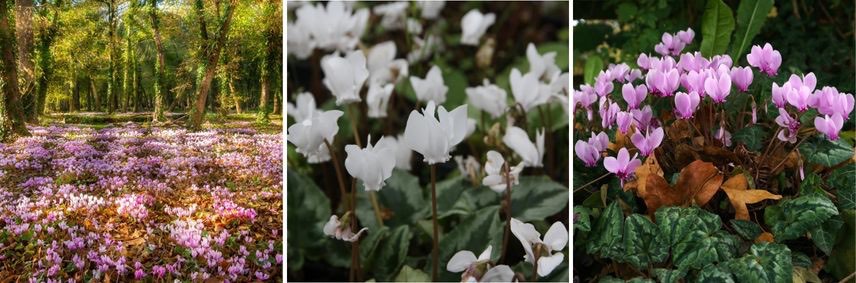
Pink and white Naples Cyclamens
Woodland Saxifrages
Saxifrages have different growing conditions depending on the species; some prefer very well-drained soil in full sun. Others are woodland perennials, thriving in cool, light, humus-bearing soil. Those with autumn flowers are the saxifrages native to Asia, including fortunei, stolonifera, cortusifolia. They enjoy shade, even dense shade. Perfect flowering shade plants, Saxifraga fortunei bloom high above the foliage, producing spikes of small star-shaped flowers with fine petals, forming soft clouds in shades of white, pink, and red. Their foliage is decorative, forming a rosette of thick, rounded, glossy leaves. In the variety ‘Wada’, this foliage is tinged with khaki green, red, and brown. In ‘Rubrifolia’, it is green-bronze, veined with purple. Some hybrids are adorned with lace-like flowers, resembling curious jewels, tinged with green, such as those from the OPERA series: ‘Lakmé’ and ‘Orpheus’. They are somewhat delicate to grow, as their soil requirements are very specific. The Saxifraga cortusifolia, on the other hand, bloom on the foliage, with serrated cups in white or pink, as seen in Saxifraga cortusifolia ‘Cheap Confections’.
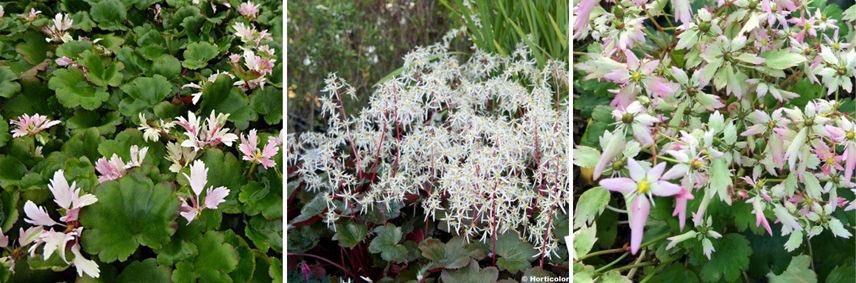
Saxifraga cortusifolia ‘Cheap Confections’, Saxifraga fortunei ‘Rubrifolia’, Saxifraga OPERA ‘Lakmé’
Camellia sasanqua
The Camellia sasanqua is a species of Camellia that blooms in autumn, thrives in bright partial shade, in a sheltered position from cold and prevailing winds. It requires warmth and has limited hardiness: around -10° C. It is more floriferous after a warm summer. Its evergreen and leathery leaves withstand short periods of summer drought. It pairs beautifully with Skimmias, Colchicums, Cyclamens, and Nandinas to create lovely arrangements. It flowers between autumn and winter, until the first frosts, producing fragrant flowers, from single to double, in shades of white, pink, and red. Notable varieties include ‘Fuji No Yuki’, with double white flowers, ‘Yume’, unique and bicolour, ‘Interlude’, pink and fleshy, or ‘Sekiyo’, raspberry with prominent stamens.
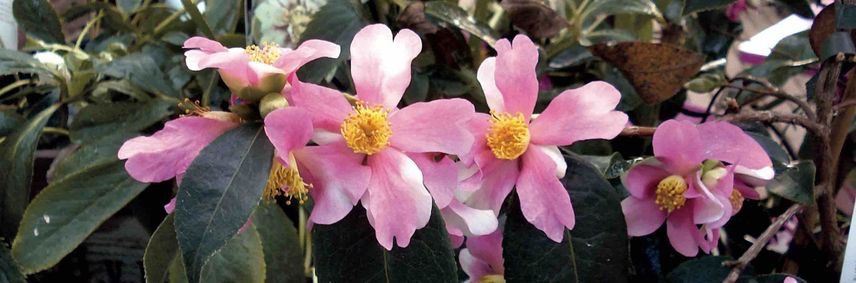
Camellia sasanqua ‘Yume’
Skimmias
After the fragrant spring flowering of these heather soil shrubs known as Skimmias, enjoy their lovely red berries (toxic), reminiscent of late autumn and the transition to winter, found on the female varieties. They are pollinated by males; therefore, ensure you have two Skimmias: one female plant and one male to benefit from all their advantages. The Skimmia japonica ‘Veitchii‘ boasts these small, highly decorative red fruits from October until the end of winter. The Skimmia reevesiana delights us with its beautiful clusters of cherry-red berries under the same conditions. The Skimmia ‘Kew White’ produces lovely cream-white autumn fruits, from October to March as well. Planted in shade or partial shade, they illuminate charming scenes with their berries alongside reddening foliage in harmony.
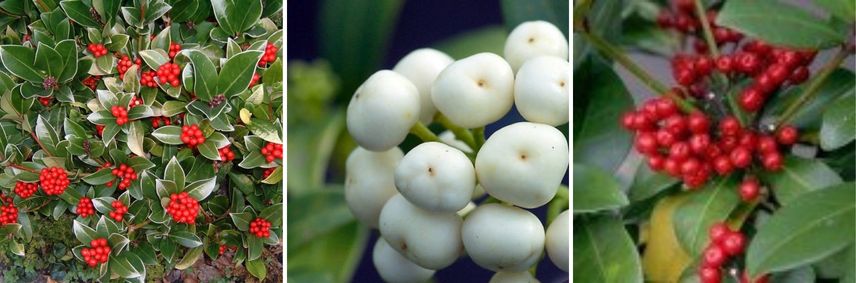
Skimmia reevesiana, Skimmia japonica ‘Kew White’, Skimmia japonica ‘Veitchii’
Nandinas
The Nandina domestica, also known as heavenly bamboo, is a highly ornamental bush with many advantages, the main one being its foliage, which is both evergreen and changes colour between spring, summer, and autumn. It generously varies between red, green, and purple. It is available in several cultivars, varying in height from 60 cm to 2 m at ripeness. Some are adorned with abundant small red berries that enhance the foliage at the end of the season, such as ‘Richmond’, set against red-orange autumn foliage. ‘Firepower’, on the other hand, turns purple during this season, just like ‘Obsessed Seika’, which is larger and has lighter foliage.
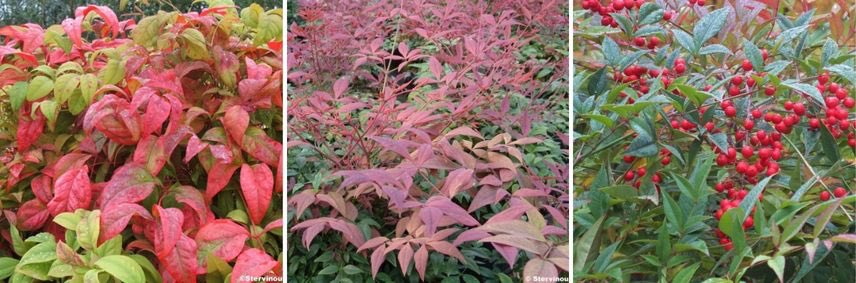
Nandina domestica ‘Firepower’, ‘Obsessed Seika’ and the fruiting of the species type
Virginia creeper
Grow Ampelopsis glandulosa var. maximowiczii in partial shade and enjoy its fruiting of multicoloured porcelain-like beads, measuring 5 to 8 mm in diameter, with colours evolving as they reach ripeness, in a mix of pale green, turquoise blue, bright blue, pink, mauve, and violet. The fruits of this very original climbing Virginia creeper, contrasting against its bright green foliage, create a luminous display in shaded corners. Modestly sized, this beautiful autumn plant can be placed on a pergola, a tree, or a fence.
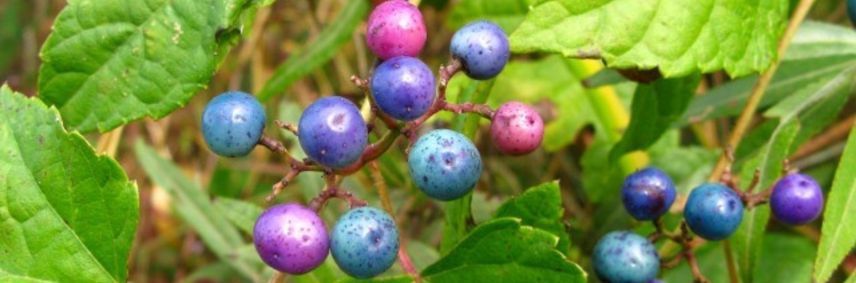
Ampelopsis glandulosa var. maximowiczii
- Subscribe!
- Contents

Comments