


Choosing an Astilbe
Our buying guide to find the ideal variety!
Contents
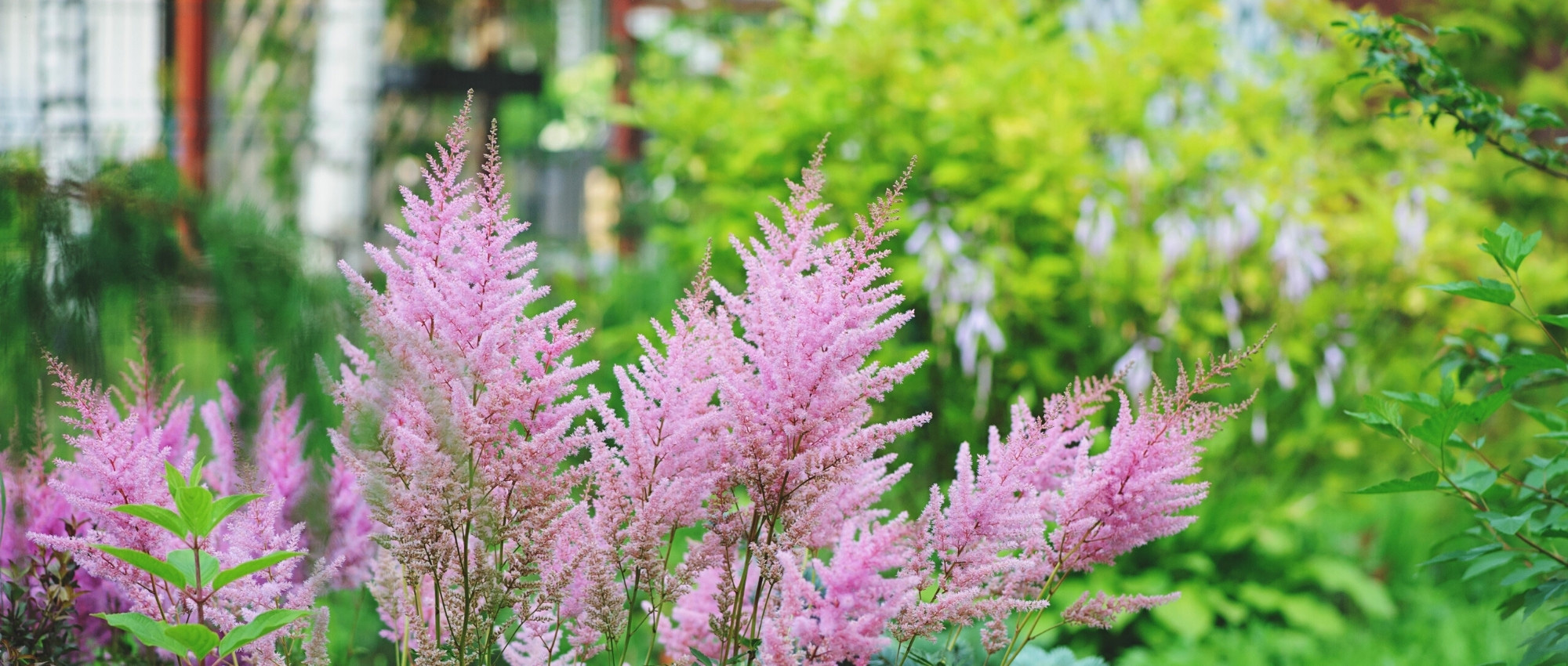
Astilbes are beautiful perennials that produce large, feathery panicles in shades of pink, white, or red during summer. Their generous, finely cut foliage is also appreciated. Astilbes are perfect for brightening up shady corners of the garden. They thrive in rich, cool to moist soil that does not dry out in summer. They are ideal for naturalistic gardens or for planting along the edges of a pond, as well as in cool, shaded rockeries, or in a large pot for the more compact varieties. There are numerous varieties available, offering different shades and heights: discover our guide to make the right choice and find the variety you need!
For everything you need to know about growing astilbes, feel free to check our comprehensive sheet “Astilbe: Planting, Cultivation, Maintenance”

According to height
The height of astilbes varies greatly: the smallest do not exceed 30 cm in height, while the largest reach between 1.50 m and 2 m! This means that their use in the garden will be entirely different depending on the chosen variety.
The Smallest Astilbes
Small astilbes can easily fit into the front of a perennial border. They will also find their place in pots, on the terrace, in a courtyard, or a small garden.
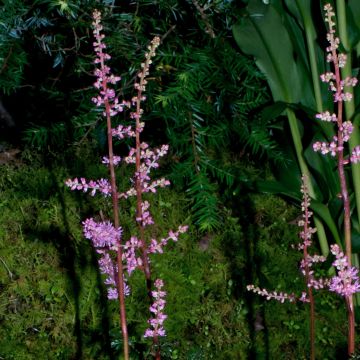
- L’Astilbe chinensis ‘Pumila’ is a dwarf variety that does not exceed 30 cm in height. It produces plume-like panicles, stiff and well-erected, in light violet-pink from July to September.
- L’Astilbe arendsii ‘Beauty of Lisse’ is a similarly sized astilbe (up to 30 cm tall) that offers pink panicles. Its foliage is notably a beautiful golden yellow in spring, before turning light green in summer.
- L’Astilbe crispa ‘Perkeo’ is an early variety that displays fine, very airy panicles in purplish pink from June. It measures about 25 cm tall when in bloom.
- L’Astilbe chinensis ‘Veronica Klose’ is slightly taller, measuring about 40 cm. It produces plume-like inflorescences in magenta pink from August to September.
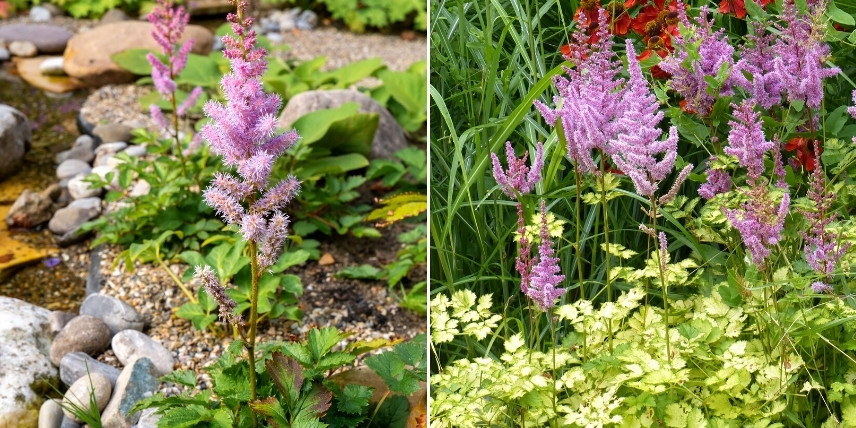
Astilbe chinensis ‘Pumila’ and Astilbe ‘Beauty of Lisse'[/caption>
The Largest Astilbes
Large astilbes easily integrate into the back of borders. You can pair them with tall grasses and perennials, or place them at the edge of a pond. They create a beautiful mass effect in a large park or garden, composing a very natural atmosphere!
- L’Astilbe rivularis ‘Grandiflora’ is one of the tallest, reaching 1.70 m in height when in bloom. It produces very airy and slightly arching panicles made up of numerous cream-white flowers from July to August. It is ideal for greening the banks of a pond.
- L’Astilbe chinensis var. taquetii ‘Purpurlanze’ features large inflorescences in purplish violet, reaching 1.20 m in height. The flowers become slightly lighter at the end of flowering, creating a lovely gradient of colours. Additionally, its young leaves have a beautiful mahogany red hue before turning dark green.
- L’Astilbe arendsii ‘Cattleya’ also reaches up to 1.20 m when in bloom. It produces plume-like inflorescences in light pink from June to August.
- L’Astilbe chinensis var. davidii is a particularly tall variety, measuring up to 1.50 m. It bears long panicles in lilac pink in mid-summer.
[caption id="attachment_155851" align="aligncenter" width="856"]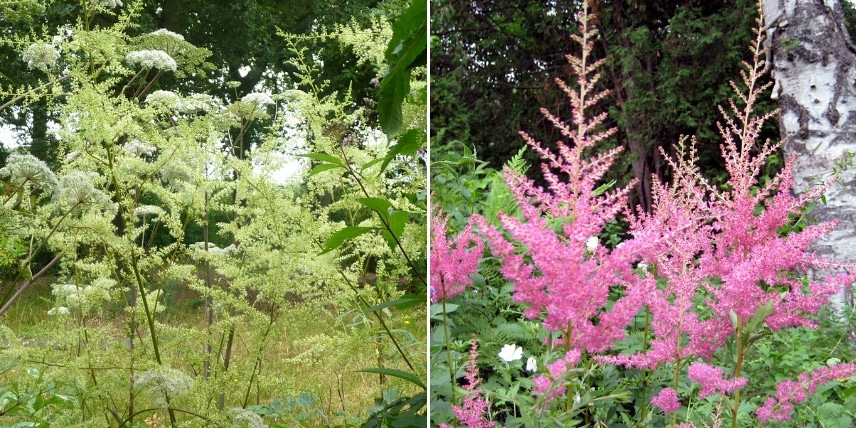 Astilbe rivularis (in association with Angelica archangelica) and Astilbe arendsii ‘Cattleya’ (photos: Peganum / Bill Wren)
Read also
Pairing AstilbesAccording to the colour of the flowers
White Flowering Astilbes
White flowering astilbes are perfect for graphic or naturalistic gardens. The white colour enhances the very elegant and light aspect of the flowering. Moreover, these varieties bring a lot of brightness to shaded corners. They pair wonderfully with the white flowering of goat’s beards (Aruncus dioicus).
- The Astilbe japonica ‘Deutschland’ is an early variety that produces short, pure white, dense and well-ramified panicles in June-July. It is a rather compact astilbe that does not exceed 50 cm in height when in flower.
- The Astilbe arendsii ‘Diamant’ offers large cream-white panicles in July-August, reaching a height of 80 cm.
- The Astilbe ‘Washington’ is a very beautiful variety that flowers from June, producing superb pure white, well-ramified panicles. It reaches a height of 50 to 60 cm.
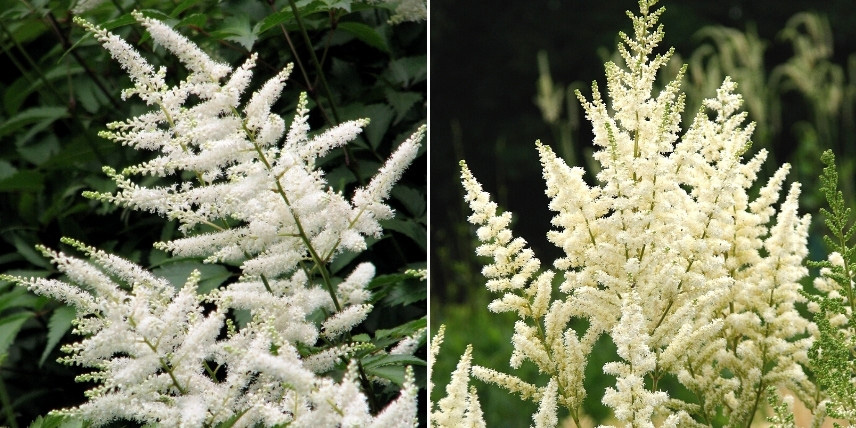
Astilbe ‘Deutschland’ (photo Agnieszka Kwiecień) and Astilbe ‘Diamant’ (photo Kor!An)
Red Flowering Astilbes
Red flowering astilbes attract attention with their vibrant hue! They are perfect for mixed borders and perennial beds, alongside other warm-toned flowers, such as those of avens, daylilies, ligularias, and knotweeds. Red is a dynamic colour, best reserved for larger gardens, as this hue tends to dominate the space and can feel a bit overwhelming; in smaller gardens, softer and cooler colours like white, blue, mauve, and pale pink are preferable.
- The Astilbe ‘Red Sentinel’ is one of the most beautiful red flowering varieties. From July to August, it produces short, dense panicles of a scarlet red hue, which stand out beautifully against its dark green foliage. It does not exceed 60 cm in height.
- The Astilbe japonica ‘Montgomery’ produces dark red feathery spikes in early summer, reaching 60 cm in height. Its dark green foliage, which may have a purplish tint, is also appreciated.
- The Astilbe arendsii ‘Spinell’ is a tall astilbe that produces long carmine-red panicles in summer, reaching up to 90 cm in height.
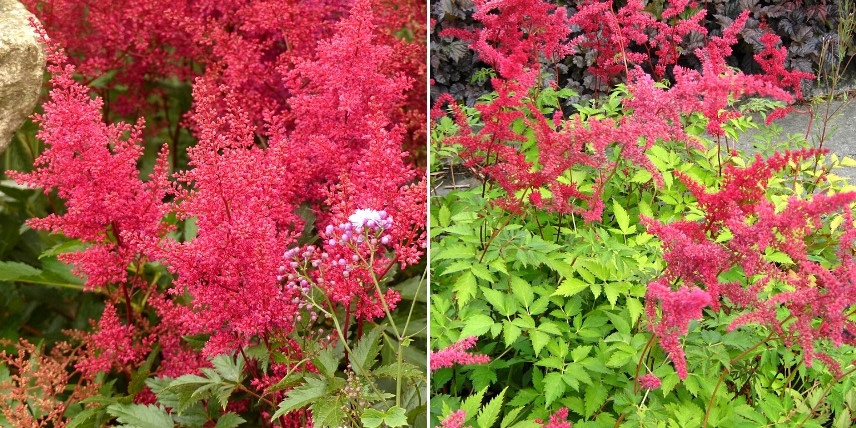
Astilbe ‘Montgomery’ and Astilbe arendsii ‘Spinell’
Pink Flowering Astilbes
Pink flowering astilbes are particularly delicate. They can find their place in romantic gardens, alongside white or pink blooms, such as those of epilobes, meadowsweet, persicarias, Japanese anemones, and roses.
- The Astilbe chinensis ‘Veronica Klose’ is a dwarf variety (up to 40 cm tall) with magenta flowers. It flowers late, from August to September.
- The Astilbe japonica ‘Delft Lace’ is a compact variety that produces light pink flowers borne on stunning red stems. It also features beautiful green foliage with reddish-purple highlights, turning orange-red in autumn.
- The Astilbe ‘Vision in Pink’ is also quite compact (up to 60 cm tall) and bears pink panicles from June to August, which bloom above its bluish-green foliage. Additionally, it has the advantage of being less water-demanding than other varieties.
- The Astilbe ‘Peach Blossom’ is a variety with light pink to white flowers, slightly orange-tinted, offering a beautiful gradient of colour! Its very delicate flowering is ideal for a romantic garden atmosphere.
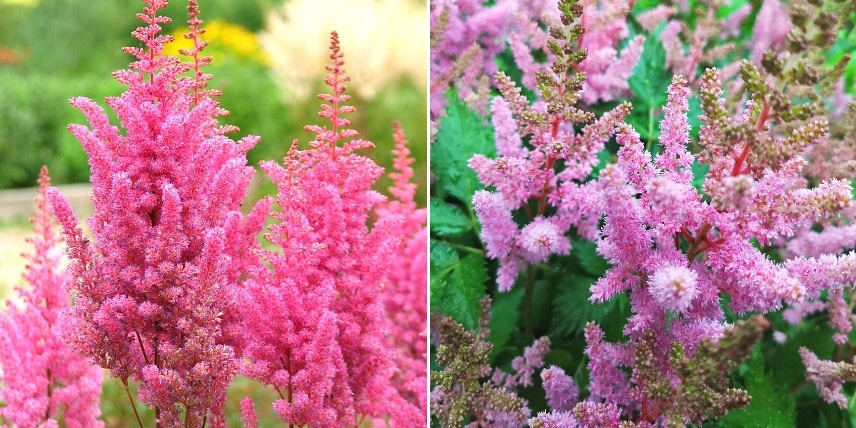
Astilbe chinensis ‘Veronica Klose’ (photo Korlan) and Astilbe ‘Vision in Pink’ (photo Karen Hine)
Purple – Mauve Flowering Astilbes
Purple – mauve flowering astilbes pair very well with other mauve, blue, white, or pink blooms. For example, you can plant them alongside hardy geraniums, astrantias, campanulas, and persicarias.
- The Astilbe arendsii ‘Amethyst’ offers stunning floral spikes of a very original amethyst purple colour!
- The Astilbe arendsii var. taquetii ‘Purpurlanze’ is a tall variety that reaches up to 1.20 m in height.
- The Astilbe chinensis ‘Pumila’ is a dwarf variety that does not exceed 30 cm in height.
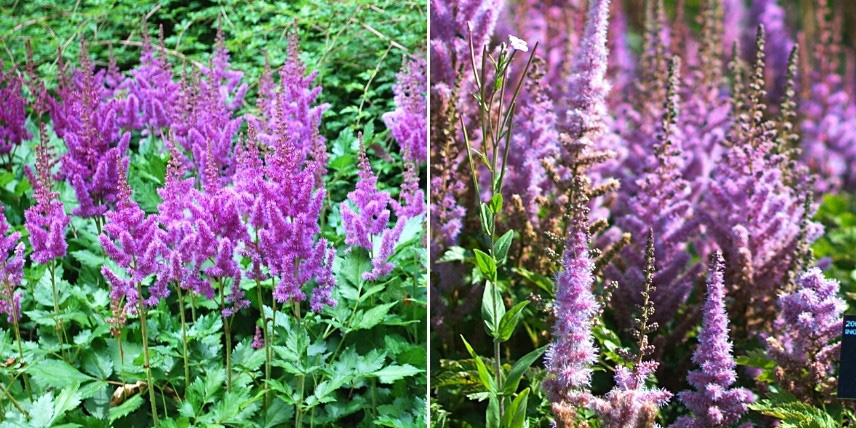
Astilbe arendsii ‘Amethyst’ (photo Jeff Hart) and Astilbe chinensis ‘Pumila’ (photo Matt)
Discover other Astilbe - False Goatsbeard
View all →
Available in 1 sizes
Available in 1 sizes
Available in 0 sizes
Available in 3 sizes
Available in 3 sizes
Available in 2 sizes
Available in 1 sizes
Available in 2 sizes
Available in 1 sizes
Available in 1 sizes
According to the flowering period
Early Flowering Astilbes (June-July)
- Astilbe ‘Washington’ is one of the first to bloom, as early as June! It offers a beautiful white flowering in ramified panicles.
- The Astilbes ‘Deutschland’, ‘Avalanche’, ‘Fanal’, ‘Bumalda’, ‘Bressingham Beauty’, and ‘Sprite’ also bloom at the beginning of summer, in June-July.
Late Flowering Astilbes (August-September)
- Astilbes ‘Veronica Klose’ and Astilbe chinensis ‘Purpurlanze’ finish the season with flowering in August-September. Feel free to combine early and late varieties so that their flowerings alternate throughout the summer!
According to the colour of the foliage
- Astilbe ‘Chocolate Shogun’ features very dark, purple-brown foliage.
- Astilbe ‘Colour Flash’ stands out with its very unique, variegated foliage of green and burgundy red.
- Astilbe ‘Beauty of Lisse’ (also known as ‘Color Flash Lime’) offers very bright, golden-yellow foliage that turns light green in summer. You can create a beautiful contrast by pairing it with the dark foliage of Astilbe ‘Chocolate Shogun’.
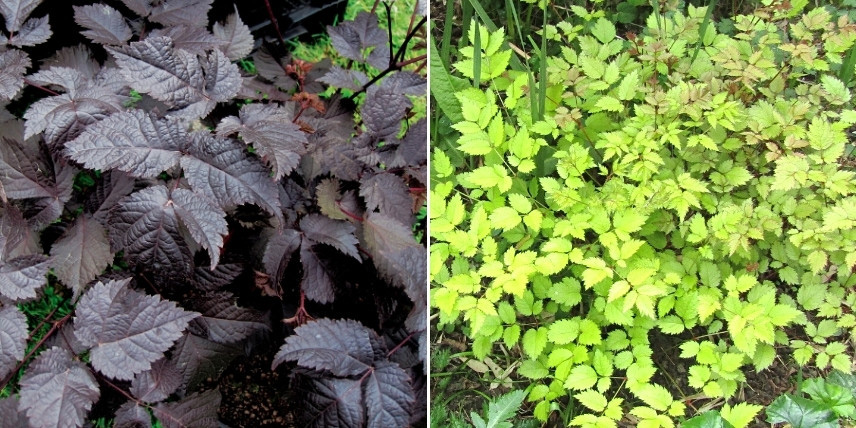
Astilbe ‘Chocolate Shogun’ and Astilbe ‘Beauty of Lisse’ (photo Leonora Enking)
Depending on the use and style of the garden
In a Naturalistic Garden
Large Astilbes with white and airy flowers will easily find their place in a naturalistic garden. We particularly recommend Astilbe rivularis ‘Grandiflora’ or Astilbe ‘Prof. van der Wielen’. You can plant it, for example, on the banks of a pond, alongside ferns, Cirsium rivulare, Eriophorum angustifolium, eupatoriums, fireweeds, meadowsweets, and willowherbs.
In a Graphic Garden
To create a graphic atmosphere that is both modern and minimalist, choose white-flowered astilbes, particularly varieties with stiff, upright panicles. For instance, you might select Astilbe ‘Deutschland’. Pair it with Alliums, white agapanthus, ferns, hostas, and grasses.
In a Colourful Mixed Border
You can create a beautiful perennial bed with astilbes, featuring bright and colourful blooms. For example, choose a red-flowered Astilbe, such as the variety ‘Fanal’, and combine it with daylilies, avens, Persicaria amplexicaulis, and coreopsis.
You can also create a striking contrast by playing with complementary colours. For instance, pair a purple-flowered astilbe, like Astilbe arendsii ‘Amethyst’, with yellow-flowered perennials (Digitalis grandiflora, echinacea ‘Harvest Moon’, ligularias…). Their hues will enhance each other!
In a Romantic Garden
The best astilbes for a romantic garden atmosphere are the varieties with white or soft pink flowers. You might choose, for example, astilbes ‘Bressingham Beauty’, ‘Peach Blossom’, or ‘Diamant’. Plant them alongside roses, astrantias, campanulas, and hardy geraniums. Also, incorporate some plants with silver foliage, such as wormwoods or Stachys byzantina.
- Subscribe!
- Contents
![[plant_selector title="Choix Astilbe" subtitle="Découvrez nos variétés d'Astilbe disponibles" category="astilbe"]](https://en.promessedefleurs.eu/blogwp/wp-content/uploads/2022/05/Choisir-une-Astilbe.jpg "Choose a Astilbe")
Comments