





























Exotic plants for shade
Our favourite plants to bring a touch of the exotic to shady or partially shaded areas
Contents
In the shade, it often seems that exoticism cannot be expressed, as this notion evokes warmth or sunshine. Yet, there are many plants that thrive in low-light conditions and provide a good dose of escapism with their large foliage, unusual shapes, or atypical flowering! They are perfect for gardens or even small urban courtyards or patios. These plants generally grow in sufficiently cool soils, in shade or partial shade.
Do you dream of creating an exotic garden and are looking for plants for shaded areas? Giant plants, oversized specimens, or botanical curiosities… what are these exotic plants that can grow in shaded conditions? We share with you some of the most beautiful plants in this article!

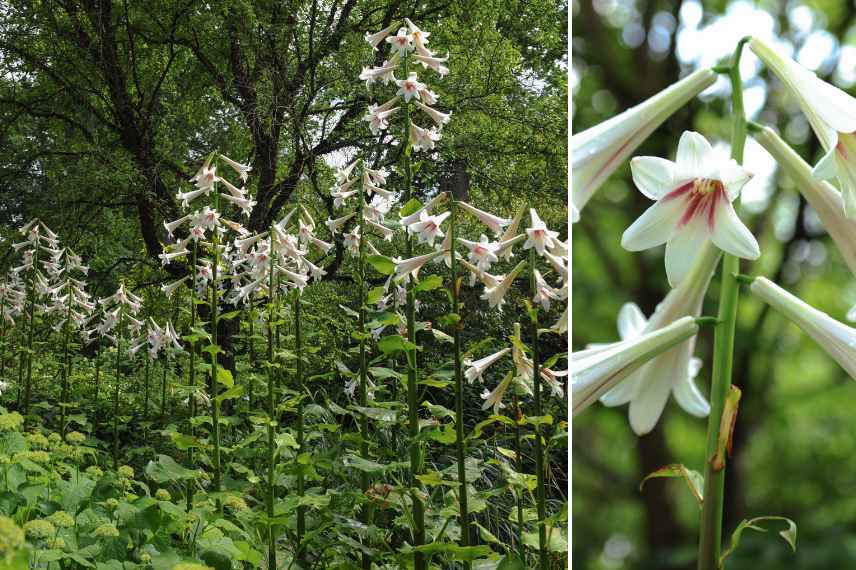
Cardiocrinum giganteum
Also known as giant Himalayan lily, this is a remarkable plant. Firstly, in its dimensions, as it can grow up to 2 m tall, or even more when it is happy. Its cream-white, trumpet-shaped flowers are large (20 cm) and delightfully fragrant. The foliage is equally impressive, undulating, glossy, and a beautiful rich green, adding a touch of freshness to the garden even when not in flower. This bulbous plant has a very slow growth rate (expect several years for a single flowering) and is a must-have for an exotic garden. It should be planted in humus-bearing, well-drained soil, and in regions with humid summers.
♥ A cultivar to discover: Cardiocrinum giganteum var. yunnanense, with slightly larger flowers and a bit shorter.
Read also
How to design a tropical garden?Kirengeshoma palmata
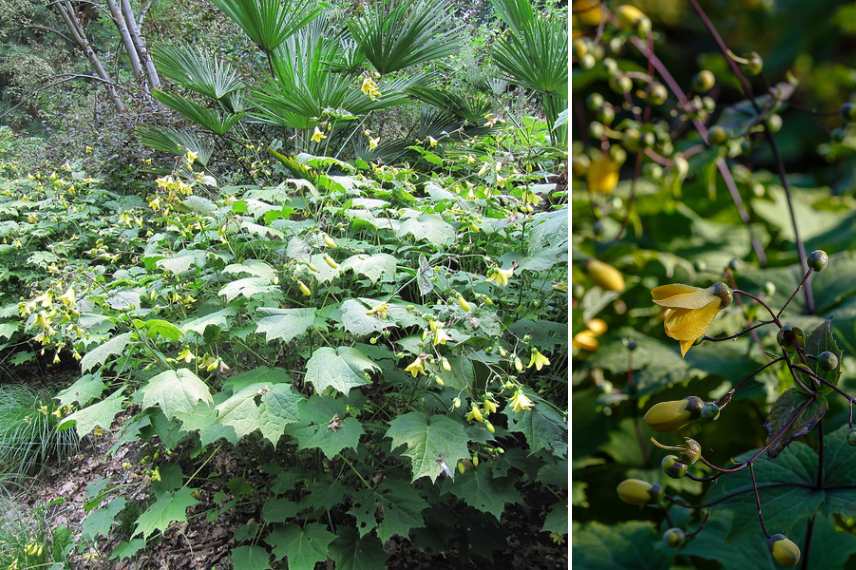
With its Abutilon-like flowers and palmate foliage, Kirengeshoma palmata catches the eye and brings a touch of renewal and exoticism to the shady garden. Particularly at home in cool shade, this deciduous perennial with a very light appearance, also known as wax flower, features yellow bell-shaped flowers in late summer that distinctly rise above the foliage, and lobed leaves that turn yellow in autumn. A close relative of hydrangeas, Kirengeshoma palmata should be planted in gardens in the northern half of France, as it requires cool environments and is particularly hardy.
♥ My recommended cultivar: Kirengeshoma palmata ‘Golden Guinea’, with its large yellow flowers.
Terrestrial orchids
Cypripedium (Venus slipper), Pleione, Calanthe, Cautleya, Bletilla (hyacinth orchid)… they all have that little exotic orchid charm, although they do not all belong to the same botanical family (Orchidaceae or Zingiberaceae) and remain relatively modest in size. Unlike so-called epiphytic orchids (which grow in trees), these grow quite slowly in the ground and are relatively hardy, able to thrive in our latitudes, as long as they are provided with soil that does not dry out too much in summer. They bring a distinctly exotic touch with the beauty and exoticism of their flowering. There are many colours among these terrestrial orchids, as well as extravagant shapes for lovers of unique plants. There is surely one for you!
A must for these flowers: humus-bearing soil that is not waterlogged in winter or too dry in summer, preferably in partial shade.
♥ My advice: one of the easiest to select for beginners might be Bletilla striata, a robust and easy-to-grow terrestrial orchid with delicate pink flowers.
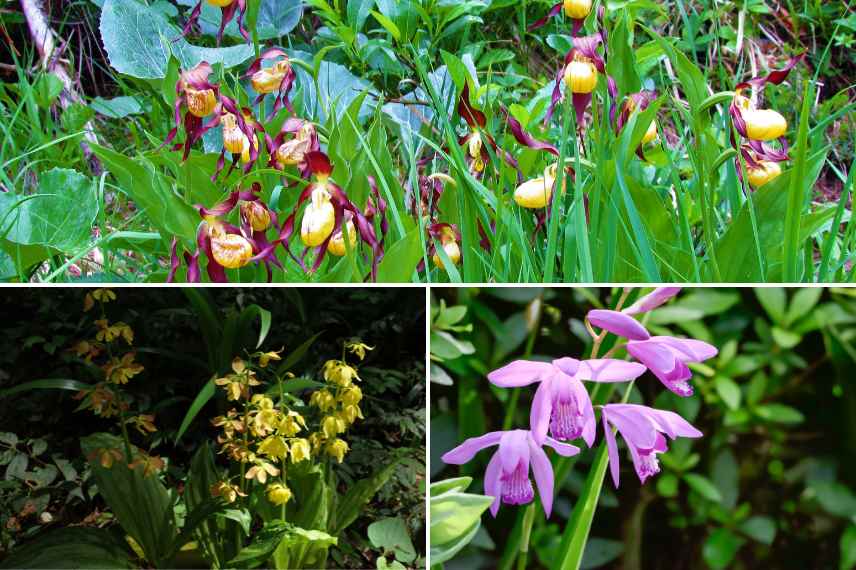
Cypripedium calceolus, Calanthe and Bletilla
Arisaema
Undoubtedly, these plants are first-rate botanical curiosities and their exotic appearance works like magic in the garden! Their flower, regardless of the different species (there are over 150 of them!), forms an astonishing spathe, which could almost make one think it is a carnivorous plant. But it is nothing of the sort, and this cobra lily as it is called by English speakers, creates a sensation while also intriguing.
Blooming in late spring, in white, green, pink, or purple, often striated, Arisaema also has decorative foliage. They thrive in woodland areas and enjoy cool shade, with soil remaining sufficiently moist in spring.
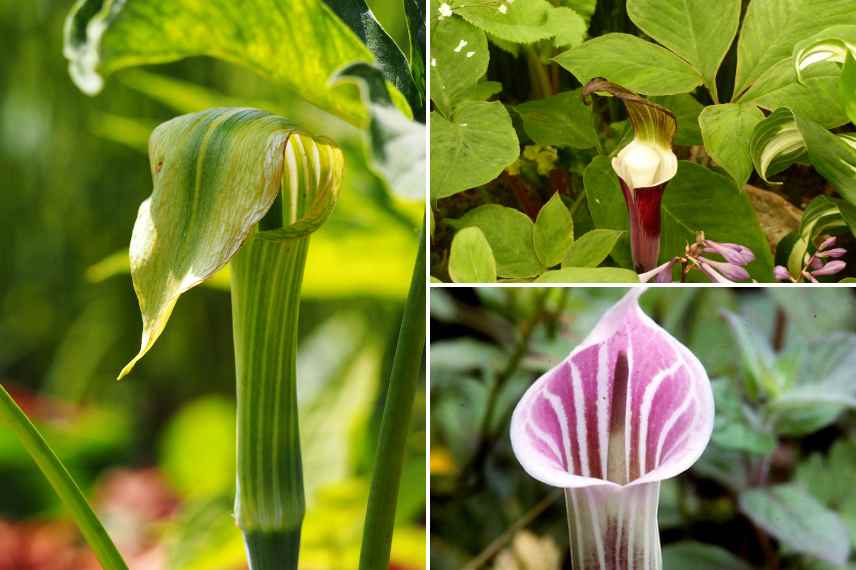
Arisaema amurense, Arisaema sikokianum, and Arisaema candidissimum
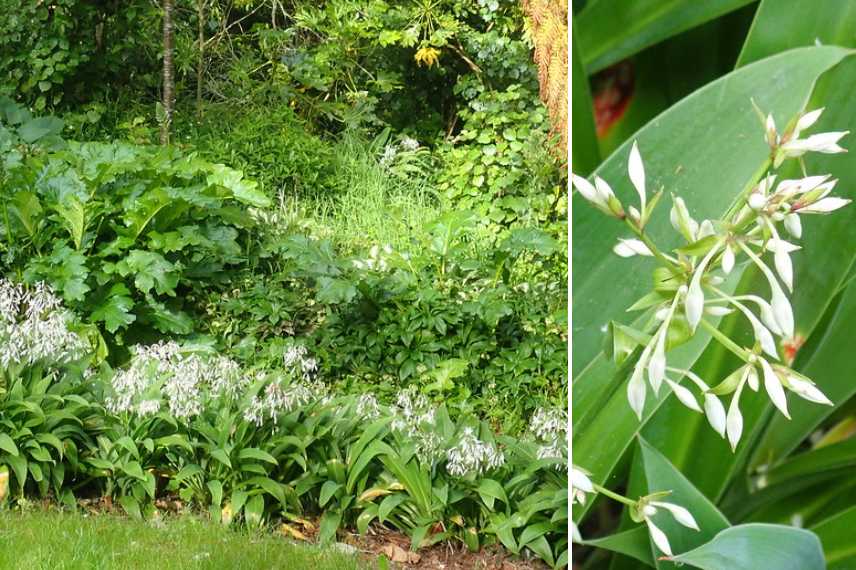
Arthropodium cirratum
Still relatively uncommon, theArthropodium cirratum (also known as New Zealand rock lily) has beautiful qualities for enhancing a shaded or partially shaded exotic area: its ribbon-like evergreen foliage forms lovely upright, slightly arching clumps, and its white flowering in long starry panicles is very graceful. It is ideal for partial shade, whether under trees, as it tolerates dry shade, by the sea as it copes well with sea spray, in borders, or even in a large pot on a terrace. It should be protected in the first few years, but ultimately withstands some frosts down to -5°C.
This beautiful herbaceous perennial grows between 50 cm and 80 cm, in well-drained, consistently moist or dry soil.
♥ My advice: Ideal for dressing a dry shaded area!
Cyrtomium fortunei
Ferns are wonderful shade plants, and some are particularly suited to a tropical or exotic atmosphere. This is the case with the holly fern (Cyrtomium fortunei in English), with its large pinnate leaves. The fronds are undulate, leathery, and evergreen in mild climates. The typical species is very beautiful, growing in a spreading manner (about 50 cm), but there are also many cultivars and other species to consider (Cyrtomium falcatum with its very glossy leaves). It can be planted in the ground or in pots, in any well-drained and cool soil.
♥ My favourite: Cyrtomium fortunei var. Clivicola, which has a lovely light green ideal for brightening up shady areas.
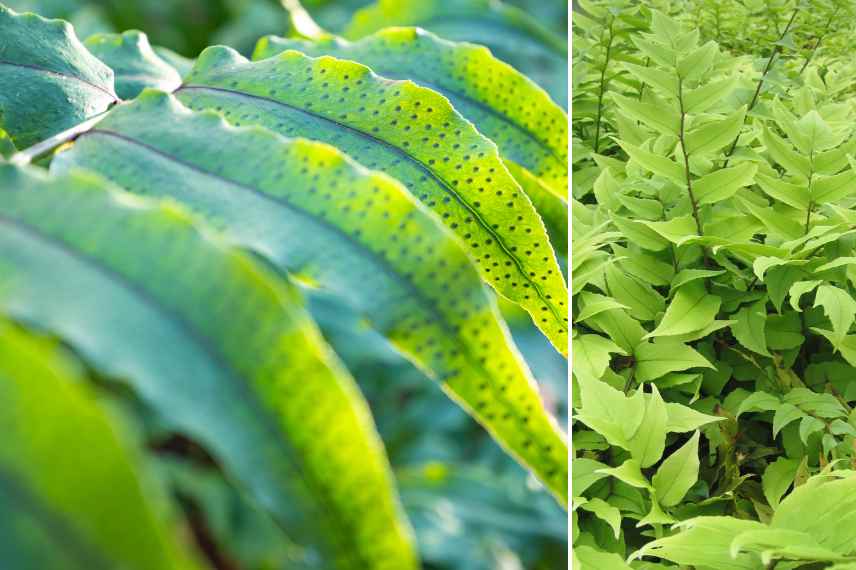
Cyrtomium fortunei and to the right the variety ‘Clivicola’
Tricyrtis
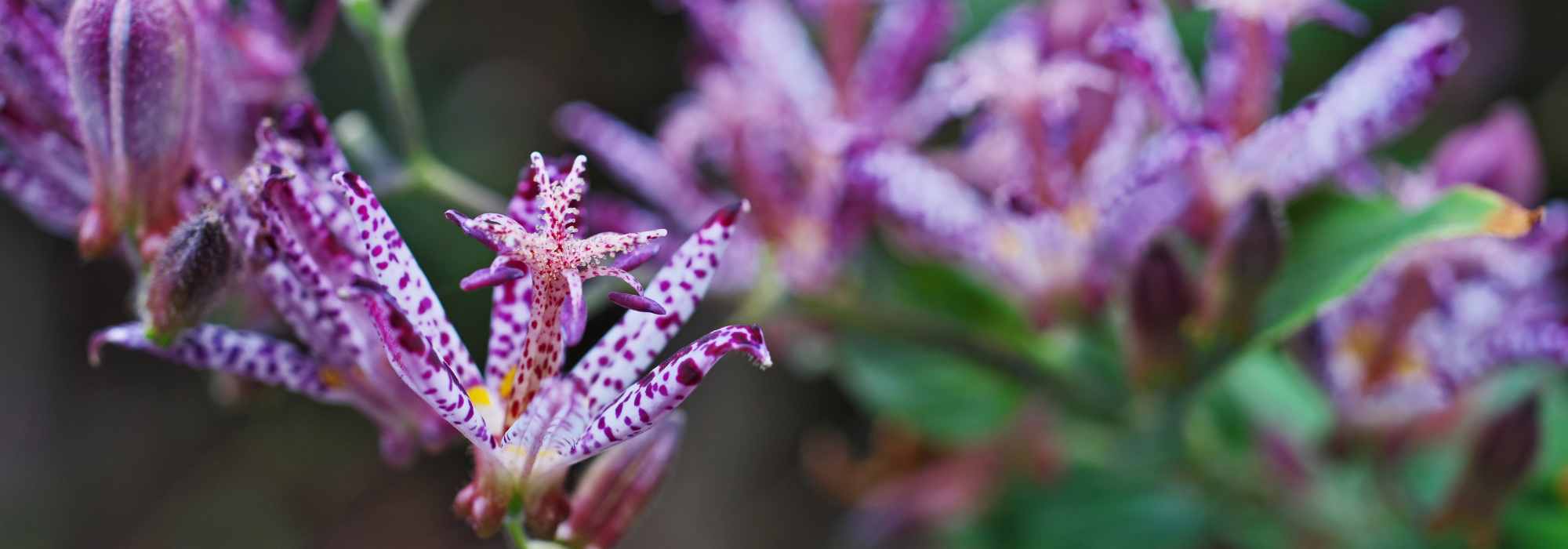
Increasingly seen in exotic gardens, the Tricyrtis or toad lily immediately captivates enthusiasts of shade and exotic plants: the spotted flowers are ultra elegant and have the advantage of appearing late in the season, around August or September, when the garden starts to tire. It also requires soil that remains cool but well-drained. Numerous cultivars are available in shades of pink, blue, and even red. Its little extra in this selection? It is very easy to grow.
♥ My favourite: Tricyrtis hirta, which is beautifully simple and delightful in groups of a few plants.
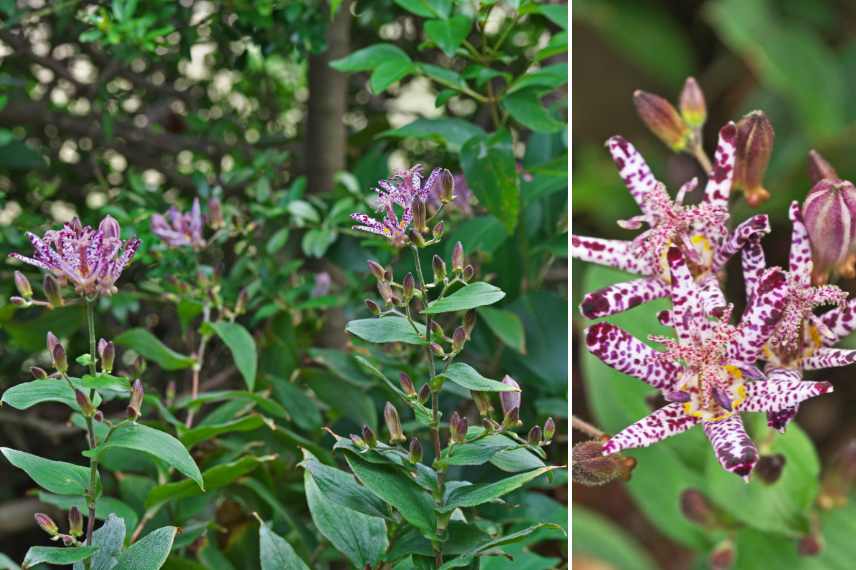
Tricyrtis hirta
Astilboides and company...
Large-leaved plants are prized for the exotic effect they provide. Among the most beautiful, the Astilboides tabularis, Farfugiums (also known as leopard plant), Podophyllum, and Petasites japonicus (which can be invasive) are truly stunning shade perennials. One of them is even called the umbrella plant, Syneilesis palmata, as its foliage resembles a parasol, with particularly notched and dentate round leaves.
This creates a lovely little shady corner full of originality and exoticism!
♥ Read also: 5 XXL foliage perennials.
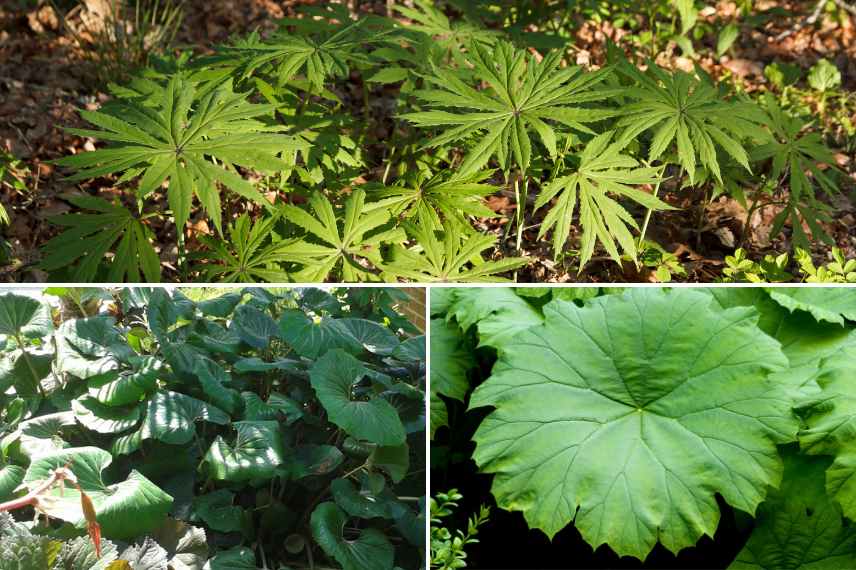
Syneilesis palmata, Farfugium giganteum (© Gwenaëlle David-Authier) and Astilboides tabularis
Typhonium giganteum
Whether discussing Typhonium (syn. Sauromatum) giganteum or Dracunculus vulgaris, these two unique plants produce an extraordinary inflorescence during the summer: a brown-red cone in the form of a large spadix, truly unusual, fitting perfectly into exotic arrangements. The foliage is also attractive, very broad for Typhonium, growing up to 60-80 cm in height. Of Himalayan origin, Typhonium is quite cold-resistant and can thrive in many regions, as long as the soil remains well-drained and cool. These “voodoo lilies,” as they are called by English speakers, are curiosities that blend perfectly into the shade of a border, alongside colocasias or arums, for example, with some Carex or ferns for contrasting texture.
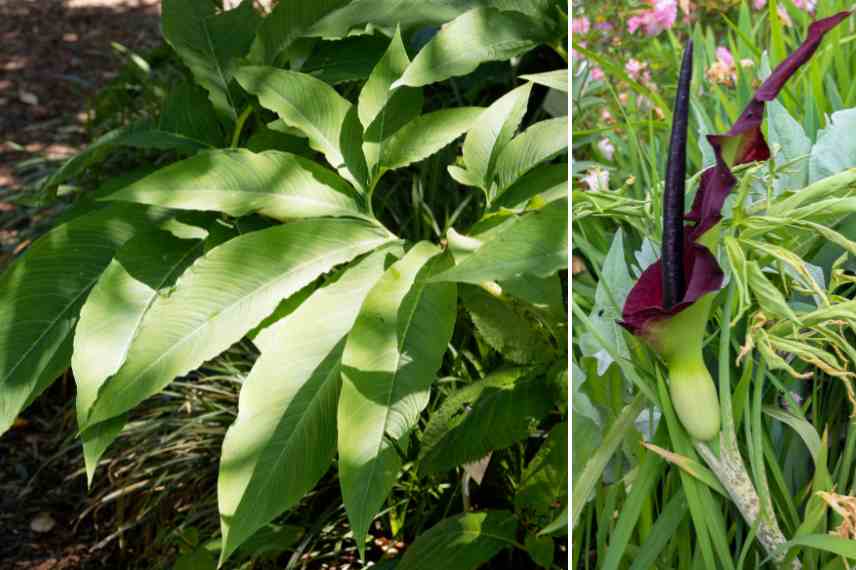
Typhonium and Dracunculus vulgaris
Roscoea
Another flower that takes us on a journey from the garden! The Roscoea enchants with its orchid-like flowers (but it belongs to the ginger family). Of medium height, between 30 and 40 cm tall, it prefers partial shade to bloom well, and a slightly acidic soil. The tubular flowers are white, pale mauve, or purplish depending on the variety.
♥ My favourites: Roscoea beesiana, particularly hardy (-15°C), and the Roscoea purpurea ‘Spice Island’ with brown stems for a lovely contrast.
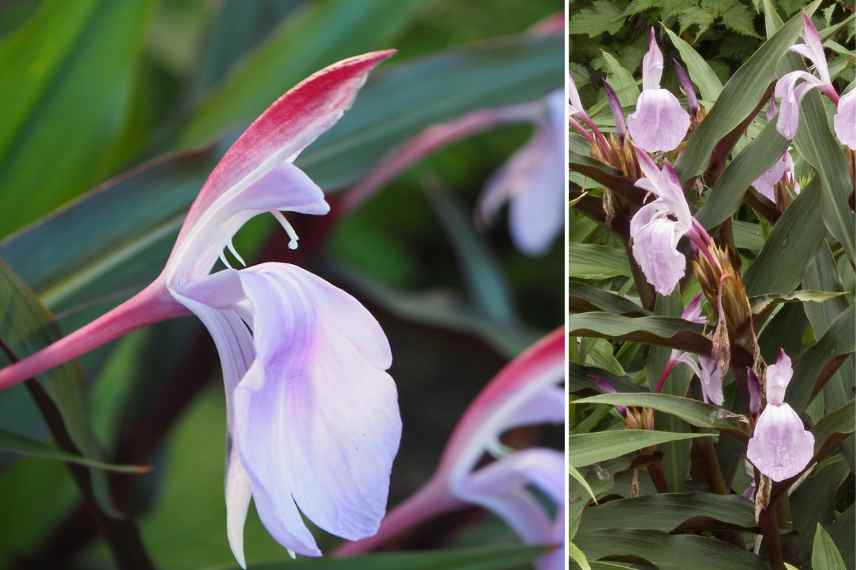
Roscoea purpurea ‘Spice Island’ (©Teresa Grau Ros) and Roscoea purpurea ‘Brown Peacock’ (© Peter Coxhead)
Schefflera
Let’s finish with a remarkable shrub for shady situations, Schefflera taiwaniana. Its large compound leaves make it an excellent choice. It grows up to 3 m high with a spread of about 2 m. Its umbrella-like, slightly weeping habit and lushness are highly sought after. This evergreen bush has the advantage of being quite hardy in our climate (down to -10°/-12°C), a bit more than its cousin, the Schefflera delavayi. Adopt it in the shade to add some height to your flower beds or in woodland areas.
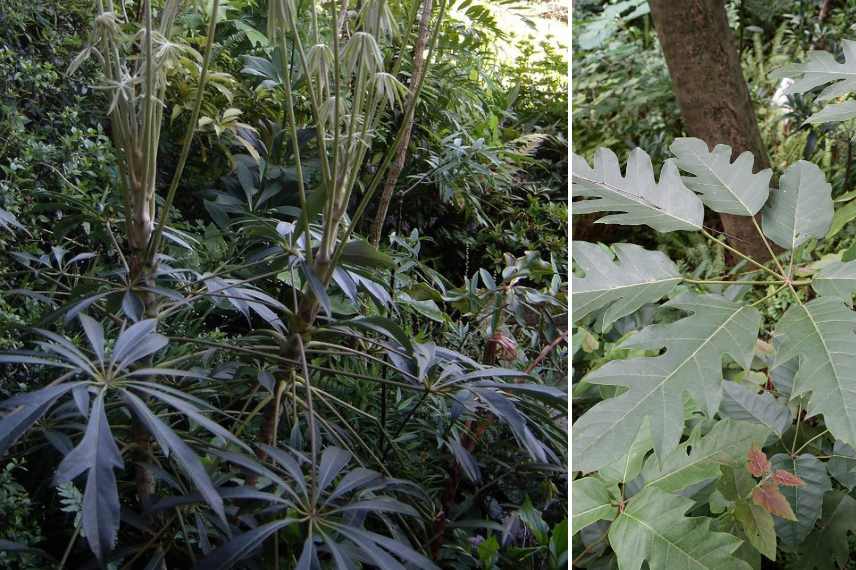
Schefflera taiwaniana (© Peganum) and Schefflera delavayi
Other, more classic plants...
But also, making a little impact in shaded borders, less well-known plants that are easily found: Mahonia, graphic, Hydrangea aspera, villous, Rodgersia podophylla (in partial shade), Aucubas with glossy and speckled leaves, giant hostas interesting for their hardiness, Fatsia with fan-like leaves, perennial impatiens, and tree ferns (Dicksonia antartica) with majestic fronds that are more tender.
♥ My favourites: Fatsia Polycarpa ‘Green Fingers’, with finely dissected foliage, and Hydrangea aspera sargentiana, with very large villous leaves and pale mauve flowers.
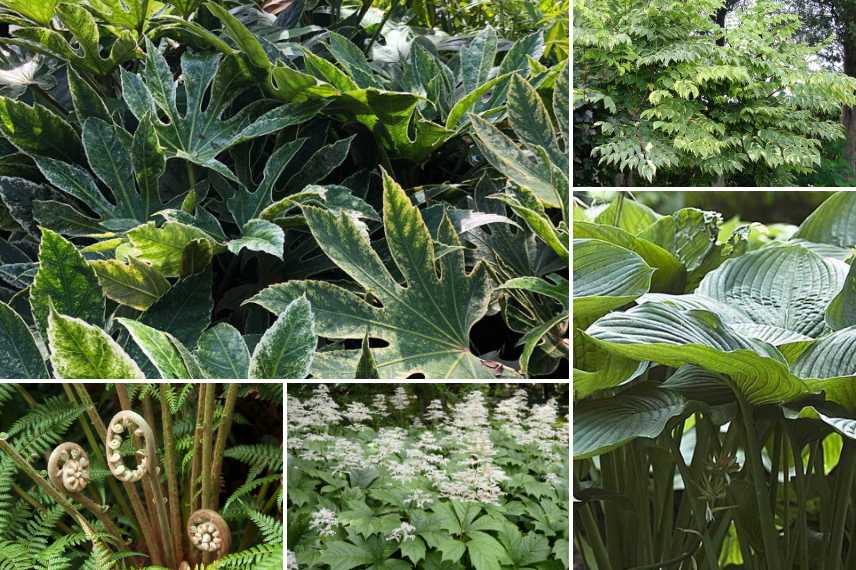
Fatsia ‘Spider Web’, Aralia elata ‘Aureovariegata’, Dicksonia antartica, Rodgersia podophylla, and Hosta ‘Empress Wu’
- Subscribe!
- Contents
Comments