


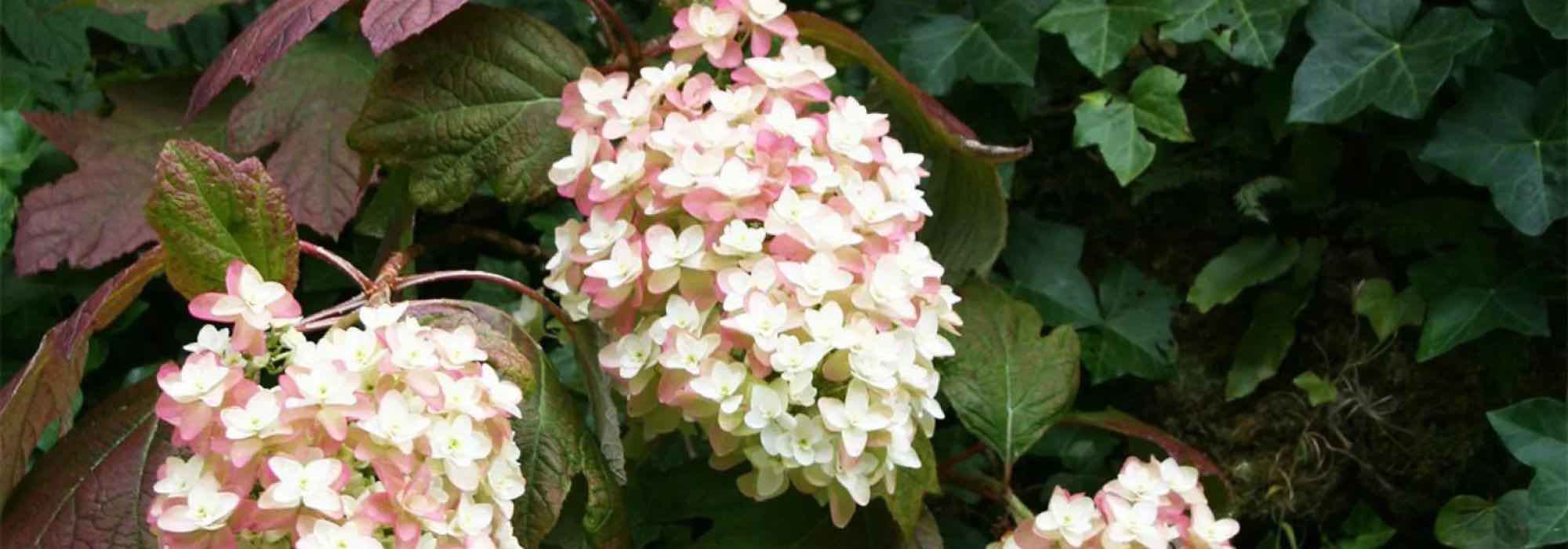
How to choose a Hydrangea?
Buying guide: choosing the right Hydrangea
Contents
Choosing a shrub hydrangea (i.e., not climbing and not dwarf) for your garden may seem complex given how many varieties, differences and criteria there are. The size of the hydrangea, the colour of its flowers, its various uses, exposure, soil type, the shape and colour of the foliage, maintenance and the pruning are all factors that influence your choice. In this article, we guide you step by step to select the shrub hydrangea that will perfectly meet your expectations and the specifics of your garden.

Depending on mature size
Our category “bush hydrangeas” lists non-climbing hydrangeas, whose mature size is greater than 1 m. According to these criteria, these hydrangeas range from 1 m to 4 m in height.
For example, among the smallest, we note the Hydrangea quercifolia ‘Tara’ which reaches 1.20 m in all directions at maturity, or the Hydrangea paniculata ‘Tickled Pink’ whose height and spread are around 1.50 m.
The majority of hydrangeas form bushes around 2 m tall and slightly narrower in width.
A little taller than average, between 2 m and 3 m in height, you will find, for example, the renowned Hydrangea paniculata ‘Vanille Fraise’ and the Hydrangea aspera ‘Macrophylla’, which reach 2.50 m on average.
The tallest belong to rarer species, such as the Hydrangea aspera ‘Bellevue’ and the Hydrangea heteromalla ‘Bretschneideri’ which reach respectively 3.5 m and 4 m in height with a width equal to or slightly less.
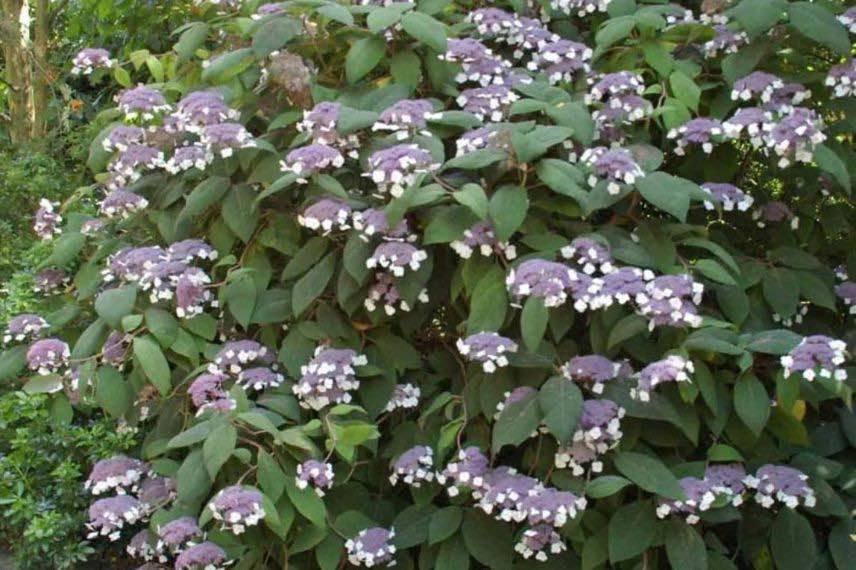
Hydrangea aspera ‘Bellevue’ forms a very large specimen
Read also
Hydrangeas: planting, pruning and careDepending on the colour of the flowers.
The colour of hydrangea flowers varies, but when they are not an enchanting blue or a crimson red, it sits in tonal monochrome shades, somewhat muted, fairly soft, ranging from white, cream, pale pink or candy-pink, apple green to mauve.
Some cultivars have an evolving flowering throughout the season, transitioning from cream-white to pink and red, for example in Hydrangea paniculata ‘Fraise Melba’. Also note the Hydrangea macrophylla ‘Ruby Tuesday’ which opens in bright green and then shifts to purplish-red, or the Hydrangea quercifolia ‘Snowflake’ which tones to reddish-brown on flowers initially anise-white. This evolving quality is present in cultivars of these three species.
For vivid blues, possible only if the hydrangea is planted in acidic soil, or if it receives aluminium sulphate, for example the varieties Hydrangea macrophylla ‘Endless Summer’ with pale blue flowers or the Hydrangea macrophylla ‘Yamato’ with flowers of a blue shade whose intensity varies from white-tinged blue to cobalt blue and bluish-grey. Note that only Hydrangea macrophylla and Hydrangea serrata have this peculiarity of producing blue flowers in acidic soil.
Mauves are well represented among varieties of the species Hydrangea involucrata and Hydrangea aspera.
Hydrangea macrophylla are the champions for the number and the variety of colours.
White colour is found pretty much everywhere, but how could one not mention the impressive white, rounded or conical heads of the Hydrangea arborescens, paniculata and Hydrangea quercifolia as with the famous variety ‘Annabelle’ or the varieties ‘Phantom’, ‘Skyfall’ and ‘Sike’s Dwarf’.
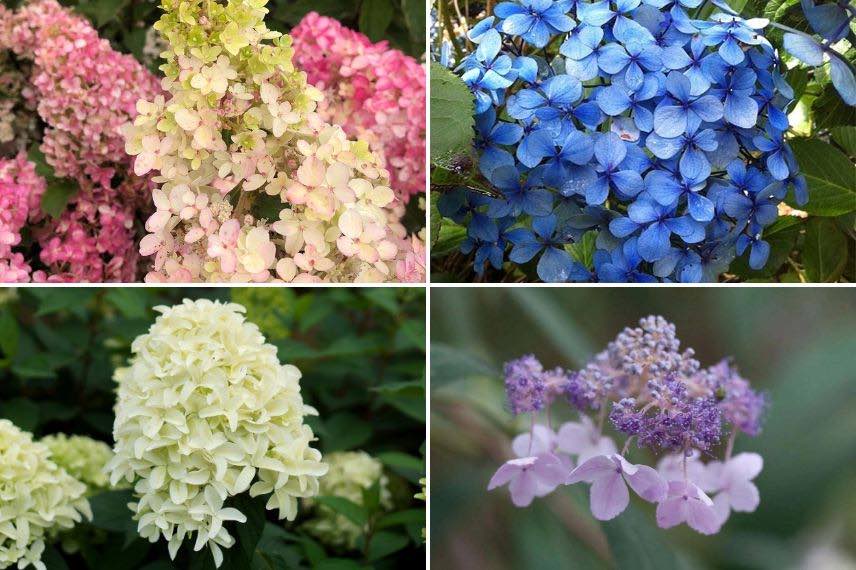
Clockwise: Hydrangeas ‘Fraise Melba’, ‘Yamato’, involucrata, ‘Skyfall’
Depending on the flowering duration
Hydrangeas flower in summer, from June to September–October.
Some are champions of flowering duration, such as those in the Endless Summer®, series, for example the Hydrangea macrophylla Endless Summer® ‘Twist and Shout’, highly repeat-flowering, which flowers from June to October continuously.
Read also
Potted hydrangea: planting and careDepending on foliage shape, foliage colour and wood
The shape of the foliage
Hydrangea quercifolia, or oak-leaved hydrangeas, are spectacular, developing large deciduous leaves that are dark green, lobed, with a distinctive form mirroring oak leaves.
On Hydrangea aspera ‘Bellevue’, the leaves are gigantic. They measure up to 50 cm long.
Colouring of foliage and wood
Some rare cultivars display variegated foliage, dark green edged with white in ‘Tricolor’, light green splashed with white in ‘Shikoku Flash’, in two tones of golden yellow and green in ‘Golden Annabelle’.
Some have foliage that colours in autumn.
- All Hydrangea quercifolia have large lobed leaves that colour in early autumn from brown, red or bronze as evenings grow cooler.
- The Endless Summer® series hydrangeas, noted above for their long flowering, have foliage that colours red in autumn. Some cultivars from time to time see their foliage colour purple in spring or autumn.
- Finally, ‘Hot Chocolate’ develops chocolaty purple foliage in spring which becomes dark green during summer, then orange-yellow in autumn.
Some varieties feature black stems, creating a striking contrast with the flower clusters. The effect remains ornamental in winter, once the inflorescences have faded.
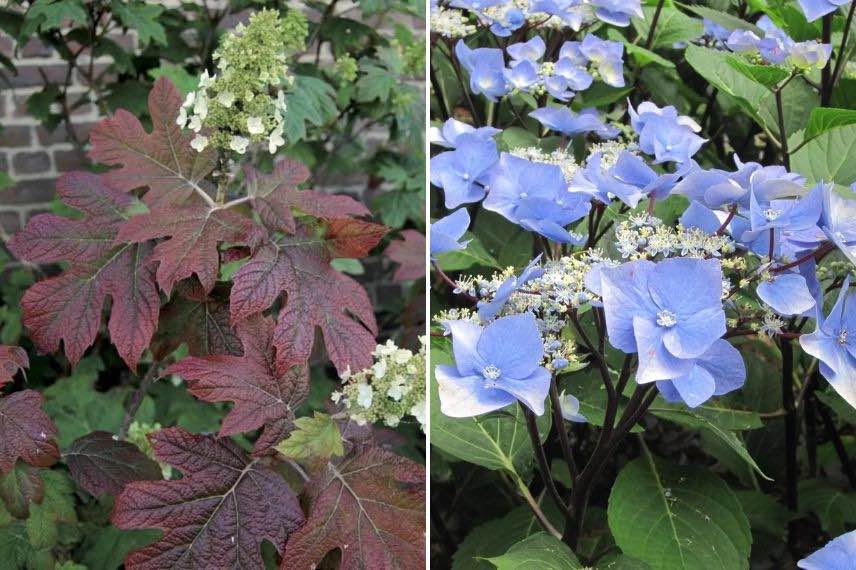
The superb oak-leaved hydrangea foliage and the black stems of ‘Zorro’
Depending on usage
As hydrangeas come in a wide range of sizes, they lend themselves to a variety of uses.
- In border beds: provided the soil remains moist, hydrangeas have their place at the back of mixed borders of perennials and shrubs, where their large flowers are highly visible.
- As specimen plants: medium- to large-sized hydrangeas form attractive, rounded shrubs that are well suited to growing as standalone specimens.
- In border: they are often noticeable along the front of houses or against a garden wall.
- In a hedge: the taller forms make a delightful addition to a mixed, flowering hedge of deciduous and evergreen species.
- In pots: many cultivars are suitable for container growing; choose the smaller forms. They reward you with an exceptional floribund display, provided you keep on top of the watering.
Depending on sun exposure and site conditions.
While most hydrangea species prefer shaded exposure, some will tolerate sun exposure, provided it is not scorching.
That is the case for Hydrangea paniculata. It needs light to bloom properly and develop its large panicles.
Hydrangea arborescens tolerates sun and drought. It is easy to grow and undemanding.
Hydrangea quercifolia tolerates sunny exposures. Alongside Hydrangea arborescens, it is one of the few to tolerate relatively dry summer weather.
In partial shade or shade, plant the rest!
Hydrangeas of the species macrophylla, serrata, aspera, involucrata enjoy protection from the scorching rays of the midday and afternoon sun, and can also be planted in bright shade, in a woodland setting, or further north, with little or no sun, but in an open position.
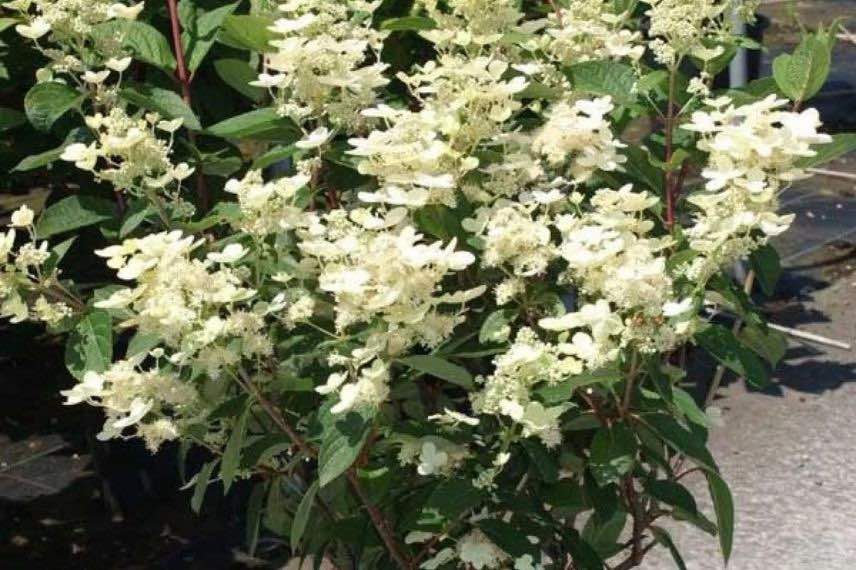
Hydrangea paniculata ‘Early Sensation’ grows in the sun
According to soil type
Hydrangeas are plants that prefer non-calcareous soil, from acidic to neutral.
However, there are exceptions as well, and some species can grow in calcareous soil. These are sun-loving species.
- Hydrangea paniculata is not particularly fussy about soil type, provided it is not too heavy and not too calcareous.
- Hydrangea arborescens prefers cool, humus-bearing, neutral soils, but also tolerates poorer soils and slightly calcareous soils.
- Hydrangea quercifolia prefers humus-bearing soil, neutral to acidic, but tolerates lime presence in the soil better than the other hydrangeas after careful planting. However, it tolerates poorly compacted and poorly drained soils.
Care: watering and pruning
Hydrangeas need the soil to stay relatively cool. Water during the summer, especially in dry spells. As noted above, the quercifolia and arborescens species are a little more drought-tolerant. They are more resilient when watering is less frequent.
The pruning of hydrangeas encourages generous flowering and helps the plant maintain a balanced, harmonious shape, but not all follow the same rules, as some flower on current-year wood and others on last year’s wood.
- In all cases, pruning is carried out in late winter and early spring.
- Significant pruning can be carried out on Hydrangea paniculata and Hydrangea arborescens, while it should be much lighter on Hydrangea macrophylla and Hydrangea serrata.
- On Hydrangea quercifolia and Hydrangea aspera, pruning should be very light, limited to removing spent inflorescences.
For all you need to know about pruning hydrangeas, visit our advice sheets: When to prune hydrangeas? and How to prune hydrangeas?
- Subscribe!
- Contents
Comments