





























How to choose thyme?
Selection of thyme varieties based on different selection criteria
Contents
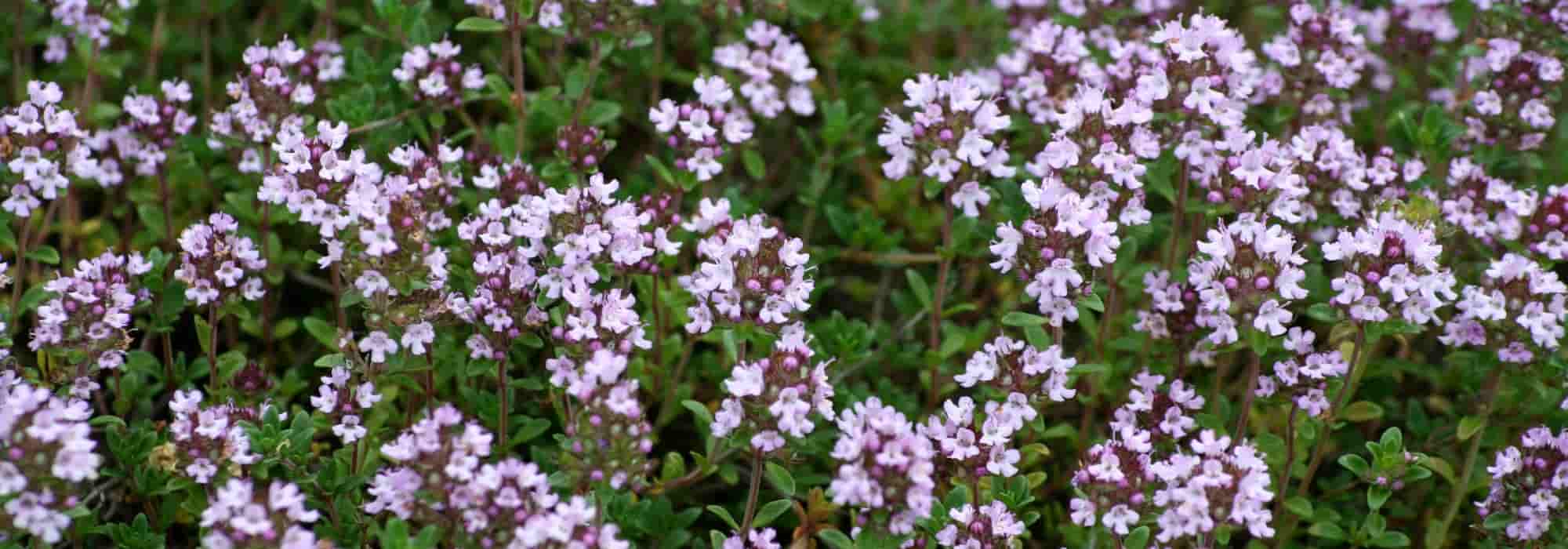
As an aromatic, culinary, and medicinal plant, thyme (Thymus) has its place in a vegetable garden, as well as in a flower bed or rockery, or even in a pot on a balcony or terrace. While the common thyme (Thymus vulgaris) is the most widespread due to its fragrance and hardiness, other thymes can also be easily grown. With their flavours, aromas, and colours, they will add a touch of whimsy to the garden and the plate. Moreover, all these varieties of thyme also offer beautiful, colourful flowering, which is highly melliferous, attracting numerous foraging insects and pollinators to your vegetable garden. Thyme is therefore an ideal plant for promoting biodiversity in your garden! It is also a plant with repellent properties against certain pest insects like aphids.
Are you convinced to plant thyme? Yes, but which one? Discover our buying guide to select your thyme based on various criteria related to flavour, habit, colour, or the uses you want to make of it.

According to the size
Thyme is a perennial plant of Mediterranean origin that is easy to grow and maintain. It primarily requires sunlight. In terms of soil, it prefers light, well-drained, and even poor, stony soils. This is why it can be planted in both vegetable gardens and flower beds, borders, rockeries, or slopes. Growing it in pots on a balcony or terrace is also perfectly feasible.
However, the height of thyme often influences its cultivation. Indeed, there are varieties of thyme with a spreading habit that make wonderful groundcovers for filling rockeries or slopes. For instance, wild thyme (Thymus serpyllum) adapts to all configurations thanks to its ramified stems. It easily spreads over 40 to 50 cm and covers all surfaces, even in poor soils. It forms a lovely carpet of small, aromatic evergreen leaves in a beautiful glossy green, adorned with pink-violet flowers in the heart of summer.
With a height of 3 cm and a spread of 35 cm, early thyme (Thymus praecox) is also an excellent groundcover, ideal for filling gaps in paving or low walls. It can even be used as an alternative to lawn between stepping stones. Depending on the variety, its flowers can be white (Thymus praecox ‘Albiflorus’), pinkish-purple (Thymus praecox ‘Minor’), purplish-pink (Thymus praecox ‘Purple Beauty’), or magenta-red (Thymus praecox ‘Coccineus’). The long-stemmed thyme (Thymus longicaulis) can also replace a non-trodden lawn due to its spreading habit. Similarly, hairy thyme (Thymus hirsutus) forms a very low, moss-like carpet.
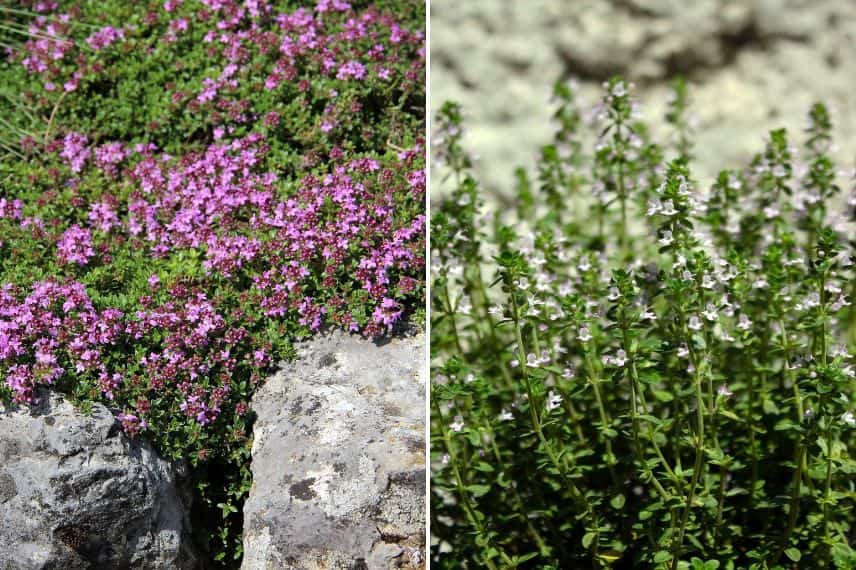
Thyme can adopt a spreading or bushy habit
Most other varieties of thyme have more bushy and upright habits, allowing them to be integrated into flower beds, borders, or low hedges. Thymus capitatus forms a well-branched, upright ball reaching 45 cm in height, while lemon thyme reaches 25 to 30 cm in height, just like common thyme.
Read also
Thyme: growing, planting, pruningAccording to the colour of the foliage
All species and varieties of thyme have small, lanceolate or linear leaves, obtuse and curled at the edges, with the underside covered in short tomentum. The foliage is most often grey-green or whitish. Thus, the leaves of common thyme and Thymus officinalis are very grey, while those of Thymus vulgaris ‘Silver Posie’ are distinctly more silver. As for the leaves of Thymus citriodorus ‘Silver Queen’, they are green-grey beautifully variegated with silvery white. The ‘Sparkling Bright thyme’ is also wonderfully variegated with cream white.
Many other species or varieties of thyme offer foliage that is greener than grey. Thus, the various varieties of early thyme provide particularly dense dark green foliage that contrasts with the colourful flowering. Just like the long-stemmed thyme (Thymus longicaulis) or the shiny thyme (Thymus nitens) with its bright green leaves. As for the hybrid lemon thyme ‘Doone Valley’, it features dark green foliage, slightly maculate with small golden spots.
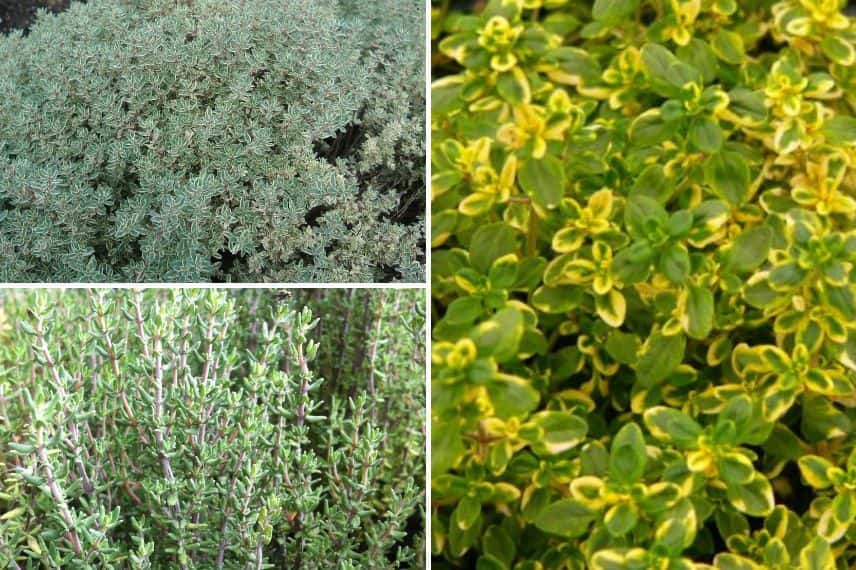
Finally, some thymes play even more with colour to draw attention to their foliage. They adorn themselves with green strongly variegated with yellow (Thymus citriodorus ‘Bertram Anderson’ or Thymus citriodorus ‘Aureus’), or even golden (Thymus vulgaris ‘Gold’).
According to the colour of the flowers
If thyme begins to flower as early as March in its natural habitat, in our gardens, flowering typically extends from May to August depending on the varieties. The flowers emerge at the tips of the woody stems, forming cymes with lower whorled inflorescences that are spaced apart. Generally, thyme flowers display white or pink hues. They are also highly melliferous and attract numerous foraging insects. 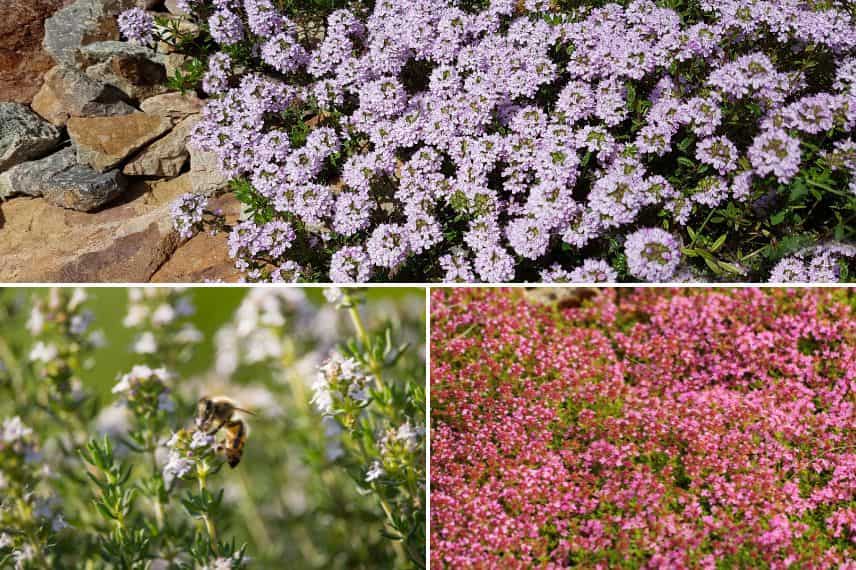 However, other species of thyme offer more colourful blooms:
- Thyme with various shades of pink: creeping thyme (pale pink), head thyme (purplish pink), Corsican thyme (Thymus herba-barona) (pale pink), hairy thyme (Thymus hirsutus) (pale pink)
- Thyme with white flowers: Early thyme ‘Albiflorus’
- Thymes with more mauve flowering: lemon thyme ‘Bertram Anderson’ (lilac)
- Varieties with pink flowers leaning towards red: Thymus praecox ‘Red Carpet’ (pure purplish pink) and Thymus praecox ‘Coccineus’ (magenta red)
Read also
How to grow thyme in a pot?According to the flavour
Thyme is an aromatic plant that is part of the famous bouquet garni. Its flowers are particularly aromatic, especially during dry periods. This fragrance, closely linked to the scents of the Mediterranean, is ideal for accompanying grilled dishes, meats, and summer vegetables like tomatoes. It is also used in the production of many perfumes, adding camphoraceous and herbaceous notes. The scent of Thymus faustinoi is thus extremely powerful and intense.
Other thymes will allow you to explore varied olfactory worlds:
- Thymus citriodorus releases very fresh lemony aromas, which are delightful in fish or shellfish dishes. It can also be used to flavour desserts.
- Thymus vulgaris ‘Fragrantissimum’ exudes a scent with fresh citrus notes, perfect for infusions or desserts.
- The rose-scented thyme certainly does not hide its fragrant qualities!
- The Corsican thyme has a scent with cumin notes, perfect with courgettes or aubergines.
According to their hardiness
Overall, thyme is hardy down to -12 to -15 °C, allowing it to be grown in open ground across the entire territory. Provided it is cultivated in perfectly drained soil, especially in winter. Thyme is sensitive to heavy, waterlogged soils.
However, some thymes are more resilient: Corsican thyme can withstand negative temperatures down to -20 to -23 °C, as can Thymus praecox ‘Bressingham’.
According to the use
You can choose thymes for their creeping or more bushy habit and their decorative appearance. However, thyme is primarily an aromatic and medicinal plant. Its leaves are very rich in essential oil. Thus, thyme possesses antiseptic, expectorant, fortifying, antibacterial, and digestive properties as it contains thymol or linalool. 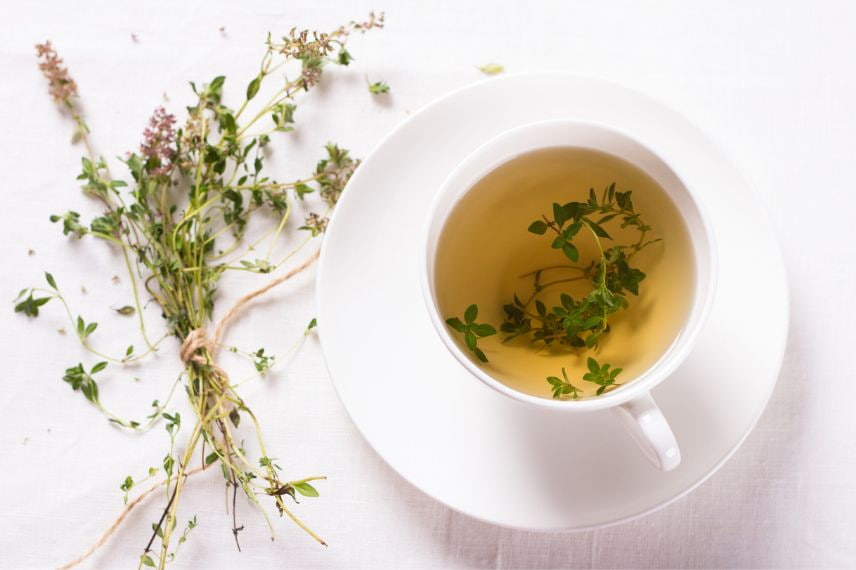
Therefore, if you wish to plant thyme for its medicinal virtues, it is better to favour the classic and highly fragrant varieties of Thymus vulgaris, which are richer in essential oil. On the other hand, lemon thyme and orange thyme are delightful in infusions, while Corsican thyme can also be used in infusions to relieve digestive issues.
The very unique resinous thyme (Thymus mastichina) is widely used in aromatherapy and is valued for its expectorant, antiseptic, and anti-inflammatory properties. As for creeping thyme, it is well known for its disinfectant, antispasmodic, and antiviral virtues.
- Subscribe!
- Contents
Comments