


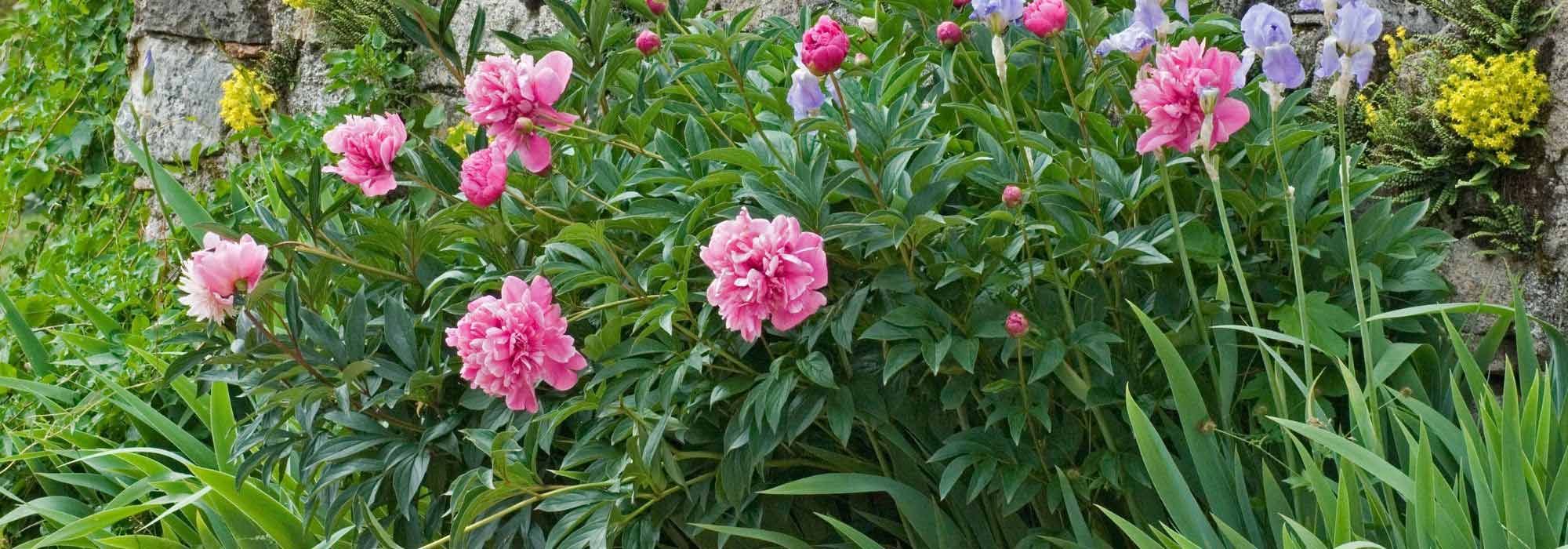
How to pair peonies?
Ideas and inspirations for different garden styles
Contents
The large flowers of peonies (Paeonia) always make a statement in the garden as spring arrives. Whether they are herbaceous, shrubby, or hybrid (Itoh or intersectional peonies), all they need are good growing conditions to thrive and live for several years.
Provide them with deep, rich, organic matter soil that is well-drained so that excess water can flow away. Choose a sunny or partially shaded location, especially in Mediterranean regions.
In terms of companionship, even though they prefer space, peonies can be paired with many plants. They will also allow you to create stunning and opulent bouquets.
So, discover our 5 pairing ideas for inspiration.
And to successfully grow peonies, check out our dedicated guide: “Peonies: planting, pruning, and care.”

In cut flower arrangement
Peonies are perfect perennials for creating colourful bouquets that last several days in a vase. In the garden, take the opportunity to pair them with other plants ideal for bouquet making.
Consider the very aesthetic evergreen foliage of eucalyptus, with its small, round characteristic leaves. While it is often quite imposing, there are varieties suitable for smaller gardens, such as the charming ‘Baby Blue’ or the columnar ‘France Bleu Rengun’. Their blue-tinted foliage will beautifully complement peonies with white or yellow flowers, such as the lovely Paeonia lactiflora ‘Jan van Leeuwen’ or the very refined ‘Marie Lemoine’.
On the foliage side, try the fronds of sun-loving ferns, like our peony. Opt for example for a Clayton’s osmunda or Dryopteris dilatata ‘Crispa Whiteside’, with its lovely frilly fronds. Also try the dark purple foliage of the wild chervil, whose flowering in airy white umbels will also be very aesthetic in a bouquet.
Add other flowering bushes, such as lilacs, which will offer you a wealth of colour options to pair with our peonies. Of course, some hydrangeas will also make good companions, as will roses. For the latter, turn to the large-flowered bush roses, considered the best for bouquets.
For perennials, grow the light, feathery flowers of astilbes. Choose varieties that bloom in June, which will be paired with late-flowering peony varieties. For lightness, also install some campanulas, for their small blue, pink, or white bells.
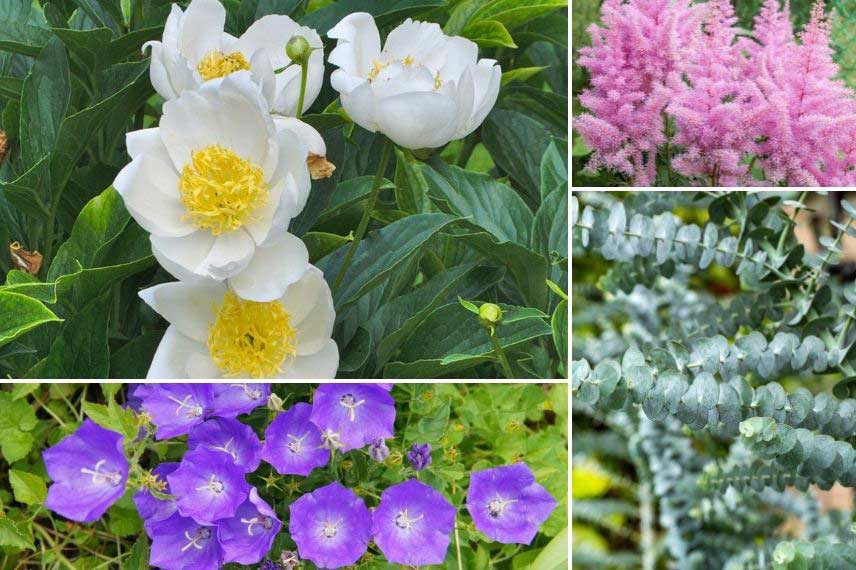
Paeonia lactiflora ‘Jan van Leeuwen’, Astilba ‘Darwin’s dream’, Campanula carpatica and Eucalyptus ‘Baby Blue’
Additionally, discover Virginie’s tips in the dedicated article “6 tips for making beautiful peony bouquets”.
Read also
Planting peoniesIn a colourful mixed border
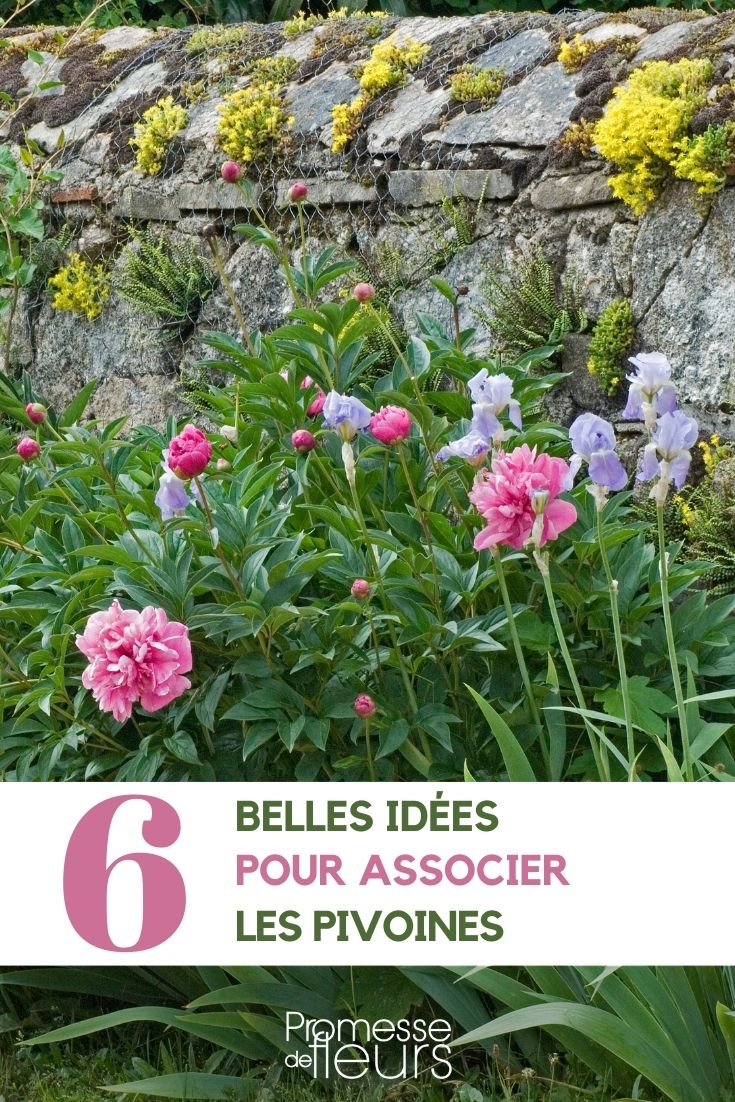
Japanese peonies and Chinese peonies integrate beautifully into a mixed border with other perennials, as long as they have enough space. So, do not crowd the plants and consider their dimensions at maturity.
Here again, feel free to grow campanulas, as well as some structural delphiniums. Their flowers in the same shades of pink, white, or blue will blend wonderfully. Add the flowers of iris, the majestic clusters of lupins or foxgloves to add even more height. Complete with bushy nepetas for volume, as well as some columbines.
On the annual side, consider wildflower daisies, pinks, and sages.
Add spring-flowering bulbs, such as alliums with their flowering pom-poms, the essential daffodils, crocuses, or hyacinths.
For lightness, also install some grasses: a small groundcover sedge (Carex morrowii ‘Ice Dance’) and the colourful exotic style of New Zealand flax, in regions where winters do not drop below -8°C to -10°C.
In the background, as a backdrop, install a beautiful climbing rose or a clematis.
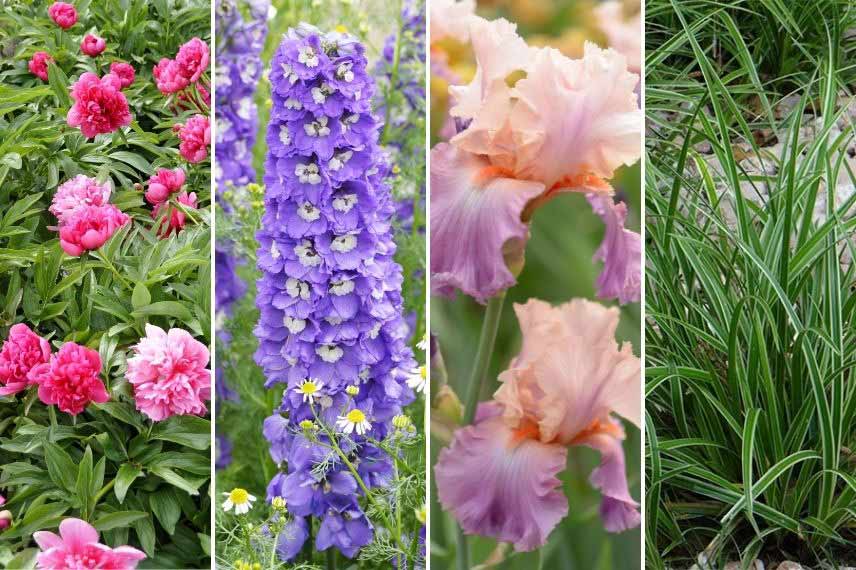
Chinese peonies, delphiniums, iris, and Carex morrowii ‘Ice Dance’ create a vibrant flowerbed of colours
Discover other Medieval garden perennials
View all →
Available in 1 sizes

Available in 2 sizes
Available in 1 sizes
Available in 3 sizes
Available in 2 sizes
Available in 1 sizes
Available in 0 sizes
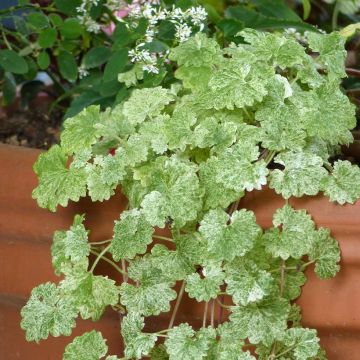
Available in 1 sizes
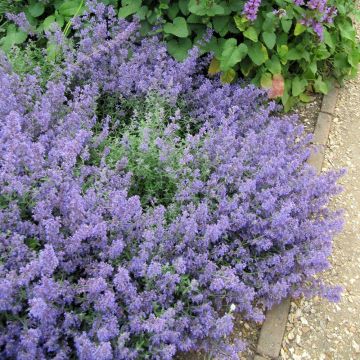
Available in 2 sizes
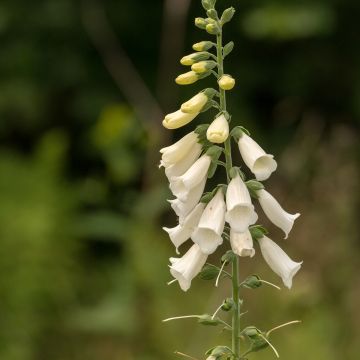
Available in 3 sizes
In a border with very long flowering
For a flower bed that blooms for many months, combine peonies with summer and then autumn flowering plants, which will take over. This way, your flower bed will be in bloom almost all year round.
First, think of summer bushes, such as lavenders, ceanothus, Siberian sages, or Buddleias. Hibiscus syriacus will also add a stunning splash of colour for weeks, with their ephemeral flowers renewing almost continuously.
Again, you can also rely on roses, by choosing repeat flowering varieties that will bloom almost continuously until the first frosts. For the front of the bed, opt for groundcover roses. In the middle of the bed, cluster-flowering bush roses will be perfect candidates.
Add veronicas, echinaceas, asters, Japanese anemones and the essential hardy geraniums. For lightness, choose filipendulas with their airy flowering. Try long-flowering daylilies, such as the cultivar ‘Everydaylily Rose’, which blooms generously for nearly 5 months from June to October. You might also consider the vibrant petunias (‘Cascadias’, ‘Surfinia’ or ‘Supertunias’).
Complete with bulbous plants, such as dahlias with their endless variety of shapes or Crocosmias.
Dress the back of the bed with a lovely climbing plant, such as Solanum.
For foliage, choose Heucheras, Carex and Pennisetum.
In terms of colours, we recommend choosing a dominant colour or two complementary ones, which can change with the seasons. You can add a few subtle touches of other colours, as well as white flowers to lighten the overall effect.
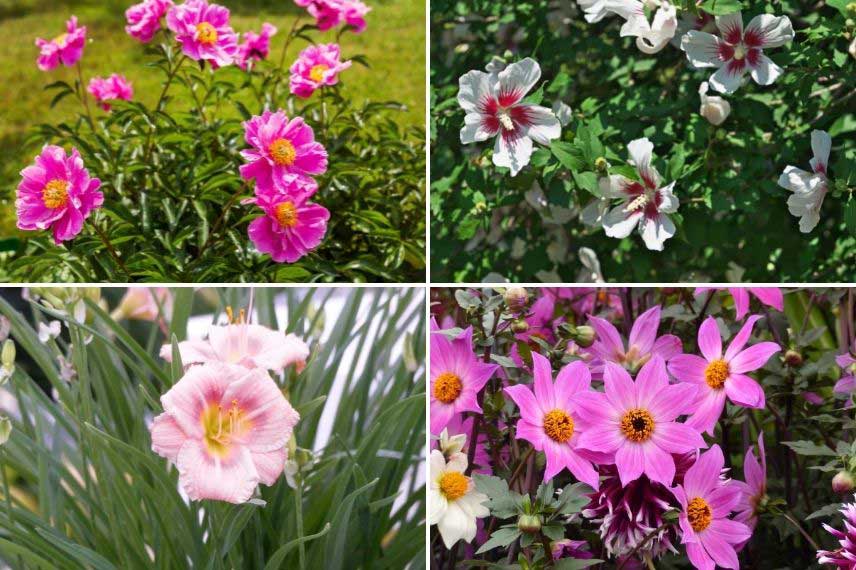
Combine Peonies, Hibiscus syriacus, Hemerocallis ‘Everydaylily Rose’ and dahlias ‘Magenta star’ to extend flowering in the garden
In a scented garden
In addition to their generous flowering, some peonies reward us with a sweet fragrance. This is the case, for example, with the common peony Paeonia officinalis (‘Rosea Plena’ or ‘Rubra Plena’), herbaceous peonies Paeonia lactiflora, as well as some shrub peonies (‘10 Lu Mu Ying Yu’).
They will thus be very well suited for use in a scented garden. By staggering the flowering times, you can enjoy pleasant fragrances almost all year round.
In spring, pair the peonies with a Burkwood viburnum, with hints of orange blossom. You can also opt for a Mexican orange blossom or a mock orange.
In summer, it will be the turn of the fragrant flowers of common jasmine and Bunge’s clerodendron.
In autumn, it will finally be the must-have sasanqua camellias that will reward us with their fragrances, right up to the gates of winter.
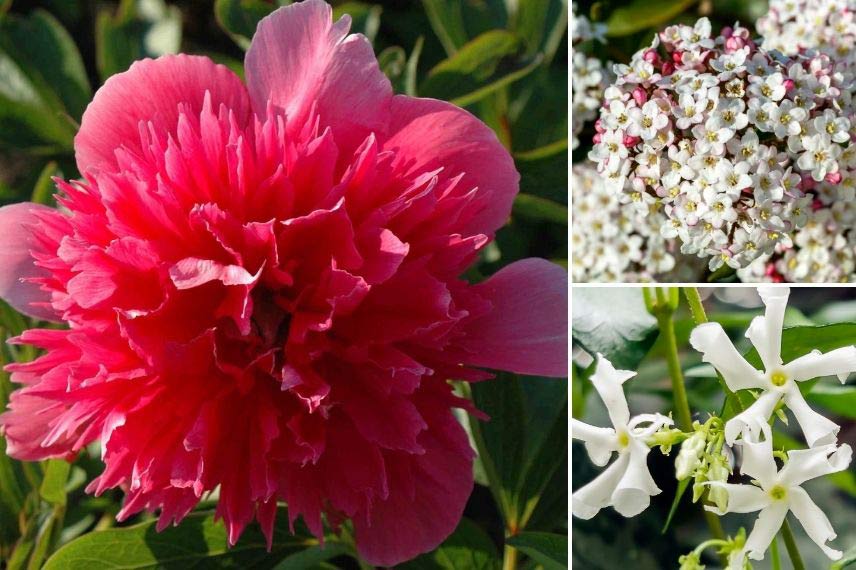
Paeonia officinalis ‘Rosea Plena’, Viburnum burkwoodii, and Jasminum officinale will delightfully blend their fragrances!
In the gentle shade
In a semi-shaded situation, adopt tree peonies or Itoh peonies. Use them in hedges or at the edge of a grove, in soil that remains consistently moist.
The tree peony will be perfect in a hedge with other bushes. Play with contrasts and highlight, for example, the deep pink flowering of Paeonia suffruticosa ‘08 Juan Ye Hong’ alongside the refined Gardenia jasminoides ‘Perfumed Petticoats’. Add a Rhododendron ‘Virginia Richards’.
In another colour harmony, pair the green-cream flowers of ‘10 Lu Mu Ying Yu’ with an Aralia nudicaulis for a lovely light and airy spring hedge. If you have space, add a Cornus ascona or a Magnolia officinalis ‘Biloba’, both flowering in white-cream.
The Itoh peony, on the other hand, will blend well with masterworts and Siberian irises. For example, try a combination of the peony ‘Itoh Morning Lilac’, the masterwort ‘Sunningdale Variegated’, and the Siberian iris ‘Not Quite White’. Also consider columbines and lady’s mantle. Finally, complete with the decorative foliage of Hosta.
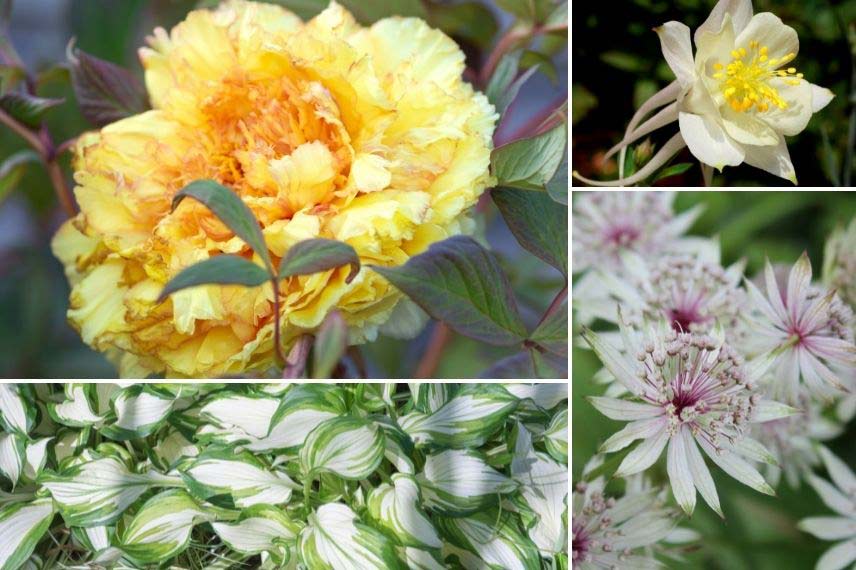
Itoh peony ‘Garden Treasure’, columbines, masterworts, and Hostas thrive in light shade
- Subscribe!
- Contents
Comments