





























Perennials for dry shade
Our selection of plants to succeed in your dry shade borders
Contents
Some perennials are content with little: undemanding, they cope well with root competition, managing to thrive in dry shade, and even create beautiful green carpets, often punctuated by delicate flowering. These dry shade perennials, known as hardy geraniums, or to be rediscovered like Aspidistras, are essential plants for greening the beds created at the base of trees, or even at the edge of evergreen hedges in the shade.
So, which perennials are not afraid of nearby roots and can adapt to the poor substrate of difficult areas under trees? Evergreen or deciduous, here are a few that are foolproof and beautiful from spring to winter!
→ To give your perennials every chance of success, also read our article: Gardening in dry shade.

Aspidistra: exotic
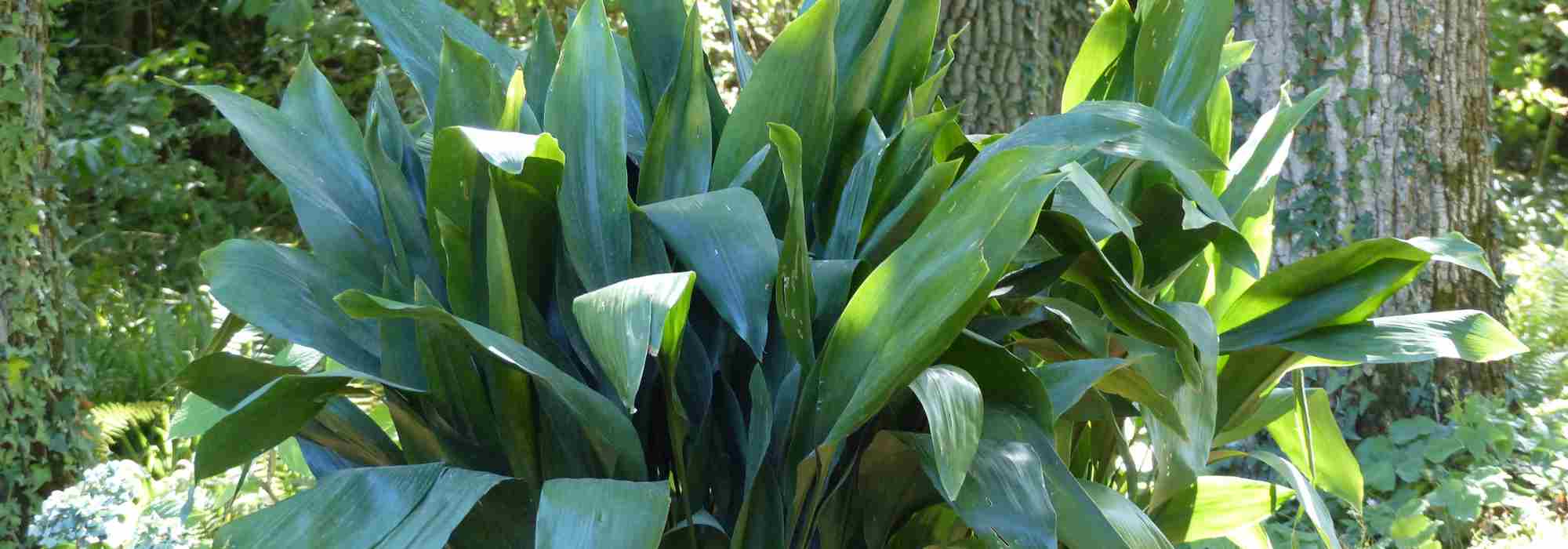
Aspidistra has a rather dated image, having once been relegated to pot planting as a dust-collecting houseplant. We have gradually rediscovered the many advantages of this characterful foliage plant: besides its ability to thrive in root competition, and being hardy down to -20°C, the Aspidistra shows, once established in the ground, that it can very well tolerate poor, dry soils at the base of trees or bushes. With its evergreen, lanceolate foliage, it reaches impressive size after 3 or 4 years, forming an almost exotic clump when planted in groups. It even withstands being at the foot of bamboo, which speaks volumes about its resilience as a perennial that does not fear competition!
Aspidistra elatior, the type species, measures about 50 cm in height with the same spread. There are now very ornamental cultivars, with leaves variably variegated with white, such as Aspidistra ‘Milky Way’, speckled, or Aspidistra elatior ‘Zebra’ or ‘Fuji No Mine’, striated.
→ Learn more with our complete guide: Aspidistra, cultivation, care.
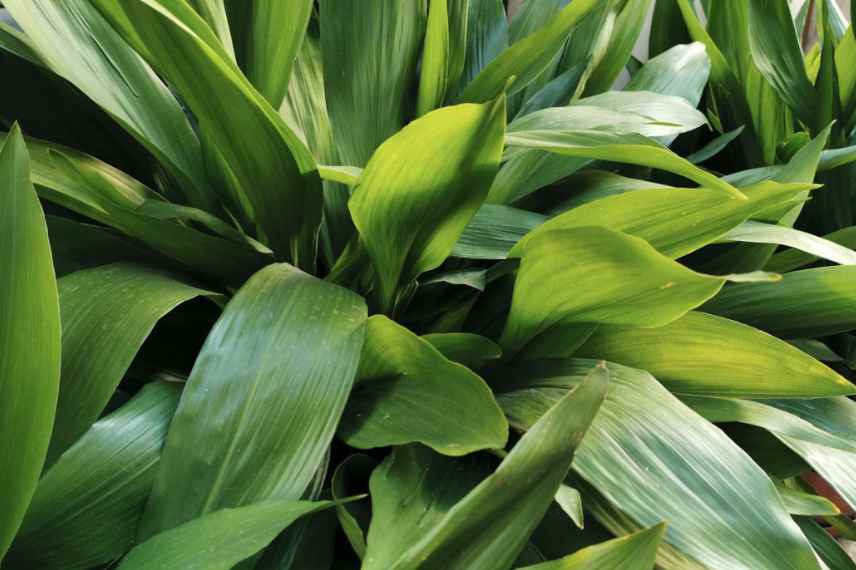
Aspidistra elatior
Read also
Planting under treesEpimedium or fairy flower: graceful
The barrenwort or Epimedium is one of the most effective perennials for dry shade. This plant is beautiful for its highly ornamental, heart-shaped, veined foliage, often evolving in its hues, and for its subtle and elegant spring flowering, just above the foliage. Over time, Epimedium spreads and forms beautiful carpets, mostly evergreen, that help reduce the growth of adventives.
There is a wide variety of cultivars, featuring delicate blooms in pale pink, yellow, cream, up to orange and deep red. The plant grows to about 40 cm in height once well established, with a greater spread.
→ Learn more about Epimedium in our complete guide: Epimedium, plant, grow and maintain and Associating Epimediums
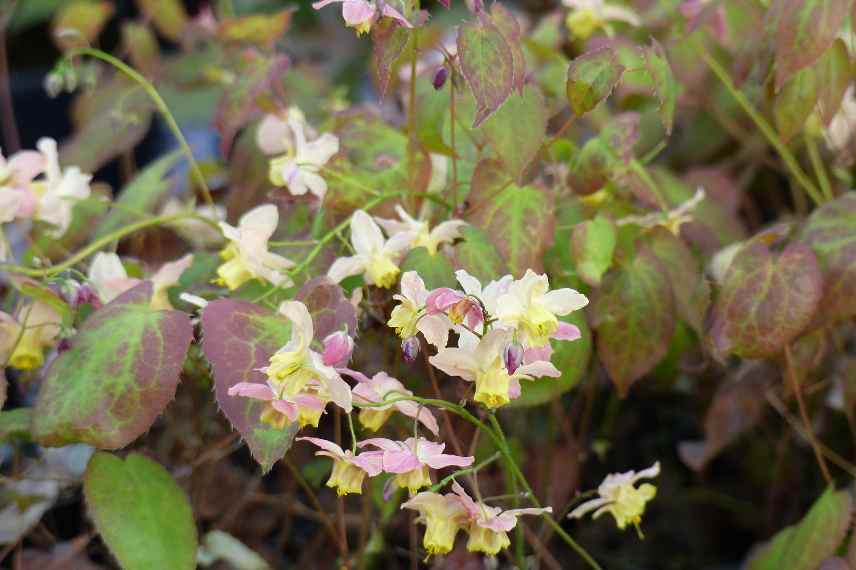
Epimedium versicolor ‘Cupreum’
Discover other Dry shade perennials
View all →
Available in 0 sizes
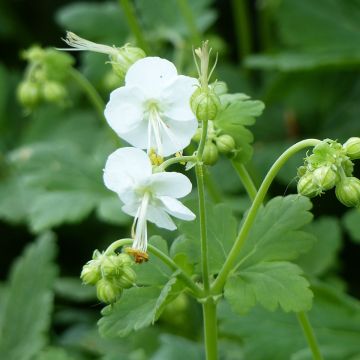
Available in 2 sizes
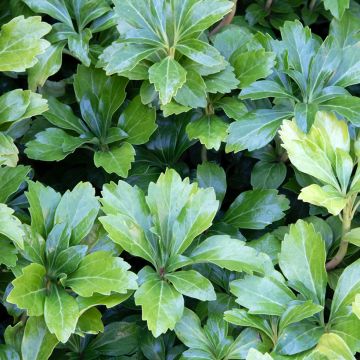
Available in 2 sizes
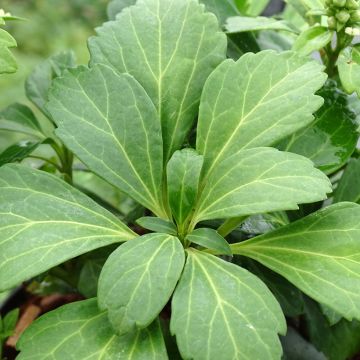
Available in 2 sizes
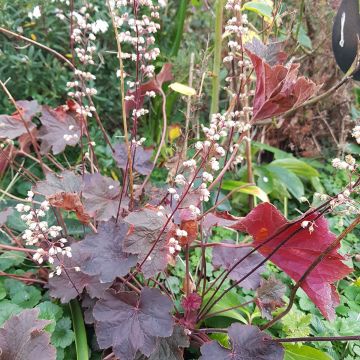
Available in 1 sizes
Available in 1 sizes
Available in 1 sizes
Available in 0 sizes
Available in 2 sizes
Available in 2 sizes
Aster divaricatus: charming
Here is a very useful Aster that can grow almost anywhere, especially in dry shade at the base of hedges or under deciduous trees! The Aster divaricatus, or spreading aster, is somewhat different from others due to its larger foliage and early flowering, often starting in late July or August and continuing until October. Its rapid growth is a considerable advantage under trees, as it will form a lovely, soft clump in the first year of planting and will already bloom abundantly with small, very airy white flowers.
Completely hardy and small in size (50 cm tall), this beautiful aster will brighten up your borders for a long time.
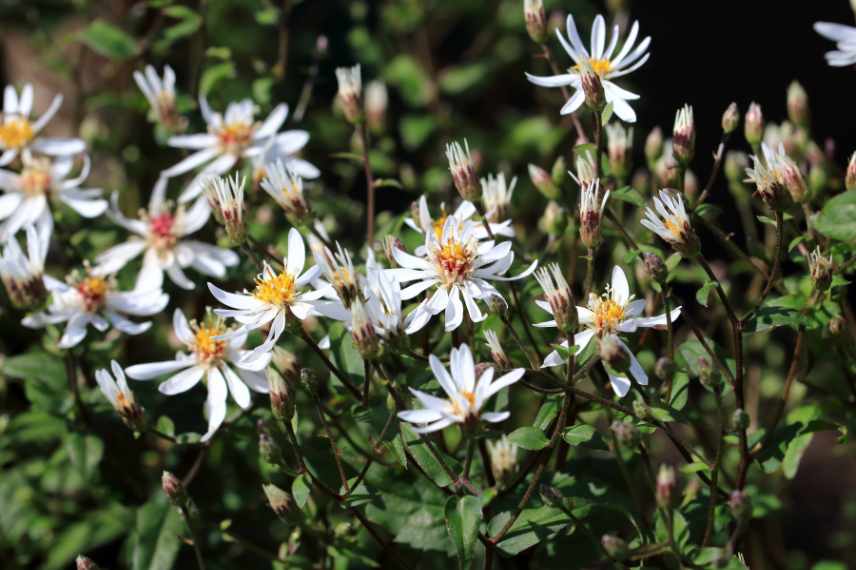
Aster divaricatus
Spring bulbs: fresh
Nothing beats small early bulbs to nestle between the roots of trees and bloom in spring. Under deciduous trees or bushes, the light is often sufficient for spring bulbs to develop properly. Entering dormancy in summer, they protect themselves from drought. Chosen for their small size, they can easily be planted between the gaps of the roots, which are numerous under the tree cover. Bulbs such as Chionodoxa, wood Anemones (Anemone nemorosa), or Ipheions bring a fresh touch from February to April. All these bulbs are available in numerous varieties for our delight, allowing us to play with different flower colours.
Bulbs that bloom in the heart of winter, such as snowdrops, Eranthis, or Cyclamen coum, are also perfectly suited.
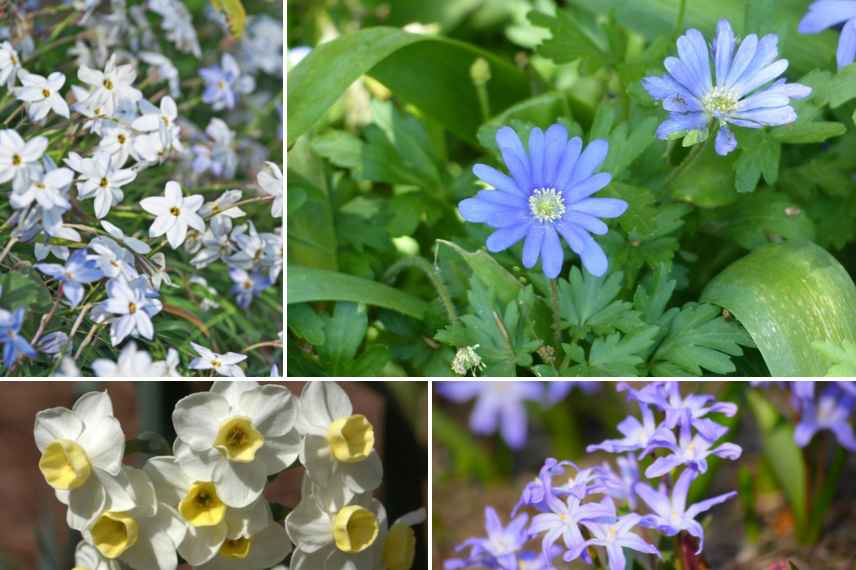
Ipheions, Anemone blanda ‘Blue Shades’, Narcissus poeticus and Chionodoxa
Bergenia: retro
Also known as the shoe maker’s plant, Bergenia is a robust plant, a tough cookie, capable of thriving in various conditions, including dry shade. It spreads its large heart-shaped, undulating, leathery, and glossy leaves of a beautiful shiny green, acting as a groundcover over time. Easy to grow, it also adapts well under trees, although some varieties may redden less in full winter when exposed to less sunlight.
Bergenia is perfect when planted in groups of five, for example, to dress bare areas under trees with its evergreen foliage, once the area is well prepared. Its flowering is delightful, with bell-shaped blooms borne on strong stems, in shades of pink, white in some like ‘Bressingham White’, or cream in ‘Ice Queen’. It appears in mid-winter for Bergenia crassifolia, and rather at the beginning of spring for Bergenia cordifolia. Their little extra: they are not afraid of lime either!
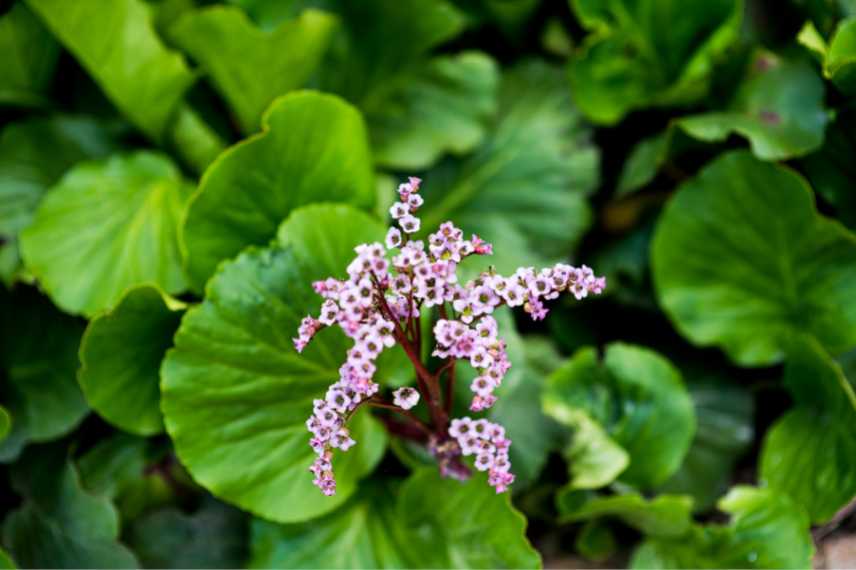
Bergenia
Trachystemon orientalis: generous
More commonly known as Caucasian borage, Trachystemon orientalis thrives in partial shade, as well as in the filtered shade of deciduous trees. Like spring bulbs, it generally receives enough sunlight to produce its small violet-blue, melliferous flowers, perched on upright stems between March and May. However, it is its large, crinkled, and rough leaves—which can resemble those of Brunnera, also a good candidate for dry shade—that is appreciated as an effective groundcover in partial shade. Insensitive to surrounding roots, hardy, the Trachystemon, rhizomatous but not invasive, quickly forms a dense and ultra-covering carpet, about 40 to 50 cm high.
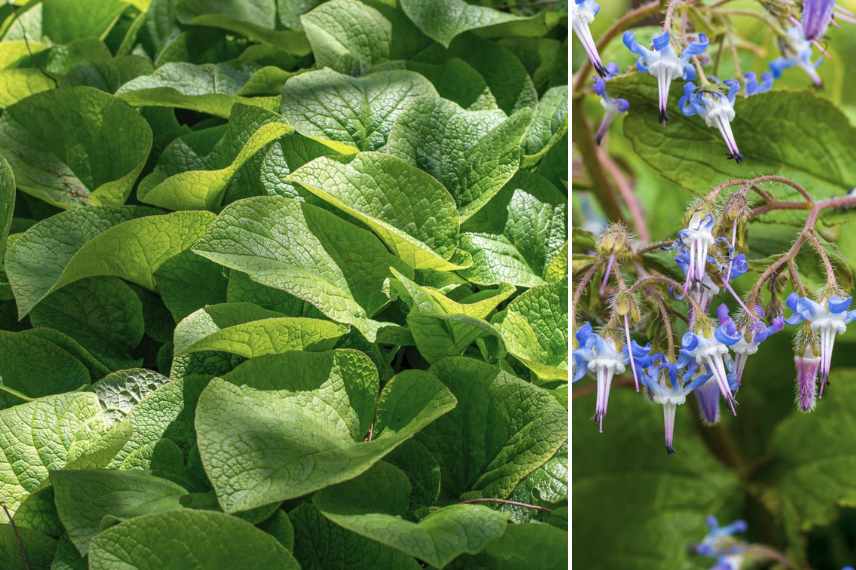
Trachystemon orientalis, foliage and flowering
Liriope: flowers in late summer
Ideal for creating lovely borders, the Liriope muscari is not afraid of dry shade and withstands it quite well once established. This perennial is appreciated for its staggered flowering in late August to September, featuring stunning mauve-lilac or violet spikes, as well as its attractive dark green linear foliage, sometimes variegated, and always evergreen. The Liriope muscari and its numerous varieties can be used to enhance the front of borders.
It forms a generous clump as it grows, acting as a true groundcover on its own. Completely hardy, you can plant it in all regions.
→ Learn more about Liriope in our comprehensive guide Liriope, planting, growing, propagating
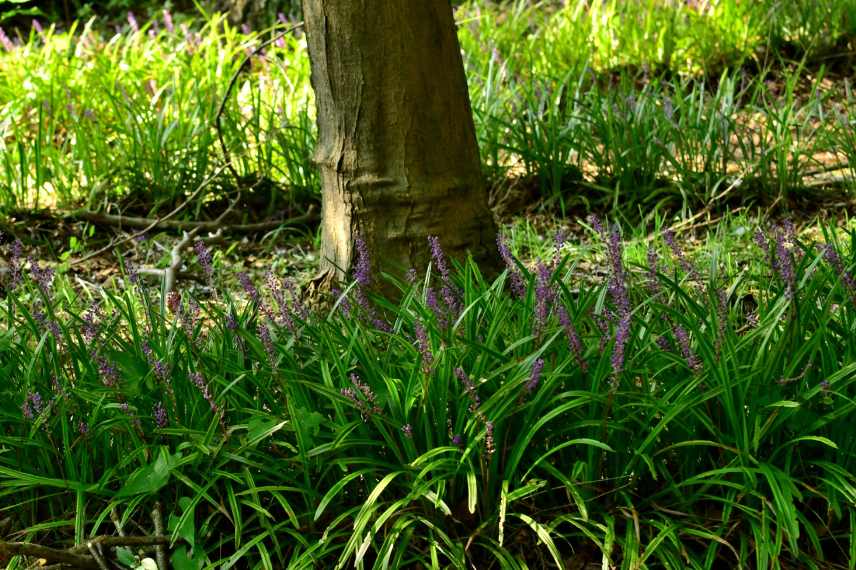
Liriope muscari
Carex: robust
Among all the known varieties, some sedges can thrive in challenging dry shade areas. These primarily include Carex oshimensis or Oshima sedge, available in numerous cultivars, and Carex grayi. These evergreen perennial plants, resembling grasses with their slender foliage, provide an interesting look when combined with other perennial plants that have rounder or broader leaves from this selection.
Robust and low-maintenance, Carex require partial shade to thrive.
→ Learn more about Carex in our dedicated sheets: Carex: planting, dividing, and maintaining and Carex: buying guide
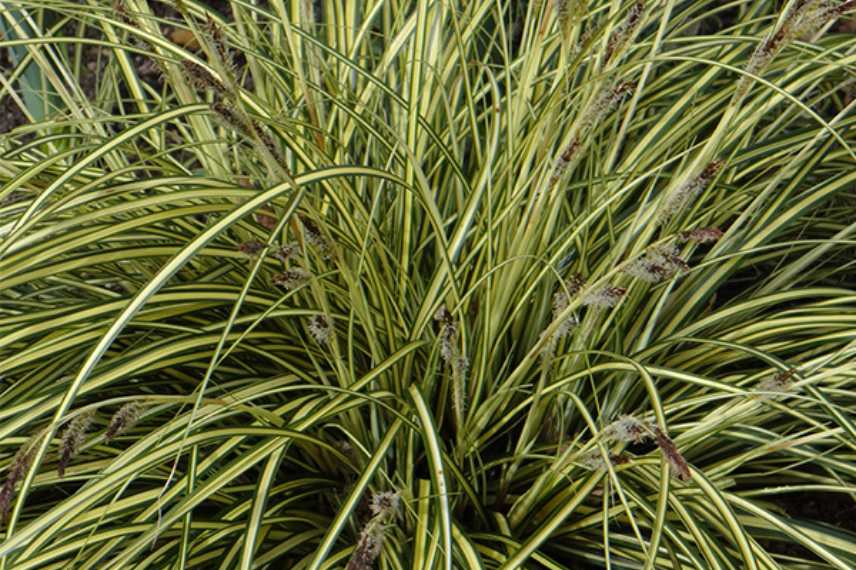
Carex oshimensis ‘Evergold’
The stinking Iris or Iris foetidissima: a winter beauty
Here is a perennial that isn’t so well-known… could it be due to its unflattering nickname? Iris foetidissima is also quite capable of thriving in the dry shade created by trees or hedges.
This is a rhizomatous iris worth discovering, with its evergreen ribbon-like leaves, its flowering between May and June, which is indeed discreet and ephemeral, but features a lovely mauve hue with yellow iridescence, and especially its astonishing fruiting. The beauty of Iris foetidissima largely lies in its capsules that open in autumn, revealing scarlet seeds. You can then cut the stems and use the iris to create beautiful winter bouquets… or leave them in place to enliven the shaded area beneath the trees. It is worth noting that the rootstocks develop quite slowly in the shade.
There are two interesting varieties: ‘Citrina’ with larger yellow flowers and fruits, and ‘Paul’s Gold’ with brighter foliage.
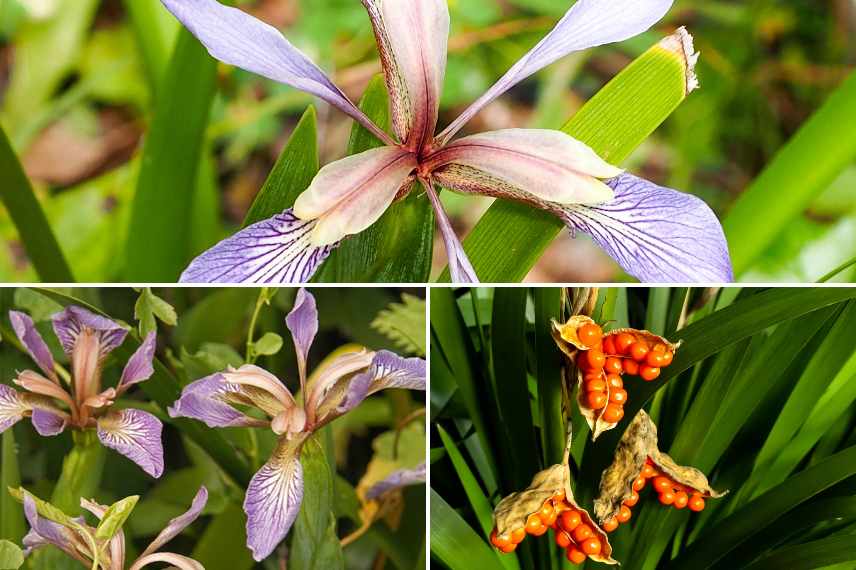
Iris foetidissima
Helleborus foetidus: unusual
Another “stinking” perennial, but let’s not be put off by this nickname and instead focus on its undeniable qualities in dry soil and shade. While most hellebores can thrive in the shade of trees, Helleborus foetidus stands out with its very fine and elegant evergreen foliage, deeply cut and finely dentate, dark green in colour. The plant quickly forms a beautiful clump 60 to 80 cm tall.
The pistachio-green flowering edged in purple appears between January and April, in the form of small 2 cm flowers gathered in clusters well above the foliage. They contrast beautifully against the dark leaves. The flowering lasts for many weeks, as is the case with all hellebores. The stinking hellebore lives for a very long time, which is another significant advantage when starting to green areas under trees. However, it is among the plants that dislike being moved, so be sure to consider its location carefully in advance.
The cultivar ‘Wester Flisk’ takes on a reddish hue on the stems and leaves in mid-winter.
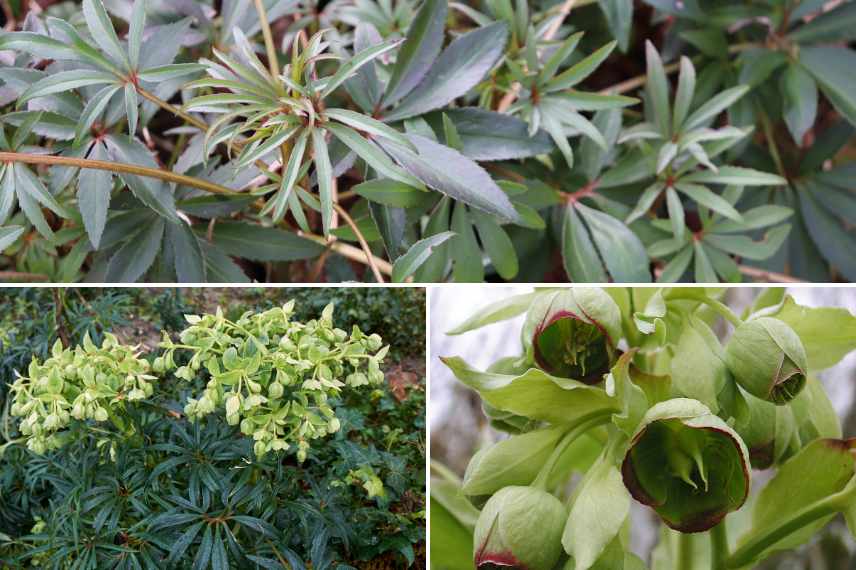
Helleborus foetidus
And also...
Many other attractive perennials thrive in dry shade and can fill spaces at the base of trees or along the edge of dense hedges, such as:
- Ophiopogons with fine leaves in green or black
- Hardy geraniums, including Geranium nodosum
- Tellima grandiflora, resembling heucheras
- Conniogramme emeiensis, or bamboo fern
- Omphalode verna with flowers similar to forget-me-nots
- Vinca (periwinkle), which may spread excessively as it tolerates difficult conditions
- Acanthes, versatile but primarily planted for their foliage, as flowering requires a minimum of sunlight
- Euphorbia amgydaloides ‘var. Robbiae’, never flinching under trees
- Subscribe!
- Contents
Comments