





























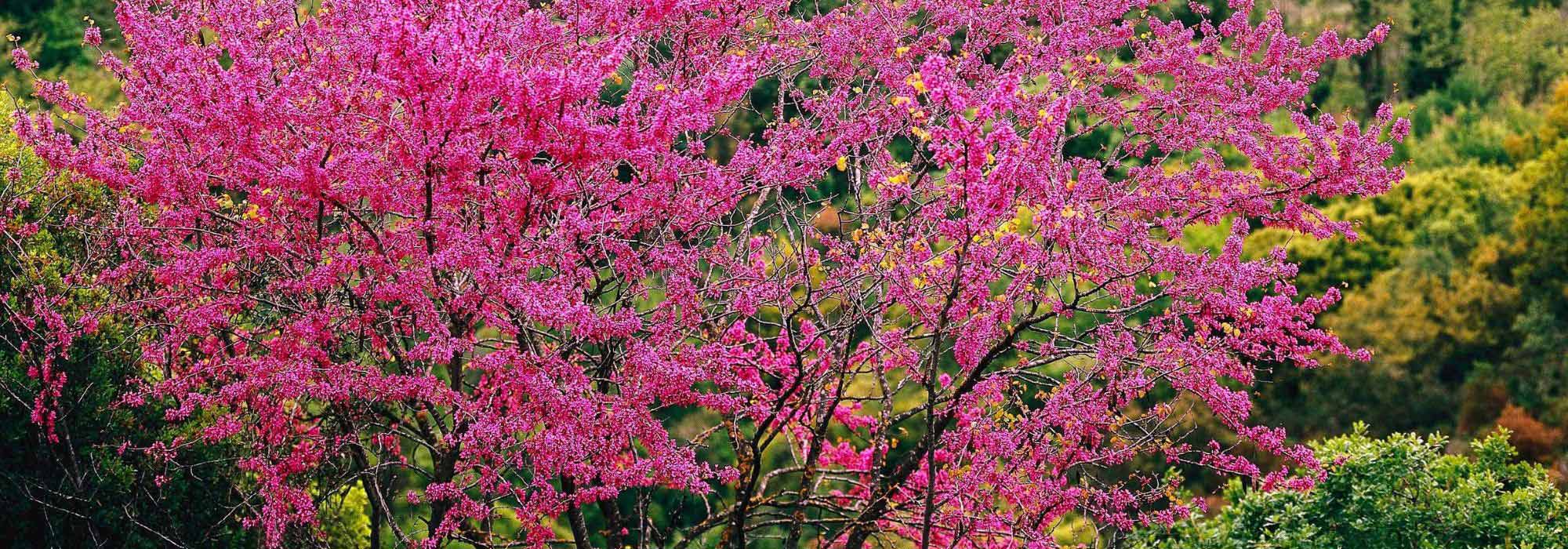
Trees for all seasons
Our selection for an attractive garden all year round
Contents
They structure the garden and provide the much sought-after shade in summer. Trees can be deciduous or evergreen, with colourful foliage or flowers, but there is such a wide range of choices that when it comes to making a selection, you might hesitate. Here is a brief overview of the best trees for the garden, highlighting their seasonal interest: remarkable flowering, decorative foliage and bark, or colourful fruits, you will surely fall for one of them!

Trees announcing spring
- When thinking of spring flowers, the image of ornamental cherry trees immediately comes to mind. These are remarkable bushes known for their spring flowering and decorative bark. With its small size, the Prunus glandulosa ‘Rosea Plena’ is ideal for small gardens; a true ambassador of spring, it adorns itself with a profusion of pretty pastel pink pom-poms in April, while the Prunus serrulata ‘Royal Burgundy’ forms a spreading tree reaching 5 metres in height and 3 to 4 metres in width. Its flowers are a purplish pink, blooming from April to May: a magical sight!
- To celebrate the arrival of beautiful days, consider the Judas tree (Cercis siliquastrum): rose-violet flowers emerge on its bare branches at the beginning of spring before the young leaves appear.
- Magnolias are not to be overlooked, with their star-shaped flowers that do not go unnoticed: purplish pink with Magnolia ‘Andre Leroy’, bicoloured and contrasting purple-violet and white with Magnolia ‘Black Beauty’ or pure white in large stars by the thousands with Kobe Magnolia. The latter is also one of the few species that tolerate lime. You will be spoilt for choice!
- Also try the Cornus ‘Ascona’: native to North America, this flowering dogwood forms a small tree remarkable for its spring flowering with large pearly white bracts.
- The Crataegus monogyna or Common Hawthorn is a beautiful thorny tree with a rounded crown, which is covered in spring with very fragrant white flowers with light pink stamens. The Hawthorn Crataegus laevigata ‘Paul’s Scarlet’ is adorned with numerous dark pink double flowers followed by red fruits. Easy to grow and low-maintenance, Hawthorns adapt well to any well-drained soil, even calcareous, and accept sunny or semi-shaded situations.
- Finally, rather unknown and rarely planted in our European gardens, the Ptelea trifoliata, also known as the Samara Elm, is a North American species with remarkable adaptability and fragrant, melliferous flowering in April. Related to the lemon tree, its deciduous aromatic foliage takes on a beautiful golden yellow hue in autumn.
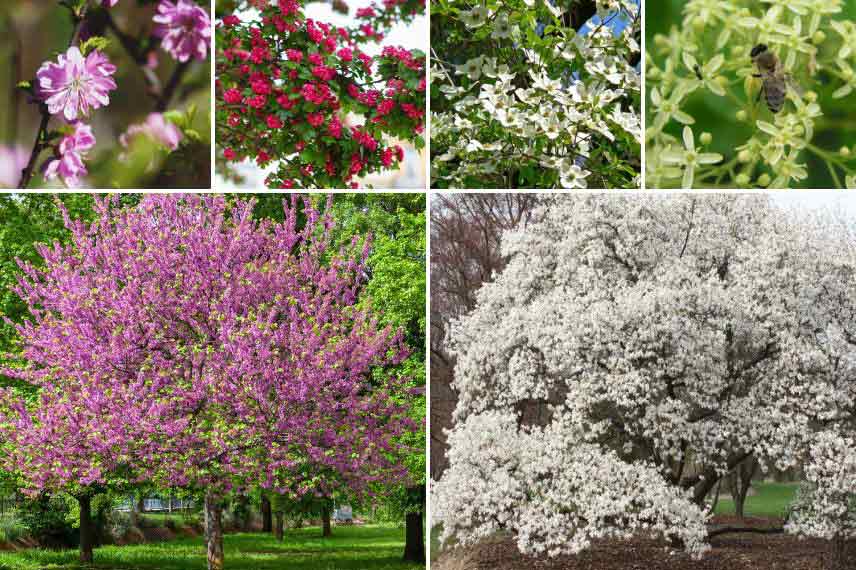
Prunus glandulosa ‘Rosea Plena’, Crataegus laevigata ‘Paul’s Scarlet’, Cornus Ascona, Ptelea trifoliata, Cercis siliquastrum and Kobe Magnolia
Read also
6 Beautiful Trees All Year RoundIncomparable trees in summer
- Featuring large light green leaves with a somewhat tropical appearance, which frame its beautiful white flowering in summer, the Catalpa bignonioides or Common Catalpa is a low-maintenance deciduous tree, perfect for shading a terrace or play area, protecting it from the intense sun rays from October until early May. It is suitable for both medium and large gardens and thrives in any type of soil as long as it is cool, fairly deep, and well-drained.
- A small fast-growing deciduous tree, the Koelreuteria paniculata has many advantages: a beautifully rounded silhouette and an abundant and bright yellow summer flowering, followed by curious pink lantern-shaped fruits that persist for a long time on the branches. Its pinnate leaves emerge pink-red, turning green and then buttery yellow in autumn.
- Also known as Silk Trees, the Albizia are small deciduous trees with finely divided foliage and a spreading umbrella-like habit. Their wonderful summer flowering in silky plumes of pink, red, or white is what makes them so popular. Plant Albizia julibrissin ‘Rosea’ with deep pink plumes or ‘Chocolate Fountain’, unique for its weeping habit and chocolate-coloured foliage: they will be a stunning addition to the garden throughout the summer season!
- Easy to grow, low-maintenance regarding soil type, and perfectly drought-resistant once established, the Chitalpa tashkentensis is a small fast-growing deciduous tree with a more or less spreading and bushy habit. It produces in summer beautiful large clusters of pale pink flowers with a yellow-striated throat, fragrant and melliferous. Equally interesting as a flowering hedge or as a standalone specimen to lightly shade the terrace, it deserves a prominent place in the garden.
- Flowers are not the only feature that gives trees summer interest. The Cornus controversa ‘Variegata’ is a striking example, as its soft green foliage, widely variegated with cream, is both bright and decorative! It adorns its very elegant silhouette with tiered branches, and its flat white flower clusters in May-June are highly ornamental. The autumn foliage of Cornus controversa ‘Variegata’ takes on red to purplish hues before revealing, come winter, the perfect architecture of its branches.
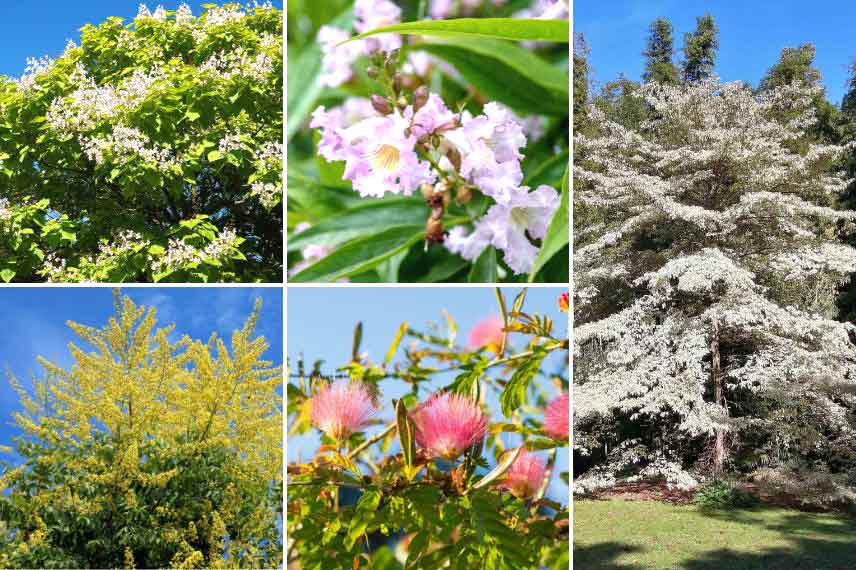
Catalpa bignonioides, Chitalpa tashkentensis, Cornus controversa ‘Variegata’, Koelreuteria paniculata, and Albizia julibrissin ‘Rosea’
Discover other Large specimen trees
View all →
Available in 3 sizes
Available in 4 sizes
Available in 5 sizes

Available in 6 sizes
Available in 6 sizes
Available in 3 sizes
Available in 4 sizes
Available in 3 sizes
Available in 5 sizes
Available in 4 sizes
Trees with vibrant autumn colours
- Berries and autumn leaf colour are the highlights of trees that enliven this season, and rowans tick both boxes. The Mountain Ash (Sorbus aucuparia) is particularly interesting for its fruits that serve as a larder for birds. Try the Sorbus ‘Wettra’, a fast-growing variety with an upright and regular habit. Its flowering in white corymbs appears in May-June and attracts bees. The flowers then produce numerous clusters of coral-red fruits, about 1 cm in diameter and very decorative, which delight the birds that feed on them until the end of the year. In autumn, the foliage takes on a beautiful yellow to orange-red colour depending on the situation, contrasting well with the grey bark.
- Hardy, low-maintenance and comfortable in urban environments, the Acer rubrum ‘Red Sunset’ is an excellent variety of Red Maple. Vigorous and fast-growing, it has a beautiful symmetrical habit and its lovely glossy green foliage turns a magnificent red at the first signs of cold. This medium-sized tree reaches about 15 m in height in our climates.
- The Ginkgo biloba or Maidenhair Tree truly fascinates when it dons its magnificent autumn foliage, made up of a thousand small fans of brilliant golden yellow. It forms a majestic, very hardy and resilient tree, as it is well known to be one of the few that survived the bomb that devastated Hiroshima in 1945. The Ginkgo shows quite slow growth, especially during the early years. Ultimately, it reaches an average height of 17 m with a spread of 15 m. The variety ‘Autumn Gold’ is a male clone that does not produce fruits (toxic and with a foul smell) and is noted for its beautiful autumn foliage of golden yellow with orange highlights.
- The Ornamental Apple Malus ‘Royalty’ is one of the best varieties of ornamental apple with purple foliage. This small tree not only offers an early, abundant and fragrant ruby-red flowering in spring, but its dark purple foliage turns red in autumn. Then, its small dark red apples resembling cherries persist on its branches until the heart of winter. Attractive throughout the year and particularly in autumn, it will look stunning as a specimen tree!
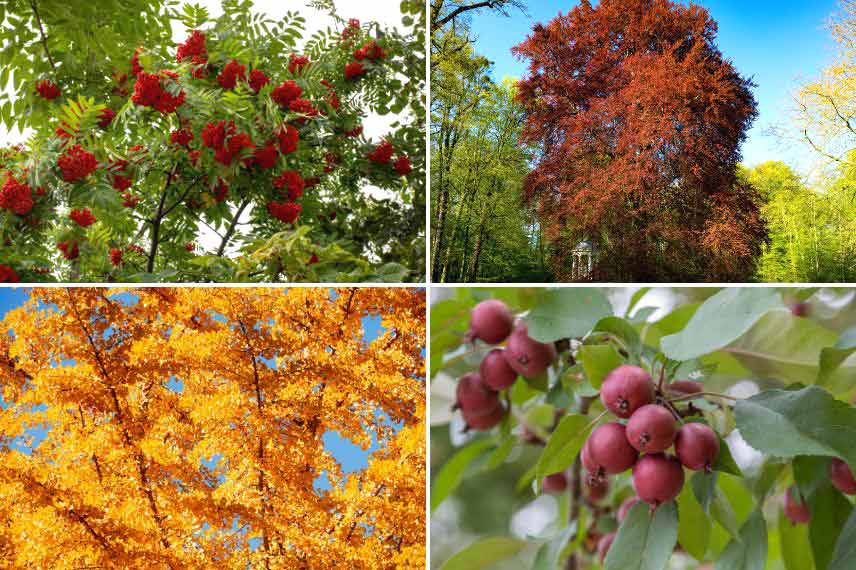
Sorbus aucuparia, Acer rubrum ‘Red Sunset’, Ginkgo biloba and Malus ‘Royalty’
→ Discover our articles Decorative fruit trees and shrubs and Creating a beautiful autumn garden
Read also
7 Trees with Unusual FoliageDecorative trees at the heart of winter
- Most often, when thinking of ornamental trees in winter, we are drawn to those with interesting bark. The Acer griseum, with its peeling cinnamon-coloured bark that exfoliates as it ages, ranks among the most interesting. There are many other Maples with decorative colours and patterns, such as the Acer palmatum ‘Sangokaku’ with its stems featuring coral pink to red bark.
- The Prunus serrula or Tibetan Cherry is also a classic, with its trunk and branches of polished mahogany, providing a splash of colour during dreary winters. It is a small, hardy deciduous tree that also bears delicate white flowers in spring.
- With their bright white trunks, birches never fail to attract attention during winter. The Betula utilis var. jacquemontii ‘Doorenbos’ or Himalayan White Birch is considered by many to be the whitest of all, with its sublime pure white bark in all seasons. The Betula nigra, the River Birch, has stunning cinnamon-coloured bark, while others have beautiful cream-coloured bark, but the underside when it peels is a coppery hue.
- With its abundant and spectacular bright yellow flowering from January to March, the Florist’s wattle Acacia dealbata ‘Gaulois Astier’ is a lovely small tree suited to mild climates. Hardy down to -10°C in a sheltered position, this grafted mimosa possesses all the qualities of the Winter Mimosa but does not exhibit the suckering and invasive character it is rightly criticised for. It is best planted in spring, in March or April, in a very sunny position sheltered from strong winds.
- Melia azedarach is a medium-sized deciduous tree, interesting not only for its summer flowering in panicles of fragrant lilac-purple flowers but also for its clusters of yellow fruits, remaining decorative after the leaves fall throughout winter. Fast-growing, it is not demanding regarding soil type, even arid, and is suitable for all exposures, making it truly a tree to discover and plant in gardens where its average hardiness (down to -12/-15°C) will not be compromised.
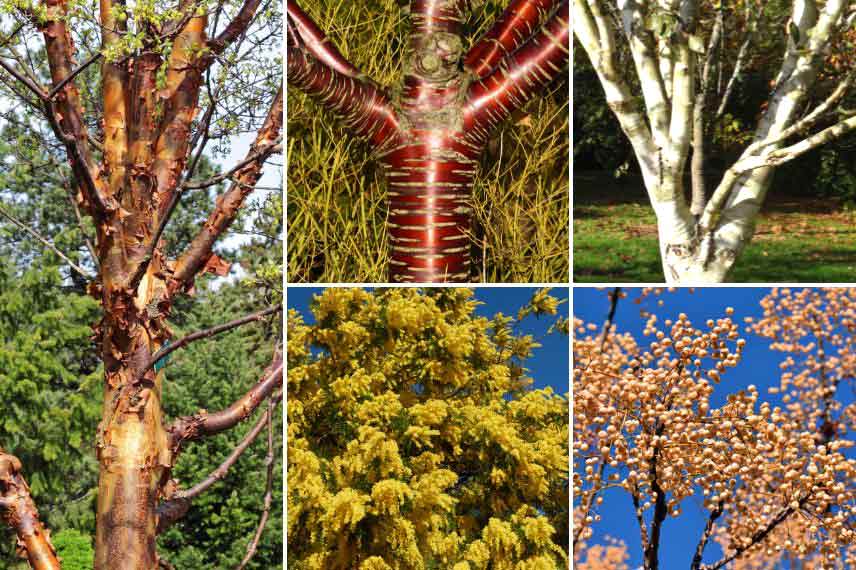 Acer griseum, Prunus serrula, Betula utilis var. jacquemontii ‘Doorenbos’, Acacia dealbata ‘Gaulois Astier’ and Melia azedarach

- Subscribe!
- Contents
![[title]Selection of Trees for the Four Seasons[/title]](https://en.promessedefleurs.eu/blogwp/wp-content/uploads/2022/11/Des-arbres-pour-toutes-les-saisons.png "[title]Trees for Every Season
In our gardens, trees play a crucial role in providing structure, shade, and beauty throughout the year. Choosing the right trees can ensure a continuous display of colours and textures, from the delicate blossoms of spring to the vibrant foliage of autumn. Let's explore some {glossary}trees{/glossary} that will thrive in every season.")
Comments